ELECDURA NETWORK

Your Whole New Supply Chain For Heavy-Duty Parts
Whatsapp:
+86 18915027366
Phone:
+86 18915027366
Views: 0 Author: Site Editor Publish Time: 2025-08-26 Origin: Site
Buying a turbocharger in France does not always mean buying a French-manufactured unit. For a heavy-duty replacement, first decide whether you need a new turbo, a named equipment-maker remanufactured product, a workshop-refurbished replacement, or repair of your own assembly. MS Motorservice France, Turbofrance and Graffeuille publish different routes that can help build that shortlist. They are examples to evaluate, not a ranking or a promise of availability. The useful comparison is the exact assembly offered, who performs or supplies the work, whether your old unit must be returned, and what must happen before the vehicle can return to service.
This guide concerns truck, bus and other heavy-duty aftermarket purchasing. For an alternative sourcing enquiry, browse Elecdura's heavy-duty turbocharger category. The category is a product enquiry route, not proof that Elecdura represents any company or remanufacturing program discussed below.
Ask the seller to identify the route on the quotation, not simply describe the unit as a replacement turbo. The following comparison reflects the linked public service descriptions reviewed on 8 September 2026. It does not establish stock, current prices, turnaround times or suitability for your reference.
MS Motorservice France: identify the product condition and named new, refurbished or reman program on the order line.
Turbofrance: distinguish purchasing a replacement from sending your own unit for assessment.
Graffeuille: ask whether the identified truck turbo qualifies for an exchange offer, an own-unit repair assessment, or both.
MS Motorservice France's turbocharger range distinguishes new equipment-maker units, its workshop-refurbished turbo by Intec range, and Garrett Original Reman, BorgWarner Reman and Holset Reman products. It explicitly includes heavy-duty, agricultural, industrial and marine applications. Intec has been integrated into MS Motorservice France; it should not be counted as a separate independent supplier in this comparison.
Its own-unit refurbishment service starts with identifying defective parts and assessing whether renovation is possible. For a buyer, that is a different quotation from purchasing a ready replacement. Ask for the exact program name, supplied assembly reference and condition. Do not let a general description such as “reman turbo” hide a switch between the workshop's product and an equipment-maker's program.
Turbofrance's service page describes new units, standard exchange and repair where possible, with heavy trucks and construction and agricultural equipment among its applications. Customers may send a turbo or bring it to Saint-Sornin-Leulac in Haute-Vienne for a quotation.
This provides a practical route when a removed assembly needs assessment, but sending it does not establish a repair outcome. Before dispatch, agree whether the request is repair-and-return, an exchange proposal or a choice after inspection. The page also describes teardown and reporting requested by automotive experts. Do not assume that this separate expert-assessment service is included with every repair or exchange purchase.
Graffeuille's truck turbocharger page explicitly offers exchange and repair for trucks and heavy-duty vehicles, with a quotation route. The business identifies itself as Ets Graffeuille S.A.S. in Rouillac.
Use that specific service description to open a truck-workshop enquiry. Ask which assembly can be exchanged and whether your own unit can instead be assessed for repair. The page does not establish a complete new-turbo catalogue, the brands available for a particular turbo, or a universal remanufacturing specification. Brand lists elsewhere on a company's engine or gearbox pages do not prove authorization or coverage for its turbocharger offer.
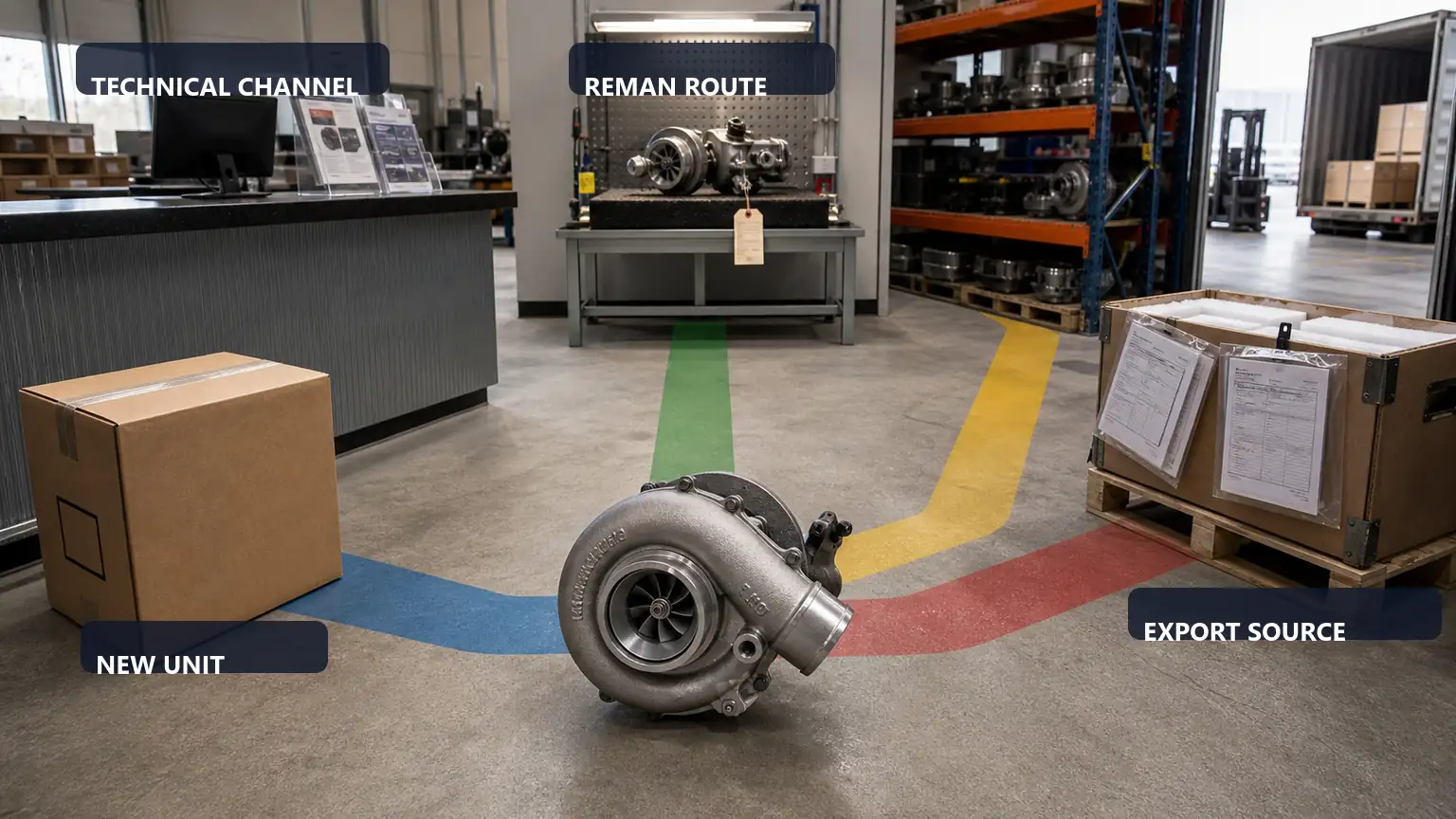
Sourcing-route illustration, not a photograph of the named businesses or evidence of a French manufacturing location.
A new unit, an equipment-maker reman product and an independently refurbished turbo can be offered for the same enquiry without being the same product. Record the brand, complete part number, condition and program separately. A supplier's workshop capability or quality-management statement does not certify every assembly it sells.
Exchange and repair-and-return describe different transactions. In an exchange purchase, the replacement and the removed unit are separate items: the seller must confirm any old-unit obligation and its conditions. In repair-and-return, the quotation concerns work on your identified assembly. Confirm how that identity will be preserved and what happens if the unit is not repairable. Neither description, by itself, tells you the final price or the delivery date.
Keep the exchange deposit, assessment outcome and credit arrangements outside the replacement price comparison. The heavy-duty core-charge and return guide explains that process in detail. Here, the important decision is whether an exchange obligation fits the workshop's removal and return arrangements at all.
Consider a truck that is off the road with a removed turbo. This is a purchasing example, not a diagnosis or a claim about any supplier's performance.
If the workshop needs a replacement date first: request separately identified new and exchange offers, each with confirmed reference, actual dispatch basis and included components. Do not treat an estimated repair completion as equivalent to an identified replacement ready for dispatch.
If retaining the original assembly matters: request an own-unit assessment. Agree any inspection charge, the approval point before repair, and the options if the proposed work is declined or repair is not possible.
If the turbo is part of a failure or warranty investigation: obtain the responsible parties' instructions before authorizing dismantling or surrendering it as an exchange core. Ask separately for any required expert report.
The French workshop or return location can matter because an assessment requires the physical unit. Compare the actual collection, delivery and return arrangements rather than assuming a French address guarantees faster service. A cross-border replacement may still be a valid alternative, but it needs its own delivery, return and responsibility terms.
Send the turbo nameplate and complete readable numbers, the truck or equipment identity, engine identification available from the workshop, and photographs of the installed configuration and removed assembly. State whether the requirement is a complete turbocharger, repair of that unit, or another defined scope. A casting mark or engine family alone may not identify the supplied configuration.
Add the question that belongs to the chosen route:
New or named reman product: which exact reference and revision will be supplied, and are the actuator and required installation components included?
Independent workshop refurbishment: what work is included, which identity appears on the finished unit, and what unit-linked checks or setup information will accompany it?
Own-unit repair: what can be decided before receipt, what requires inspection, and what written approval is needed before work proceeds?
For an electronically controlled or variable-geometry application, the workshop must also resolve actuator identity, setup responsibility and any required application-specific procedures. These are questions to settle with the responsible specialists, not evidence that every listed supplier performs the same calibration process.
At receipt, match the unit and carton identity to the ordered reference, product condition and named program. Check that the actuator, connectors, housings, ports and included hardware match what was approved; preserve the labels and any supplied unit-linked documentation. Photograph transit damage or an unexplained difference before installation and contact the seller through the agreed nonconformance route.
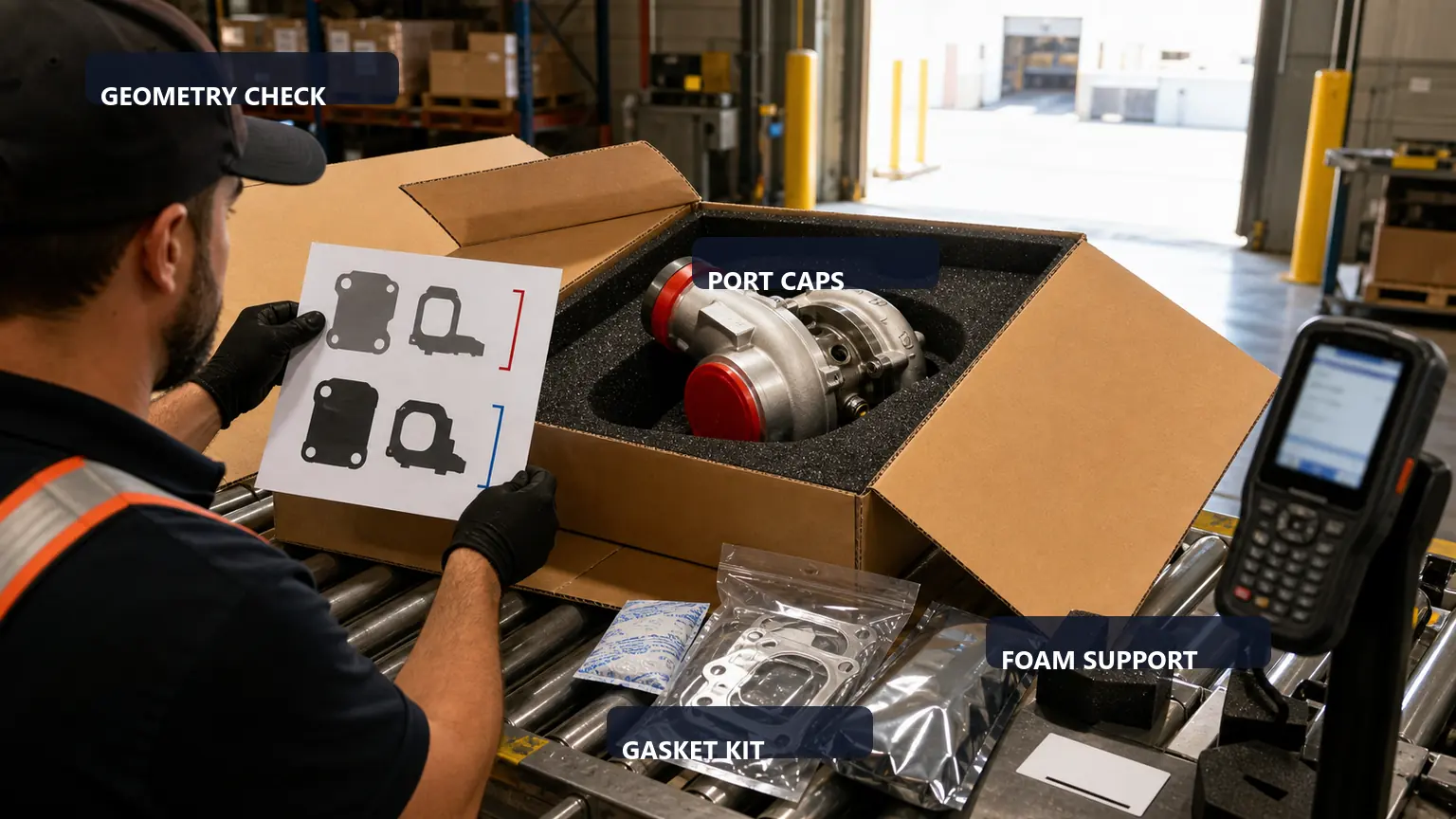
Receiving illustration only. The pictured packaging and parts do not establish what a particular supplier includes or certify the assembly.
A clean exterior, a shaft that turns by hand or an unlinked sample report is not proof that the delivered turbo is correctly balanced, calibrated or suitable for the engine. Follow the applicable workshop and manufacturer instructions; do not use this purchasing guide as an installation or testing procedure.
Use the enquiry form on this page to request an Elecdura aftermarket sourcing comparison. Provide the identified assembly, application, quantity, destination and preferred product condition. If an exchange or repair proposal is already available, state its scope so the comparison does not confuse a complete replacement with a repair service.
Ask which references and conditions Elecdura can actually quote. This article does not claim that Elecdura operates the named French workshops, represents the listed brands, accepts their exchange cores or provides their program warranties. Product matching and commercial terms must be confirmed for the proposed order.
Yes: put the required program and exact assembly reference into the enquiry and require the seller to identify the offered product. A differently branded workshop-refurbished unit is an alternative for review, not an automatic substitute. Ask what product labels and traceable supply documents will accompany it.
No. Distribution, refurbishment and repair locations do not establish the origin of a new assembly or its components. If origin matters to the purchase, request documentation for the actual supplied item. Do not derive origin from the seller's language, address or trading name.
Not without the applicable instructions. The seller may need an intact unit for exchange assessment, while an investigator may need it preserved for another purpose. State its current condition and any claim before authorizing changes; resolve those instructions before sending it away.
Photographs can support identification and an initial discussion, but they cannot establish all internal damage or the final repair scope. Ask which quotation elements remain conditional on inspection. Agree what happens if inspection leads to a revised price or a finding that repair is not possible.
Compare the supplied scope and total transaction first: product condition, included actuator and hardware, freight, any deposit, inspection charges and the handling of the old unit. A lower headline figure may describe a different assembly or exclude a charge. Choose only after the differences are explicit.
Not necessarily. This guide selects a sourcing route; it does not determine why the turbo failed. The responsible workshop must follow the engine and turbo manufacturer's diagnostic and installation requirements and address the underlying fault before releasing the vehicle. An accepted quotation is not technical approval to install.
Editorial source review: 8 September 2026. Company descriptions are limited to the linked official pages; availability and order-specific terms require direct confirmation.


