ELECDURA NETWORK

Your Whole New Supply Chain For Heavy-Duty Parts
Whatsapp:
+86 18915027366
Phone:
+86 18915027366
Views: 0 Author: Site Editor Publish Time: 2026-08-25 Origin: Site
A core charge is refundable only under the exchange terms attached to your order. Returning a used part does not, by itself, establish its identity, condition or credit value. Before buying a remanufactured heavy-duty assembly, agree which core is acceptable, when and where it must arrive, who pays for transport, and how the credit will be issued. Keep a separate record for each returned unit. Photographs, delivery confirmation and the supplier's assessment support that record, but the transaction remains open until the agreed refund or account credit has actually been posted.
This guide is for fleet purchasing teams, parts distributors and repair businesses managing removed starters, alternators, turbochargers, compressors and other exchange assemblies. The process below is a purchasing and logistics control, not a diagnostic test or a universal manufacturer policy. The applicable seller's written conditions take precedence.
Terminology matters particularly with turbochargers: an exchange core is the used assembly being returned, whereas a CHRA is a specific turbocharger component. When sourcing through the complete turbocharger category, state both what the replacement includes and what must be returned. Do not assume that a quotation mentioning a “core” answers both questions.
Record the replacement price and core deposit as separate amounts. Add outward delivery, return freight and any agreed handling charges. Treat the deposit as recoverable only to the extent supported by the acceptance terms; do not approve the order using an assumed full refund.
Two quotations can have the same eventual net price but require different cash outlays and return work. A higher deposit ties up more funds until assessment and credit. An apparently cheaper offer can cost more if it excludes return transport or offers only account credit that your business cannot readily use.
Comparison stage | Include in the record | Do not assume |
|---|---|---|
Order approval | Replacement price, deposit, currency, quoted charges and payment terms | The advertised exchange price includes the deposit or transport |
Return planning | Accepted reference, condition requirements, destination, deadline and freight owner | Any similar used assembly earns the same credit |
Supplier assessment | Unit identity, inspection outcome, approved credit and itemized deductions | A delivered carton has passed inspection |
Financial closure | Posted refund or credit note matched to the original invoice | A promised credit has already reduced the amount owed |
For budgeting, compare a full-credit outcome with the consequence of a rejected core. These are planning scenarios, not predictions of the supplier's decision. If rejection would make the purchase uneconomic, resolve the uncertain core condition before authorizing the exchange order.
A program name or familiar brand cannot replace order-specific terms. Ask the entity issuing the invoice to identify the return procedure and the person who can resolve an exception. A manufacturer, distributor and repair workshop may have different responsibilities within the same transaction.
Identify the permitted core part number or exchange family and any required attached components.
Record whether the deadline runs from invoice, shipment, delivery or another stated event, and whether dispatch or receipt satisfies it.
Name the return location and any authorization, tag or reference that must accompany the shipment.
Agree the assessment process, possible deductions, credit method and expected handling period.
Specify the freight payer, carrier arrangements and responsibility for loss or damage during the return journey.
Ask what happens to rejected cores: return, storage, disposal or another agreed disposition, including any charges.
Keep the accepted version with the purchase order. If a salesperson grants an extension or agrees to consider a damaged core, obtain written confirmation identifying the affected unit. A general email about future business is not a clear exception to an existing return deadline.
BorgWarner's REMAN program states that eligible cores must come from OE turbocharger manufacturers and directs buyers to its accepted-number list. Its published exclusions include non-genuine-manufacturer units, dismantled turbochargers and broken connecting flanges. For that route, taking the old turbo apart before checking the rules can defeat the intended exchange.
This example does not establish the return deadline, freight arrangement or credit amount for your quotation. It also does not establish another manufacturer's policy. Cat's explanation of core return and acceptance notes that criteria vary by component and that partial refunds are available for some components. Obtain the applicable requirements instead of turning either source into an all-brands checklist.
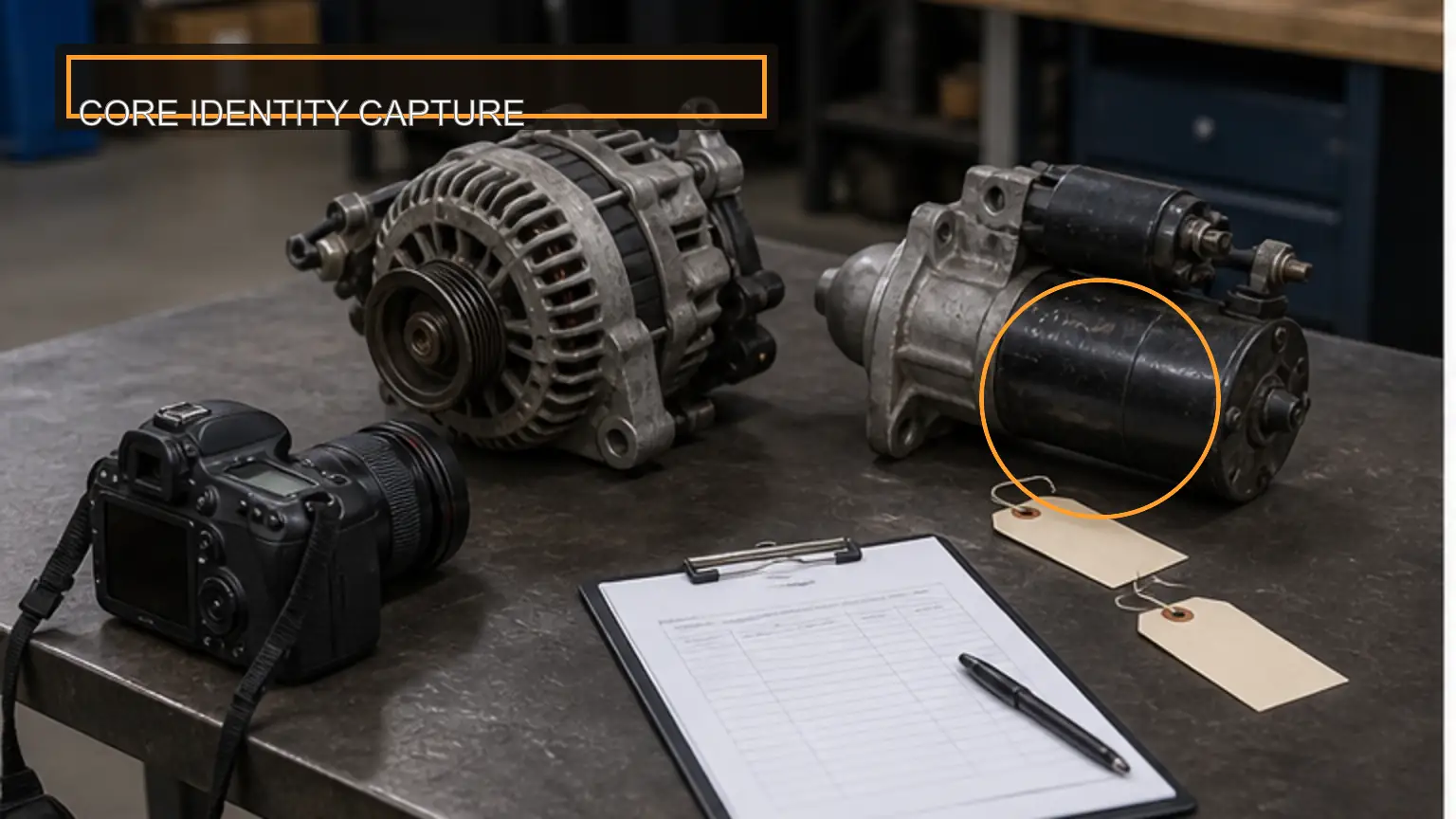
Give each core a return reference before it leaves the workshop. Link that reference to the removed unit's readable identification, vehicle or engine record, replacement invoice and intended exchange line. Photograph labels and distinctive features before cleaning or packing changes their visibility.
Keep the manufacturer's assembly number separate from a housing casting mark, supplier stock code and engine number. Those identifiers can help investigate a match, but they do not necessarily identify the same thing. Record an unreadable or disputed field as unresolved; do not fill it with a number copied from the replacement carton.
For a multi-core return, use a manifest with one row per unit. Include the carton or pallet position so the supplier can connect each assessment to the correct invoice line. Mixed references should not be described only as “five old turbos” or “one pallet of starters.”
Illustrative core-identification record. Actual return approval requires the identity of each removed unit and its matching order line.
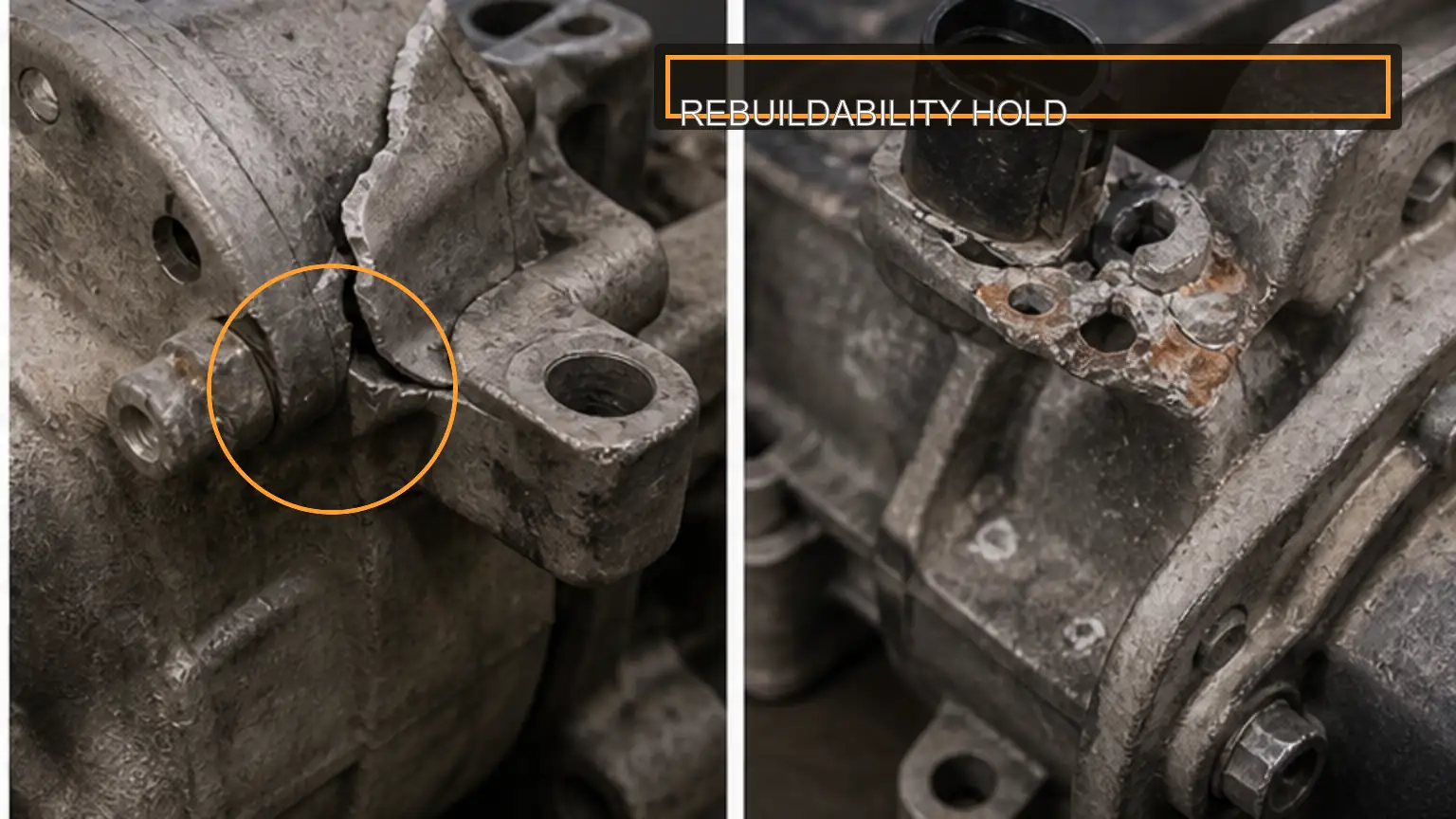
Compare the as-removed unit with the supplied acceptance requirements. Record visible housing damage, broken connections, corrosion, contamination, missing sections and evidence of previous dismantling. State what you can see; do not infer internal rebuildability from a clean exterior or a shaft that turns.
Photographs are useful for seeking a preliminary decision on a questionable core. Ask whether the response is a binding exception or only an initial opinion subject to receipt and inspection. If the latter, retain the uncertainty in the purchase decision rather than recording the expected credit as confirmed.
A failed assembly may also be needed for a warranty investigation. Core-return acceptance and warranty liability are separate decisions: accepting the old part for exchange does not prove why it failed, and rejecting a warranty claim does not automatically settle its core value.
Before authorizing disassembly, tell the responsible parties if both processes apply. Agree which inspection is permitted, who will retain removed components, and whether an extension is needed. Do not ask a workshop to dismantle a unit for diagnosis while separately promising an undismantled core to the exchange supplier.
The heavy-duty turbocharger supplier guide distinguishes manufacturer programs from independent repair offers. Use that distinction when identifying who controls the assessment; a repairer's finding and a manufacturer's exchange decision are not interchangeable approvals.
Illustrative condition findings. Whether damage causes rejection or a deduction depends on the applicable program, not this image.
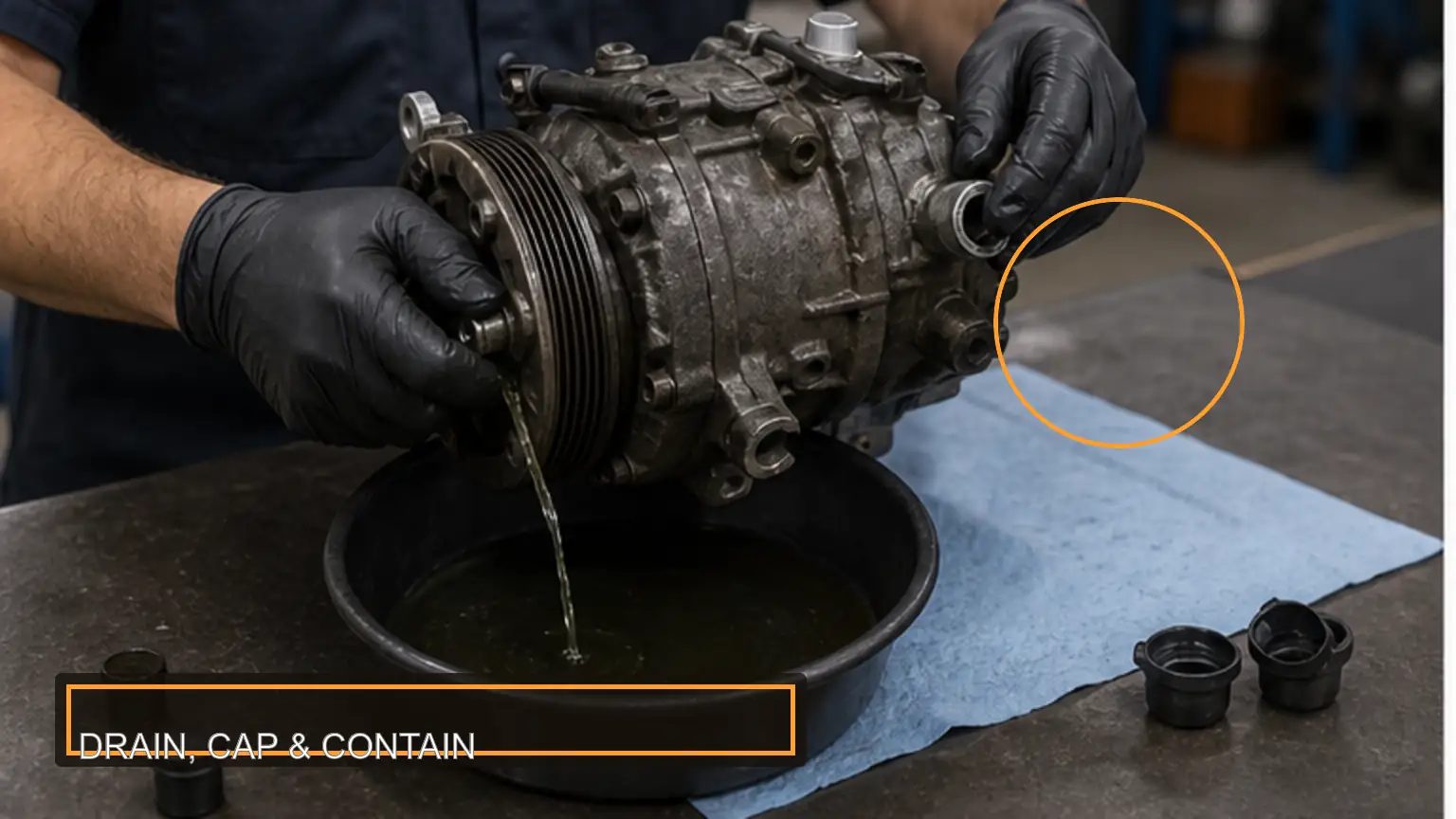
Obtain the product-specific preparation instructions before dispatch. Fluid handling differs between component types. Qualified personnel should follow the applicable service and shipping requirements; this guide does not provide a universal draining method or authorize venting an A/C system.
Protect connections, shafts, labels and exposed openings as instructed, without removing components needed for acceptance. Keep any residual-fluid containment separate from the identity tag so a leak cannot erase the return reference. A visibly leaking package is not ready for collection.
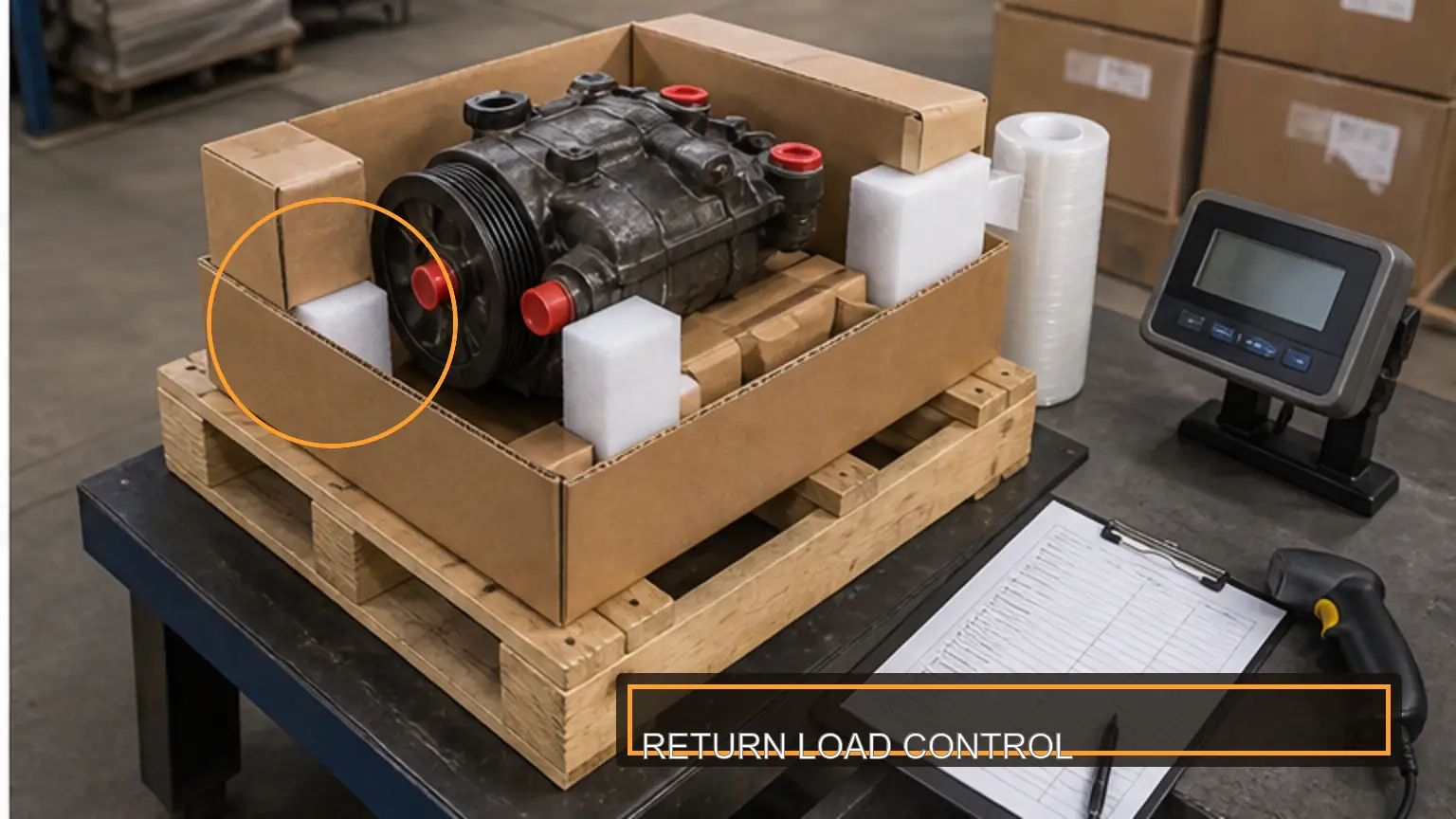
The replacement carton is useful only if it is suitable for the removed unit's actual weight, shape and condition. Check that inserts support the main body, prevent movement and do not load an actuator, connector or fragile flange. Replace damaged packing through the agreed process; do not assume an outward-shipping carton automatically satisfies return requirements.
Preparation illustration, not a refrigerant-handling procedure. Use qualified personnel and the instructions for the actual component.
Photograph the identified part, its support and protection, and the closed package label. Put the required documents where the receiver can find them. For shared pallets, preserve the connection between each tag, carton and manifest row after wrapping. Check handling requirements with the carrier before booking an unusual or fluid-containing return.
Record when the core was ready, collected, delivered and acknowledged by the receiving team. Keep the tracking number and proof of delivery, but also obtain confirmation that the supplier received the identified unit. A carrier's signature can establish package delivery without proving the contents or their condition.
If the carrier reports damage, preserve the packaging and notify the parties named in the return agreement. Avoid repacking or disposing of material needed for the investigation without instructions. Record the observed damage and handover history; photographs alone may not establish when the damage occurred.
After assessment, match the accepted quantity, deductions and credit to each original invoice line. For an open deposit, distinguish “awaiting receipt,” “awaiting inspection,” “credit approved” and “credit posted.” These statuses direct follow-up to different people and prevent an unresolved return from disappearing into a general warranty or freight balance.
Illustrative return packing. Retain the actual package record and carrier handover details for the unit being credited.
Request an itemized reason tied to the applicable acceptance condition and the assessed unit. Compare it with the removal photographs, manifest and return agreement. Separate a wrong-reference rejection from missing-component, condition, late-return or transport issues; they require different evidence.
Where only one unit is disputed, ask whether the undisputed lines can be credited separately. Confirm the review deadline and whether the rejected core will be retained while the issue is considered. Do not assume that a complaint automatically suspends storage or disposal arrangements.
Close the file when the refund or account credit is visible and reconciled, or when an authorized person accepts a documented non-credit outcome. Record why any deposit was lost. That information is useful when choosing a future exchange route, negotiating packaging requirements or deciding that a new unit without an exchange obligation is more practical.
This workflow does not determine whether a failed part is safe to reuse, diagnose the failure or certify a remanufactured replacement. Those questions require the applicable technical procedures and responsible specialists. It also does not establish customs classification, transport eligibility or a legal entitlement to a refund across jurisdictions.
Some purchases have no core deposit; others involve repair and return of the customer's own assembly rather than an exchange. Confirm the actual transaction before creating a core-credit claim. Where an engine manufacturer, customer agreement or regulated application imposes a specific process, follow that requirement.
Send the required replacement references, application, quantity and destination together with the available identities and condition photographs of the proposed cores. State whether the old parts are still installed, removed, dismantled or involved in a claim. Include the expected removal and return timing, rather than promising a date the workshop has not agreed.
Ask the supplier to price the replacement and deposit separately and identify the return conditions before order approval. The repair-versus-replacement purchasing guide gives a related example of separating the repairer, seller and installation responsibilities. Its Saudi service-channel discussion is not a universal core policy.
You can send your part references and exchange requirements to Elecdura for a sourcing enquiry. Ask which product condition and supply route can be quoted and which return terms apply. This article does not promise that Elecdura accepts every used core, operates the named manufacturers' programs, or offers a particular refund, warranty or delivery arrangement.
Only if the supplier confirms that its exchange rules accept that reference. Compare the full assembly identity and required components, then obtain a written match to the order line. Similar castings or dimensions do not prove membership in the accepted exchange family. Keep an uncertain unit out of the approved return manifest until the mismatch is resolved.
Preserve the remaining marks and photographs, and assemble the engine or equipment record and removal history. Ask the receiving program what alternative identity evidence it accepts. A replacement invoice can help trace the job, but does not prove which unit was removed. If identification remains unacceptable, evaluate the order without assuming a refund rather than relabeling the old part as the replacement.
No. A label tells you how that shipment is being booked; it does not necessarily settle liability for inadequate packing, loss, damage or a rejected return. Check the written allocation and carrier instructions. Retain photographs and collection evidence, and identify who must open a transport claim. Resolve a conflict before dispatch instead of relying on the label as a complete agreement.
Do not change its condition without the applicable instructions. Dismantling can violate an acceptance requirement and remove evidence needed for a failure investigation. Ask what preparation is allowed, particularly where labels are obscured or fluids must be handled. Photograph the initial condition and keep any permission with the return reference. Cleaner appearance is not proof of a more valuable core.
The agreed assessment and credit process controls this, so do not assume either an all-or-nothing result or automatic line-by-line credit. A unit-level manifest gives you a basis to request separate treatment. Ask the supplier to identify accepted and disputed units individually, then reconcile the undisputed credit against the relevant invoices while the remaining case is reviewed.
Delivery confirmation alone does not. Establish whether the delay is receipt matching, inspection, approval or posting, then send the evidence to the responsible contact. Obtain the assessment outcome and trace the approved amount into the refund or credit note. If the supplier declines credit, keep the reason, supporting condition and agreed disposition of the core before an authorized buyer closes the case.
Editorial review: Elecdura, 7 September 2026. Manufacturer examples were checked against the linked public sources; order-specific acceptance and commercial terms must be confirmed with the responsible supplier.