ELECDURA NETWORK

Your Whole New Supply Chain For Heavy-Duty Parts
Whatsapp:
+86 18915027366
Phone:
+86 18915027366
Views: 0 Author: Site Editor Publish Time: 2026-07-17 Origin: Site
A gear reduction starter can be a suitable replacement for a diesel truck when its application, voltage, loaded output and installation interfaces match the starting system. Its gears let a faster-running motor deliver torque at a lower pinion speed. They do not prove that any particular replacement will crank the engine faster, use less current or solve a difficult start.
For a fleet workshop or parts buyer, the decision has two parts: establish why the existing system is not performing, then verify that the proposed starter meets the engine's requirements. A correct replacement may differ in size or appearance. Conversely, a unit that bolts into place may still have the wrong engagement geometry, electrical connections or control arrangement.
This guide explains what to compare before ordering, which findings require workshop diagnosis, and how to turn an approved sample into a repeatable purchasing specification. Browse the heavy-duty starter motor range by reference and application, not by the words “gear reduction” alone.
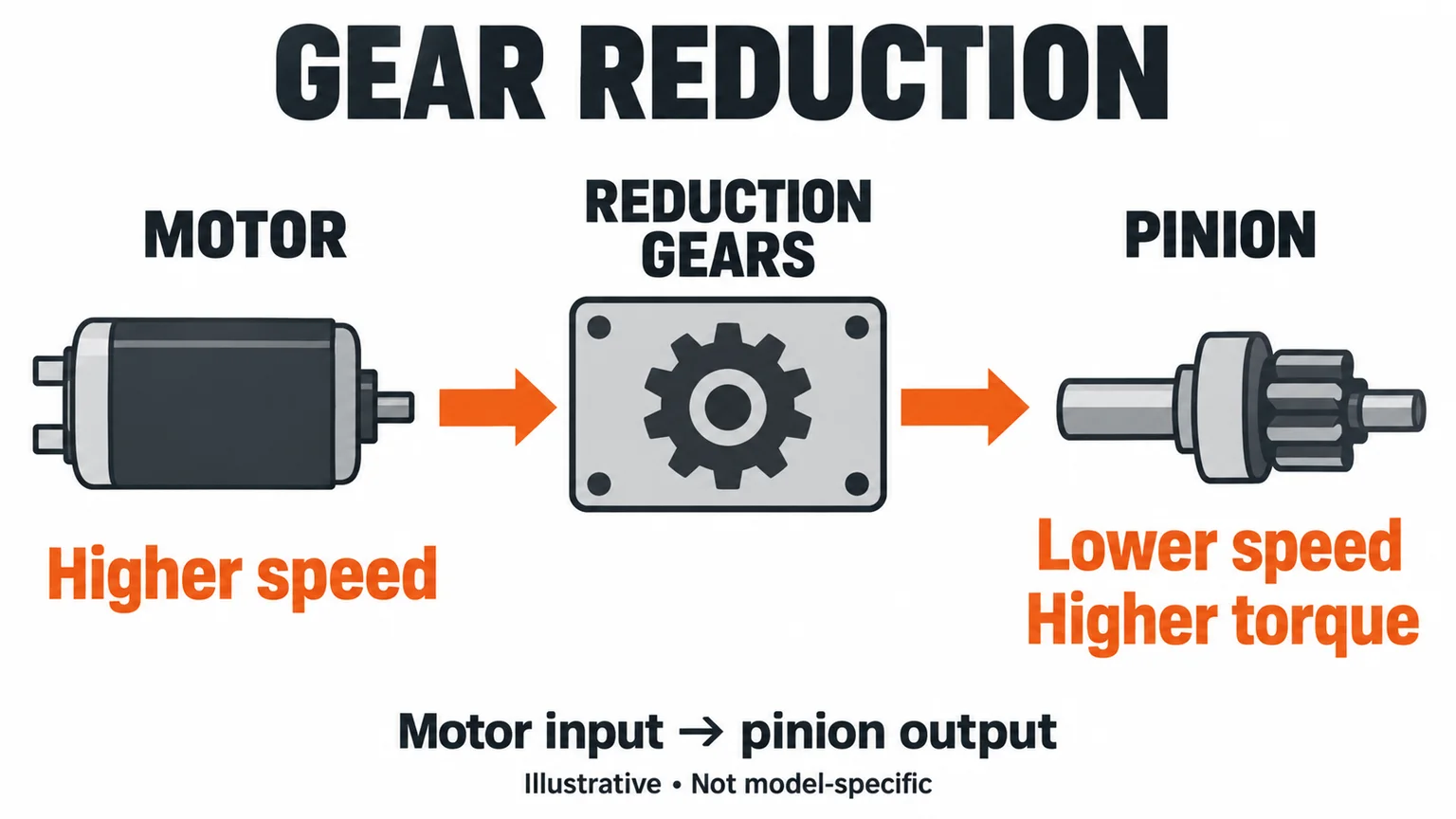
A direct drive starter connects the motor's rotation to the drive assembly without an additional internal reduction stage. A reduction starter places gearing in that path. The motor and output pinion therefore need not operate at the same speed, allowing the designer to select a different balance between motor size, motor speed and output torque.
For a given input operating point, reduction lowers output speed and increases available output torque, with mechanical losses reducing the ideal gain. This is a comparison between the input and output of the same mechanism. It is not automatically a comparison between two complete starter products installed on an engine.
Increasing reduction while holding everything else unchanged cannot make both the output speed and torque rise without another change. A replacement designer may use a faster motor, different windings and a different gear arrangement together. That is why an internal ratio on its own is insufficient evidence of the engine cranking performance of the finished assembly.
In a simple reduction calculation, output speed equals input speed divided by the reduction ratio. Ideal output torque equals input torque multiplied by that ratio; actual torque also reflects transmission efficiency. These relationships describe a mechanical operating point, not a guaranteed engine starting result, and this guide assigns no ratio or efficiency to an unidentified starter.
The distinction is practical when reviewing a supplier explanation. If a claimed torque improvement comes entirely from greater reduction, ask what happened to loaded output speed. If the answer relies on a faster motor, request the finished starter's relevant performance evidence. Neither the motor's speed nor the gear ratio should be evaluated in isolation.
Diagram key: a faster-running motor drives reduction gears, which deliver lower speed and higher torque at the pinion relative to the same mechanism's motor input. Original explanatory artwork, not a product photograph or a model-specific test. Actual layout, direction, ratio and losses depend on the design. Open the diagram at full size.
The starter's internal gears and its engagement with the engine ring gear serve different parts of the drive path. The internal stage changes the motor-to-pinion relationship. The external tooth geometry and shaft position determine whether that pinion meshes correctly with the engine's ring gear.
A quotation stating only a reduction ratio leaves the second question unanswered. Ask for the application reference and drive-end information as well. The buyer does not need to redesign the gearing, but does need to distinguish a description of the starter's architecture from evidence that the complete starter belongs on this engine.
DENSO's starter overview distinguishes planetary and reduction designs rather than treating every reduction starter as identical. Compact construction can be an advantage where space is restricted, but the available space includes the solenoid, wiring and removal route—not just the diameter of the motor body.
Keep the architecture description in the comparison, but place verified fitment ahead of it. A smaller replacement that obstructs a cable connection is not an installation improvement. Equally, a differently shaped replacement should not be rejected solely because it does not resemble the old housing.
The engine needs rotation under load. Free-running speed, peak power, pinion torque and electrical current describe different aspects of a starter; they are not interchangeable scores. Ask which measurement the supplier is reporting before deciding that one offer is stronger than another.
A high torque value measured near a stopped output does not tell you how quickly the engine will turn. At the other extreme, a fast unloaded starter has not demonstrated that it can sustain useful speed against engine resistance. The relevant evidence connects load, speed and supply conditions.
For purchasing, request the applicable output specification or a traceable performance report for the exact proposed reference. Identify whether measurements concern the motor shaft, pinion or engine crankshaft. Comparing values taken at different points in the drive path can make an ordinary transmission difference look like a product advantage.
Also establish what a supplied test actually covers. A report limited to unloaded rotation can support the checks it records, but it does not demonstrate performance against an engine's resisting load. A loaded starter test addresses another question; an installed application trial adds engagement, vehicle wiring and engine conditions. These evidence types complement rather than replace one another.
The Delco Remy 38MT family specification lists peak output alongside voltage, battery resistance and other configuration information. This illustrates why a power figure should not be copied into a comparison without its conditions. A family page also contains options; it is not the complete specification of every part number in that family.
Ask the supplier to identify the supplied variant and explain the basis of any claimed improvement over the current starter. If the quotation gives only a larger kilowatt number, record the comparison as incomplete. Do not invent an equivalent engine size or cold-start capability from that number.
Current alone cannot rank two starters. A unit drawing less current while cranking too slowly has not demonstrated an advantage. A unit drawing more current might be doing more useful work, or it might be operating abnormally. The direction of the current change does not settle which explanation applies.
For a controlled comparison, use the same identified engine configuration and record battery condition, measurement locations, temperature and the observed cranking result. A test after battery charging should not be compared uncritically with one taken before charging. Describe any remaining differences in the report instead of presenting them as a proven starter benefit.
A slow-cranking complaint is a starting-system problem until diagnosis locates its cause. Buyers should obtain the technician's findings rather than treating “weak starter” on a return note as a completed diagnosis. A design change is particularly unlikely to solve a problem that remains in the vehicle after the old unit is removed.
Battery voltage and voltage available at the starter are not the same observation. A good reading at the battery does not describe losses along the loaded positive and return paths. Likewise, a low reading at the starter does not identify whether the battery, a connection or another part of the circuit is responsible.
DENSO's troubleshooting guidance distinguishes resistance-related current restriction from high-current, low-speed faults. The useful purchasing record contains the measurement points, load condition, current and speed—not an isolated photograph of a voltmeter. Apply the correct vehicle procedure and limits rather than importing a threshold from another voltage system.
The following branches explain the evidence a workshop should supply; they are not instructions to energize an unsecured starter or bypass vehicle controls. Diagnosis and loaded testing belong with a qualified technician following the equipment's service and safety procedures.
Excess resistance in the supply or return path can restrict current reaching the starter. Slow rotation under that condition does not establish that a larger or reduction-type starter is required. The workshop needs to locate and correct the loss before judging the replacement options.
A useful fault report identifies the affected path and records the result after repair. “Battery checked” is not an adequate substitute for this distinction. If the concern disappears after a cable or connection repair, keep that result in the vehicle history so the same symptom does not trigger an unnecessary parts change later.
High current with low speed can indicate internal starter problems or excessive mechanical resistance, including engine-side problems. It should not be reduced to the rule that low voltage always causes high current. The technician must separate the electrical and mechanical explanations.
For a warranty or replacement decision, record what has actually been excluded. If engine resistance has not been assessed, label that question unresolved. A report that names the remaining uncertainty is more useful than a confident but unsupported statement that the replacement needs more torque.
The control circuit commands engagement; the main circuit supplies the motor. A click, no click, or repeated engagement attempt therefore requires different observations from an engine that is steadily turning too slowly. Consult the model's control arrangement before deciding that the reduction gears or motor have failed.
Delco Remy's Smart IMS guidance also describes protective delays and inhibit functions that can be mistaken for faults. Those are features of the specified system, not universal behavior for all starters. Do not remove a protection device simply to make a replacement respond like the old unit.
For a broader symptom-led investigation, use the diesel-truck starter symptoms guide. Here, the purchasing consequence is narrower: establish whether the fault calls for a starter, a circuit repair or further engine investigation before choosing the design.
“Heavy duty” does not describe one starting task. An overnight cold start, a hot restart after a delivery stop and frequent restarts in a working shift expose different conditions. Describe the difficult event precisely enough that the proposed replacement can be evaluated against it.
Delco Remy's cold-weather guidance identifies oil viscosity, main cables and batteries as important contributors. Oil selection remains an engine-manufacturer decision. A buyer should not specify a different lubricant merely because an advertisement promises better cranking with a particular starter.
Record the actual ambient conditions and whether the engine was cold-soaked or recently operated. A successful warm workshop start does not reproduce an overnight complaint. If the available trial does not include the intended environment, approve only what it demonstrates and arrange the missing observation before making a fleet-wide reliability claim.
A route with many normal starts is not equivalent to repeatedly cranking an engine that will not fire. The purchasing brief should describe both the normal operating pattern and any abnormal extended attempts. This prevents a combustion or control problem from being presented as a need for a different starter duty class.
Follow the model's cranking and recovery limits; do not treat overcrank protection as permission for unlimited attempts. When the engine turns at its specified speed but does not start, the starter has not thereby been identified as the cause. Investigation must follow the engine's own no-start procedure.
An older vehicle may no longer have its original engine or ring-gear arrangement. Ask the workshop to identify what is installed now. A chassis description can establish the vehicle's history, but it cannot prove that every engine-side component still matches the original build.
Keep conversion details with the approved starter reference. This is especially important when purchasing for mixed fleets: two trucks with similar model descriptions can require different replacement decisions. Group demand by verified application configuration rather than assuming that a familiar vehicle badge defines a single starter specification.
An unchanged, correctly specified direct drive system does not become unsuitable because a reduction alternative is available. Retaining its approved replacement may be the practical choice when performance is satisfactory and service support is established. A conversion needs a defined purpose, such as an approved replacement route or a documented installation advantage, rather than a presumption that newer architecture is always better.
Fitment is a set of connected requirements, not a visual resemblance test. The essential evidence should identify the engine application, exact starter reference, system voltage, drive-end geometry and electrical arrangement. Missing information in one category cannot be compensated for by a close match in another.
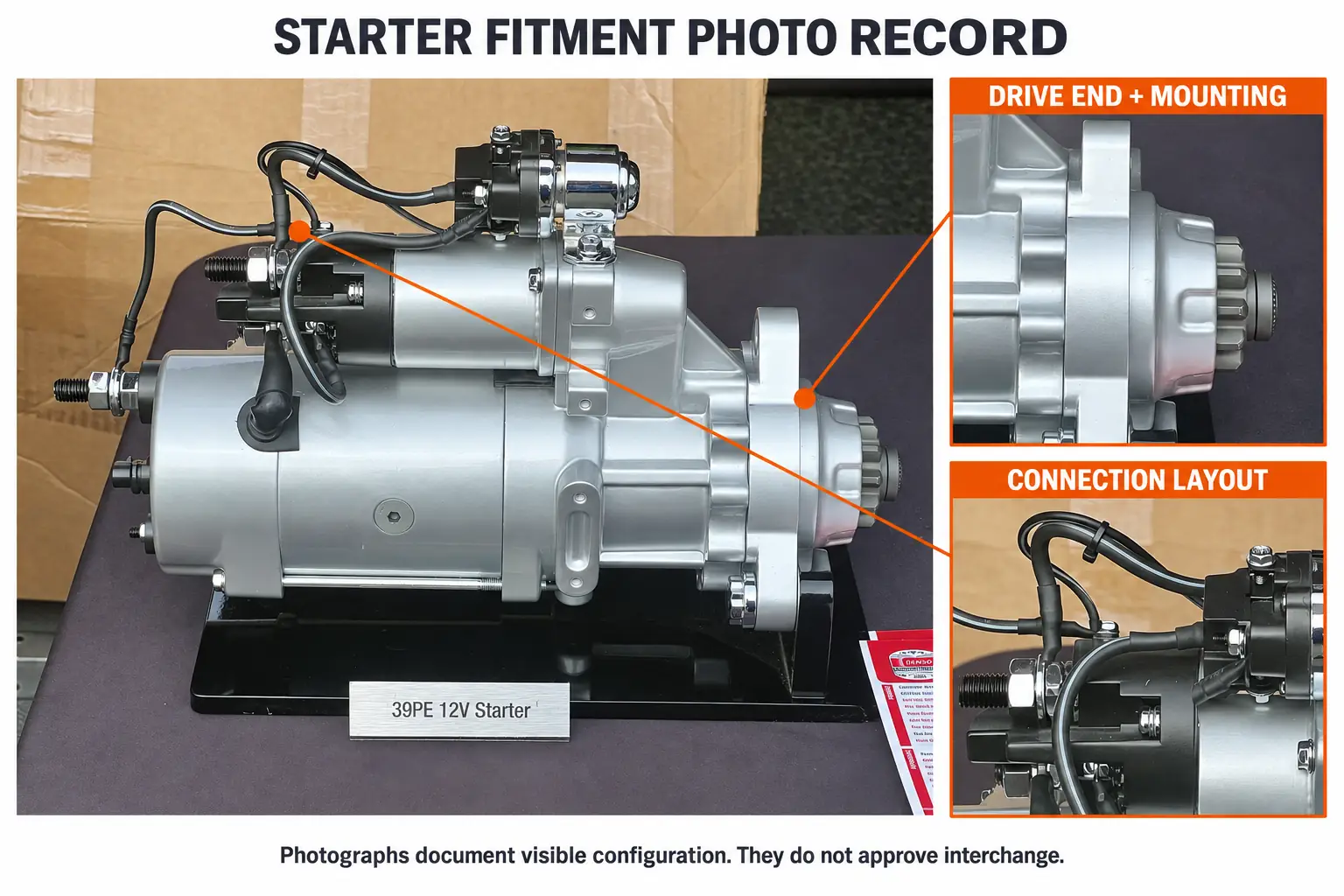
Visual key: upper detail shows the photographed drive end and mounting flange; lower detail shows the connection layout. Photograph by TaurusEmerald, via Wikimedia Commons, CC BY-SA 4.0; crop, detail enlargements and orange annotations added, shared under the same license. This third-party display example documents visible configuration only, not Elecdura stock or approved interchange. Open the photograph at full size.
Tooth count matters, but it is not the whole engagement specification. In its starting-motor gear differences guidance, Delco Remy explains that an approved replacement can use a different pinion with a corresponding drive design. The engine, ring gear and recommended replacement must first be verified.
Matching counts are a useful observation, not permission to stop checking. Retain the specified pitch or module, drive position, mounting information and rotation convention in the application record. Do not substitute a photograph for a dimensional or catalog requirement that the photograph cannot establish.
For rotation, obtain the supplier's stated viewing direction rather than comparing two unexplained clockwise arrows. Opposite viewing ends reverse the apparent direction. A clear drawing or written convention prevents that communication error, while the approved application mapping remains the basis for accepting the unit. The buyer should not infer rotation from the angle of the visible housing or cable terminals.
Do not automatically reject a documented supersession, and do not accept a difference merely because the supplier says it is an upgrade. Request the exact application mapping and the engineering or manufacturer documentation supporting that replacement. If the evidence is absent, hold the substitution; do not experiment on the customer's ring gear.
Use the mounting face as a consistent reference when comparing the proposed unit with the approved application. The inspection should show the drive end, relevant mounting features and available installation space. Photographs taken at unrelated angles can conceal a meaningful difference or exaggerate an innocent one.
Do not overlook the mating component. A correct new pinion can be damaged by an already damaged ring gear; inspecting only the removed starter leaves that cause unresolved. Ask the workshop to document the ring-gear condition over the inspection coverage required by the service procedure. A clear photograph of one accessible section is not proof that the entire circumference is sound.
Delco Remy's conversion guidance highlights the engine's OE spacer: where required, it preserves the intended pinion-to-ring-gear clearance and can remain stuck to the removed starter. This is not an invitation to add generic shims. An uncertain or missing spacer calls for application-specific confirmation.
Some models have approved rotatable mounting arrangements. The 39MT clocking guidance concerns specified rotatable-flange models; it does not authorize dismantling or rotating every starter housing. Obtain the correct instruction for the supplied part before planning a change in solenoid orientation.
Review the resulting terminal access and cable route as part of the installation, not after tightening the starter into place. A permitted housing position still needs to work in the actual vehicle. Record the approved configuration for repeat orders so the next installer does not have to rediscover it.
Confirm the starter's nominal voltage against the vehicle's actual starting circuit. Battery quantity or a photograph of the battery tray is not a reliable substitute for that information. Ask the workshop for the relevant identification or circuit documentation when a modified arrangement makes the configuration uncertain.
An insulated-return starter also requires its specified return connection. The 44MT installation sheet explicitly addresses this arrangement. That model-specific example shows why a replacement should not be assumed to obtain its electrical return through the mounting surface.
The same instruction sheet specifies battery capacity limits for its own starter configurations. It is therefore unsafe to turn “more battery capacity” into an unlimited improvement rule. A buyer proposing changes to both the starter and battery arrangement should request approval of the combination, without transferring the published limits of that example to another starter family.
List the supplied relay, protection and connector arrangement separately from the motor rating. An integrated magnetic switch supplied as part of an approved conversion should be retained and connected according to that instruction. A similar terminal position does not prove that the old and new terminals perform identical functions.
A workable quotation connects the proposed SKU to the verified vehicle application and to a defined physical configuration. “Gear reduction starter for diesel truck” is a search description, not a purchase specification. Before comparing price, ask whether both suppliers are quoting the same replacement task.
Start with the old unit's readable identification and the engine information, then add photographs of the mounting face, drive end, solenoid and terminal layout. Keep the original reference distinct from the supplier's replacement reference. This avoids a copied cross-reference becoming mistaken for a number physically observed on the vehicle.
When a label cannot be read, say so. Record which details came from the workshop, which came from a supplier catalog and which still require confirmation. An orderly uncertainty record is preferable to filling the missing number from a visually similar online listing.
Ask the seller to state the product condition and included assembly clearly. A brand reference may identify compatibility without establishing that the offered unit is a genuine product of that brand. Request consistent wording on the quotation, product identification and invoice rather than relying on a familiar family name.
Any core return, claim procedure or warranty condition should belong to the actual offer. Do not import another manufacturer's published warranty into the purchasing decision. For a distributor, the important question is what evidence and action will be available if the supplied reference or configuration proves wrong.
Identify what arrives with the starter and what the installer must retain, obtain or verify on the vehicle. An application spacer, return cable, relay arrangement or protection connector can affect readiness without changing the motor's basic description. The quotation should not leave these responsibilities to assumptions made at the workshop bench.
Ask how a change to the agreed solenoid, drive-end casting or connector will be communicated on subsequent orders. Accepting an initial sample should not silently authorize every later variation sold under a broad catalog description. Keep the replacement reference and approved deviations together.
An incoming inspection can establish identity, visible condition and agreed interfaces. It cannot by itself establish loaded cranking performance or service life. Decide which question each acceptance activity answers, and avoid giving a visual check a stronger conclusion than its evidence supports.
Compare the delivered identification with the purchase record before treating the unit as stock. Inspect the drive-end features, accessible terminals, connectors and packaging condition against the approved reference photographs. If a protected terminal or housing is visibly damaged, document the condition and separate the unit from accepted stock.
Use consistent photo views across the sample and repeat deliveries. Those images can support identity checks and discussions about a changed feature; they cannot show hidden winding quality or prove performance. Keep customer information and shipment identifiers out of externally shared photographs unless their inclusion is necessary and authorized.
Packaging acceptance should focus on the vulnerable features of the supplied assembly. Check whether the starter is restrained and whether handling loads can reach a projecting terminal, solenoid or drive end. Preserve the delivered packaging record if damage is found. Appearance at unpacking cannot prove the absence of internal damage, so a suspect unit should not be released on a cosmetic inspection alone.
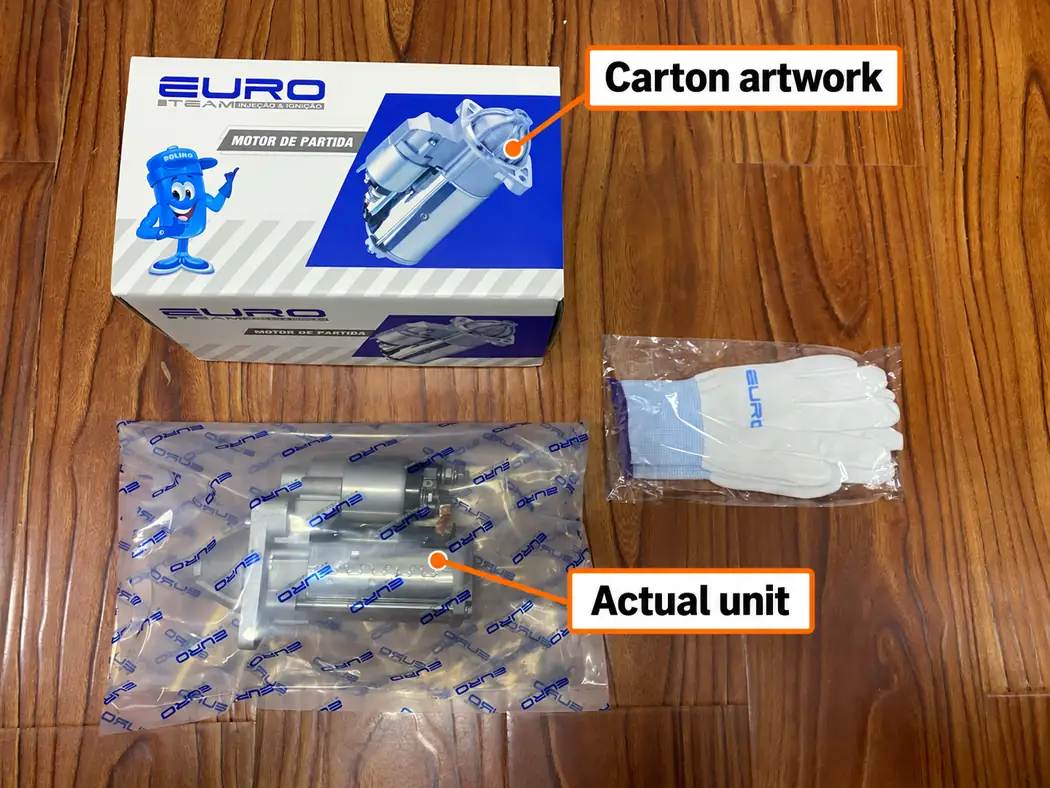
Photo context: Check the delivered unit separately from the illustration printed on its carton. This packaging photograph does not identify the internal reduction mechanism, prove compatibility or establish the contents of a particular purchase order.
A qualified installer should use the applicable instructions and confirm the engine-side condition before operating the replacement. DENSO's installation guidance calls for checking such details as connector locations, housing orientation and the ring gear, with fastener tightening governed by the vehicle specification.
Record whether the starter can be mounted correctly, whether connections can be made without interference, and whether the observed operation meets the application's requirements. A successful trial on one identified configuration supports that configuration. It does not approve every engine in the same commercial vehicle family.
Name the vehicle or engine configuration, supplied reference, installed orientation, trial conditions and person responsible for the inspection. Include the relevant measured results with their limits and any approved installation differences. Write the conclusion in terms of the requirements assessed, rather than simply “tested OK.”
Hold approval when an unexplained fitment difference remains, a required instruction is missing, or a starting complaint has not been separated from a vehicle fault. State the single next piece of evidence needed to decide. This lets the supplier answer a concrete question without encouraging repeated uncontrolled installation attempts.
Save the accepted configuration, relevant photos, delivery condition and supplier reference with the SKU. Warehouse release should use that record, not the memory of the buyer who handled the first sample. A documented variation can then be reviewed deliberately instead of slipping through because the carton uses a familiar description.
If a later batch differs, distinguish a cosmetic change from a changed interface or specification. Request the supplier's explanation and supporting record before release where function or identity may be affected. Do not label every visible difference defective, but do not let uncertainty become an unrecorded substitution.
The financial comparison should include the supplied unit, required installation work and the consequences of a wrong-fit decision. A lower purchase price can lose its advantage if essential components or unresolved application work appear later. Conversely, a higher price is not evidence of better reliability.
Where a fleet trial is available, compare documented results on defined vehicles before claiming fewer failures, easier cold starts or lower operating cost. Do not predict battery or cable savings solely from the reduction architecture. Those benefits need evidence from the actual system and operating conditions.
For an Elecdura inquiry, send the existing reference, engine application, system voltage and clear drive-end and connection photographs through the contact page. Include the diagnosed complaint and any unresolved fitment question. This provides a practical starting point for discussing a replacement without treating a generic description as confirmed compatibility.
The purchasing rule is straightforward: select the complete, documented replacement—not the architecture label. Gear reduction explains how torque reaches the pinion. Application evidence, a healthy starting circuit and a controlled acceptance record establish whether the proposed unit is appropriate for this diesel truck.
Manufacturer guidance supports the technical distinctions above. Published model examples do not establish an Elecdura product specification or authorize interchange outside the stated application.