ELECDURA NETWORK

Your Whole New Supply Chain For Heavy-Duty Parts
Whatsapp:
+86 18915027366
Phone:
+86 18915027366
Views: 0 Author: Site Editor Publish Time: 2026-06-22 Origin: Site
A heavy-duty diesel truck that will not start does not necessarily have a failed starter motor. Clicking, silence, slow cranking and grinding lead to different diagnostic checks. First distinguish an engine that does not turn from one that cranks normally but will not start. Then identify the exact symptom and the conditions under which it occurs.
Battery condition, cable resistance, ground connections, control signals and mechanical engagement can all affect starting performance. Replacing the starter before identifying the cause may leave the original problem unresolved.
This guide helps fleet maintenance teams, repair shops and parts buyers organize the initial diagnosis and collect the information needed to make an informed replacement decision.
Use the observed symptom to identify the next diagnostic branch. The possible causes below are prompts for investigation, not confirmed diagnoses.
Observed symptom | Possible cause or affected area | Next diagnostic step |
|---|---|---|
Single click, no crank | Battery supply, cables, solenoid, starter motor or mechanical resistance | Check battery condition, power and ground paths, and control response. |
Rapid repeated clicking | Insufficient or unstable electrical supply, poor connections or control faults | Check battery condition and electrical connections. |
Slow cranking | Battery condition, cable resistance, starter wear or increased mechanical load | Evaluate cranking performance and circuit measurements. |
No click, no crank | Power supply, missing start command, interlock, relay, wiring or solenoid fault | Verify the start-command path and component response. |
Starter spins but the engine does not turn | Drive engagement, mounting or ring-gear problem | Inspect the drive and engagement system. |
Grinding or abnormal engagement noise | Pinion, ring gear or mounting condition | Stop repeated attempts and arrange mechanical inspection. |
Engine cranks normally but does not start | Fuel delivery, injection, compression or engine-control problem | Follow the engine no-start diagnostic procedure. |
Tell the technician whether the fault is constant or intermittent and whether it changes with temperature, vibration or repeated starting attempts. A precise symptom description is more useful than an early conclusion such as “bad starter.”
It is also important to distinguish a no-crank condition from a crank-no-start condition. In the first, the engine is not being turned by the starting system. In the second, the engine turns but does not begin running; the investigation may need to focus on fuel delivery, injection, compression or engine controls rather than the starter.
The starter depends on an adequate electrical supply and sound positive and ground connections. A weak battery or excessive resistance in a cable can therefore produce symptoms that resemble internal starter failure.
A battery that appears adequately charged at rest may still fail to supply the required current under starting conditions. Likewise, a connection can look secure but have excessive resistance under load.
Check battery condition, terminals, cable paths and engine ground connections using the applicable vehicle or equipment procedure. Where appropriate, measure voltage drop while the starting circuit is operating under the specified conditions.
Delco Remy’s guidance on diagnosing starter cranking problems provides additional information on separating slow-crank, click/no-crank and no-click/no-crank complaints.
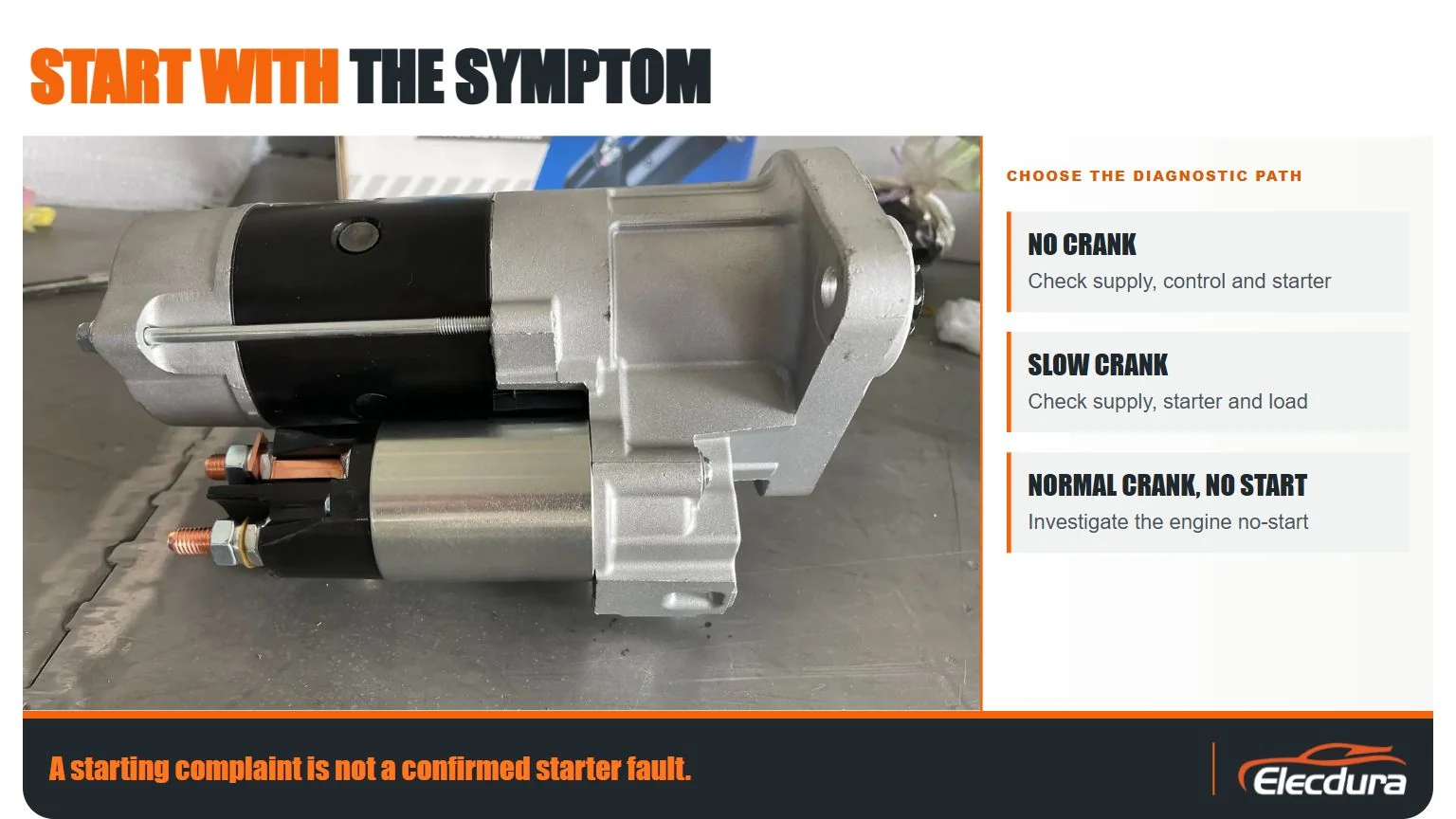
Starter symptom overview: distinguish no-crank, slow-crank and normal-crank no-start conditions before choosing a diagnostic path.
Visible terminal areas help document the installed configuration. Their functions and test points must be established using the correct system information.
A click indicates that something has responded to the start command, but the sound alone does not establish that the starter motor has received the correct electrical supply.
Identify where the sound originates and verify the start-command path, relevant relay and solenoid response according to the applicable wiring diagram.
Some starting systems use an integrated magnetic switch (IMS) or other application-specific control arrangements. Where fitted, these components require the corresponding diagnostic procedure. Do not assume that every starter uses the same control architecture.
If there is no click and no crank, determine whether the starting system is receiving the required command and whether any applicable safety interlocks or control conditions are preventing operation.
The starter must engage the engine and transmit sufficient torque to turn it. A starter that spins freely without turning the engine has a different problem from one that does not rotate at all.
Possible causes include a worn or damaged pinion, a drive mechanism that fails to engage, damaged ring-gear teeth or an incorrect mounting arrangement.
Repeated grinding or engagement attempts can worsen mechanical damage. Stop repeated attempts and arrange inspection when abnormal engagement noise occurs.
The starter drive, mounting interface and ring gear should be assessed according to the applicable service procedure before deciding whether the starter, related mechanical components or both require attention.
Separate a single click from rapid repeated clicking, then request the battery, main-circuit and control-system findings.
Ask whether the checks were performed while the complaint was present. A connection that appears secure with the vehicle at rest may still require evaluation under the specified starting conditions.
See our Heavy-Duty Starter Clicks but Won't Crank Diagnosis guide for a more focused diagnostic sequence.
For a parts request, retain the technician's conclusion about the affected component rather than recording only the original description of the sound.
A silent starter does not distinguish a missing start command from a component that fails to respond.
Verify the power supply, start-command path, applicable interlocks and control response using the correct vehicle or equipment wiring information. Do not bypass safety interlocks or apply power to unidentified terminals as a shortcut.
The repair record should show how the technician distinguished a control-circuit fault from a starter fault before recommending replacement.
Record when the engine turns slowly or fails to crank, including relevant temperature and operating conditions. Determine whether the fault occurs consistently or only intermittently.
The diagnostic process may require battery testing, cable voltage-drop measurements, control-circuit checks and an assessment of mechanical load.
Our Heavy-Duty Starter Voltage-Drop Test Guide explains the role of circuit voltage-drop checks.
Current measurements also require context. A number without the system voltage, test conditions and applicable acceptance limits is not enough to justify replacement. See our Starter Motor Current-Draw Analysis for Fleet Maintenance guide for further discussion.
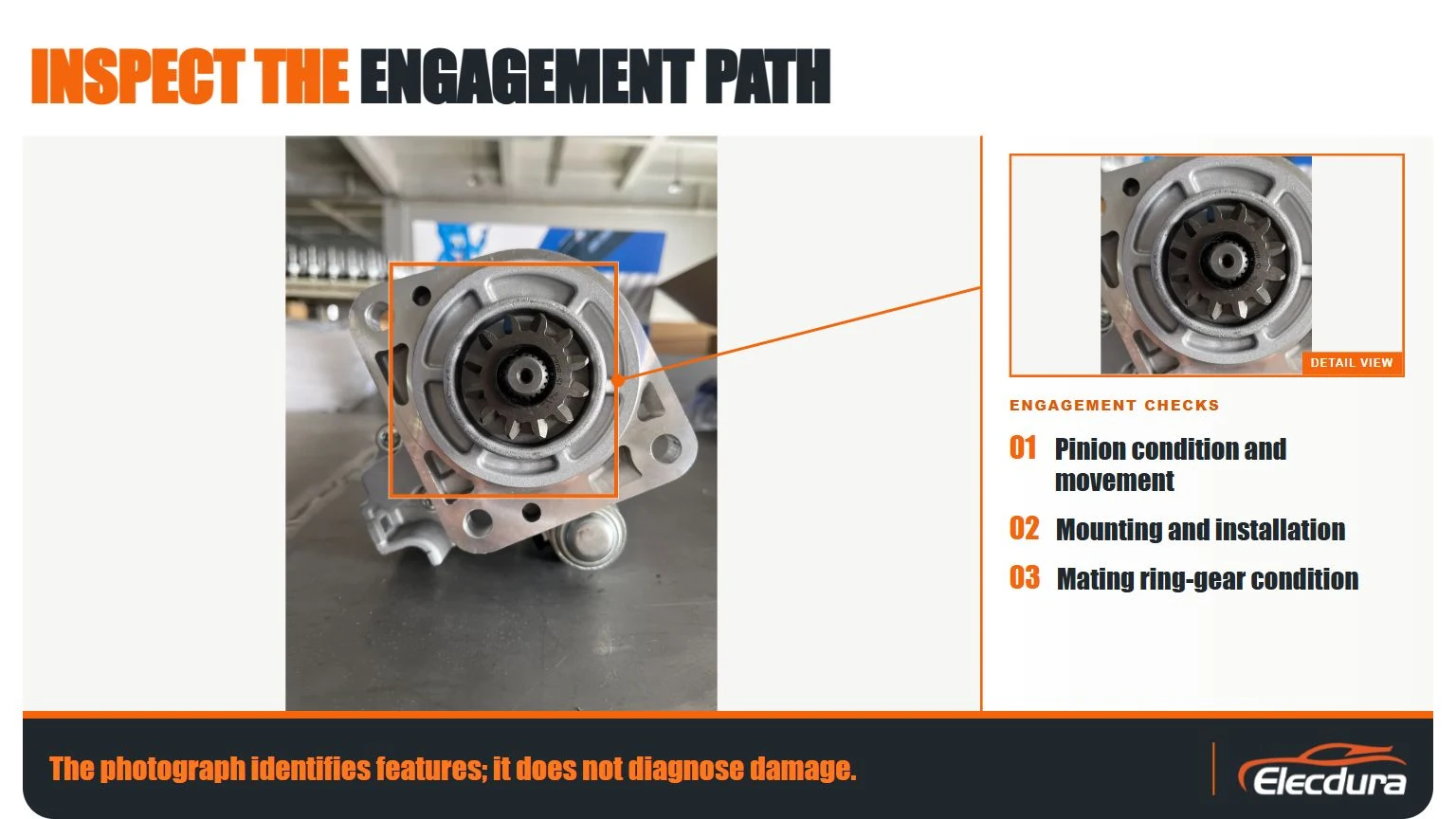
Request an inspection of the drive mechanism, mounting arrangement and mating ring gear as appropriate.
A starter that spins without turning the engine is not the same as an engine that turns normally but fails to start. Keep the two complaints separate in the repair record.
The pinion and mounting interface are part of an engagement assessment. This photograph does not show or establish a diagnosed fault.
The Starter Bendix Problems in Heavy-Duty Starter Motors guide covers drive and engagement considerations in more detail.
Replacement is justified when the applicable diagnostic checks isolate a starter or starter-integrated component fault and establish the required repair scope.
The diagnostic record should identify what was checked, what failed and whether a related condition also needs correction.
For example, a technician may find that a cable connection accounts for the complaint and confirm normal operation after correcting it. That finding does not justify ordering a replacement starter.
If the technician isolates a starter fault after the required checks, the buyer can proceed to application and part-number matching. If drive damage is involved, the associated engagement condition must also be considered.
Keep unresolved findings visible. A recommendation to replace the starter without supporting diagnostic evidence is a reason to request clarification, especially before applying the same decision across several fleet vehicles.
For a structured comparison of repair and replacement decisions, see our Starter Motor Repair vs. Replacement for Heavy-Duty Fleets guide.
Once the diagnosis supports replacement, identify the correct unit before ordering.
Start with the complete original part number and the vehicle or engine application. Confirm the electrical system, mounting arrangement, nose and pinion configuration, specified rotation and control architecture as applicable.
If a proposed replacement differs from the original, obtain application-specific evidence rather than approving it because the main body looks similar.
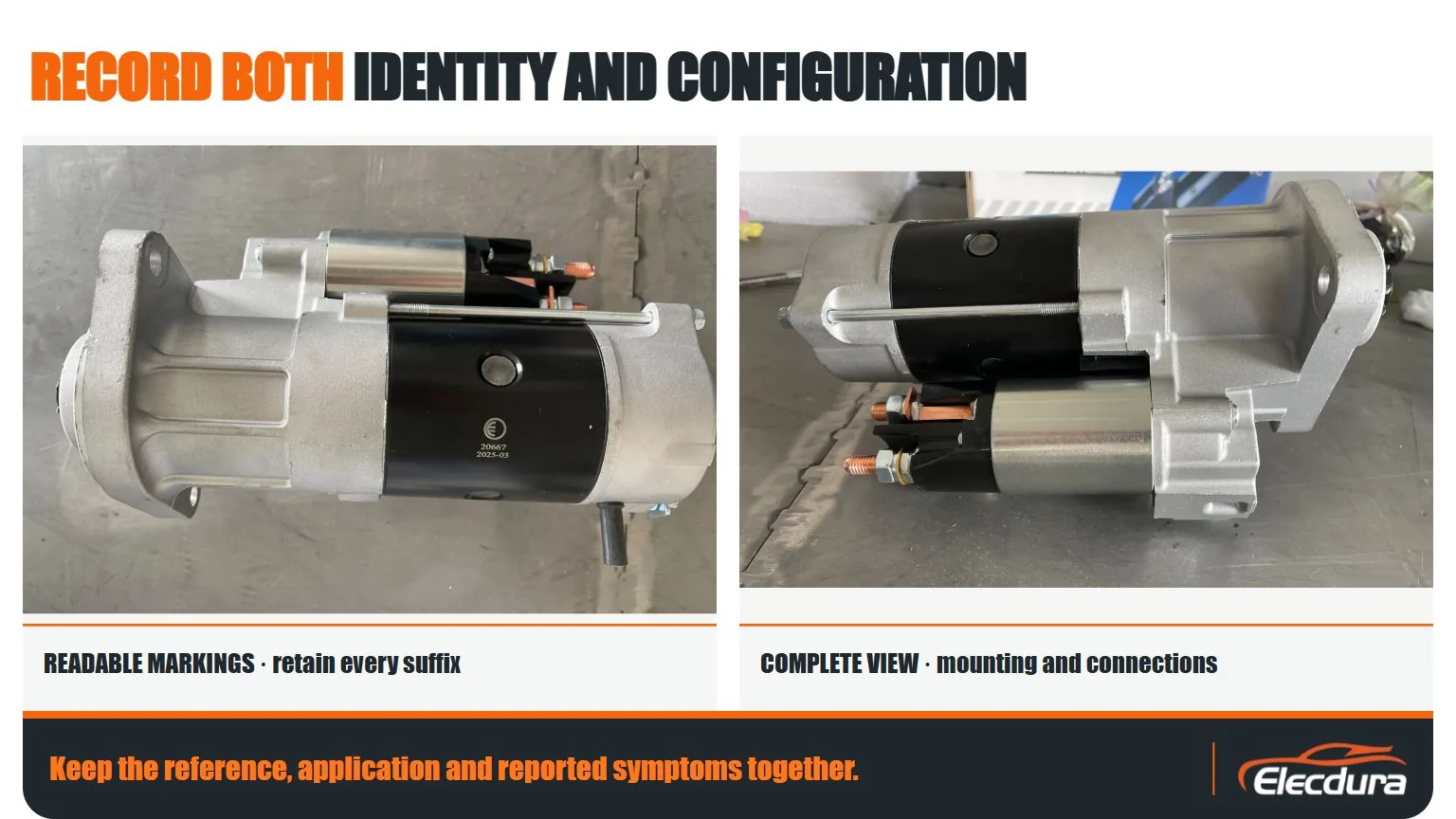
Record readable markings together with the full starter configuration. A body marking alone may not contain all the application information needed.
Information | What to provide or confirm |
|---|---|
Original identity | Complete starter or OE number and clear photographs of available markings |
Application | Vehicle, engine and relevant variant details |
Electrical configuration | Confirmed system voltage and control arrangement |
Mechanical configuration | Mounting, nose, pinion, specified rotation and relevant interfaces |
Failure finding | Workshop conclusion, relevant checks and any corrective work required |
Supply request | Quantity, required product condition, destination and supporting documentation needs |
If the original part number is missing or unreadable, provide the available engine and application information with clear photographs. Additional verification may be necessary before compatibility can be established.
Do not assume that two starters are interchangeable because their housings look similar. Differences in voltage, mounting geometry, drive configuration or electrical connections can affect compatibility.
Keep the original vehicle complaint, diagnostic conclusion and replacement identity in the same job record. After the repair, add the installation date and the workshop's completion findings.
This record helps distinguish a recurring original fault from a new problem and makes follow-up investigation more efficient.
For wholesale sourcing, the buyer should also specify the quantity required for each reference and the relevant commercial requirements. Availability, application compatibility, product condition and supporting documentation should be confirmed against the actual offer.
Elecdura supplies aftermarket replacement automotive parts for business customers. To discuss a replacement starter, contact Elecdura with the original reference, engine details, voltage, mounting or pinion information, photographs and required quantity. Compatibility and commercial conditions must be confirmed for the proposed replacement.
For supply and quotation considerations, see our Starter Motor Wholesale Price Guide.
Common complaints include clicking without cranking, slow cranking, no response to the start command, free spinning without engine engagement and intermittent operation. Each symptom can have multiple causes, so the starting system should be checked before the starter is condemned.
Yes. A weak battery or excessive resistance in the cables and connections can limit the electrical supply available to the starter. Battery condition and circuit integrity should be checked before deciding that the starter has failed.
Possible causes include insufficient electrical supply, poor cable connections, a faulty solenoid, internal starter damage or mechanical resistance. The exact cause requires testing under the applicable service procedure.
The starter drive may not be engaging correctly, or the drive mechanism or ring gear may be damaged. Inspect the engagement system before selecting a replacement.
Start with the original part number, engine model and application. Confirm voltage, mounting arrangement, drive configuration and relevant electrical connections. Photographs can help resolve identification questions, but compatibility must be verified for the specific application.
Previous: Starter Motor Wholesale Price Guide: MOQ, Lead Time, and Cost Factors for B2B Buyers
Next: How to Evaluate an Alternator Export Supplier Before Your First Order
This guide describes general diagnostic considerations. Always follow the applicable engine and starter manufacturer's service procedures and specifications.