ELECDURA NETWORK

Your Whole New Supply Chain For Heavy-Duty Parts
Whatsapp:
+86 18915027366
Phone:
+86 18915027366
Views: 0 Author: Elecdura Publish Time: 2026-09-29 Origin: Site
A new diesel fuel filter may restore flow without removing the reason the previous element plugged. When microbial contamination is involved, water, growth on tank surfaces and accumulated biomass can remain upstream. Material then reaches the replacement element and the restriction returns. Effective recovery therefore needs three connected decisions: establish what is blocking the filter, locate the affected fuel and equipment, and coordinate contamination control with application-correct replacement filters.
Repeated plugging is not proof of microbes. Wax, fuel-chemistry deposits, incoming particles and an incorrectly diagnosed supply problem can produce a similar complaint. This guide follows the microbial-contamination branch for fleet maintenance teams and parts buyers. It explains how to turn a recurring filter order into a defined investigation and recovery scope, without substituting a general article for the equipment procedure, laboratory plan or fuel-treatment instructions.
“The filter failed again” can describe several different events. The driver may have reported low power; the workshop may have measured an excessive restriction; or an element may have been changed as a precaution without a confirming measurement. Keep those events separate. The decision to investigate microbial contamination is stronger when a documented restriction repeatedly develops unusually early and the removed material or fuel history supports a contamination question.
Record the filter position, exact reference, installation date, operating time and reason for removal. Add any restriction measurement with its test conditions and applicable limit. A primary separator, a secondary engine filter and a dispenser element do different work. Combining their changes into one average “filter life” hides the location where contamination is being captured and may suggest a trend that does not exist.
An immediate improvement after replacement shows that the intervention changed something; it does not identify the deposit. A filter change also involves opening connections, disturbing seals and following a priming procedure. If the complaint returns immediately, check the documented service sequence and fuel-supply diagnosis before attributing it to rapid biological growth. The separate clogged-filter symptom guide covers the broader diagnostic entry point.
Several vehicles developing verified restrictions after using one dispenser justify investigating that shared path. One affected vehicle using several supply points puts more attention on its own tank and installation. Neither pattern proves the origin. A common delivery, transfer hose or previously stored batch may connect apparently separate incidents, while differences in filter efficiency and operating hours can make vehicles respond at different times.
Build the comparison from actual fueling and service records, not a presumed common cause. Note vehicles that used the same source without a reported problem, but do not treat their silence as a laboratory clearance. They may have consumed different quantities, operated fewer hours or simply not reached the point where a restriction becomes apparent.
Microbial contamination involves organisms and the material associated with their activity. Bacteria and fungi can grow where suitable fuel and water conditions exist. Donaldson's technical guidance describes free water at tank bottoms, the fuel-water interface, warm conditions and prolonged storage as relevant factors. The useful maintenance question is not simply whether a filter contains dark material, but whether the connected system still supports contamination.
A tank is not necessarily uniform from top to bottom. Fuel, associated water, settled material and attached deposits may occupy different locations. A sample from a convenient outlet can help answer a question about fuel leaving that outlet while missing another part of the tank. Likewise, a new engine filter only intercepts material that passes through it; it does not clean every upstream surface or low point.
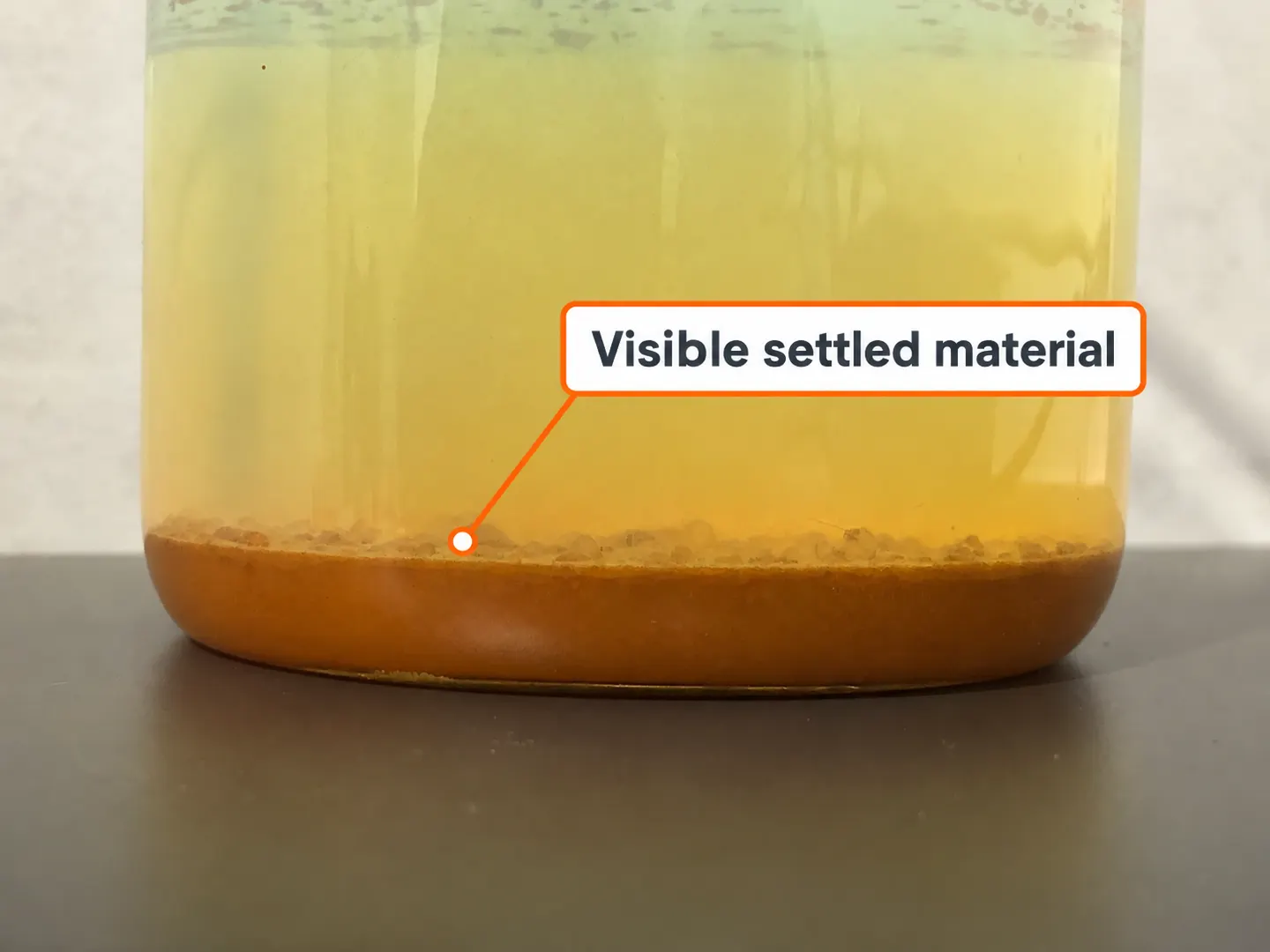
Settled material in a photographed diesel sample. Its appearance alone does not identify the contaminant or represent every location in a tank. Photograph: MrCarter188, CC BY-SA 4.0; annotation added, derivative under the same license. Source photograph; CC BY-SA 4.0. View full-size image.
Removing accumulated free water addresses an important growth condition. Removing settled or attached material addresses a reservoir of contamination and a future solids burden. Those actions are related, but one should not be recorded as proof that the other occurred. The responsible service provider needs to identify which locations were accessible, which were treated or cleaned, and which remain outside the completed work.
This distinction also prevents an unrealistic purchase expectation. An application-correct filter can retain contamination and still require early replacement when presented with an abnormal load. Its short service life may be evidence that upstream work remains necessary, rather than evidence that selecting another brand will solve the source problem.
Killing microorganisms does not make their physical material disappear. Donaldson specifically warns that dead microbial material left after treatment can rapidly load high-efficiency filters. A result showing reduced microbial activity and a continuing restriction complaint are therefore not automatically contradictory. The treatment may have affected living organisms while leaving a solids-removal task unfinished. Both biological control and fuel delivery must be evaluated.
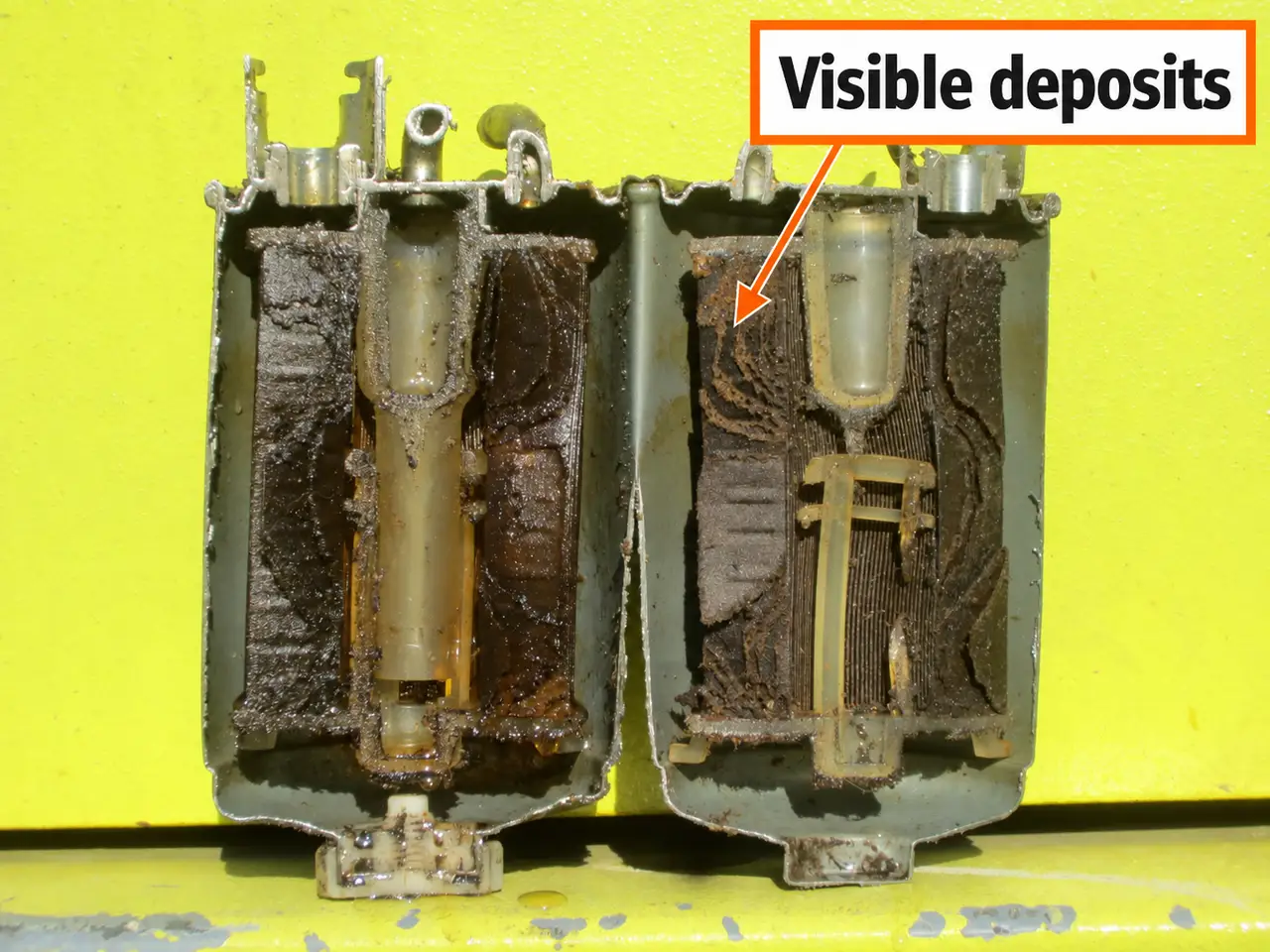
Dark, slimy or unusual material is a reason to investigate, not a reliable identification method. Photos are useful for recording where a deposit appeared and how successive elements compare. They cannot by themselves establish organism type, activity or the chemistry of a plugging deposit. Describe the observation neutrally until the selected examination supports a more specific conclusion.
A cut-open used Volkswagen diesel filter, photographed after reported clogging. Visible deposits do not identify their composition or establish microbial contamination. Photograph: Kat1100, CC BY 3.0; orange annotation added. Source photograph; CC BY 3.0. View full-size image.
Donaldson's filter-plugging overview discusses wax and several fuel-chemistry or additive-related deposits alongside traditional contamination. A fleet can therefore experience rapid restriction without a microbial explanation. The timing of a weather change, a new fuel batch or a treatment application matters because it identifies another branch worth testing, rather than because timing alone establishes causation.
Where the problem follows cold exposure, preserve the batch and temperature history for the supplier or laboratory. Use the cold-weather fuel-batch guide for cloud-point and filterability evidence. Advice about a winter bulk-filtration option does not authorize a coarser engine element. Changing the engine's protection requirement to obtain temporary flow can conceal the restriction while creating a different risk.
A water-in-fuel warning and a microbial test answer different questions. The warning requires the installed separator and sensor system to be assessed; it does not identify bacteria or fungi. Conversely, absence of a warning does not establish that every storage tank and transfer point is free of water or microbial activity. Follow the separate water-sensor diagnostic path where circuit or bowl behavior is uncertain.
Do not abandon ordinary fuel-supply checks. Air entry, damaged seals, restricted lines or a supply-pump problem can survive an unnecessary filter replacement. The workshop should confirm which part of the flow path is abnormal using the application procedure. This keeps a fuel-contamination investigation from becoming an explanation for every loss-of-power complaint.
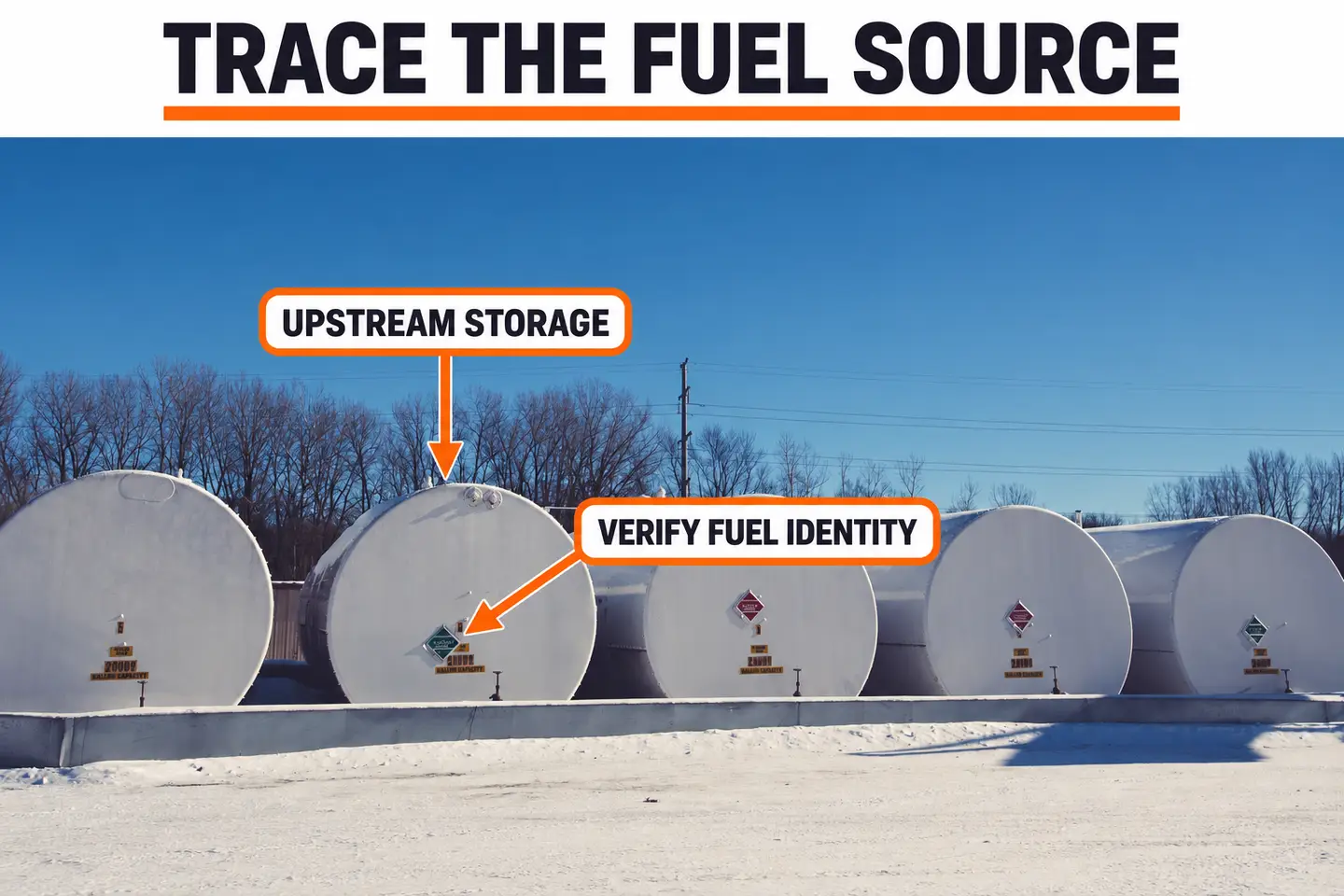
Map the actual sequence from delivery to storage, transfer equipment, dispenser, vehicle tank and engine filters. Include temporary tanks or shared hoses if they were used. Intertek's fuel-microbiology guidance emphasizes that activity can be local or elsewhere in the supply chain. Cleaning a vehicle tank cannot establish that the dispenser feeding it is clean; treating a bulk tank cannot certify every vehicle previously supplied from it.
An external example of upstream fuel storage. Trace the actual supplying tank and fuel identity in a recurrence investigation; this photograph is not evidence of contamination, a sampling plan or an Elecdura facility. Photo: Tony Webster, 20,000-gallon Fuel Tanks, CC BY 2.0. Cropped and annotated for Elecdura; no endorsement implied. View full-size image.
Tell the laboratory what recurred, where restriction was confirmed, what material was observed and what interventions have already occurred. Ask which locations and sample types can distinguish the suspected paths. SGS describes fuel, fuel-water mixtures and associated-water analysis, together with controlled sampling and transport. A single convenient bottle should not silently stand in for all those different materials.
Treatment, fuel transfer, water removal and cleaning can change what a later sample represents. Arrange any necessary baseline collection with the laboratory before those steps when safe and practical. If urgent work has already taken place, record it accurately and request a post-intervention plan. Do not label a sample taken after treatment as untreated evidence merely because it came from the same tank.
Use the laboratory's specified containers, collection method, preservation and transport arrangements. An improvised container or a sample left under uncontrolled conditions can undermine the intended comparison. Tank access and fuel handling belong to trained personnel following site procedures; this guide does not instruct readers to enter tanks, improvise sampling equipment or open high-pressure fuel lines.
A useful result remains attached to its tank or vehicle, location within the system, collection time and treatment state. Include the corresponding filter-change record where relevant. Without those connections, a buyer may receive a positive result from one point and a satisfactory result from another, then mistake the difference for a laboratory disagreement rather than a real difference in what was sampled.
Fuel-microbiology methods are not interchangeable labels for one measurement. The laboratory may use ATP-based screening, culture-based procedures or other analysis selected for the investigation. Ask what the reported result detects, which specimen was tested, how the result is expressed and what interpretation applies to that method. Avoid creating a universal pass value by combining numbers from different tests or sample types.
Finding microbial activity supports a contamination finding in the examined material. It does not automatically prove that all restriction came from microbes or that an injector failure was caused by that particular sample. A restriction investigation can require examination of deposits and other fuel properties as well. Where liability or an injector claim is involved, the fuel-analysis report guide explains that separate evidence boundary.
After treatment, ask whether the planned check addresses remaining activity, physical contamination, fuel suitability or a combination. A microbial result alone does not quantify all solids waiting to reach the next filter. Similarly, acceptable flow during a brief run does not measure microbial control. Record which endpoint was checked and leave the other endpoint open until the agreed evidence is available.
A negative finding needs the same attention to sample location and method as a positive one. If the original concern involves a low point or another connected tank, a satisfactory outlet sample may not resolve that concern. This does not mean every negative result is unhelpful. It means the scope of the conclusion should match the investigation that produced it.
For follow-up, agree on comparable collection points and interpretation with the laboratory. Mark any change of method, sampling location, fuel batch or treatment. A sequence of results is useful only when the reader can understand what changed between entries. The aim is a defensible assessment of the affected system, not a chart that appears to improve because unlike results were placed on one scale.
A recovery quotation should identify the problems it is intended to address. Water control, microbial treatment, tank cleaning and filtration are different operations with different limitations. The correct combination depends on the affected installation and evidence. A fuel-treatment specialist or equipment service provider should specify the sequence, compatibility requirements, access needs and verification—not simply sell a chemical or replacement element as a complete cure.
For water removal, identify the locations covered and how renewed ingress will be addressed. For cleaning, identify whether the scope includes accessible deposits and what cannot be reached. For filtration or polishing, identify the fuel path being processed and the intended removal task. For microbial treatment, establish the product's applicable instructions and the specialist's basis for selecting it for this system.
If treatment is expected to leave a substantial biomass load, the plan should explain where that material will be captured before fuel reaches the engine. It should also identify who monitors the relevant elements and arranges replacement. Otherwise, the fleet may mistake the predictable loading of downstream filters for a failed treatment, or keep operating while assuming that treated fuel must already be physically clean.
Do not adopt a generic dose, circulation duration or waiting period from another installation. Different products and applications have their own requirements. Treatment selection also needs compatibility and applicable product-use requirements checked by the responsible provider. Changing concentration or combining products without that review can create an additional fuel-quality problem while making the original investigation harder to interpret.
Identify the person accepting the fuel condition, the person releasing the storage or dispensing system, and the workshop responsible for each vehicle. These may be separate organizations. A completed tank-service invoice should not silently become an engine-system clearance. Document handover conditions, unresolved locations and the follow-up triggers so the parts team knows whether it is supporting a controlled recovery or merely responding to another emergency order.
Two proposals described as “fuel cleaning” may cover different operations. One may circulate fuel through an external unit, another may include accessible tank cleaning, and another may chiefly supply a treatment product. Compare the work and acceptance basis before comparing price. A lower quote is not automatically inadequate, but missing operations must remain visible so the fleet does not mistake a narrower service for the complete recovery scope.
Use the investigation findings to request specific deliverables. A laboratory, tank contractor and engine workshop should each describe the part of the problem they will address. Where their scopes meet, identify who accepts the handover. For example, a contractor returning processed fuel needs an agreed destination; returning it through unassessed equipment can reintroduce an unresolved part of the original path.
Locations included: Name the tank, transfer equipment and dispensing path included. State whether vehicle tanks are excluded, so a bulk service is not purchased as if it covers the whole fleet.
Material removed: Distinguish free-water removal, suspended-solids capture and accessible deposit removal. Ask which remaining material could continue loading filters and who evaluates that limitation.
Treatment responsibility: Identify the responsible specialist, exact proposed product and applicable instructions. Keep compatibility review and treatment selection separate from a general parts quotation.
Fuel disposition: Define where fuel goes during work and what evidence supports its subsequent use. Filtration should not be represented as proof that every relevant fuel property is acceptable.
Consumables and waste: State which replacement elements, seals and contaminated-material handling are included. Clarify responsibility for additional changes if the observed loading exceeds the original service estimate.
Release and follow-up: List the checks supporting handover, who interprets them and what remains conditional. A report of work performed and an acceptance decision should be individually identifiable.
If a contractor cannot access part of a tank or does not evaluate vehicle tanks, record that as an exclusion. It may be an acceptable division of work when another provider covers the gap. It is not an acceptable basis for saying the entire system was cleared. The buyer's job is to connect those scopes, not to ask each provider to promise beyond the work it actually controls.
Consider an illustrative fleet, not an Elecdura customer case: several vehicles report early restriction, the shared storage system is investigated, and microbial activity is confirmed in an agreed sample. A specialist completes treatment, but vehicle filters continue loading. The purchasing response should not automatically be a larger repeat order of the same treatment or a different engine-filter specification.
First compare what was included in the treatment with what the later observations show. Was residual material expected? Was it intercepted before dispensing? Were the vehicle tanks within the service scope? Was the later restriction measured at the same filter position? These answers distinguish an unfinished removal task from possible reinfection, an unassessed vehicle or a different supply fault.
The example does not establish which explanation is most likely in a real fleet. Its purpose is to check whether the proposed handover leaves enough information to make the next decision. If every recurrence would simply trigger another filter purchase without revisiting the unresolved path, the plan has not yet converted the diagnosis into a controlled recovery.
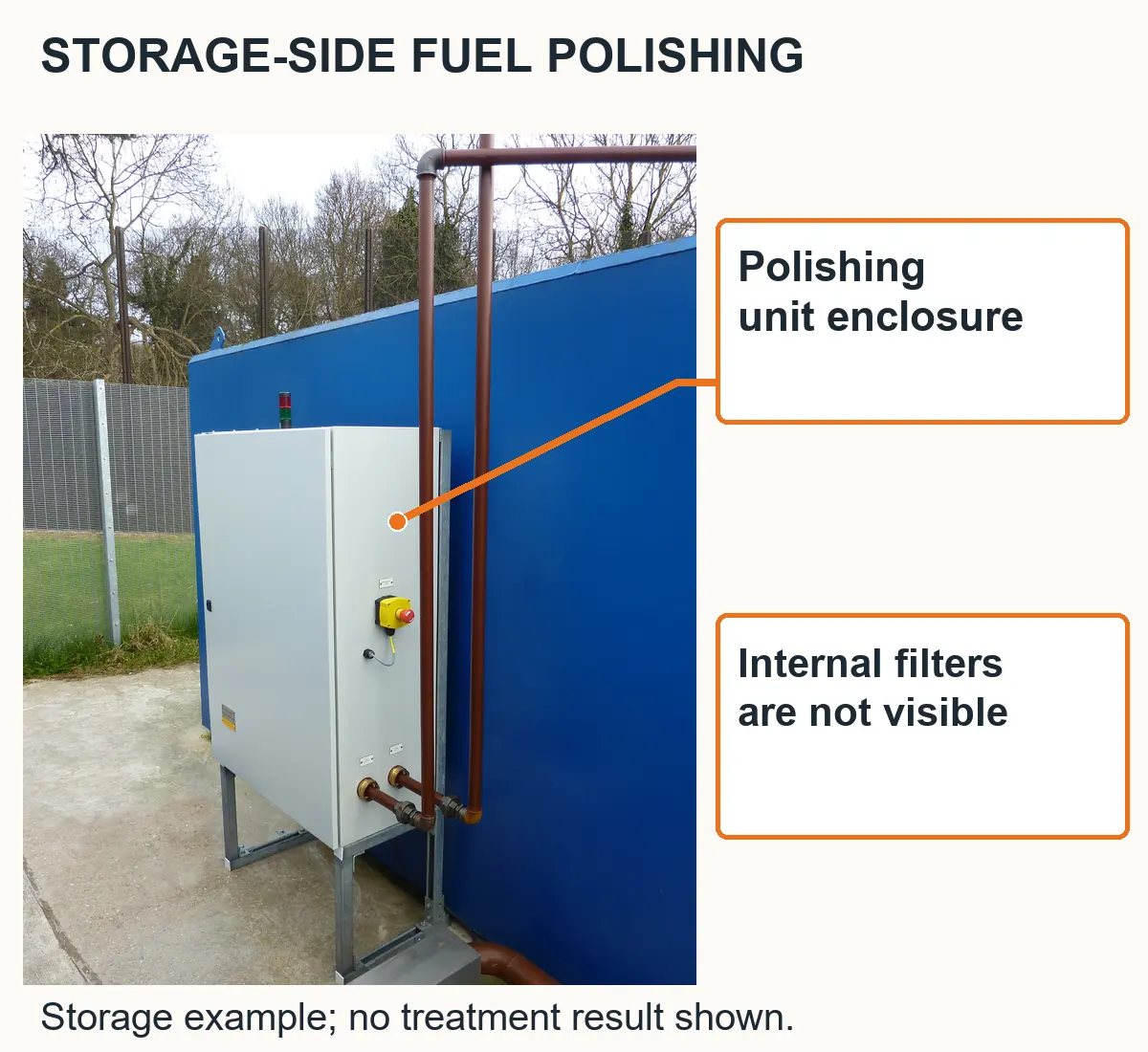
Bulk-tank filtration and engine filtration need separate replacement decisions. The bulk system can intercept material before distribution; the on-engine stages protect the installed fuel system under their specified conditions. A larger element or a similar connection does not make those products interchangeable. Keep the supplier's proposal attached to the installation where it will be used.
An independent storage-side fuel-polishing example at a UK hospital, photographed in 2016. The enclosure is visible; its internal elements are not. This photograph shows the installation context, not measured fuel cleanliness or a treatment outcome. Photo: Markchamilton, fuel-polishing system at a UK hospital, CC BY-SA 4.0. Resized and annotated; derivative under the same license. No endorsement implied. View full-size image.
For an engine-filter order, identify the engine and application, installed head or housing, primary or secondary position, existing reference and required service components. Include water-separation, bowl, drain, sensor and seal provisions where applicable. A substitution must preserve the documented function, not only fit the thread or external dimensions. The contamination event is not permission to bypass an element or lower the required protection.
Emergency demand can make an available cross-reference attractive. Ask what evidence supports it in this exact filter position and configuration. Do not use the promise of longer life as the sole selection criterion: longer life could reflect a different duty or protection level, not a superior solution to contamination. Keep any approved change identifiable in the maintenance record so later results are interpreted correctly.
Count the affected equipment and distinct filter positions, then ask the recovery provider which stages may require additional changes. Reserve the correct elements, seals and other specified consumables for those stages. There is no universal number of extra filters that proves readiness. The expected solids burden, treatment arrangement and monitoring plan determine the practical stock discussion.
Separate confirmed requirements from contingency stock. That distinction helps purchasing avoid both a shortage during planned work and an unsupported large order. Record which replacement lot was issued to which vehicle or service stage. If restriction returns, the fleet can then compare actual service conditions and identities instead of debating whether every new element came from the same unspecified batch.
Keep unused replacement elements protected while contaminated parts are being handled. The work order should distinguish unopened spares, installed replacements and removed investigation samples. They should not share an unidentified pile at the service point. Retain the packaging and lot details needed for traceability, but keep any fuel-contaminated material within the workshop's approved handling arrangements rather than treating ordinary parts packaging as a sample container.
When returning an element for review, arrange the receiving party's requirements first. Identify whether it is an unused fitment concern or a used element from the contamination event. Those are different investigations, and the recipient may require different preparation and transport. This simple distinction helps prevent a useful field specimen from arriving without its history, or an unused replacement from being incorrectly included in a fuel-contamination claim.
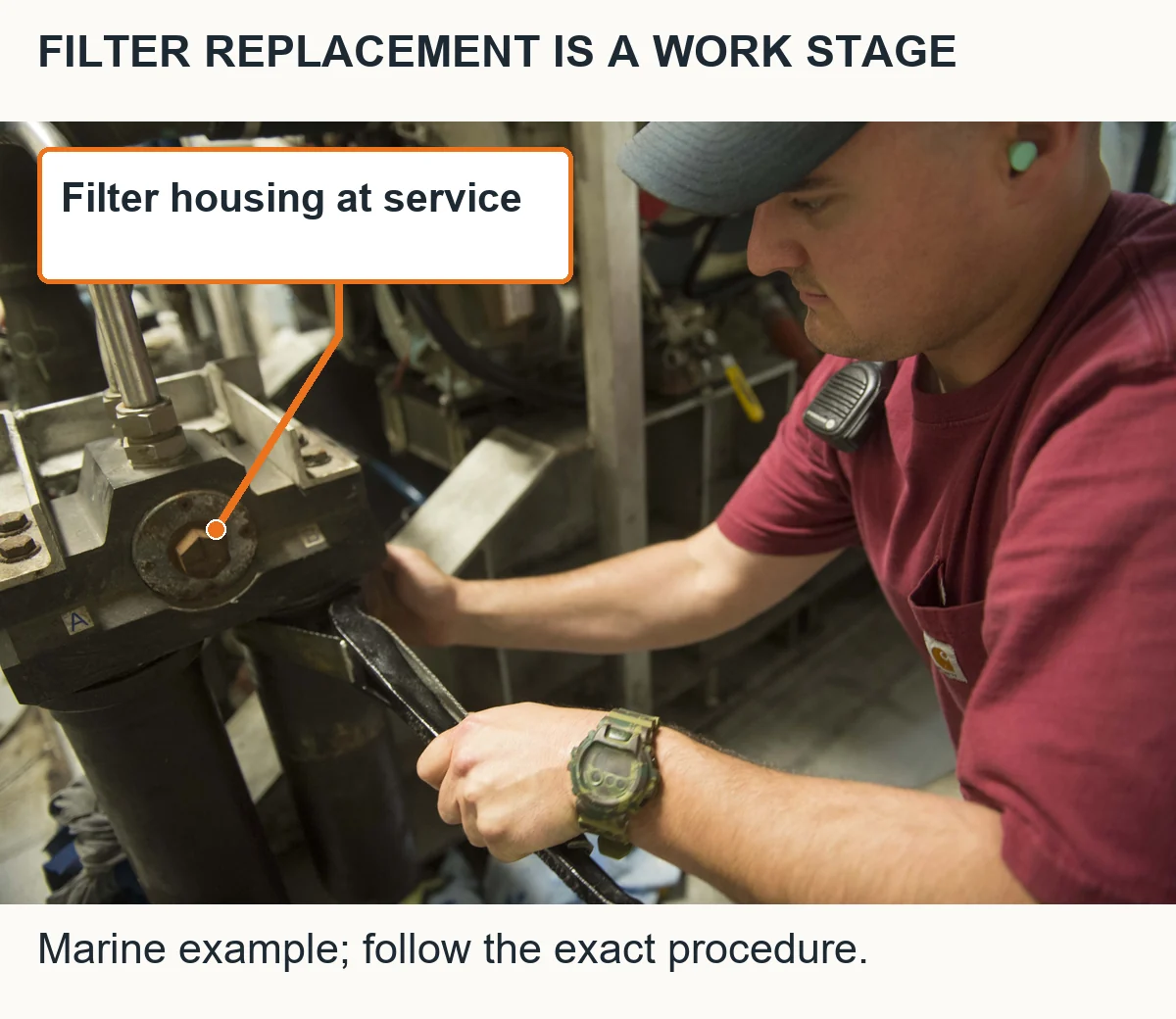
Fuel-filter replacement aboard USNS Spearhead in 2016, shown as a separate service stage from storage treatment. This marine example is not a truck replacement procedure, a packaging-identity record or evidence of microbial contamination. Follow the procedure for the actual installation. Photo: U.S. Navy / Amy M. Ressler, 160425-N-WV703-064, public-domain source. Resized and annotated. No Navy or individual endorsement implied. View full-size image.
Return to service should connect the completed work with the questions that caused the equipment to be held. The responsible team needs to know whether the contamination source was addressed, whether the fuel meets the agreed acceptance basis, and whether the installed system functions correctly after service. These conclusions require different evidence; none should be inferred simply from an engine starting.
First, retain the treatment or cleaning scope and completion record, including exclusions. Second, retain the relevant fuel and microbial follow-up results with their interpretation. Third, retain the workshop's application-specific checks after filter installation and priming. Together they show what was done and what was demonstrated. One satisfactory record does not replace the other two when all three are necessary for the incident.
An initial run can confirm immediate service checks but may not expose a remaining upstream load. Agree on follow-up conditions and triggers with the maintenance team rather than inventing a universal test duration. Keep subsequent fueling, operating time, restriction observations and element changes linked to the recovery record. A return of the same pattern should reopen the relevant unresolved branch promptly.
If several serviced vehicles again develop restrictions after using the same source, review the shared path and later deliveries. If one vehicle alone recurs, review its tank, installation and exposure history. If microbial activity is reduced but physical loading remains, discuss remaining solids with the provider. These are investigation priorities, not automatic diagnoses; new observations must still be compared with the original findings.
Avoid restarting the entire process without using the evidence already gathered. Identify what is genuinely new: a different deposit, a new sample location, a changed filter reference or a later fuel delivery. That targeted comparison makes follow-up more useful and prevents repeated chemical treatment or repeated parts replacement from becoming the default response to uncertainty.
Prevention should respond to the source actually found. Review the relevant water-entry routes, storage practices, transfer equipment and inspection responsibilities with the site team. If the investigation did not establish a source, keep that uncertainty visible and define the monitoring that will help resolve it. An unproven explanation should not become a permanent purchasing rule.
Frequently replenished fleet storage and equipment that retains fuel for long periods present different monitoring questions. The latter may receive little operational feedback between inspections; the former may experience repeated transfers and changing batches. Use the actual storage and consumption pattern when agreeing on sampling and housekeeping. A generic calendar interval copied from another facility is not evidence that the local risk is controlled.
A storage-system modification, extended shutdown, different fuel source or new recurrence pattern can justify reviewing the existing program. Record the change and the question it raises, then decide whether sampling or service scope should change. This is more informative than adding another routine test whose result has no defined consequence for fuel release, maintenance or filter purchasing.
For a replacement-filter inquiry, use the Elecdura fuel-filter category and provide the exact application, installed reference, filter position and required interfaces. Add quantities by confirmed requirement and contingency, destination, packaging needs and any agreed replacement restrictions. Relevant label and interface photos help clarify the requested part without claiming that appearance proves filtration performance.
Send those details through the parts inquiry page. Fuel sampling, treatment selection and tank remediation remain the responsibility of the appropriate laboratory and service providers; a filter quotation does not certify the fuel or release the system. The practical objective is straightforward: correct filters available for a defined recovery plan, with the source addressed and the outcome verified rather than another unexplained early change.