ELECDURA NETWORK

Your Whole New Supply Chain For Heavy-Duty Parts
Whatsapp:
+86 18915027366
Phone:
+86 18915027366
Views: 0 Author: Site Editor Publish Time: 2026-09-16 Origin: Site
Cold-weather diesel fuel filter plugging does not, by itself, prove that a replacement filter is defective. Before changing the filter specification or buying another fuel treatment, check whether the delivered fuel batch was suitable for the temperatures and equipment involved. Cloud point, cold filter plugging point (CFPP), and low-temperature flow test (LTFT) results describe different observations or test conditions; none is a universal temperature guarantee for every vehicle. Keep the batch documents together with the cold-exposure and sample history. That comparison helps a fleet decide whether it needs a fuel-supplier review, equipment service, or application-correct replacement filters.
A delivery described as “winter diesel” still needs an agreed meaning. Ask the supplier which fuel grade and blend were delivered, which cold-flow properties support its recommendation, and what location and period that recommendation covers. An invoice from a local depot is not automatically evidence for a truck traveling to a colder region or equipment standing outside through an extended shutdown.
Separate three questions in the purchase review: what the supplier delivered, what is now in the receiving tank, and where that fuel will be used. A delivery certificate may describe the incoming load without describing a tank that still contains an earlier batch. Record the remaining fuel and subsequent additions so the supplier can assess the resulting mixture. Do not calculate a new cloud point by averaging two certificates.
This is a practical reason to review seasonal purchases before committing to a large load. Donaldson's cold-weather maintenance guidance emphasizes discussing changing weather and seasonal blending with the fuel supplier. The purchasing consequence is specific: confirm the intended use of the delivered batch, rather than accepting a seasonal label as the whole specification.
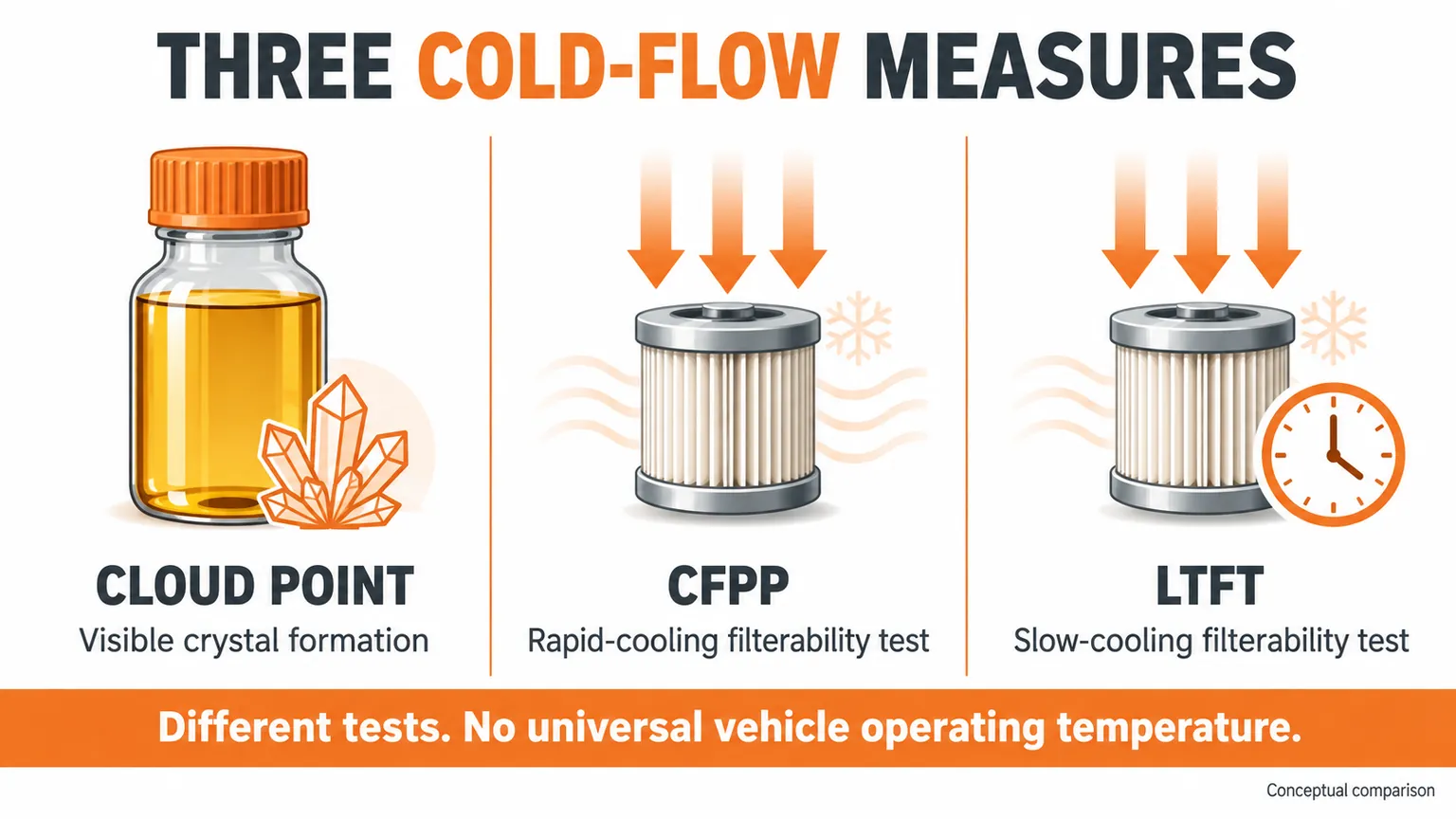
The NREL Biodiesel Handling and Use Guide, sixth edition, distinguishes visible crystal formation from standardized filterability tests. Its discussion of diesel and biodiesel blends explains why test names matter when comparing supplier reports.
Reported property | What it describes | What a buyer should not assume |
|---|---|---|
Cloud point | The first visible small solid crystals as fuel is cooled under a specified method. | A universal engine shutdown temperature, or a complete description of treated-fuel filterability. |
CFPP | A standardized filterability result. The guide describes rapid cooling and a European light-duty fuel-system background. | That every exposed filter or North American heavy-duty installation will operate down to this result. |
LTFT | A separate slow-cooling filterability test, discussed in relation to severe North American heavy-duty fuel-system designs. | An interchangeable name for CFPP, or a field test of the buyer's actual vehicle. |
Conceptual comparison, not test apparatus or measured results. Keep the reported method with each fuel property.
These results can be useful together. They are not three competing advertisements where the lowest number automatically wins. A comparison should retain the test method, its reported revision, the fuel sample identity, and any conditioning or treatment information supplied with the result.
The public significance-and-use section of ASTM D6371-24 describes CFPP as an estimate for certain fuel systems and identifies limitations related to system configuration. It does not promise trouble-free operation in every vehicle. Ask the fuel supplier and equipment service provider which evidence supports the intended application. A fleet should not invent its own universal offset between a laboratory result and the forecast.
Also distinguish a typical product data-sheet value from a result tied to a delivery or a documented supplier specification. Both may have a role in an agreement, but they answer different questions. If a quotation simply says “protected to” a temperature, ask whether that means a measured property, a treatment claim under stated conditions, or a service recommendation for the proposed use.
Dispatch may call any cold-related loss of fuel flow “gelling.” That label is useful for communicating an incident, but too broad to assign responsibility for a filter return. Wax, frozen water, and other material can lead to a restriction complaint without requiring the same response.
Donaldson's fuel-filter plugging technical article explains that wax-related plugging can occur before obvious cloudiness and also discusses additive-related and other fuel-chemistry deposits. A clear-looking sample therefore does not settle every plugging question. Nor does rapid plugging establish that the element was manufactured incorrectly.
Water needs separate attention. DAVCO's Diesel at Cold Temperatures sheet describes water collecting in low areas of a fuel system and freezing to restrict flow. This is a different issue from judging a fuel's wax-related cold-flow properties. A favorable cold-flow report should not be treated as evidence that water is absent.
Use a photograph to show what was observed, not to identify the chemistry of a deposit. “Pale material on the element,” “hazy fuel,” or “restriction reported after overnight parking” are observations. “Wax caused this failure” is a conclusion that needs supporting evidence. Other contamination or an equipment fault may still be involved. For the equipment-side work, use the application procedure and the separate fuel restriction and priming diagnosis guide; this article is not a substitute for that testing.
A sample received at room temperature cannot simply be treated as a photograph of fuel at the time of a cold incident. Its condition may have changed during collection, transport, or storage. ASTM D6371's public guidance notes that sample conditioning can affect results used to investigate complaints. That is a reason to document the sample's history and let the investigating laboratory specify handling—not to improvise a heating test in the workshop.
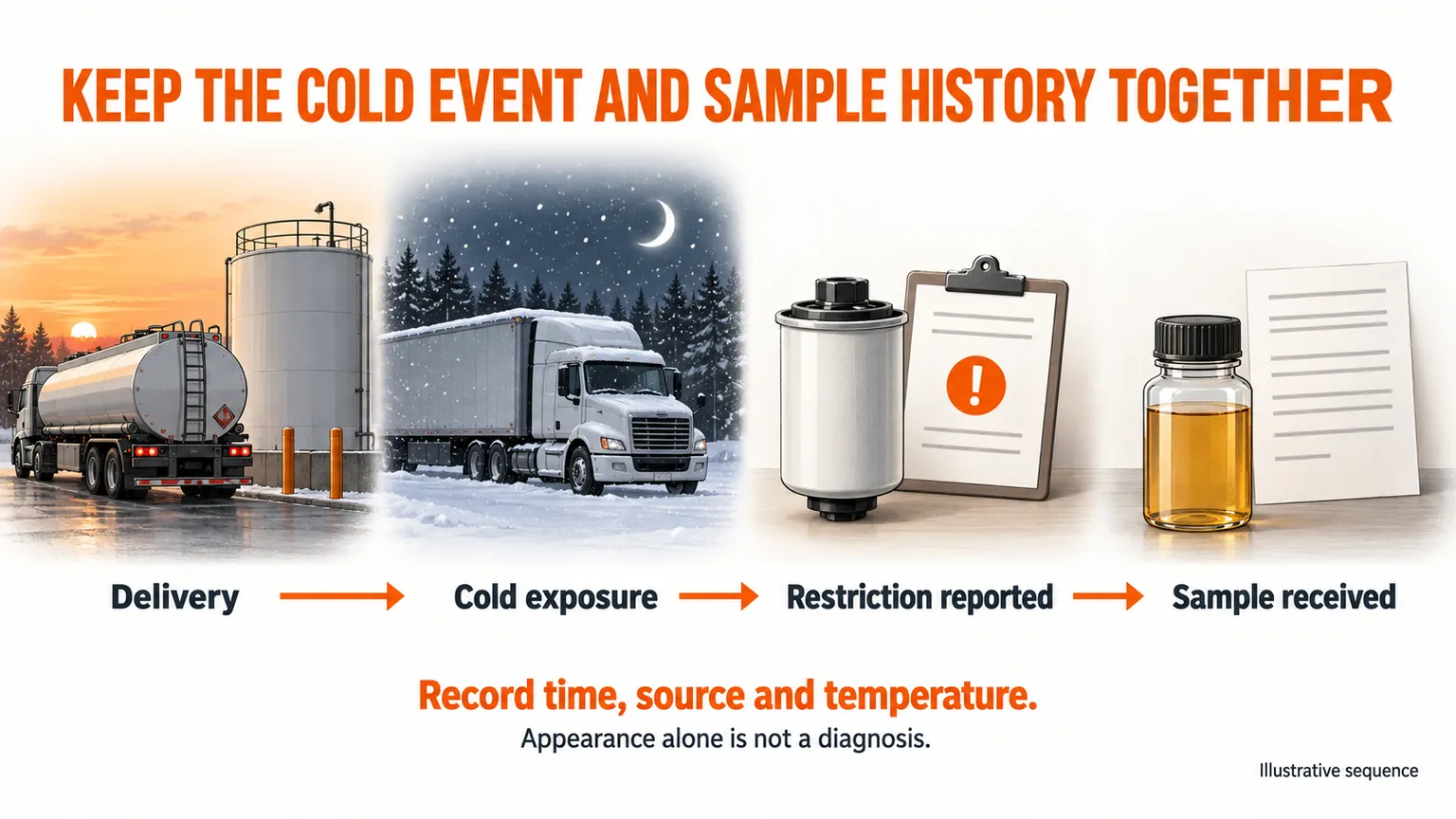
When arranging an investigation, describe the sequence in plain language: delivery and receiving tank; vehicles or equipment fueled; cold exposure; reported symptom; any service intervention; and sample collection and receipt. Record known temperatures with their source. Keep a weather forecast, measured ambient temperature, and measured fuel temperature labeled separately. Do not retrospectively turn an outdoor air reading into a fuel-temperature measurement.
A useful incident packet identifies the batch and sample locations, the reported restriction, installed filter references, photographs, and what changed before the fuel was examined. If fuel was transferred, treated, warmed during authorized service, or mixed with another load, include that fact. The aim is to let the fuel supplier, laboratory, and service provider compare the same event, not to accumulate a large set of unconnected photographs.
Illustrative chronology only. Record actual times and known temperatures; appearance alone does not identify the cause.
Agree on sampling, containers, shipping, and retention with the responsible service provider or laboratory. This article does not prescribe opening a fuel system, cutting a filter, or warming a fuel sample. Follow the applicable equipment and fuel-handling safety procedures; do not use open flames or improvised heaters.
Use the batch and incident review to ask one focused question: what documented supply specification or batch evidence supports the proposed fuel for this use? Keep the supplier's response with the delivery record, including any conditions or unresolved gaps.
If a treatment program is proposed, ask who is responsible for selecting and applying it and what evidence covers the actual fuel mixture. FS's cold-weather plugged-filter guidance notes that blending conditions matter and that water or microbial issues can also be involved. Buying more additive without resolving the cause may leave the purchasing question unanswered. There is no universal dose or mixing instruction in this guide.
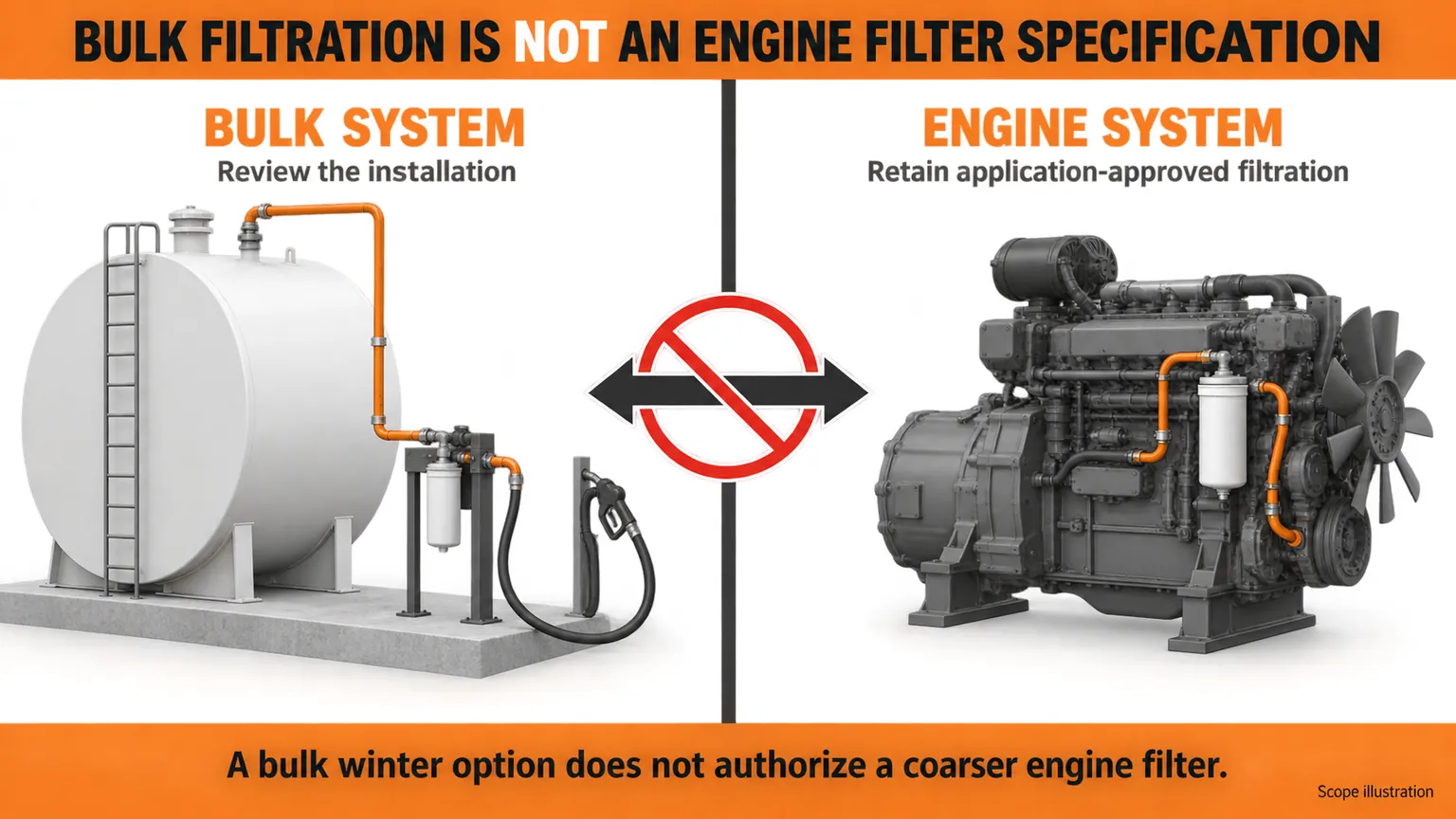
Advice for a storage or dispensing system has a different scope from advice for an engine's fuel system. Donaldson's F111538 filter-plugging sheet discusses a 7-micron anti-static winter option specifically for bulk filtration. It is not permission to fit a coarser engine filter, alter an engine's required filtration efficiency, or bypass a filter to maintain flow.
Scope illustration only, not an installation drawing. A bulk-system option does not change engine filtration requirements.
Keep the bulk-system review and the engine replacement order as separate purchasing decisions. For the engine, retain the application-approved element and configuration. For the bulk system, obtain an assessment of that installation from its responsible supplier. The bypass and restriction guide covers the separate equipment-side diagnostic boundary.
Plan application-correct spare filters around the fleet's service arrangements while the cause is investigated. For an Elecdura replacement-filter inquiry through the fuel-filter category, provide the engine or equipment identity, installed filter reference and position, and any approved substitution requirements. A parts quotation does not establish that the fuel batch is suitable for cold operation.
No. Pour point concerns loss of bulk flow under its test conditions; CFPP concerns passage through a specified test filter. A fuel that still pours is not necessarily suitable for an engine filter. Keep the property names attached to every temperature in a quotation.
It can make the receiving tank different from the incoming load. Tell the supplier about the existing fuel and planned additions, and ask for an assessment of the resulting mixture. Do not assume the new delivery certificate automatically represents the whole tank.
No. Record how and when the sample was taken and what happened before examination. A laboratory should decide what testing is appropriate. Its appearance alone cannot reconstruct the earlier cold exposure or identify every possible plugging material.
Ask what documented supply specification or other evidence supports the intended use, and whether additional testing is appropriate. Mark the missing information explicitly. A lack of a batch report is neither proof of bad fuel nor proof of adequate cold-weather performance.