ELECDURA NETWORK

Your Whole New Supply Chain For Heavy-Duty Parts
Whatsapp:
+86 18915027366
Phone:
+86 18915027366
Views: 0 Author: Site Editor Publish Time: 2026-06-11 Origin: Site
A China alternator exporter should be shortlisted against the exact order, not a company ranking or catalogue size. Establish who is selling, which party controls the quoted configuration, and what evidence connects the sample to later deliveries. Then compare equivalent electrical duty, interfaces, included components and commercial scope. An attractive price is actionable only when these requirements are defined; an unresolved fitment or identity question cannot be cancelled out by a good score elsewhere.
This guide is for heavy-duty parts distributors, fleet purchasing teams and equipment importers. Its twenty audit points are a buyer's working method, not a ranking of twenty companies or a certification scheme. The China focus concerns a cross-border supplier relationship; it does not imply that geography establishes manufacturing quality. Use the same disciplined evidence review wherever the physical producer and contractual seller are different organizations.
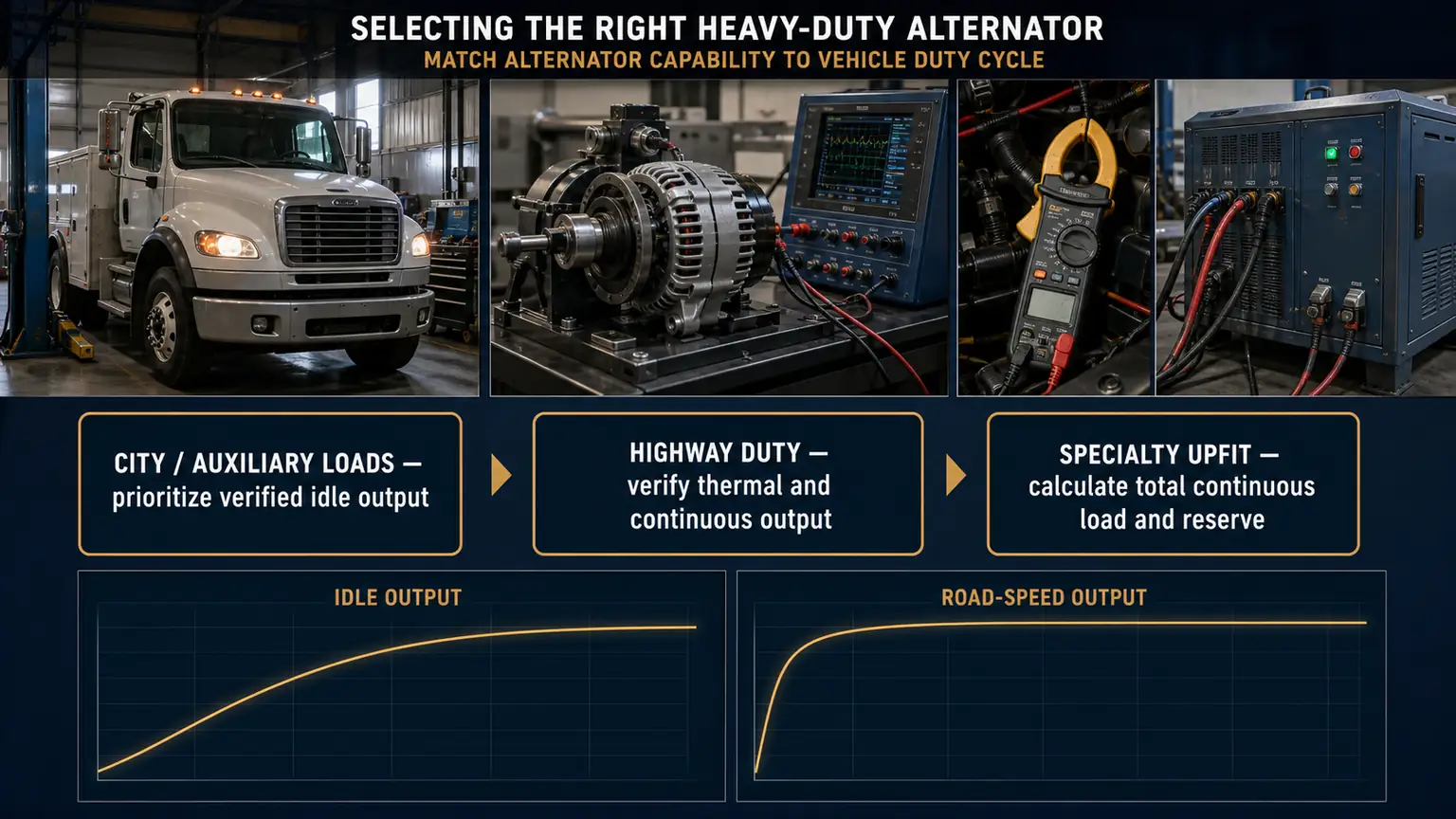
Illustrative review areas: electrical demand and operating duty come before supplier comparison. This historical explanation image is not a recorded vehicle or laboratory test.
Start with the business decision you need to make. A distributor stocking replacements for identified fleet configurations needs a different evidence package from a buyer consolidating a mixed range of slow-moving parts. State the expected order pattern, technical owner and receiving capability. Without that context, suppliers may quote different assembly scopes while appearing to answer the same enquiry.
Use three decision columns: confirmed, unresolved and incompatible. Confirmed means the supplied evidence answers the stated requirement. Unresolved means an item may be acceptable but a named document or check is missing. Incompatible means available evidence conflicts with the requirement. Record the evidence owner and next action beside each unresolved item so that follow-up produces an answer rather than another sales brochure.
Do not average a missing terminal-function drawing or uncertain seller identity into a percentage score. These are different risks from an inconvenient carton size. Ask the responsible technical or purchasing reviewer which decision is blocked: payment, sample shipment, installation or bulk release. A limited sample evaluation may proceed under controlled conditions while production approval remains open, but the restriction must travel with the sample and order record.
The U.S. Commercial Service's due-diligence guidance treats company background checks as a way to evaluate a potential partner. Such checks complement this product-specific audit; a business profile does not establish that a particular alternator fits a particular truck.
Keep one evidence sheet per quoted configuration, with shared company documents linked rather than copied into every row. The twenty points below are organized around decisions a buyer actually makes. They are not equally weighted, and completing a form is not the same as resolving its open questions.
Identify the legal seller named on the quotation and proposed order. Compare the registered name, trading name, invoice issuer and payment beneficiary, and ask for an explanation where they differ. Keep the explanation with the order rather than relying on a salesperson's email signature. An unexplained change of payment recipient needs independent confirmation through an established contact before payment is released.
Ask who performs manufacturing, assembly, procurement and final release for these specific part numbers. A supplier can occupy different roles for different ranges. Record the physical production or release location when the buying program requires it, and identify who can approve a technical deviation. A trader with clear responsibilities may be more useful than a claimed factory whose control of the quoted product cannot be explained.
Define whether the offer is for complete new alternators, remanufactured assemblies, components or a mixed range. Record any core-return requirement separately. Confirm which variants are actually being quoted rather than treating the catalogue's broad coverage as available inventory. If the buyer needs a complete assembly, a price excluding the pulley or regulator belongs in a different comparison column until the missing scope is resolved.
Review export-document examples relevant to the proposed shipment, with customer information removed. Ask which party prepares each document and who corrects discrepancies before dispatch. Evidence from another destination may show document-handling experience, but it does not establish that this order satisfies the receiving country's requirements. Assign destination questions to the buyer's competent logistics or compliance adviser instead of copying a previous transaction's paperwork.
Trace the supplier reference to the removed-unit identity and the vehicle or equipment record. Keep the full reference, source and revision rather than only the final search result. Ask whether a listed alternative is a direct replacement, a kit or an application-dependent option. Where the old label and vehicle record disagree, keep both visible and resolve the conflict before describing the quotation as an approved fit.
Describe the electrical configuration with its system voltage, polarity, return arrangement and regulator requirements. Request output information with the relevant speed and temperature conditions, especially where prolonged low-speed operation matters. A higher headline current alone does not demonstrate adequate performance in that duty. If two offers use different reporting conditions, mark the comparison incomplete rather than inventing a conversion between their advertised ratings.
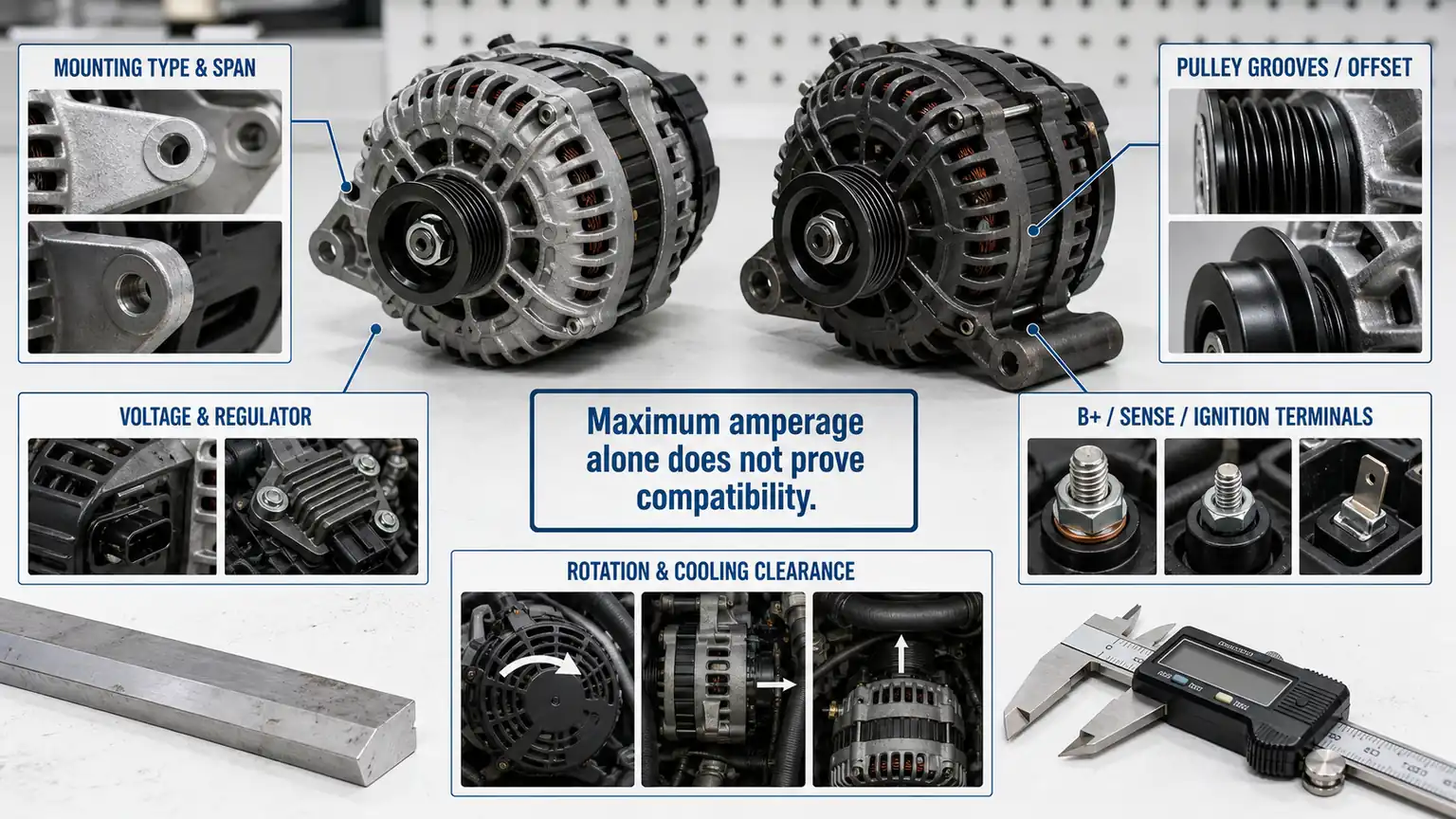
Compare mechanical interfaces using a part-specific drawing and clearly identified datums. Include the mounting arrangement, holes and offsets, pulley arrangement, belt line and available installation space. Photographs help locate a difference but do not supply an unmarked dimension. When a pulley transfer or spacer change is proposed, identify the applicable installation instruction and reviewer; do not hide the extra work in a footnote to the price.
Match terminal functions, not only connector shape. Ask for the applicable output, return, sense, warning and control information, including any adapter supplied with the replacement. A rear-view photograph is useful identification evidence but does not authorize energizing an unknown terminal. Refer unresolved functions to the technical source, keeping mechanical fit and electrical approval as separate findings until both are supported.
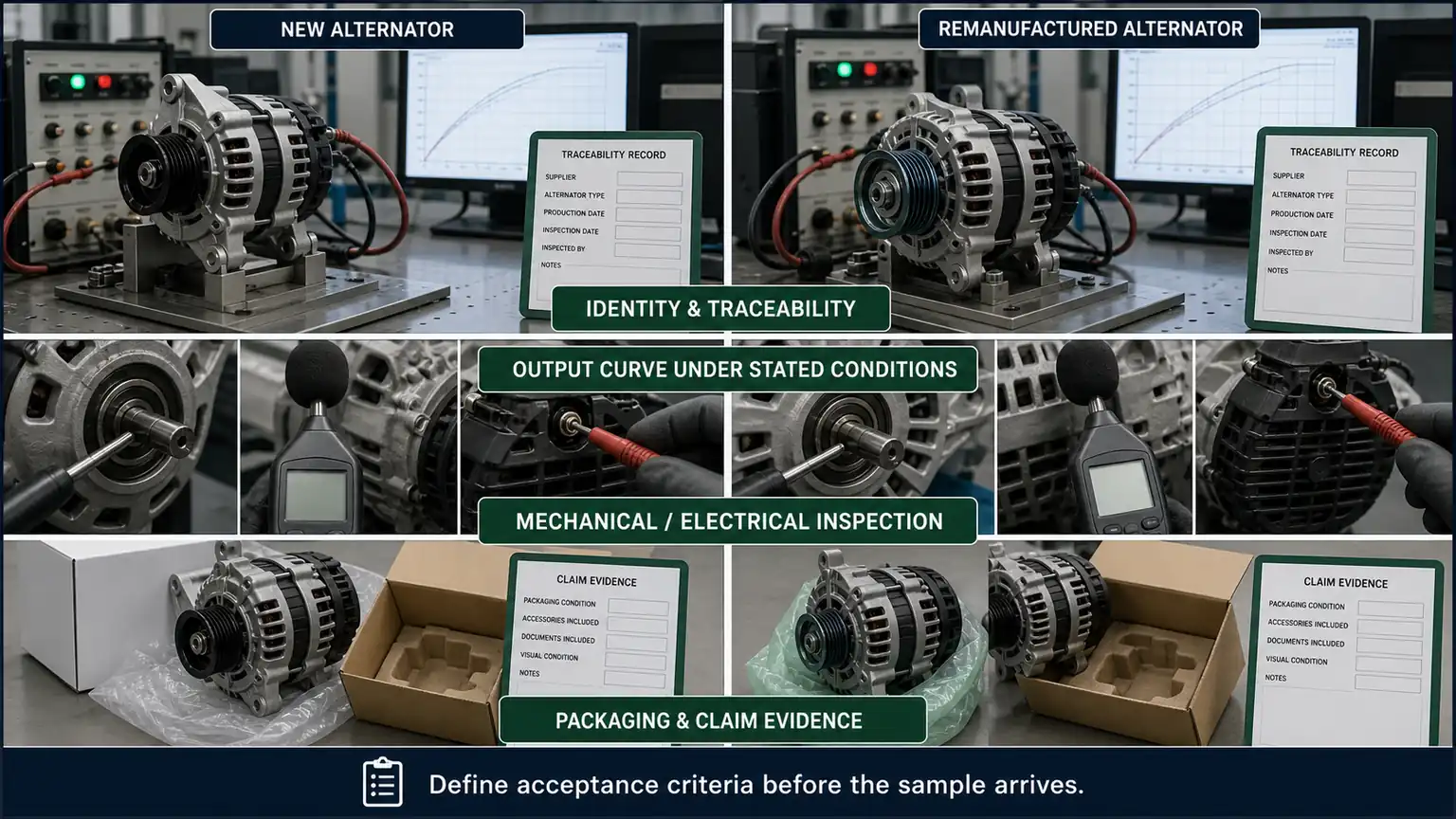
Give the sample an identity that links its label, carton, quotation and review record. If the sample is specially prepared or differs from normal production, record that fact before testing. Retain photographs of the delivered assembly rather than a catalogue image supplied afterward. Otherwise the team may approve one configuration and later compare a production shipment with an idealized picture that was never examined.
Record visible workmanship observations individually: damaged insulation, loose hardware, impact marks, missing protection or a surface condition needing explanation. Distinguish an observed defect from a cosmetic preference and from a feature that requires a drawing to judge. A clean casting and attractive coating are not evidence of internal component life; conversely, an unfamiliar appearance is not automatically a functional failure.
Connect each test record to the sample or defined lot and to the test conditions. Ask what functions were assessed, where measurements were taken and which acceptance criteria were used. A generic report bearing a family name should not be assigned to every item in that family. Where the buyer requires independently witnessed or third-party testing, make that scope explicit before ordering the sample.
Agree on a practical lot, date or serial identifier and how it appears on the product, packaging and shipping record. The purpose is to locate affected units if a later problem occurs, not merely to print a code. Test the traceability route with a sample carton: can the receiving team identify the corresponding order line and supplier release record without relying on one employee's memory?
Separate sample, pilot and repeat-order quantities, prices and timing assumptions. Ask whether the quoted minimum applies per reference, per configuration or across a mixed order. A low unit price may require a quantity the buyer cannot use, while a sample price may include one-time work. Compare the order you intend to place rather than multiplying a promotional sample price into an unsupported production estimate.
List the supplied items in plain language: alternator assembly, pulley if included, fan where applicable, regulator, terminal hardware, adapters and instructions. Identify anything transferred from the removed unit. Assign installation responsibility for additional parts before accepting a kit as a direct replacement. This prevents a cheaper incomplete assembly from appearing equivalent to a ready-to-install supply scope.
Review packaging against the actual product and distribution route. Look for protection of protruding terminals, restraint of the heavy assembly and separation from loose accessories. Confirm whether the carton represents one piece or a grouped quantity and how mixed references are distinguished. A sample package can establish a design to review, but a photograph alone cannot establish resistance to every transport hazard.
Agree how changes to the regulator, connector, pulley, housing, component source or packaging will be notified. Link notification to the approved configuration rather than an informal promise that quality will stay the same. Define who decides whether a change requires a new sample, a drawing review or only a documentation update. Unannounced substitution should not inherit approval because the sales reference remains unchanged.
Set the pilot's purpose before choosing its quantity. A fitment trial, a packaging assessment and a repeated-duty evaluation answer different questions and may need different resources. Agree the selected configurations, inspection scope, acceptance criteria and disposition of the evaluated units. Avoid treating an arbitrary small order as a statistical demonstration of long-term reliability or as approval of untested configurations.
Define how a nonconformance is reported and contained. Specify the identity, photographs, measurements and operating context needed to review a complaint, plus the parties responsible for responding. Keep commercial remedies and technical causation separate: an agreed replacement shipment does not itself establish why a unit failed. Any warranty period, response time or reimbursement must come from the actual agreement, not from this checklist.
Reconcile the commercial invoice, packing list, carton marks and agreed order lines before dispatch. Review quantities, assembly descriptions and identification consistently; investigate differences rather than editing one document to conceal them. Confirm required origin or destination documents with the responsible specialist. Record whether a shipment is prepared, collected, departed or delivered so that a loading photograph is not used as proof of every later event.
Give receiving staff a usable release instruction tied to the approved record. Identify the checks they can perform, the evidence that requires a qualified technician and the conditions requiring quarantine. Keep uninspected, accepted and held quantities distinguishable. A receiving signature establishes only the checks actually completed; it should not silently turn a visual carton check into electrical, application or lifetime approval.
The useful question is not simply whether a business uses the word factory. It is whether the proposed relationship gives the buyer control over the required product and changes. A producer may purchase some subassemblies; an export supplier may coordinate several producers. Map responsibilities for the quoted range instead of making a company-wide assumption from a single workshop photograph.
Choose a representative quoted reference and ask how its specification moves from enquiry to purchasing, assembly, inspection and dispatch. Request a redacted example showing how revision information is passed between these steps. The buyer is looking for a coherent route and responsible parties, not access to unrelated customer records or a claim that every operation is performed in-house.
Record each entity's role and the supporting relationship. A seller may legitimately quote goods made elsewhere, but that does not transfer another company's certificate, test capability or production history to the seller. Ask which contractual party answers a configuration question and which technical party can supply evidence. If no one owns the answer, the problem is an uncontrolled responsibility gap, not merely a missing logo.
Visual key: compare the mounting interfaces, pulley arrangement and documented connections. This historical explanatory image is not a dimensional drawing or evidence of a tested shipment.
Ask when and where a photograph was taken, which organization controls the location and how it relates to the quoted order. A warehouse picture can illustrate handling space without proving stock availability for your references. A packing photograph can show the visible condition of particular goods without establishing the performance of the alternators inside the cartons.
The supplier should not have to expose another customer's names, addresses or order details to demonstrate a process. Ask for a suitably redacted example that preserves the relationship between the product identity, inspection record and release decision. Keep its purpose clear: an example explains the process, while your own order needs its own records. This approach tests whether the evidence chain is usable without treating unrelated customer information as a sales credential.
Handle certificate claims separately from product approval. IAF CertSearch's official FAQ explains that its database concerns accredited management-system certification, not product certification. Relevant fields include certificate status, standard, scope, certified locations, certification body and accreditation body. These distinctions matter when a supplier presents a certificate as evidence for the business relationship.
Write down the claim being evaluated before checking the document. Is the supplier claiming that the contractual seller operates a certified management system, that a named production site is covered, or that the alternator itself has a particular approval? Those are different assertions. Compare the entity and location with the supplier-role record, and retain the verification date and unresolved differences.
Do not label the certificate fake from a failed search alone. Request the complete document and a verifiable issuer contact, then ask for clarification of the name, scope or status. Keep the claim unresolved while that clarification is pending. Equally, a matching database entry is not permission to expand its scope to every product in the catalogue or to an unlisted production location.
A certificate belongs in the organizational evidence file. The sample still needs an identity, a defined configuration and the checks relevant to its intended application. Do not replace a missing output record, drawing or connector explanation with a certificate copy. Conversely, a successful fitment trial says little about the supplier's organization beyond the specific work and units actually reviewed.
Organize the enquiry around a defined assembly and unresolved questions. Use the Elecdura heavy-duty alternator category to identify the broad product family, then supply the full reference and label, vehicle or equipment details, photographs and quantity. Keep verified information distinguishable from an estimate or a field that the workshop has not yet checked.
Use front, rear, mounting and label photographs from the same removed unit where possible. Label the viewpoints and explain if photographs show different revisions. Include the installed belt arrangement and access constraints when they affect selection. For changed electrical loads, describe which equipment operates together, the relevant engine-speed condition and why the existing configuration is being reconsidered.
A replacement request seeks an approved equivalent for the existing duty. An upgrade request changes the required capability and may affect the drive, wiring, protection or control arrangement. Keep these requests separate even if both begin with the same old part number. Otherwise one supplier may quote a direct replacement while another assumes an engineered conversion, producing an apparently competitive but technically misleading price comparison.
DENSO's alternator replacement guidance identifies housing and pulley offsets, pulley type, mounting locations and terminal configurations as comparison points. Use that principle to ask for evidence appropriate to your assembly; do not apply another vehicle's dimensions or installation settings as universal alternator specifications.
Build a line-by-line comparison from the quotations actually received. Separate the alternator assembly from optional accessories, sample evaluation, packaging and delivery scope. Mark a blank field as unanswered rather than assuming it is included. If a price depends on a larger order or a mixed-reference minimum, keep that condition beside the price so it cannot disappear when the offer is circulated internally.
Consider a hypothetical enquiry answered by one offer for an alternator with its specified pulley and another for a bare-shaft assembly. The second may still be commercially attractive, but its buyer must arrange a suitable pulley, controlled fitting and responsibility for the completed configuration. Request revised comparable offers or record the additional work explicitly. This example does not assign a cost or claim that either supplier's product is better.
Use the same discipline for new, remanufactured and other declared supply conditions. Do not let an ambiguous description become an assumed condition of sale. Ask what the proposed condition means for the exact offered line, what identification accompanies it and which evidence supports the claim. Keep unrelated marketing statements out of the comparison; a broad company brochure does not resolve an unanswered order-line question.
A supplier may answer a mixed enquiry convincingly for some references and incompletely for others. Grouping them in one shipment does not make their technical evidence equal. Maintain separate status for each line and identify which documents can genuinely be shared. Business-identity evidence may apply across the relationship, while a drawing, regulator explanation or output record normally belongs to a specified configuration.
Decide whether the resolved lines can proceed independently without changing the commercial arrangement. Ask the supplier to confirm the revised quantities and scope instead of informally dropping unresolved lines from an old quotation. If consolidation is essential to the buyer's plan, record that dependency. This allows purchasing to make an informed decision about timing without turning an incomplete technical answer into approval of the entire range.
For stock replenishment, retain the approved identity in the buyer's item record so a future purchaser does not restart from a vague family name. Keep unresolved or rejected alternatives outside the approved substitution list. This is especially useful when several staff members discuss the same enquiry with different sales contacts: one controlled decision record prevents a provisional suggestion from becoming a warehouse instruction.
Before evaluation, agree what will count as success and who may release the result. Preserve the sample's supplied configuration, including packaging and loose accessories. If an installer changes a pulley, connector or other component during the trial, document that change so the recorded approval does not accidentally describe the untouched shipment.
Identity checks establish which assembly arrived. Bench assessment addresses the functions and conditions included in that assessment. An installed trial addresses the vehicle configuration and duty actually observed. These records should connect, but none automatically answers all three questions. For example, an acceptable bench result does not document an untested connector function or prove that every later production unit has the same configuration.
Suppose a sample matches the drawing and performs acceptably in the agreed trial, but its carton label omits the purchase-order reference. A buyer might approve the technical configuration while holding packaging release until the labeling is corrected. This is a decision example, not an Elecdura case. It illustrates why separate findings produce a useful action plan instead of an unexplained overall pass or failure.
A sample establishes a defined review baseline. This historical explanatory image does not document measured output, a particular facility or acceptance of a production lot.
Receiving should compare the delivered identity and agreed visible interfaces with the approved record, then apply the inspection plan appropriate to the order. Escalate an unexplained changed regulator, connection or mounting feature. A packaging-only correction can be reviewed at its own scope; it need not trigger unrelated tests if no product change occurred. The review should follow evidence of change, not habit.
Separate the affected units and preserve the received labels, packaging and lot references before asking for clarification. State what differs from the approved record: a terminal arrangement, pulley, part marking or supplied accessory. Avoid describing an entire lot as defective when the only established fact is an identity discrepancy. Equally, do not blend the unexplained units into accepted stock because their external housings look similar.
Ask the supplier to connect each variant to an order line and explain whether a controlled change occurred. The responsible reviewer can then decide which checks are affected and whether the existing approval remains applicable. Keep the quantities and final disposition traceable, including any corrected documents or replacement items. This closes the loop between the original audit and the shipment actually received rather than treating supplier qualification as a one-time exercise.
This purchasing method does not replace the vehicle service procedure, a buyer's formal supplier qualification system or application-specific engineering. Use qualified technical review when an alternator change affects electrical controls, drive loading or unfamiliar operating conditions. Legal, payment and destination-compliance questions require the appropriate professional review; this article does not prescribe contract terms or certify any supplier.
For an Elecdura enquiry, send the reference list, application record, photographs, quantities, destination and the audit items that remain unresolved through the Elecdura contact page. Ask what configuration and supporting documents are available for the exact quotation. If the order also covers starting-system parts, keep the requirements for the heavy-duty starter motor range in separate lines rather than assuming alternator approval transfers to another product family.
The following two situations need an explicit agreement about the evidence the buyer will receive. They cannot be resolved by completing the audit checklist alone.
Send both passages back together, identifying the document revision, part number and disputed field. Ask the technical owner to explain the difference and issue a consistent record. Do not silently edit a translated copy to make it match the quotation: that can hide whether the problem was translation, a superseded drawing or a different assembly.
Keep the original wording and ask for a labelled feature or terminal diagram. An unexplained translated word such as “output” may refer to a current rating, a connection or a measured result. Require the unit and applicable condition beside the value. Ask both parties to identify the document version they will use for technical review and receiving; this is a proposed document-control step, not a statement about which language has legal priority.
Identify which information is genuinely needed for your decision rather than demanding the entire internal design. Ask whether the supplier can provide a controlled interface drawing, a redacted extract or a documented measurement of the relevant sample. Such an alternative is useful only if it identifies the quoted configuration and still shows the feature, datum and applicable requirement being assessed.
If the alternative still leaves a critical interface undocumented, keep that approval item unresolved. A confidentiality explanation may be legitimate, but it does not establish compatibility. Where an independent inspection is proposed, agree beforehand what the inspector will check and what usable findings the buyer will receive. Do not assume the inspection can answer a design question outside its scope or that the buyer will automatically receive proprietary drawings.