ELECDURA NETWORK

Your Whole New Supply Chain For Heavy-Duty Parts
Whatsapp:
+86 18915027366
Phone:
+86 18915027366
Views: 0 Author: Site Editor Publish Time: 2026-07-20 Origin: Site
Wheel bearing replacement should begin by identifying the wheel-end design and confirming which components are damaged. A conventional adjustable hub, a spacer-controlled pre-adjusted hub and a unitized bearing assembly do not share one installation procedure. Noise, heat or lubricant leakage warrants inspection, but does not independently prove bearing failure. The repair may involve an approved bearing set and seal, a service kit for a pre-adjusted hub, or a complete unitized assembly. Correct selection also depends on the hub, spindle, lubrication and retaining hardware; fitting a new bearing cannot restore a damaged bearing seat or correct brake drag.
Use the axle and hub references together with the manufacturer's parts and service information. Hubcap shape, visible nut style or a seller's description of "preassembled" is insufficient. Previous conversions or repairs can make the installed configuration different from the original vehicle specification.
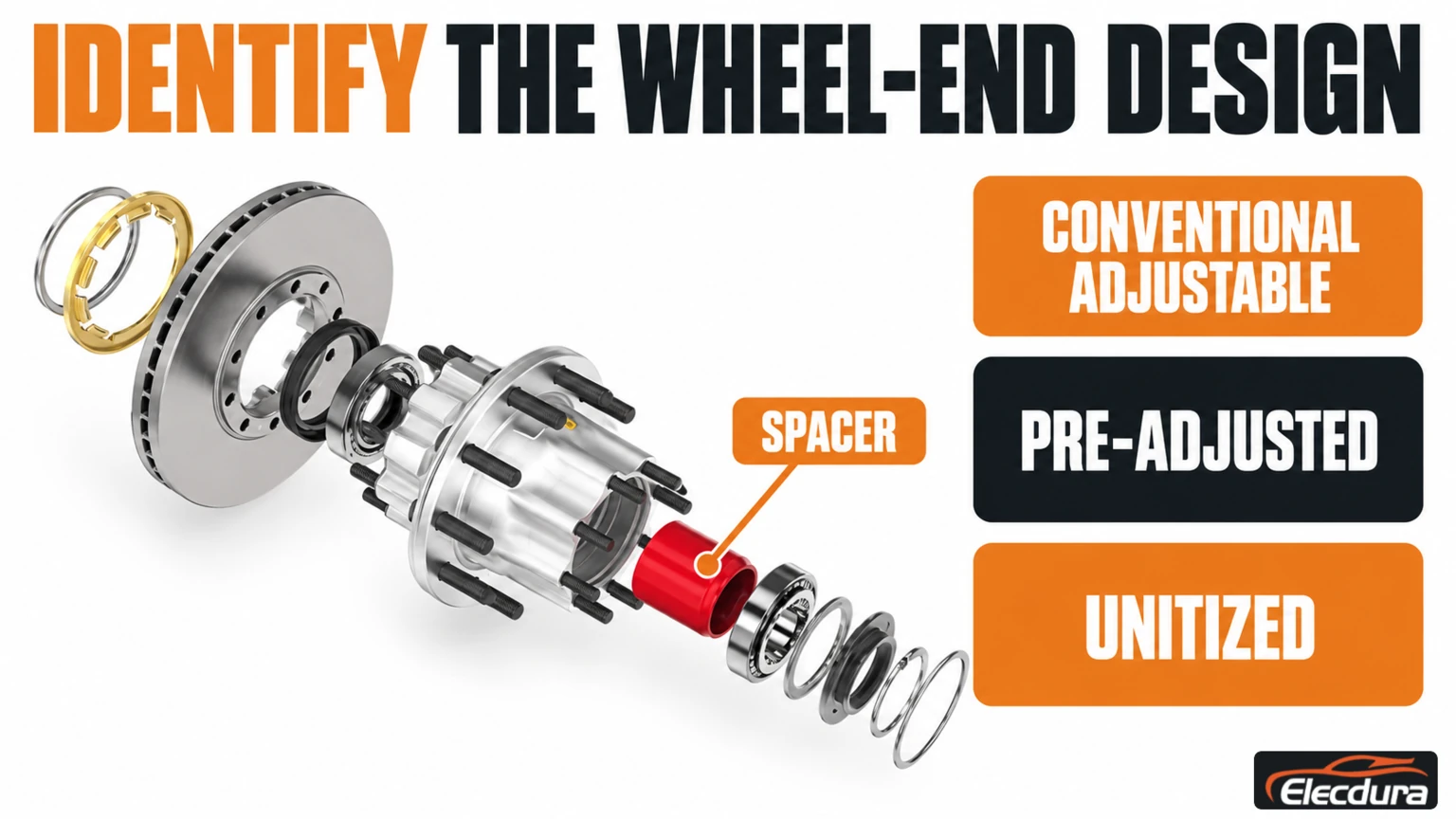
Wheel-end design | How the bearing setting is established | Service boundary |
|---|---|---|
Conventional adjustable tapered-roller arrangement | The specified adjustment and retention system establishes the bearing setting. | Bearings and seals are serviceable when the hub and spindle remain within limits. Use the procedure for the actual nut system. |
Spacer-controlled pre-adjusted hub | Matched component geometry and a precision spacer establish the setting when the specified retention procedure is completed. | Some designs are field-serviceable with approved bearings, spacer and seals. Pre-adjusted does not mean nonserviceable. |
Unitized bearing arrangement | The bearing package is factory-set and supplied as the designated service assembly. | Do not dismantle and rebuild its internal bearing package. Replace the specified hub or bearing assembly when required. |
Pre-adjusted and unitized are not synonyms. For example, a spacer-based pre-adjusted hub may permit replacement of specific service components, while a sealed unitized package has a different repair boundary. Identify the manufacturer's product family before deciding what can be opened, reused or adjusted.
Conventional adjustable, pre-adjusted and unitized designs require different procedures.
Record the affected axle and wheel position, operating conditions, recent brake work and lubrication history. Rumble, vibration or heat can also involve tires, brakes or driveline components. If brake drag is suspected, the brake caliper replacement guide separates hydraulic and air disc checks.
Qualified technicians should assess movement using the method appropriate to the hub, not a universal shake test. A reading needs its measurement location and test conditions. Neither normal-looking play nor quiet unloaded rotation proves that the bearing is satisfactory under road load.
Do not touch a hot hub to judge its temperature. Secure and support the vehicle as specified before inspection or removal, and support heavy wheel-end assemblies with suitable handling equipment. A jack alone is not an adequate working support.
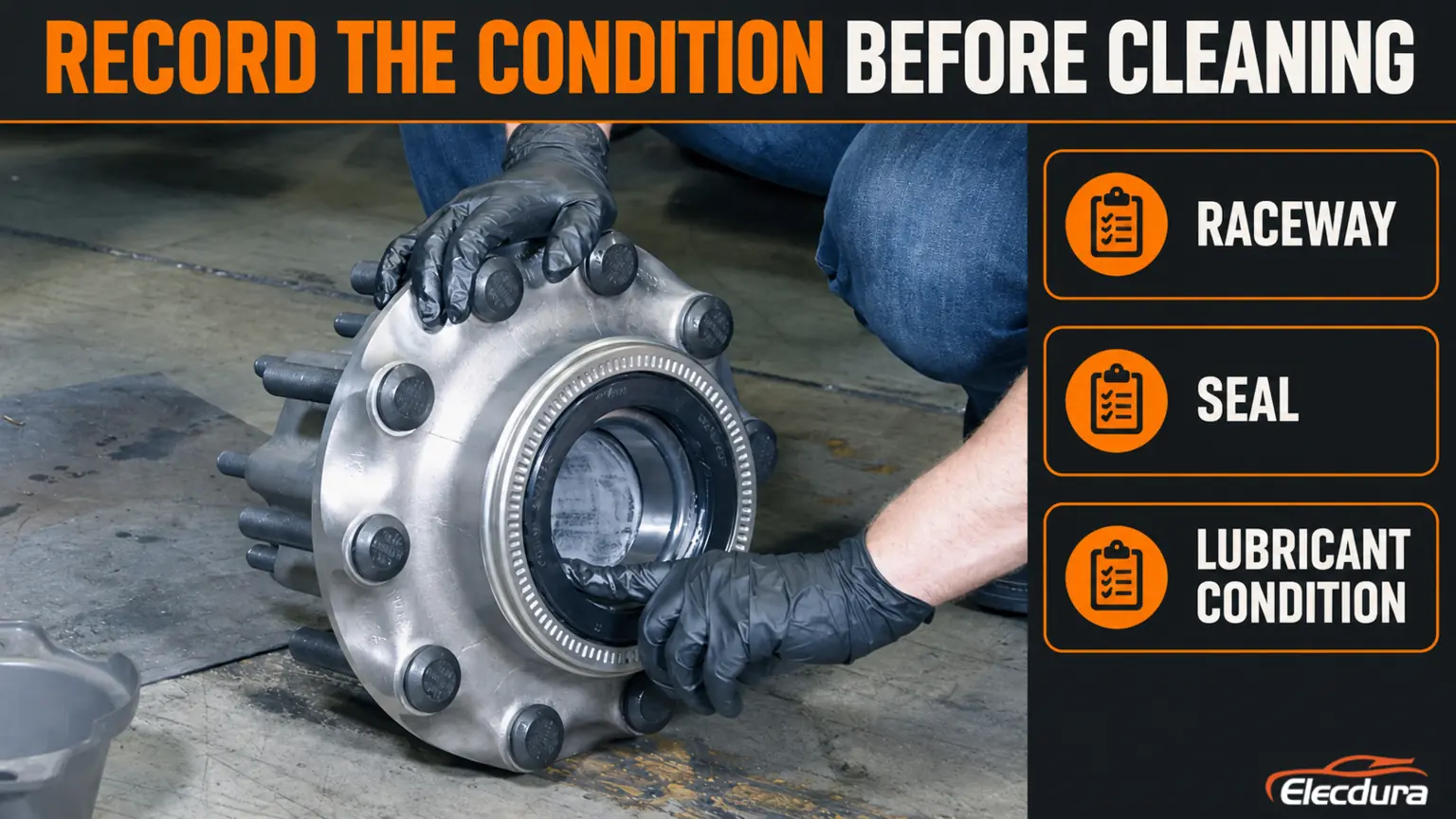
Before cleaning, preserve photographs of leakage, lubricant condition and component positions. Where disassembly is permitted, keep the inner and outer bearing parts, cups, spacer, seal and retaining hardware identified by wheel position. Record water, debris and wear patterns rather than immediately discarding them. Do not open a unitized package merely to obtain these photographs.
Inspection of serviceable parts should distinguish raceway or roller damage, cage damage and corrosion from harmless surface appearances using the bearing manufacturer's criteria. Discoloration or a photograph of debris does not establish the original cause by itself. Retain relevant samples when further analysis is warranted.
Record component and lubricant condition before cleaning when the specified hub design permits inspection.
Confirmed finding | Repair direction | Related check |
|---|---|---|
Damaged bearing in a serviceable hub with acceptable seats and spindle | Replace the specified bearing components as an approved cup-and-cone set, with other required service parts. | Determine why the bearing was damaged before assembly. |
Loose or spun cup, damaged hub bore or distorted seat | Assess hub replacement under the hub manufacturer's rejection criteria. | A new bearing does not restore the required housing fit. |
Damaged spindle, threads or seal journal | Obtain the axle manufacturer's repair or replacement direction. | Do not compensate by tightening harder or adapting the retention hardware. |
Seal leakage without confirmed bearing damage | Inspect lubricant loss, contamination and the bearing condition before defining the repair. | Check the seal journal, venting and other relevant causes; leakage is not proof that every bearing has failed. |
Incorrect components in a pre-adjusted hub | Restore the approved bearing, spacer and retention combination or replace the specified assembly. | Do not assume a conventional bearing with similar dimensions has the required tolerances. |
Failed unitized bearing package | Replace the manufacturer's designated service unit. | Inspect the mounting and connected components; do not attempt internal field rebuilding. |
Structural damage, severe overheating or contamination can extend beyond the bearing. Define the repair after inspecting the wheel end, rather than pricing a bearing alone and discovering the damaged hub or spindle during installation.
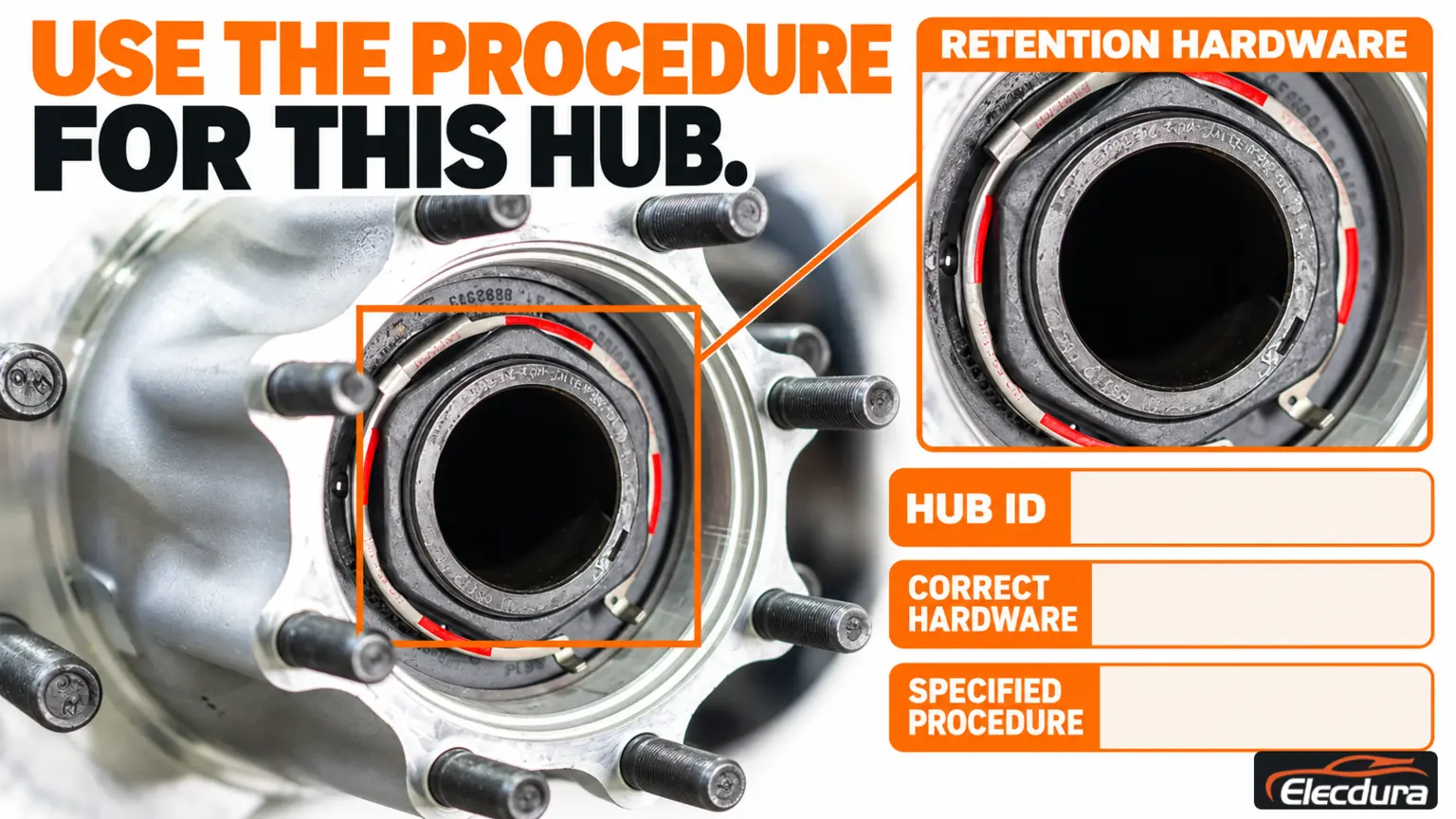
Use the axle, hub and retention-system instructions to establish the required setting. The procedure may include seating, adjustment, locking and a final measurement, but its sequence and criteria depend on the design. A remembered nut back-off angle or a torque value from another axle is not a specification.
A precision spacer removes the conventional manual adjustment step in designs built around it; it does not eliminate correct assembly, tightening or locking. Preserve the specified component stack and use its installation procedure. Do not add a conventional back-off step when the pre-adjusted system's instructions prohibit it.
Special bearing tolerances and spacer dimensions are part of that system. Omitting the spacer or substituting ordinary components is not routine bearing replacement and must not be treated as an undocumented conversion.
The internal setting is established within the supplied bearing package. Installation fasteners still require the specified tightening and securing procedure, but loosening a retaining nut to "adjust the bearing feel" is not an approved substitute. Do not open, repack or reset a sealed package that is designated nonserviceable.
Across all three arrangements, tightening completion is not the same as documented acceptance. Verify the required retention and inspection results before the wheel end returns to service.
Identify the exact hub and retention hardware before applying the specified service procedure.
For tapered-roller bearing replacement, identify both the cone assembly and its cup. Do not combine a new cone with a worn cup or mix unapproved parts merely because their basic dimensions match. Internal geometry and tolerances matter, especially in spacer-controlled systems.
Application identity: axle, hub reference, wheel position and relevant production or conversion details.
Bearing specification: complete inner and outer references and the approved cup-and-cone combinations.
Hub architecture: adjustable, pre-adjusted or unitized, including the required spacer where fitted.
Sealing and lubrication: seal reference, journal condition, hubcap arrangement and specified lubricant.
Retention: nut system, locks, washers and any single-use hardware requirements.
Other interfaces: wheel and brake mounting, plus wheel-speed sensor or tone-ring requirements where integrated.
A package marked "bearing kit" does not establish that the required seal, spacer or locks are included. Confirm the contents and application rather than using photographs of loose parts as a complete specification.
Keep replacement parts protected until assembly and use the approved tools for bearing, cup and seal installation. Do not spin bearings with compressed air. Prevent dirt entering open hubs and avoid transmitting installation force through rolling elements in a manner not permitted by the procedure.
Follow the specified lubricant type, amount and filling method. Do not assume that a pre-adjusted hub is supplied with every lubrication requirement already satisfied, and do not add lubricant to a sealed unitized package contrary to its instructions. A previous oil or grease choice is not proof of the correct specification.
Confirm seating, seals, retention and lock engagement. Perform the prescribed rotation and bearing-setting checks, with measured endplay where required by the particular design. Keep brake drag separate when interpreting rotation resistance. Restore relevant sensor connections and inspect for leakage and interference.
Record the installed references, lubricant, procedure used and actual inspection results. Any controlled operational check and follow-up inspection must use the vehicle's requirements. A quiet first run does not prove correct retention, and no generic temperature, distance or re-tightening rule applies to every wheel end.
No. Brake drag, lubricant problems, adjustment errors and other wheel-end faults can produce heat. Compare observations under relevant conditions and follow the hub inspection procedure. Smoke, severe heat or abnormal movement requires safe professional assessment, not continued driving to see whether the symptom clears.
No. Spacer-controlled pre-adjusted hubs may have approved serviceable bearings and seals. A unitized bearing package is factory-set and must not be internally dismantled for routine bearing replacement. Identify the exact hub before deciding which parts can be serviced.
Do not install a new cone against a worn or damaged cup. Use the approved matched replacement set and inspect the hub seat. Matching basic dimensions is insufficient, and a pre-adjusted assembly may require specially toleranced bearings and its specified spacer.
No. The correct components must be seated and lubricated, the retention device secured and the required checks completed. Some designs require a measured final setting; others prescribe a different verification process. Torque alone does not identify the hub type or establish complete installation quality.
There is no universal pair-replacement rule for every truck hub. Inspect the opposite side and follow the axle manufacturer's policy. Shared contamination or service errors may justify wider action, but define that scope from the findings rather than assuming either side is automatically good or bad.
Provide axle and hub identification, wheel position, bearing and seal references, readable markings, retention-system photographs, lubricant information and the confirmed fault. State whether an approved bearing kit or a complete unitized assembly is required.
Send those details and the quantity through the Elecdura contact page for review of the sourcing request. Availability and compatibility require confirmation; retained measurements and photographs support identification but do not replace the manufacturer's application specification.
Image references: ConMet. Illustrations adapted with cropping, annotations and AI-assisted composition.