ELECDURA NETWORK

Your Whole New Supply Chain For Heavy-Duty Parts
Whatsapp:
+86 18915027366
Phone:
+86 18915027366
Views: 0 Author: Site Editor Publish Time: 2026-07-24 Origin: Site
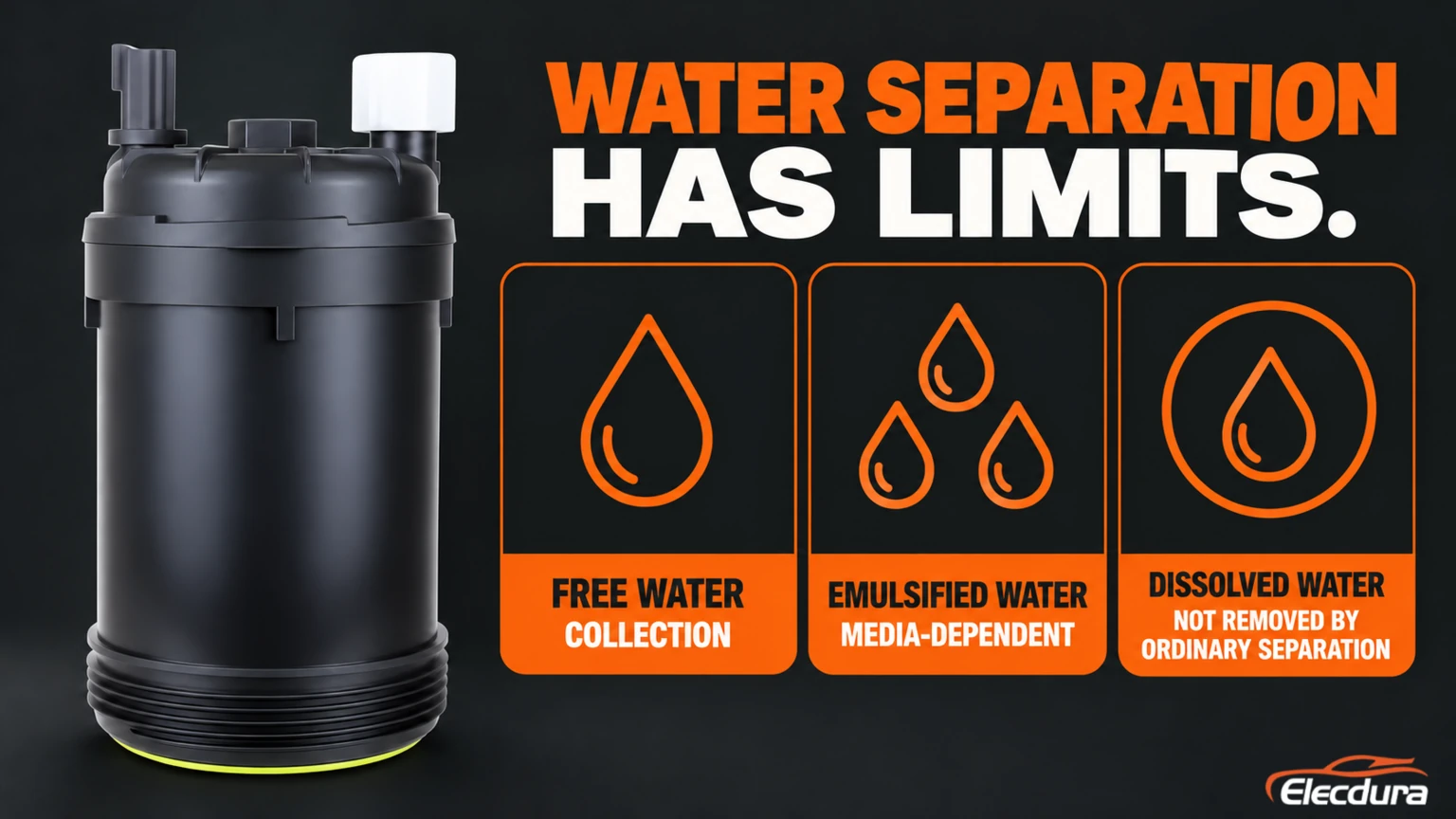
A fuel water separator collects water that its media and assembly can separate from diesel fuel; it does not guarantee that every form of water is removed. Free-water droplets are different from finely dispersed emulsified water, and dissolved water is not removed simply by draining a bowl. Maintenance therefore combines the prescribed inspection and drain routine, prompt response to water warnings, and investigation of recurring contamination. Before replacing an element or sensor, identify the installed assembly and the actual finding. Draining, filter replacement and restoration of fuel supply may require different procedures on the same engine.
Many separators use media that encourages droplets to merge into larger drops, followed by separation into a collection area. Some incorporate additional water-repellent layers. The mechanism and capability belong to the specific element and housing, not to the generic name "fuel filter."
Water condition | What it means | Separator limitation |
|---|---|---|
Free water | Distinct droplets or a separate water layer rather than water dissolved in the fuel. | A suitable separator can collect it, but performance and collection capacity still depend on the design and operating conditions. |
Emulsified water | Fine water droplets dispersed through the fuel that do not readily settle into a separate layer. | Removal depends on the media, fuel properties and test conditions. Not every separator removes emulsified water equally. |
Dissolved water | Water held in solution, without a separate droplet or layer. | Ordinary mechanical separation does not remove it as collected liquid. Changing conditions can cause some water to leave solution. |
Flow, temperature, fuel composition, additives and element condition can affect separation. A particle-filtration micron rating alone does not establish water-removal performance. Equally, an empty collection bowl does not prove that the fuel elsewhere in the system is free of water.
Use the engine's required filtration arrangement and the element manufacturer's relevant performance data. A removal percentage from another product or laboratory condition is not a guarantee for the installed separator.
Water separation depends on water form and media; ordinary separation does not remove dissolved water.
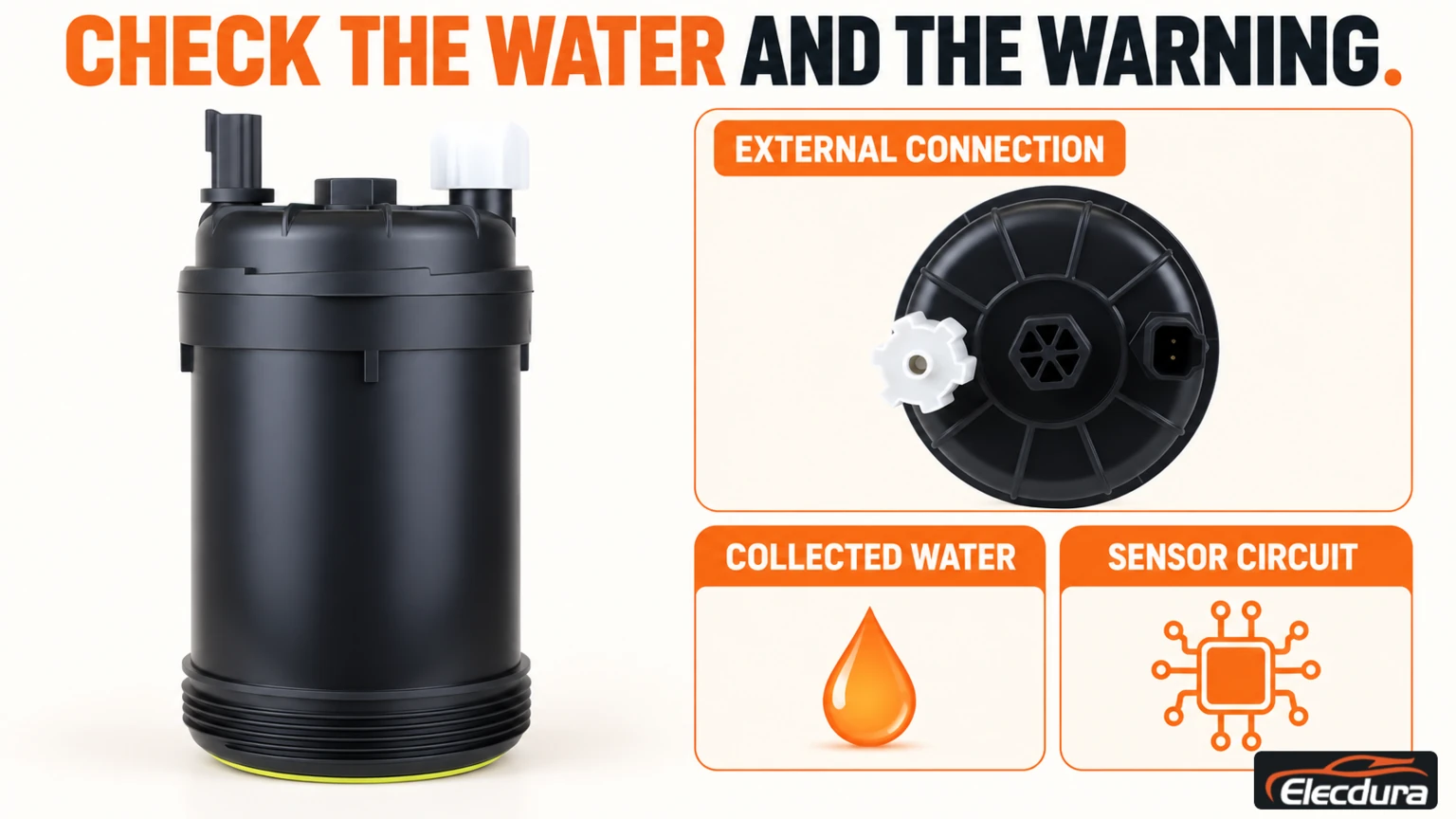
Follow the vehicle's warning instructions promptly, including any required stop or shutdown action. Do not keep operating simply to see whether the warning disappears. The sensor generally monitors a designated collection area; it is not a measurement of every part of the fuel system.
Identify which separator and sensor generated the alert. Check the collected fluid using the applicable service procedure and record whether water was actually found. The warning and the observation should be considered together, not used as reasons to replace the element automatically.
If the warning remains after correct draining, investigate renewed water accumulation, contamination on the sensing area, damaged connectors, wiring faults or an incompatible sensor as appropriate to the design. Sensor types and circuits differ. Do not disconnect the sensor, bridge its connector or substitute a generic electrical test to silence the warning.
Collected water and the warning circuit require separate checks under the specified procedure.
Start with the engine or vehicle manufacturer's inspection and draining requirements. Use contamination history to identify a need for earlier attention, not to extend the required schedule without approval. Some assemblies provide visible bowls, some have opaque collection areas, and some use automatic drains; they require different checks.
For manual service, follow the specified shutdown and fuel-system precautions, control ignition sources and use a suitable collection container. The correct sequence depends on whether the assembly is on the suction or pressure side and on its venting and priming arrangement. Opening the wrong connection can introduce air, release fuel or damage components.
Use only the designated service drain and the relevant instructions. Do not loosen common-rail injection lines as a means of draining or bleeding the separator. Retain a sample when investigation requires it, without returning drained fuel to the clean system.
After draining, restore seals and connections as specified, perform any required priming and check for leakage and normal warning operation. Clear-looking fuel is not a laboratory cleanliness result. Neither a universal drain duration nor a fixed quantity is suitable for every assembly.
A separator manages water that reaches it; it does not repair a leaking tank or remove contamination from a fuel-delivery system. Repeated findings require a change in the investigation, not simply more frequent filter purchases.
Finding | Appropriate next action | What not to assume |
|---|---|---|
Collected water found during a prescribed check | Complete the approved drain procedure, record the finding and monitor according to the service requirements. | It does not automatically mean the element or sensor has failed. |
Water returns rapidly or affects several vehicles after a common delivery | Identify the fuel source, affected vehicles and storage or dispensing equipment; arrange appropriate sampling and contamination control. | Replacing each vehicle's separator does not correct a shared supply problem. |
Warning remains without confirmed water at the sensing point | Use the model-specific sensor and wiring diagnostics while checking the collection area again. | A warning is not proof that every filter needs replacement or that bypassing the sensor is acceptable. |
Unusual sludge, cloudiness, debris or recurring restriction | Assess fuel condition, element findings, temperature and tank history; obtain appropriate analysis where needed. | Appearance alone cannot distinguish water, wax, microbial contamination or other material. |
Running problems accompany confirmed contaminated fuel, or metallic debris is found | Seek the engine manufacturer's contamination procedure and assess the affected circuit before further operation. | A fresh filter does not establish that downstream pumps and injectors are undamaged. |
Keep the vehicle identity, refueling location, delivery batch where known and service findings together. Isolate suspect fuel supplies where appropriate and involve the fuel supplier or responsible workshop. Do not add an unapproved dispersant simply to make visible water disappear; changing its appearance does not remove it from the fuel.
For loss of power or supply restriction, the clogged fuel filter symptoms guide addresses competing causes. A water-management complaint and a restricted filter can coexist, but neither diagnoses the other.
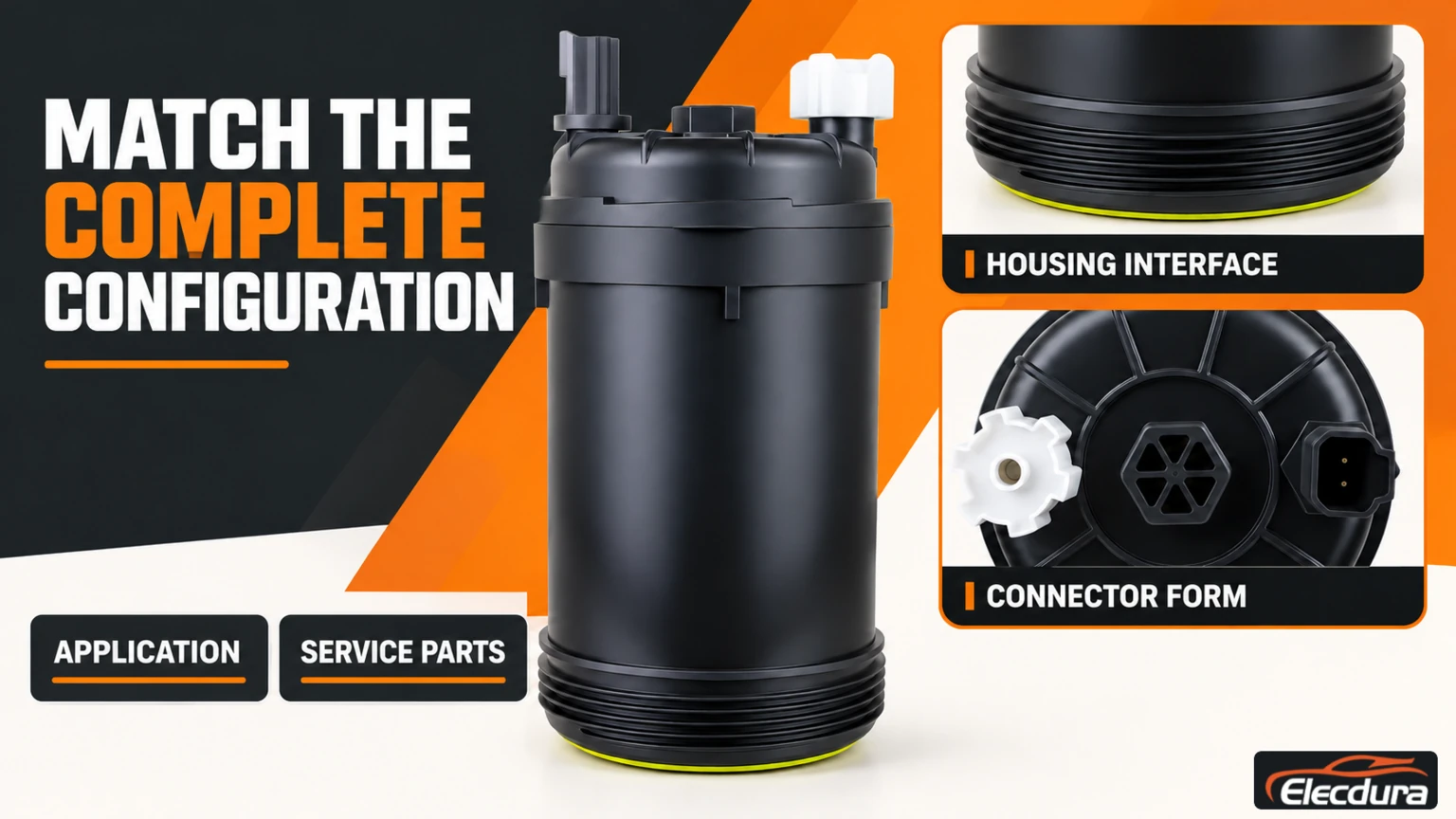
A replacement must preserve the intended flow path, sealing and water-detection functions. A filter that screws onto the head is not necessarily the correct replacement.
Element: verify the original reference, engine application, filtration stage and specified particle and water-separation performance.
Head and flow arrangement: identify suction-side or pressure-side installation, flow direction, ports and any primer or check-valve functions.
Seals and bowl: confirm gasket locations, dimensions and approved materials, bowl attachment and collection configuration.
Drain: match the specified valve or plug and its sealing arrangement; confirm what is included with the element.
Sensor and optional equipment: verify water-sensor compatibility and any heater or wiring requirements, not just connector shape.
Do not silently omit a reusable bowl or sensor from a quotation, or assume a new element includes every seal and accessory. Review the complete configuration against the installed housing and engine parts information. The fuel water separator component-matching guide provides the separate overview of filter and assembly roles.
Match the complete application configuration and the specified service parts.
After service, follow the engine and separator instructions for filling, priming and removing air. Do not automatically prefill a new filter with unfiltered diesel, especially through an outlet that feeds the clean side. Equally, do not assume every manufacturer specifies dry installation: some assemblies have a defined, controlled housing-filling procedure.
The method permitted after draining may be insufficient after an element change or a run-out-of-fuel event. A hand primer, an electric priming cycle or a dedicated service tool is used only where the relevant instructions specify it. Do not rely on prolonged repeated cranking to overcome an unprimed fuel circuit.
Confirm correct sealing, restored supply and any required warning checks before return to service. Hard starting after maintenance should prompt a review of priming, seals and connections, not an immediate assumption that the high-pressure pump has failed.
No. Free-water collection, emulsified-water removal and dissolved water are different issues. Confirm the element's specified capability under the relevant conditions. Draining the collection area does not demonstrate that the tank or downstream system is completely free of water.
Use the vehicle's maintenance schedule and warning instructions, with earlier attention when contamination requires it. Do not copy an interval from another separator or extend the specified schedule because the bowl looks clear. Automatic-drain systems also need their prescribed checks.
Water may be returning, or the sensing area, wiring or sensor may require attention. Confirm the actual fluid condition and then use the correct electrical diagnostic procedure. Do not unplug the sensor as a repair or assume that an apparently empty bowl proves the warning is false.
No. Follow the exact system's instructions, which may require dry installation, controlled housing filling or a dedicated priming method. Never pour unfiltered fuel into the clean-side outlet or use another engine's filling procedure merely because the filter looks similar.
Not necessarily. It may be collecting water from an ongoing tank, storage or delivery problem. Verify the fitted element and operating requirements, but investigate the fuel source before changing the design. More collection capacity cannot eliminate continuing contamination.
When reviewing diesel fuel filters, provide the engine and assembly references, element and sensor identification, bowl and drain photographs, observed contamination and quantity. Specify element-only or complete-assembly requirements.
Submit those details through the Elecdura contact page. Compatibility and availability require confirmation; product selection does not replace investigation of the fuel source or the engine's service requirements.