ELECDURA NETWORK

Your Whole New Supply Chain For Heavy-Duty Parts
Whatsapp:
+86 18915027366
Phone:
+86 18915027366
Views: 0 Author: Elecdura Publish Time: 2026-09-28 Origin: Site
There is no single correct weight for an automotive A/C compressor. Before using a figure in kilograms or pounds, establish whether it covers the compressor alone, the compressor with its clutch, or the packed shipment. A catalogue weight is not automatically the weight used to calculate freight charges.
For example, Sanden's legacy SD Service Guide lists the SD5H14 at 5.1 kg for the compressor, 2.7 kg for the clutch and 7.8 kg for the assembly. Those are three descriptions of different supplied objects, not three conflicting answers. They are typical figures from that guide, not a measurement of the particular unit in your quotation.
A useful quotation puts the weight beside the exact part reference and supplied configuration. If one quote says “compressor” and another says “compressor with clutch,” compare their contents before comparing their kilograms.
Compressor or bare unit: establish whether the clutch, pulley, mounting hardware and other supplied items are included.
Clutch assembly: establish whether this is a separate component weight or already part of the compressor assembly figure.
Net product weight: identify the goods included in that order line, excluding packaging. “Net” does not necessarily mean a compressor without its clutch.
Packed or gross weight: identify the shipping piece, including its product contents and packaging.
Chargeable weight: this is the billing weight determined under the selected carrier service's rules. It can depend on package dimensions as well as actual weight.
The SD5H14 example comes from section 6.3 of the Sanden SD Service Guide. Its separate compressor, clutch and assembly columns show why a figure detached from its column heading can mislead a buyer. The assembly value already includes the clutch; adding the clutch again would count it twice.
Keep that historical example attached to its source and scope. For the offered part, ask whether the quoted weight is a typical catalogue value or a measurement of the identified configuration. A family name alone does not establish what is included in the seller's box.
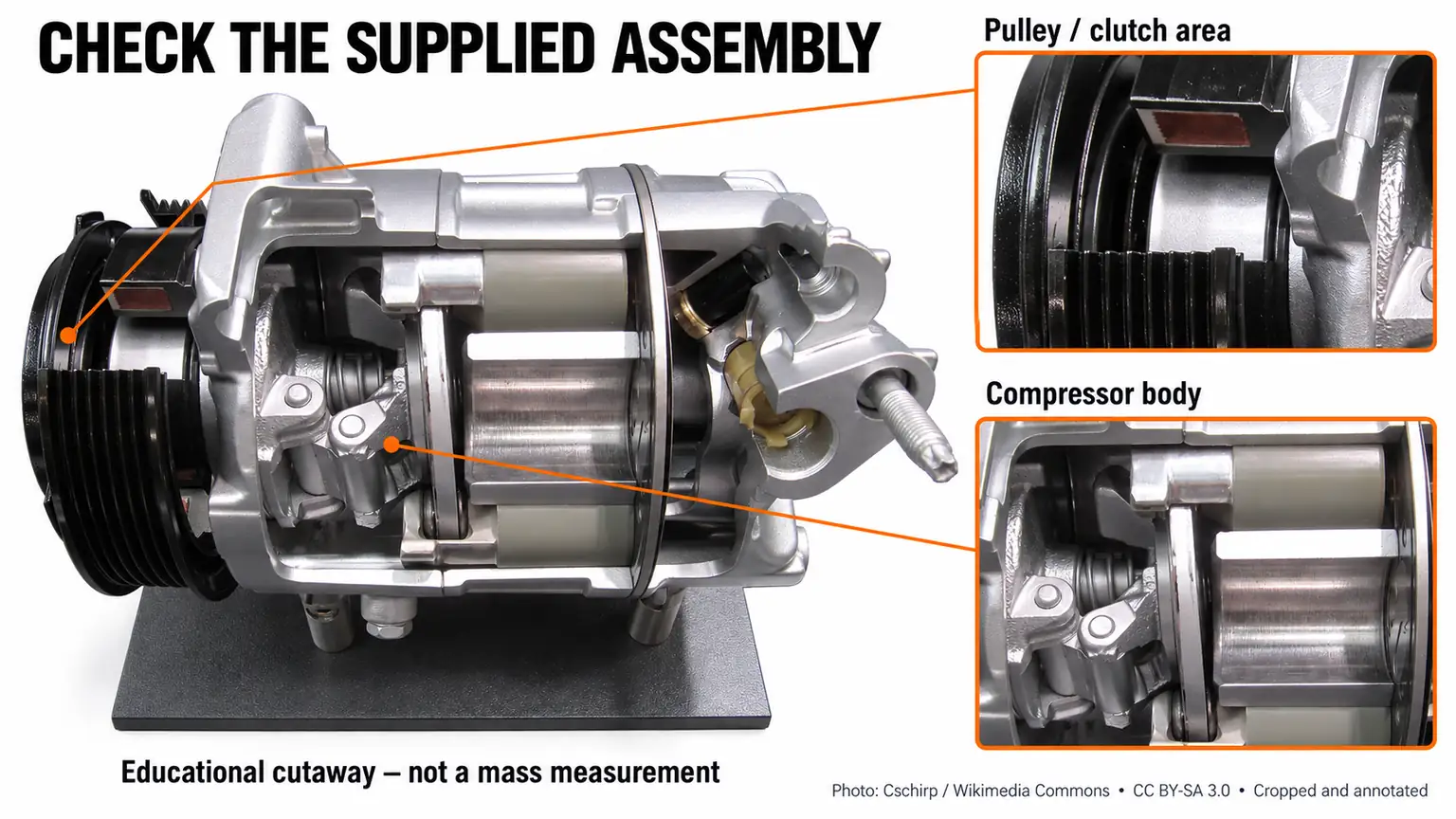
Visual key: the upper enlargement shows the photographed pulley and clutch area; the lower shows the cutaway compressor body. These visible areas help define the supplied assembly boundary, but do not establish a complete unit's mass. This is an educational cutaway, not an identified SD5H14, an Elecdura product or a weighing record; missing cutaway material must not be treated as a complete unit. Open annotated image at full size.
Photograph: Cschirp, “Taumelscheibenverdichter-Schnitt,” via Wikimedia Commons, CC BY-SA 3.0. Cropped and annotated by Elecdura; the adapted image is shared under the same license. No photographer endorsement is implied.
If the order is for a compressor with its clutch fitted, describe that complete supplied assembly when requesting net weight. If a bracket or adapter is supplied separately, say whether it belongs in the same goods total. Packaging then adds another boundary: an individual carton, a master carton and a pallet are not interchangeable weighing units.
A photo can clarify what is present, but it does not establish mass. Likewise, a packing list marked “net” and “gross” is easier to use when the unit count, packing level and included accessories are stated beside those figures.
Treat the quotation as a description of an object, not just a part number followed by a price. Ask whether the photographed clutch is included, whether an adapter is attached or loose, and whether the delivery includes installation hardware. Where an accessory is optional, separate its price and mass from the base configuration. This prevents a lighter, cheaper offer from appearing equivalent when it contains fewer components.
A practical comparison starts with the configuration required for the vehicle and then checks each offer against it. If one supplier cannot identify the included components, mark that offer as incomplete rather than estimating its assembly weight from an unrelated listing. This is particularly important when a product page uses a representative photograph for several references: the pictured pulley or clutch may not define the selected variant.
Use the supplier's wording precisely. A listing described as a compressor assembly may still leave the bracket, connector adapter or fasteners outside the price. Conversely, a net weight may include a complete kit of saleable items. An agreed inclusion list allows you to compare those offers without assuming that commercial terms have identical meanings across catalogues.
Do not use mass as a shortcut for build quality or cooling performance. A heavier offered item could have a different clutch, housing or supplied accessory package; a lighter item could have a different configuration. None of those possibilities establishes the explanation for a particular discrepancy. Compare the identified parts and supporting records before drawing a conclusion about construction.
The same limitation applies to interchangeability. Two assemblies can weigh the same while their mounting geometry, pulley position or electrical connection differs. A weight field helps with handling and shipment planning, but the fitment decision needs its own evidence. Keep the weight comparison subordinate to the approved configuration instead of accepting an otherwise unsuitable replacement because its kilograms match.
For an unidentified used unit, a measured weight is a record of that particular object in its received condition. It does not reveal the original oil charge, completeness or internal condition. Record visible missing parts and attached items separately; do not infer a missing quantity of oil by subtracting the received mass from a family-level catalogue figure.
Ask for the part reference, supplied condition, included components, unit of measure and basis of the value. Distinguish a supplier estimate, a catalogue figure and a measured sample. If the figure comes from a sample, retain the sample reference and measurement date rather than presenting it as a verified weight for every unit in a production lot.
For a measurement photograph, the product identity and scale display should be traceable to the same weighing event. Record any tray or support and whether it was included or tared. Do not request that a supplier remove shipping caps, drain oil or detach a clutch merely to recreate a “bare” catalogue value; first agree on the supplied object you actually need to compare.
For procurement verification, agree on a simple sequence: identify the object, record the weighing arrangement, obtain the reading and connect that reading to the quotation. The purpose is not to create a laboratory report for every enquiry. It is to make the number explainable if the buyer, supplier or freight provider later asks what was actually weighed.
Use a scale and supporting arrangement appropriate to the complete load, including any tray or fixture. Follow the equipment instructions and applicable shipping requirements. A detailed digital display alone is not evidence of accuracy, and adding decimal places to a spreadsheet cannot improve the measurement. If a difference matters commercially, ask what equipment and verification basis support the reported result.
Position the object so that the load is supported by the weighing platform rather than partly resting on a bench, cable or adjacent carton. A support may be needed to keep an irregular compressor stable. In that case, describe the support and establish whether the displayed reading includes it. Never trade safe support for an apparently simpler photograph.
A useful photograph shows the object and the readable display together. If that is impractical, use linked photographs from the same identified weighing event and explain what connects them. Keep the original files; an enlarged display crop can improve readability, but it should remain traceable to the wider photograph rather than replacing it.
Tare is the excluded mass of a support or container when that exclusion is part of the agreed method. A supplier might zero a tray before loading the part, or record the loaded and empty tray separately. Either approach needs a clear description. Do not subtract a tray again from a reading that already excludes it, and do not deduct a guessed packaging allowance from a packed measurement.
Preserve the original unit and reported resolution in the source record. Convert units in a separate field if the comparison requires it. If one document gives a rounded whole-kilogram estimate and another gives a more detailed measured result, the number of displayed digits explains part of the apparent mismatch, but it does not establish which value is more accurate.
Agree on the purpose of any acceptance limit before applying it. A receiving check intended to detect a missing accessory differs from a freight estimate intended to select a billing band. There is no universal compressor-weight tolerance in this article. A limit must relate to the identified configuration, measurement method and purchase requirements; otherwise, a percentage threshold creates false certainty.
Where the result is close to an agreed limit, request a repeat under the same documented conditions before making a disposition. Do not average unrelated catalogue, sample and shipment figures together. If the second measurement changes materially, investigate the setup and object identity first, retaining both readings instead of deleting the inconvenient one.
One identified sample can establish the recorded mass of that sample under the stated conditions. To use it for a larger order, explain why it represents the offered configuration and what remains unmeasured. A supplier may use the sample for planning while final production and packing are still pending. The buyer should retain that distinction rather than converting the sample result into a statement that every ordered unit was individually weighed.
For a mixed order, organize evidence by actual configuration. Different pulleys, clutch arrangements or accessory kits should not disappear behind one average simply because the catalogue family is shared. If the supplier reports a range, ask which configurations or observations produced it and whether the endpoints are measured or estimated. A range without that explanation is not a defined acceptance limit.
The extent of a receiving check should follow the purchase agreement and the reason for concern. A packing-count discrepancy, an unexplained part substitution and a routine freight reconciliation call for different evidence. Do not invent a universal sample size or claim that a small sample statistically proves the entire lot. Where such assurance is required, agree on the inspection method separately.
Use an internal part or package reference to connect the measurement photographs with the quotation and packing record. The buyer normally needs the object identity, unit of measure and measurement basis, not unrelated personal information on a courier label. Retain the unaltered source record securely and use a privacy-masked copy when customer names, addresses or tracking details are unnecessary for the comparison.
Explanatory arrows can identify the assembly boundary or weighing display, but they must not add a reading, conceal an included support or imply that a different product was weighed. If an image is only an educational example, label it accordingly. A useful illustration helps readers understand the method; only evidence from the identified weighing event can support the quoted measurement.
For a shipment estimate, request the package count, contents of each piece, packed weight and external length, width and height. If these are provisional, label them as estimates and obtain the final values after the packing arrangement is confirmed. A product photograph and a closed-carton photograph answer different questions; neither substitutes for a recorded weight.
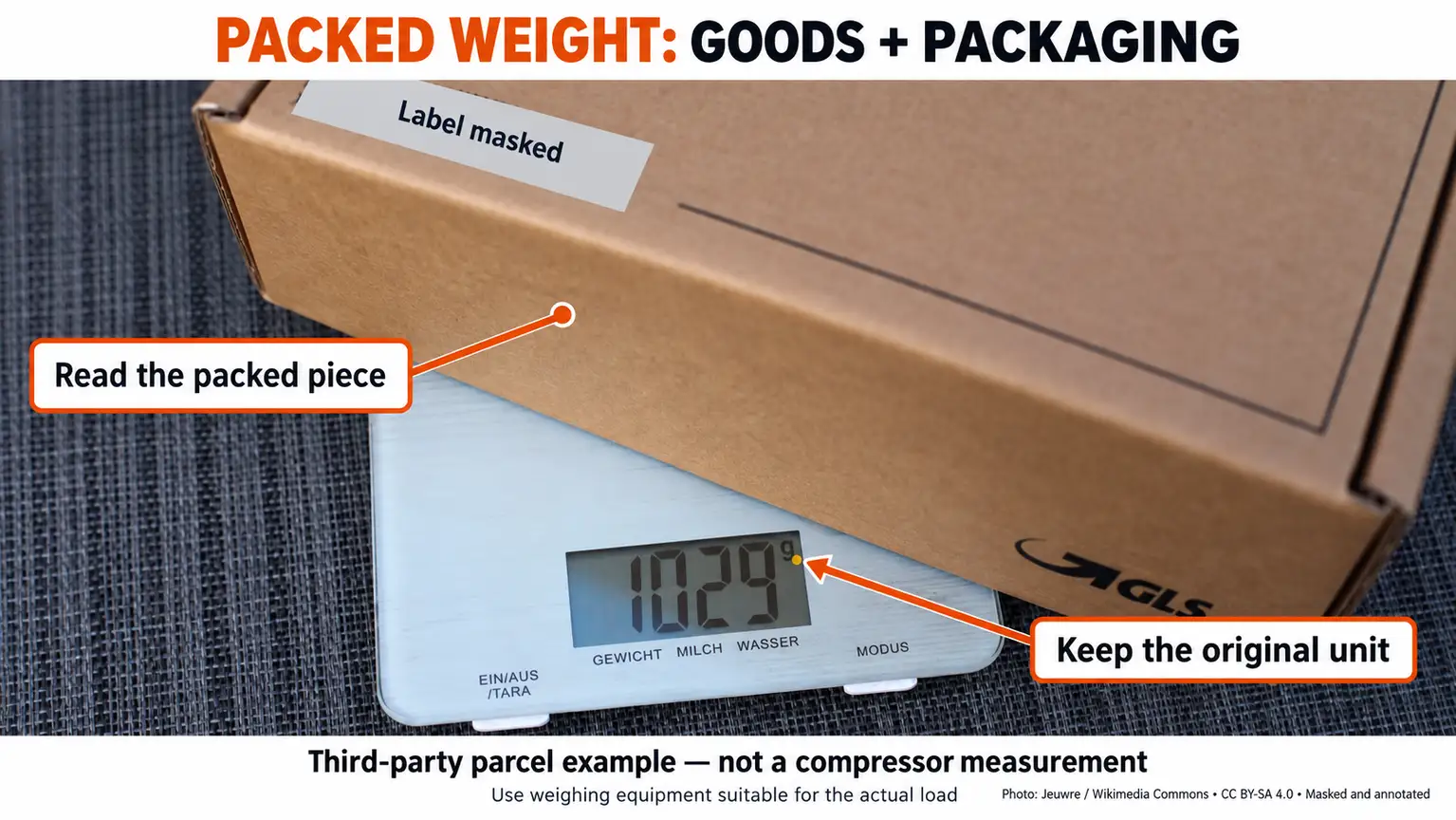
Visual key: the closed parcel and its packaging form the weighed piece; keep the unit shown on the original display. Third-party parcel-weighing example: the photographed display reads 1029 g for this parcel, not an A/C compressor or an Elecdura shipment. Its contents, tare, scale accuracy and capacity are unverified. This is not a recommendation to weigh a compressor on a kitchen scale; use equipment suitable for the actual packed piece and applicable shipping requirements. Open annotated image at full size.
Photograph: Jeuwre, “Measuring weight with a kitchen scale,” via Wikimedia Commons, CC BY-SA 4.0. Cropped, privacy-masked and annotated by Elecdura; the adapted image is shared under the same license. No photographer endorsement is implied.
Tie the gross weight to the carton contents, not to a single compressor unless the carton contains only that quoted unit and its stated accessories. If several cartons are later combined on a pallet, obtain a separate packed-pallet record. Dividing the pallet's gross weight by the number of compressors gives an average shipment allocation, not a measured net weight for each product.
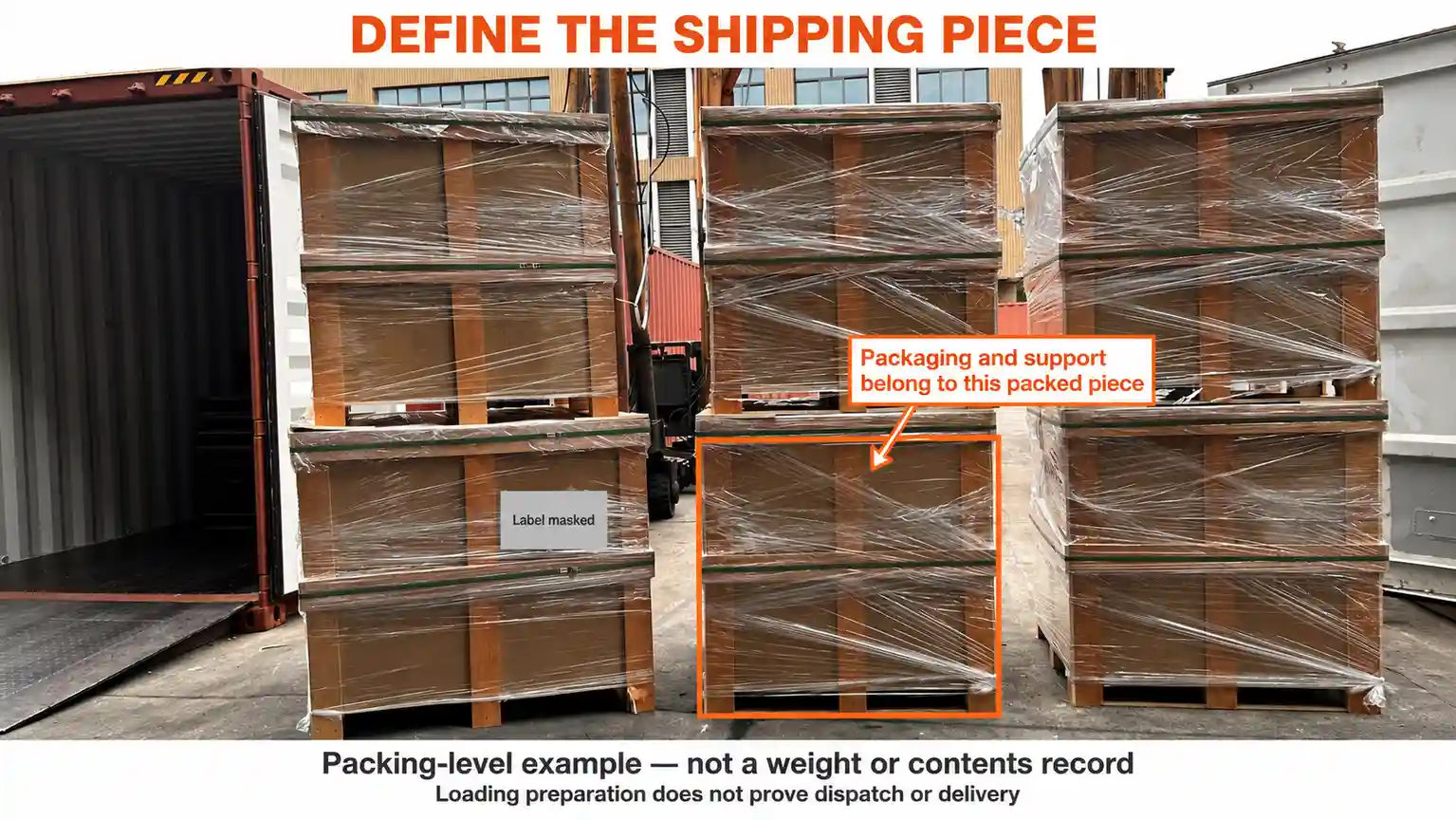
Visual key: the orange outline marks one packed piece; its packaging and supports belong to that complete piece when weighed. This Elecdura order loading-preparation photograph illustrates a packaging-unit boundary. It does not identify the contents as compressors or establish dimensions, net or gross weight, shipment departure or completed delivery. Open annotated image at full size.
Source: Elecdura's original order loading-preparation record. The orange frame is explanatory, and nonessential paper labels have been masked for privacy. No weight or dimension has been added to the scene.
A packing record should let another person reconstruct the shipment without guessing its hierarchy. Identify which products are inside each carton, which cartons are on each pallet, and which level the carrier treats as a shipping piece. Keep the unit count separate from the package count. Five compressors do not necessarily mean five cartons, and five cartons do not necessarily mean five separately billed pieces.
Consider a hypothetical shipment containing two identical assemblies, each with an agreed net mass of eight kilograms. If the complete carton measures nineteen kilograms, the difference is three kilograms of packaging and any other included material, provided the inclusion list contains nothing else. That subtraction reconciles the defined example; it does not establish a standard packing allowance for compressors.
If that carton is later placed on a pallet, the nineteen-kilogram carton record remains valid for the carton, but it no longer describes the entire shipping piece. The pallet, securing materials and any additional cartons belong in the new packed-piece record. Record the completed pallet separately rather than quietly changing the carton figure and losing the distinction between the two measurements.
For mixed-reference cartons, an average weight per compressor can help allocate an internal freight budget, but it is not a measured specification for any individual reference. Label allocations as allocations. Keep the actual carton and pallet measurements intact so that purchasing, receiving and logistics can use the same records without confusing accounting arithmetic with physical measurements.
If the proposed packing arrangement changes after the quotation, request a revised piece list before booking transport. Combining pieces or adding protection may change both gross mass and external dimensions. A revised freight estimate should identify the revised packing version; it should not imply that the product itself has become heavier.
When several departments use the same spreadsheet, name the columns explicitly: product net mass per defined unit, carton gross mass, pallet gross mass and chargeable mass. Avoid a single column called weight that changes meaning from row to row. Keep a separate quantity column and label the packaging level. This makes addition meaningful: carton totals may be combined only when they refer to distinct cartons, not when some rows already include the cartons listed elsewhere.
For the same reason, do not add a pallet gross figure to the gross figures of the cartons already on that pallet. That double counts the contents. Reconcile the package hierarchy first, then calculate the shipment total from the non-overlapping shipping pieces actually being tendered.
The DHL Express China 2026 service guide describes dimensional weight as length × width × height in centimetres divided by 5,000 for each piece. Where that dimensional weight exceeds actual weight, the space occupied determines the chargeable weight. This is a service-specific rule, not a universal formula for every carrier or transport mode.
For comparison, DHL's U.S. eCommerce chargeable-weight guidance describes a different divisor. Before accepting a freight estimate, identify the actual service and the applicable calculation and rounding rules. The name of the carrier by itself is not enough.
Suppose a hypothetical packed carton weighs 8 kg and measures 40 × 35 × 40 cm. Using a divisor of 5,000 gives 11.2 kg dimensional weight. Under a higher-of-actual-or-dimensional rule, dimensional weight would govern before any applicable rounding. The 11.2 kg figure would not mean that the compressor itself weighs 11.2 kg.
That illustration calculates a weight basis only. It is not an Elecdura shipment measurement, carrier quote or promise of a shipping cost.
Measure the external packed shape that will be tendered to the carrier, not the compressor's catalogue dimensions or the internal dimensions printed on an empty box. Confirm the service's rules for irregular shapes, protrusions and rounding. A neatly typed length, width and height are still provisional if they were taken before the carton was closed or before the final pallet arrangement was secured.
Avoid optimizing one field in isolation. Removing needed protection to reduce a dimension can create a different handling risk, while choosing a larger stock carton may increase the dimensional calculation without changing the product. Compare feasible packing arrangements that retain the required protection, then request a freight estimate based on the selected arrangement.
Under the hypothetical divisor of five thousand used above, an eight-kilogram packed piece reaches the same dimensional weight at forty thousand cubic centimetres. This is simply eight multiplied by five thousand. Above that volume, the dimensional result exceeds eight kilograms before any applicable service rounding; below it, the actual mass is the larger of the two calculated values.
This threshold helps explain a quote; it is not a packing target or permission to remove cushioning. When volume drives the result, reducing a small amount of product mass may leave the billing basis unchanged. When actual mass drives it, a smaller carton may not change that basis. Obtain the carrier's final calculation rather than promising a saving from one changed measurement.
Separate the weight basis from the shipping price. A confirmed chargeable weight does not by itself confirm a rate, a delivery time or the complete charges. Ask the freight provider to identify the service, route, piece assumptions and quotation validity. Retain the actual gross weight alongside the billing weight so that receiving staff are not asked to reproduce a calculated number on a scale.
When two documents disagree, first put the figures on the same basis. Check the complete reference, included clutch and accessories, packing level, number of units, kg or lb, and whether each number is typical, estimated, measured or calculated. Preserve the original entries while the supplier explains the difference.
If one number describes the assembly and another the packed carton, request the missing boundary labels rather than treating the difference as a shortage.
If the same identified product has different measured weights, check included items, supports, tare and measurement conditions before attributing a cause.
If only the freight weight is higher, compare the final package dimensions and service calculation with the actual packed weight.
Weight alone does not prove interchangeability, performance or the cause of an oil trace. Use the separate compressor RFQ evidence guide for fitment information. If oil or shipping damage is present, preserve the receiving evidence and follow the shipping-cap and oil-leakage receiving workflow rather than trying to diagnose the unit from a weight discrepancy.
Start with the least invasive explanation that the records can resolve. A missing unit label or different inclusion list can often be clarified without opening a sealed product. Ask a specific question tied to the disputed field: whether the clutch is included, whether the value is per unit, or whether the number came from a carrier calculation. This is more useful than asking the supplier to confirm that its weight is correct.
A typical family specification and a measurement of a particular supplied assembly answer different questions. Request the exact reference and configuration for the sample, then compare them with the scope of the catalogue entry. If the manufacturer does not publish a weight for that exact configuration, keep that gap explicit rather than relabelling the family figure as an exact specification.
A sample measurement can support a provisional quotation when its scope is clear. It does not automatically verify every production unit or final packed shipment. Decide which later event requires a fresh record: a changed configuration, a changed packing arrangement or the completed shipment. This keeps early planning possible while preserving the distinction between an estimate and a confirmed dispatch record.
Compare the inclusion lists and photographs before examining the numerical difference. Look for attached brackets, loose accessories included in the weighing, caps and supports. Check whether both records describe the same supplied condition and whether either reading already excludes a tared support. If those details match, request a repeat measurement with the method documented.
If a discrepancy remains unexplained, preserve the product identity and segregate the affected receiving decision from the rest of the order as your agreed procedure requires. Do not declare a counterfeit, a missing internal component or a manufacturing defect from weight alone. The next investigation should follow the specific evidence, not the most alarming explanation.
Ask for the carrier's piece-level measured mass and dimensions, the service rule applied and the package identifier. Compare those with the final packing record rather than the earlier sales estimate. Where the difference comes from a dimension, establish whether the same packed shape was measured and whether the carrier applied its rounding convention.
Keep the discrepancy record factual: original value, revised value, measurement basis and explanation requested. A higher invoice weight may reflect dimensional billing rather than extra physical mass. Conversely, a difference in actual gross weight should not be explained away as dimensional weight without the piece-level evidence. Ask the freight provider to resolve the relevant field before updating your future estimate.
For an automotive A/C compressor enquiry, send the complete reference, application, quantity and destination. State whether you need a bare unit, a compressor with clutch or another defined supply configuration. Then request the product-weight basis, packed piece count, gross weights and external dimensions as separate fields.
Send Elecdura those requirements with your parts enquiry and ask which figures are available, estimated or still to be confirmed. The useful result is a quotation whose product, package and freight assumptions are explicit—not one kilogram figure expected to answer all three questions.
At enquiry stage, provide the required configuration and ask which weight figures already exist. A clearly labelled estimate may be enough to compare broad transport options while the part selection remains open. Record what the estimate assumes so that it can be replaced, not silently reused, when the final reference and quantity are agreed.
At order confirmation, connect the agreed product scope to the line item and identify any outstanding packing information. State who will supply the final gross weights and dimensions and at what stage they will be available. This creates a concrete handoff between purchasing and logistics without inventing a measurement before the goods are packed.
Before transport booking, use the completed piece list and the applicable service rules. At receiving, compare the delivered objects and package identifiers with those records, retaining any discrepancy evidence before repacking. Each stage uses a different part of the same information chain; none requires pretending that a preliminary catalogue number was a final shipment measurement.
An actionable request names the missing value and its intended use. For example, ask for the measured mass of the quoted assembly with its specified clutch for a product comparison, or ask for the final gross mass and external dimensions of each shipping piece for a freight estimate. Also ask whether the answer is measured, typical or provisional. That wording lets the supplier answer the actual question.
If a measurement cannot yet be supplied, keep the field pending and identify the condition needed to close it. Do not fill the gap with a weight from a visually similar part. A transparent pending field is more useful than an apparently complete quotation whose product, packing and billing weights cannot be reconciled.
Source scope: the Sanden example is a typical specification in a legacy service guide. Carrier guidance was reviewed on September 28, 2026 and applies only within its stated service scope. The carton calculation above is explicitly hypothetical.