ELECDURA NETWORK

Your Whole New Supply Chain For Heavy-Duty Parts
Whatsapp:
+86 18915027366
Phone:
+86 18915027366
Views: 0 Author: Elecdura Publish Time: 2026-09-04 Origin: Site
A heavy-duty A/C compressor RFQ should identify the installed system before it asks for price. Send the vehicle or equipment identity, engine and HVAC context, every readable compressor number, clear photographs, mounting and pulley measurements, rear-head port geometry, electrical connector, refrigerant and oil evidence, quantity, destination and required timing. Ask each supplier to return the same fields for the proposed part. A single cross reference or a photograph of a similar compressor is only a candidate match; it is not approval for installation or a bulk order.
This packet is designed for distributors, A/C specialists, fleet maintenance teams and importers comparing aftermarket replacements for trucks, buses, construction, agricultural and industrial equipment.
Begin with the most authoritative and application-specific evidence available: vehicle or machine service information, the installed compressor label, a trusted previous order for the same configuration, and controlled measurements of the removed unit. Cross-reference lists, marketplace descriptions and visual similarity sit lower in the hierarchy. If two sources disagree, keep both visible and ask the supplier to explain the conflict.
Record the vehicle model, chassis or serial identifier where available, engine model, HVAC arrangement, single- or dual-evaporator layout, and whether the compressor is original, previously replaced or removed from a modified system. Off-highway and bus systems can have long hose runs and application-specific oil requirements, so the compressor label cannot always be read in isolation from the equipment procedure.
Use the existing rear-head and hose-port identification guide when the installed unit must first be classified. The RFQ packet goes further: it turns that inspection into controlled quotation fields and a supplier response that can be compared.
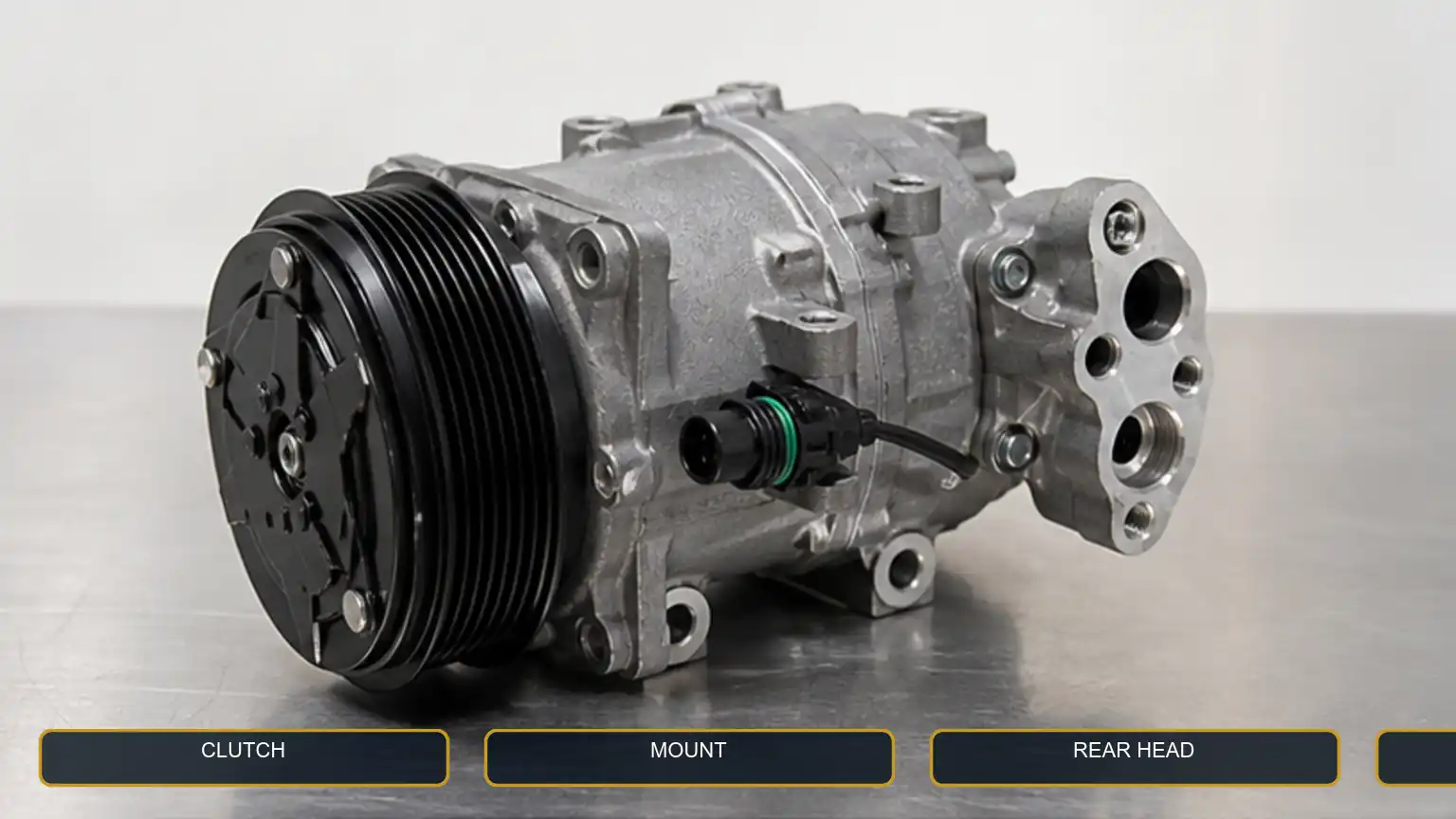
One complete three-quarter view establishes orientation; it does not replace straight-on photographs and measured interface data.
Photograph the unit before removal when access allows. Show hose routing, belt plane, bracket, nearby interference and connector orientation. After recovery and safe removal by a qualified technician, clean only enough to reveal identity; do not erase labels or contamination evidence. Place the compressor on a neutral surface with a scale and case ID.
Required view | Question it answers | Common failure |
|---|---|---|
Full label, square to camera | Model, part number, serial or batch, refrigerant, oil and charge fields that are actually readable. | A cropped or angled image hides the suffix that separates configurations. |
Pulley and clutch face | Groove type and count, diameter, offset, hub and coil lead arrangement. | A side view cannot prove groove count or front-face geometry. |
Mounting faces | Ear or direct mount, holes, pilots, spacers, bosses and datum surfaces. | Perspective makes spacing appear equal when it is not. |
Rear head and ports | Pad, manifold, threaded or other connection; suction/discharge location, clocking and clearance. | Protective caps hide the actual sealing interface. |
Connector and harness side | Coil or control-valve connection, pin count, keying, pigtail length and routing. | Matching voltage does not prove connector or control compatibility. |
Installed context | Bracket, belt, hoses, body or frame clearance and service access. | A bench match ignores the route the part must occupy. |
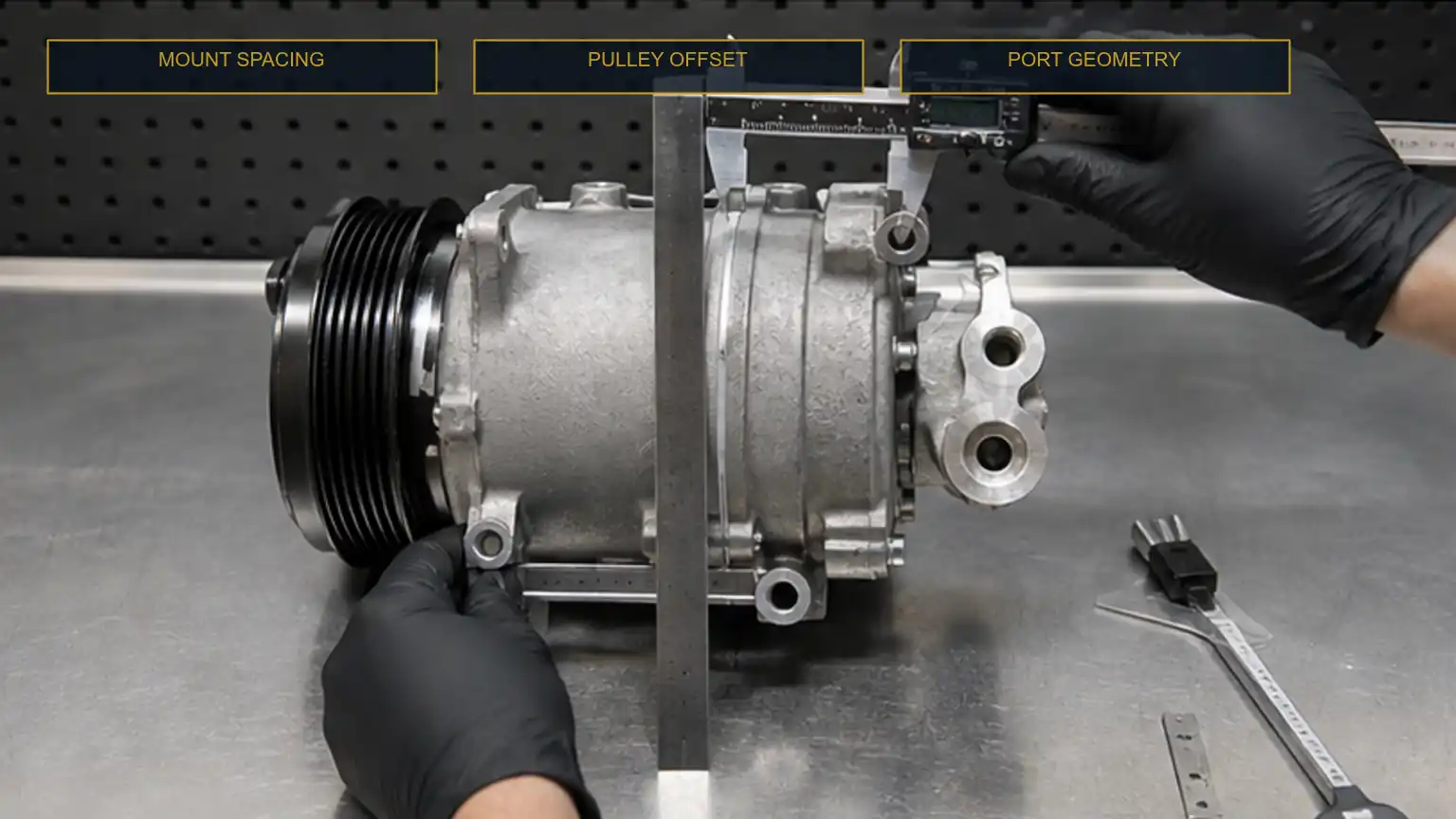
Do not send isolated dimensions with no start and end points. Identify each datum on a marked photograph or drawing: mounting-face to mounting-face, center-to-center hole spacing, pilot diameter, pulley outside diameter, groove count, pulley gauge line or offset, shaft or clutch face reference, rear-head orientation and port-center location. Record the tool resolution and whether caps, bushings or spacers were installed during measurement.
Sanden configuration tables demonstrate why the packet needs several fields at once: model, mount, clutch diameter, grooves, voltage, port direction and port type can all vary within a compressor family. A shared footprint or family name therefore does not settle the complete configuration. Supplier drawings should use the same datums as the buyer's record or explicitly show the conversion.
Measurements are useful only when the supplier can reproduce the datum definition. The illustration contains no approved values.
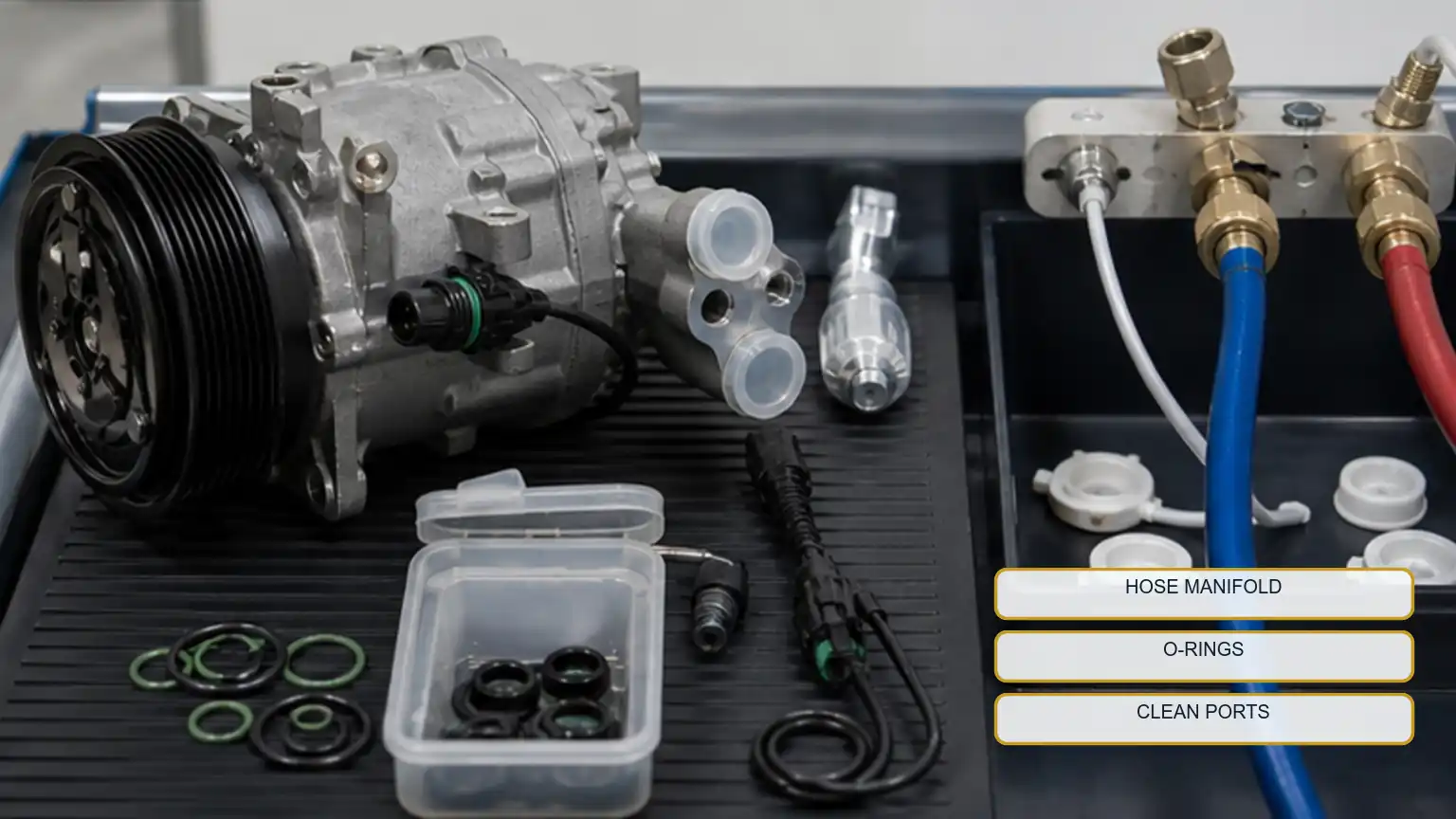
For ports, identify connection style, bolt or thread arrangement, sealing method, suction and discharge function, center spacing, orientation, rear-head clocking and installed hose clearance. Do not infer suction and discharge from hole size alone. Ask whether the quoted compressor includes caps, O-rings, a manifold, adapter or service valve, and whether those items are installation parts or shipping protection.
For electrical control, distinguish a simple clutch coil from a control valve, speed sensor or electronically controlled variable-displacement system. State system voltage and connector evidence; request mating-interface or harness information when the supplier proposes an adapter. A connector that physically clicks together does not prove pin assignment, control strategy or current capacity.
The supplier response should name every unresolved interface. “Same as photo” is not an acceptable response when the image cannot show sealing geometry, pin function or pressure rating.
Record the refrigerant, compressor oil type and any label charge information exactly as shown. Then compare them with the vehicle or equipment service procedure. DENSO and Sanden both direct technicians to identification labels and application guidance for oil type and quantity, while Sanden notes that some heavy-truck, off-highway or school-bus systems can require additional system oil for long hoses. This prevents the RFQ from converting a label value into a universal system-fill instruction.
Ask the supplier what oil is inside the proposed unit, how much, whether it is a shipping or system quantity, and which document supports it. Also ask whether ports remain sealed and how long the unit may stay open during receiving. Do not specify “universal oil” or mix oils because a generic quotation template lacks the field.
If metal debris, black residue or another contamination condition is present, pause fitment selection and follow the applicable system-cleaning procedure. The A/C compressor metal-debris guide explains why replacement scope depends on the circuit evidence, not only the compressor.
Place the buyer's evidence and supplier response in adjacent columns. Every quote should state the proposed brand and condition, exact reference and revision, application basis, mount, pulley and clutch, port configuration, electrical interface, refrigerant/oil statement, included parts, sample availability, packaging, label and change-notification process. Commercial fields such as quantity, sample cost, MOQ, quoted lead time, destination terms and discrepancy process belong in the same versioned record.
Do not let a low price erase a blank technical column. Classify each response as matched, conflicting, not provided or not applicable. A conflict can be resolved by a new drawing, controlled measurement or sample; a blank remains an unknown. Keep quotation date and revision because suppliers may update references, packaging or included hardware.
Release gate | Minimum evidence | Hold reason |
|---|---|---|
Identity | Application packet plus complete old-unit and proposed-unit references. | Suffix, revision or condition is unclear. |
Mechanical fit | Named datums, mount, pulley/gauge line and installed clearance. | “Looks the same” replaces measurement. |
Fluid interfaces | Port and seal geometry, suction/discharge assignment, refrigerant and oil evidence. | Adapter or oil assumption is undocumented. |
Electrical control | Voltage, connector, pin/control basis and harness clearance. | Connector appearance is the only proof. |
Sample-to-order | Approved sample ID, supplier revision, packaging/label and change control. | Production lot cannot be tied to the approved sample. |
Receiving inspection should compare the sample to the approved response before caps are removed. Verify carton and unit labels, visible damage, protected ports, clutch/pulley freedom according to the applicable method, mount and interfaces. Trial-fit only with clean approved seals and without forcing hoses, brackets or connectors. A fit problem is not corrected by pulling a hose into position or adding an unapproved spacer.
Record the sample ID and every deviation. If the supplier authorizes a revision, update the drawing and RFQ line before production approval. Keep installation and commissioning records with the same file so a later complaint can be traced to identity, configuration, oil handling and system condition.
A controlled trial fit validates the recorded interfaces; it does not authorize a system to be charged before oil, cleanliness and service requirements are resolved.
Stop and obtain qualified system diagnosis when the removed compressor failed internally, debris or contaminated oil is present, the vehicle has been converted to another refrigerant, hoses or brackets were modified, the control system is not understood, or the original unit is unavailable and vehicle identity is incomplete. The RFQ packet supports matching and quotation; it does not replace refrigerant recovery rules, pressure-system safety or model-specific repair instructions.
It is a strong starting point when complete and current, but suppliers should still confirm the application and interfaces. Superseded numbers, remanufactured labels and shared families can contain different mounts, clutches, ports or controls.
Rarely. One view cannot prove hidden mount spacing, pulley offset, rear-head sealing geometry, connector keying or installed clearance. Send a repeatable shot list and named measurements.
The label is evidence about the unit, but the correct service action also depends on the vehicle or equipment procedure and oil retained elsewhere in the system. Ask what the quoted compressor contains and reconcile it with the application instruction.
No. Pulley, belt plane, clutch, ports, connector, control method, displacement, refrigerant and oil requirements can still differ. Release the complete interface set, not one footprint.
Both must answer the same versioned technical and commercial fields. Mark blanks and conflicts explicitly, then resolve them by documentation, measurement or controlled samples before ranking price.
Review the heavy-duty A/C compressor range to identify a possible product family, then send Elecdura the complete RFQ packet. Include quantity, destination and required timing, and require the proposed aftermarket reference to be tied back to the supplied evidence. Unknowns should remain visible until the supplier returns a documented answer.
Technical references reviewed September 4, 2026: Sanden Enhanced Compressor configuration tables; Sanden SD Service Guide; DENSO compressor-label information; DENSO A/C Compressor Installation Manual. Application-specific service procedures control refrigerant, oil, safety and installation decisions.