ELECDURA NETWORK

Your Whole New Supply Chain For Heavy-Duty Parts
Whatsapp:
+86 18915027366
Phone:
+86 18915027366
Views: 0 Author: Site Editor Publish Time: 2026-09-01 Origin: Site
Metal in A/C compressor oil turns a component replacement into a refrigerant-circuit repair, but it does not create one universal parts list. Recover the refrigerant with approved equipment, identify the compressor failure and contaminant, and map where oil and debris could travel. Then classify every component by the vehicle and component-maker procedure: replace, remove and bypass during flushing, flush by an approved method, or inspect with an explicit acceptance rule. Compressors, driers or accumulators, and expansion or throttle devices are commonly treated as nonflushable; some parallel-flow condensers also require replacement. Record the actual design and procedure instead of relying on the phrase “black death.”
This article is for commercial-vehicle workshops and buyers defining the repair before selecting a unit from the heavy-duty A/C compressor category. Refrigerant service must be performed by qualified personnel under the applicable safety and environmental rules.
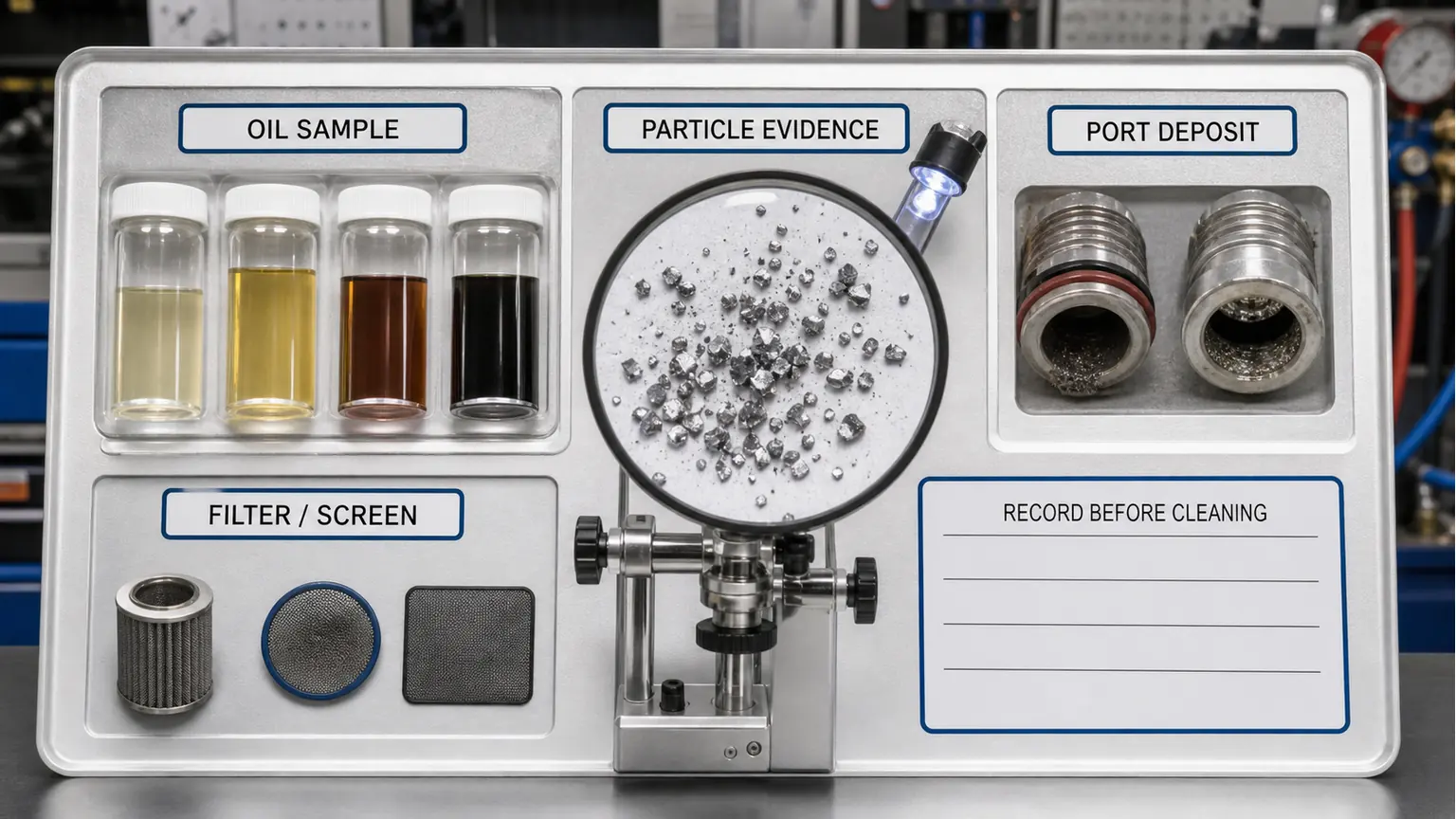
Document where the sample came from: compressor drain oil, suction or discharge port, orifice tube or valve area, receiver-drier, line, condenser or service equipment. Record color, visible particles, odor and any laboratory or filter finding without upgrading an observation into a chemical diagnosis. Dark oil may reflect heat or material degradation; metal particles may reflect internal wear; moisture and incompatible oil can create other risks.
“Black death” is informal shorthand used for severe contamination. It does not state particle size, material, moisture, acid content, refrigerant compatibility or how far debris traveled. Photograph the sample against a clean reference, retain it if the return process allows, and link it to the exact compressor and system.
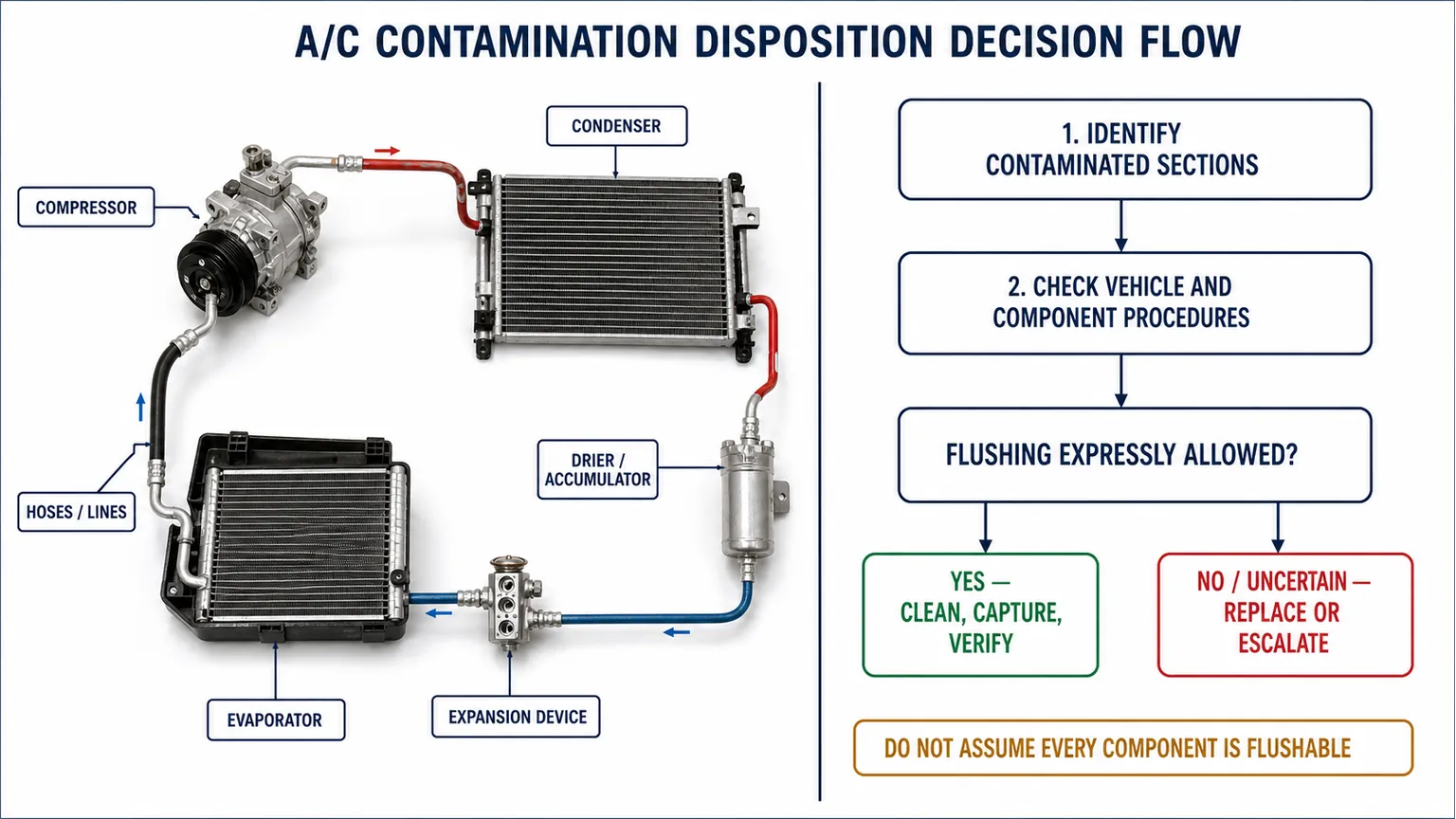
Trace the refrigerant path for the actual expansion-valve or orifice-tube system. Mark the compressor, condenser, receiver-drier or accumulator, metering device, evaporator, mufflers, manifolds, hoses and lines. Note integrated components: a drier may be built into a condenser, and a hose may contain a muffler that traps debris. A generic diagram cannot decide whether those parts can be cleaned.
Disposition | Required evidence | Typical hold |
|---|---|---|
Replace | Procedure identifies component as nonflushable or damage exceeds limit | Unknown design or integrated debris trap |
Remove and bypass | Flush plan excludes the component from solvent or refrigerant flow | Compressor, drier or metering device left in the flush loop |
Flush | Approved fluid, direction, equipment, cycles and dryness or cleanliness rule | No method to prove residue and debris removal |
Inspect and retain | Design is cleanable and acceptance result is documented | “Looks clean” is the only record |
MAHLE's flushing poster states that compressors, filter-driers or accumulators, and expansion or throttle valves cannot be flushed; it also notes that some parallel-flow condensers cannot be flushed. Sanden's service manual likewise separates contamination inspection, oil amount and component-specific flushing procedures. The exact vehicle and component documentation governs the repair.
A condenser with many narrow parallel passages can retain particles even when some fluid exits. A drier contains desiccant and filtration material. A metering device can trap debris at a restriction. A compressor contains internal moving and lubricated parts. Bypassing or replacing these items is not wasted cleaning—it prevents the flush from redistributing contamination or leaving solvent where it does not belong.
Use only equipment, fluids, adapters, pressure limits and disposal methods approved for the system. MAHLE describes reverse-direction flushing with suitable service equipment for applicable components. Do not substitute brake cleaner, shop solvents or unfiltered compressed air. The method must remove the flushing agent and leave the circuit compatible with the specified refrigerant and oil.
Define what the procedure uses to decide completion: filtered return free of unacceptable particles, a prescribed number of cycles, mass or visual inspection of the captured filter, dry-out and evacuation criteria, or another manufacturer method. Replace the flush equipment filter as required and prevent cross-contamination from hoses, recovery machines, containers and tools.
Keep before-and-after samples or filter photographs when permitted. A clean final sample does not prove an unflushable condenser passage is clean, and vacuum holding does not prove debris removal. Leak integrity, moisture removal and particulate cleanliness are different acceptance questions.
The repair list may include the compressor, condenser when its design or contamination requires it, receiver-drier or accumulator, expansion valve or orifice tube, seals, contaminated hoses or mufflers, approved oil and the specified refrigerant. Do not add or omit components solely because a generic kit contains them. Record why every line item is replaced or retained.
Confirm the replacement compressor by complete number, clutch or pulley and electrical configuration, mounting, rear head and ports, control valve where applicable, and system oil requirements. The A/C compressor oil-balancing guide explains why oil already retained in system components affects the service decision; it does not supply a universal fill quantity.
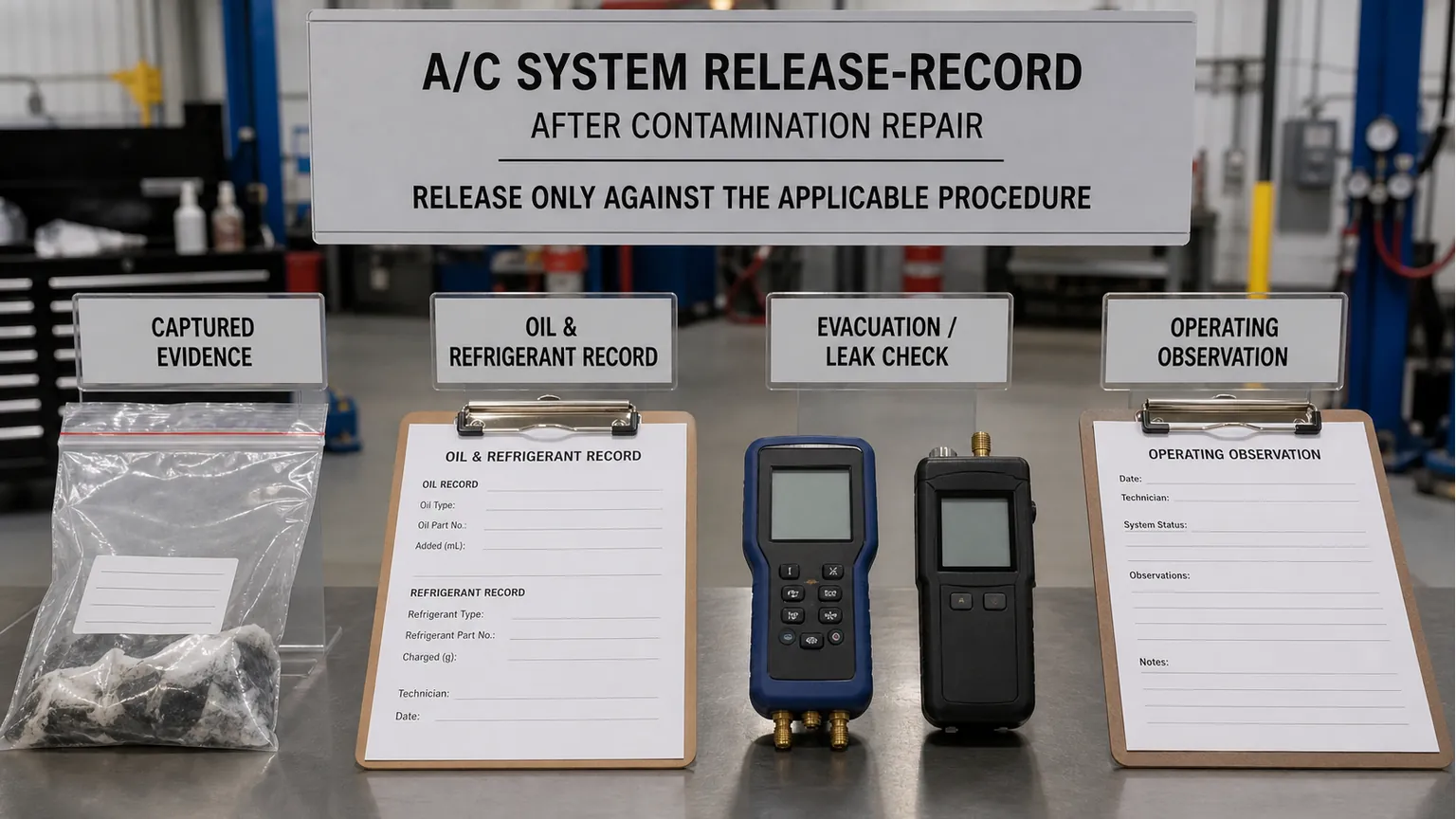
After the circuit is closed, evacuate, leak-test, charge and operate it according to the vehicle and equipment procedure. Verify the specified refrigerant and oil, charge quantity, pressure and temperature observations, control command and condenser airflow. Record ambient and operating conditions so the result can be interpreted.
Keep the removed parts, captured debris, oil record, flush report, replacement list and commissioning result linked to the work order and supplier return. A cooling result at one condition does not prove that all debris was removed, while a clean circuit does not prove the original compressor failure cause has been corrected.
This guide does not authorize venting refrigerant, using an unapproved solvent, flushing through a compressor or desiccant component, applying compressed air without the specified safeguards, or energizing an electric compressor whose oil dielectric requirement is unknown. Hybrid and electric compressors can require special oil and electrical safety controls.
If the system contains an unidentified refrigerant, mixed refrigerants, severe pressure hazard or electrical isolation concern, quarantine it for the appropriate qualified procedure.
Provide vehicle or equipment identity, complete compressor label, refrigerant and verified oil specification, failure mode, sample photographs, circuit design, condenser and drier configuration, component disposition plan, required supply scope, quantity and destination. If the old compressor is being returned, request handling instructions before draining, cleaning or opening it.
Send Elecdura the compressor identity and the system repair scope for matching and quotation. A compressor quotation does not validate the workshop's flush plan or replace the vehicle service information.
It establishes a serious downstream contamination concern, but the disposition depends on the condenser design and the applicable procedure. Identify whether it is flushable, whether the drier is integrated, and whether debris can be removed and verified. If the manufacturer classifies it as nonflushable or cleanliness cannot be established, replacement is the defensible boundary.
Only within the limits of the approved method and the component's internal design. Record flow direction, fluid, cycles, captured filter and acceptance criterion. Clear fluid does not prove every parallel passage or muffler is free of embedded debris, nor does it prove moisture has been removed.
Its desiccant and filtration media can retain moisture, flushing medium and particles that are not visible externally, and MAHLE classifies these components as nonflushable. Confirm the vehicle procedure and whether the drier is integrated with another component. Visual absence of metal is not evidence that its capacity or cleanliness is restored.
No. A screen may be permitted as an additional protective measure in a specified repair, but it does not remove contamination, correct an unflushable component or restore the correct oil balance. If used, record the screen type, location and required follow-up; do not let it become an excuse to retain a contaminated circuit.
Retain both compressor identities, original and repeat failure modes, oil and debris samples, component disposition and flush records, drier and metering-device replacement, refrigerant and oil quantities, evacuation and leak checks, operating readings and return instructions. This evidence helps distinguish residual contamination, system cause, installation error and product concern without guaranteeing claim acceptance.