ELECDURA NETWORK

Your Whole New Supply Chain For Heavy-Duty Parts
Whatsapp:
+86 18915027366
Phone:
+86 18915027366
Views: 0 Author: Elecdura Publish Time: 2025-12-11 Origin: Site
The right heavy-duty alternator is the unit that matches the truck's electrical system, installation and operating load—not the model with the highest advertised amperage. Confirm nominal voltage, grounding and regulator compatibility first. Then compare available output at the alternator speeds and temperatures the vehicle actually encounters, including loaded idle and battery recovery between stops. Mounting, pulley alignment, terminals and cable capacity remain separate approval checks. Manufacturer catalogues offer useful candidate families, but a family name does not establish an exact replacement. Fleet buyers should approve a defined part and configuration against a measured duty profile before consolidating stock or upgrading output.
This guide supports replacement selection for fleet maintenance teams, distributors and importers. Use the alternator product catalogue to find candidates after recording the installed unit's number and configuration. A product listing or OE cross-reference starts the investigation; it does not replace the vehicle's parts and service information.
Heavy-duty vehicles can use different nominal voltage systems. Vehicle size alone does not tell you whether the charging system is 12V or 24V. Read the installed alternator label and vehicle documentation, and confirm any modifications. A charging-voltage reading is also not the same thing as a nominal system-voltage specification.
Check grounding and regulation at the same stage. A case-grounded unit and an isolated-ground unit need the appropriate return path. An alternator with a visually similar plug can have different terminal functions or control requirements. Where the vehicle uses a commanded charging strategy, establish the required regulator and communication arrangement from the application documentation rather than assuming a replacement is “smart charging compatible.”
| Question | Record to compare | Reason to hold the candidate |
|---|---|---|
| Does it match the nominal system voltage? | Vehicle specification, installed identification and candidate specification | A mismatch, unreadable identification or an unexplained conversion |
| Does the ground arrangement match? | Grounding specification and installation instructions | A required isolated return or terminal arrangement has not been resolved |
| Do the control connections perform the required functions? | Exact terminal or connector documentation | Matching plug shape without a confirmed pin/function match |
| Is the offered part a direct replacement or an upgrade proposal? | Application record and the supplier's written scope | Changed output or regulation without a review of the surrounding system |
A line-haul tractor, a delivery truck with a liftgate and a vocational vehicle working at low engine speed do not draw power in the same pattern. Avoid a universal amperage recommendation based only on the fleet label. Have a qualified technician record the relevant operating states, including electrical consumers, engine speed, charging-system condition and the time available for battery recovery.
Separate loads that run together from loads that occur briefly or under different conditions. Lights, controls, blowers and auxiliary equipment may overlap; a liftgate or other intermittent load may draw heavily from the battery while the engine is stopped. The purchasing question is not simply whether the alternator can power the largest single load. It is whether the approved charging system can support the operating cycle without an accumulating charge deficit.
Compare candidates at the relevant shaft speed and thermal condition. An alternator's maximum rated current is not a promise of that current at engine idle. Manufacturer curves commonly use alternator speed, so do not place engine rpm directly on the curve without accounting for the drive ratio and the specified test conditions.
For example, with a verified 3:1 drive ratio and no belt slip, 600 engine rpm corresponds to 1,800 alternator rpm. This is an arithmetic illustration, not a recommended pulley ratio or a measured vehicle result. A different pulley changes low-speed output potential and maximum shaft speed together; it also requires checks of belt geometry, wrap, tension and the manufacturer's speed limits.
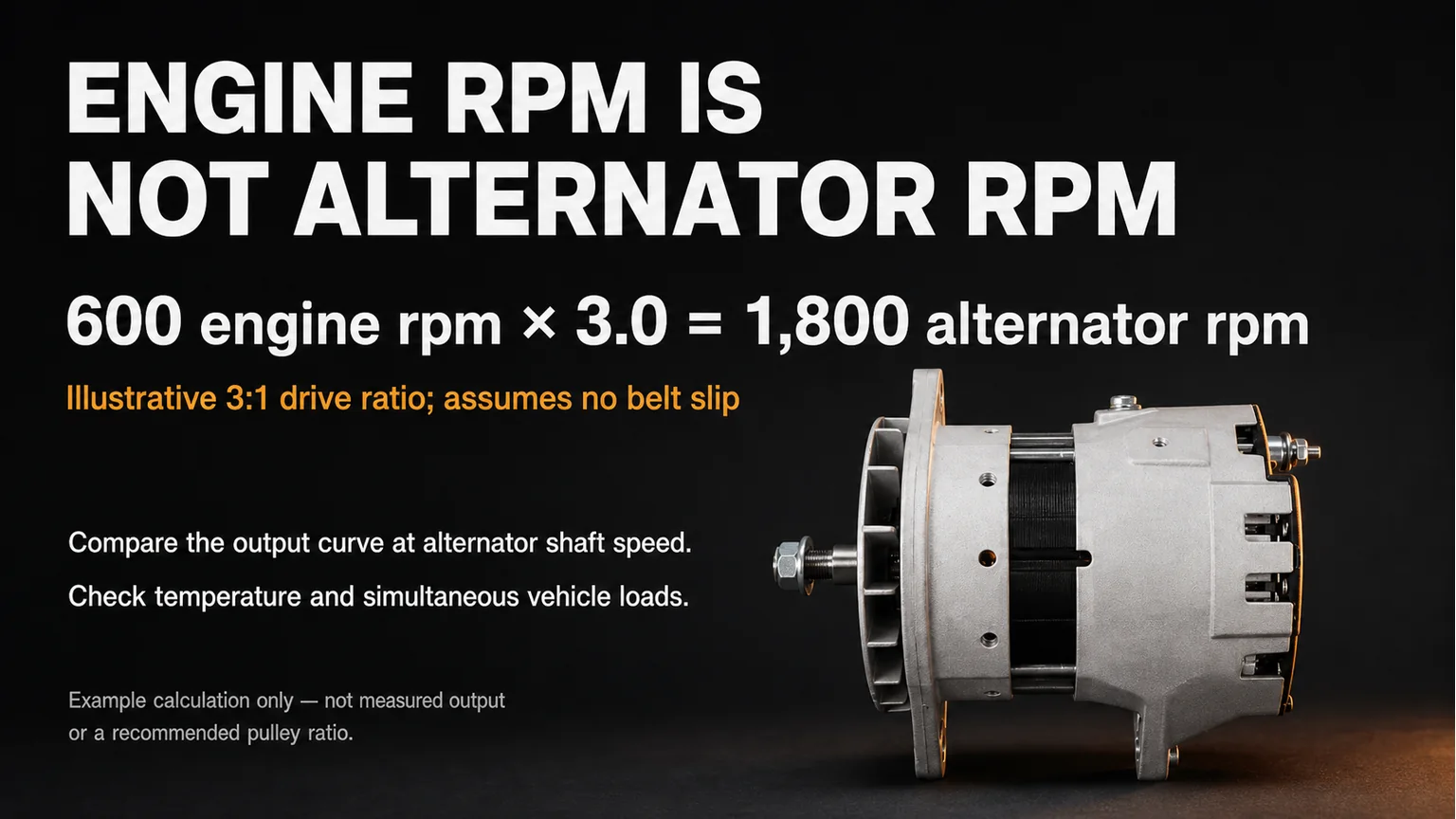
The ratio is an arithmetic example, not a pulley recommendation. The pictured reference unit has no pulley installed and does not establish an output curve.
A simple current balance can identify a potential shortfall: alternator output supplies the simultaneous vehicle load and any current entering the battery. But battery acceptance varies with state of charge, temperature, chemistry and regulation. Do not add an arbitrary percentage to an accessory total and present the result as a validated charging-system design. Use the vehicle and battery requirements, the observed operating cycle and the candidate output data.
Manufacturer data can show why two superficially similar offers deserve different questions. It cannot establish the best alternator for every truck. The examples below are reference points for comparison, not declarations that these models fit your fleet or that Elecdura's products have the same tested performance.
The manufacturer's 40SI brochure lists 12V options including 240A with 160A at idle, 275A with 180A at idle, and 300A or 320A with 190A at idle. These are published family specifications, not measurements on your installation. Confirm the exact part, speed and temperature conditions before comparing them with a vehicle load record. The 320A label alone does not imply more idle output than the listed 300A option.
The same brochure lists a temperature rating of 125°C (257°F) for its 240A and 275A options, compared with 115°C (239°F) for the 300A and 320A options. A higher nameplate amperage therefore is not a substitute for checking the proposed unit's thermal rating. Confirm that the current exact part and configuration carry the cited rating; a family name alone is insufficient.
Keep operating-temperature rating separate from output at a stated temperature. Those temperature ratings do not prove that a unit continuously delivers its maximum current at the rating limit. The brochure's family output curves do not provide a complete, temperature-matched acceptance test for a particular truck installation. Request the relevant hot-output data and test conditions before approving the higher-amperage option.
Delco Remy's 61011313 product record identifies a 12V, 170A, J180-hinge, coreless remanufactured 36SI alternator with Remote Sense. The significance is the specificity: condition, voltage, output, mounting and terminals are associated with a particular number. Do not expand that record into a claim that every 36SI has the same configuration or that any 36SI will fit every truck carrying a J180 mount.
Prestolite's alternator range includes IdlePro and IdlePro Extreme products, with an emphasis on low-speed output and features such as isolated grounding and available Remote Sense. Use the current application catalogue to identify the offered part and its installation requirements. A range description is not sufficient evidence for an individual unit's amperage, pulley, connector or warranty coverage in your destination market.
A short, verified shortlist is preferable to twenty rows of guessed fitments. Keep any other proposed manufacturer or aftermarket unit in consideration if it provides the correct application record and useful evidence; do not reject it merely because it is absent from these examples.
Photograph the installed unit from the mounting, pulley and rear-connection views before it is removed where practical. Compare mount geometry and dimensions, pulley type and effective diameter, groove arrangement, offset, overall envelope, terminal access and the required rotation specification. Mount names such as J180 or pad mount describe a family of interfaces; they do not eliminate dimensional checking.
The belt must run in the intended plane with the specified drive components. A pulley that appears to line up by eye can still require dimensional confirmation, and a higher-output alternator can change the demands placed on the drive. Use the applicable installation information rather than correcting a mismatch with improvised spacers or a convenient replacement pulley.
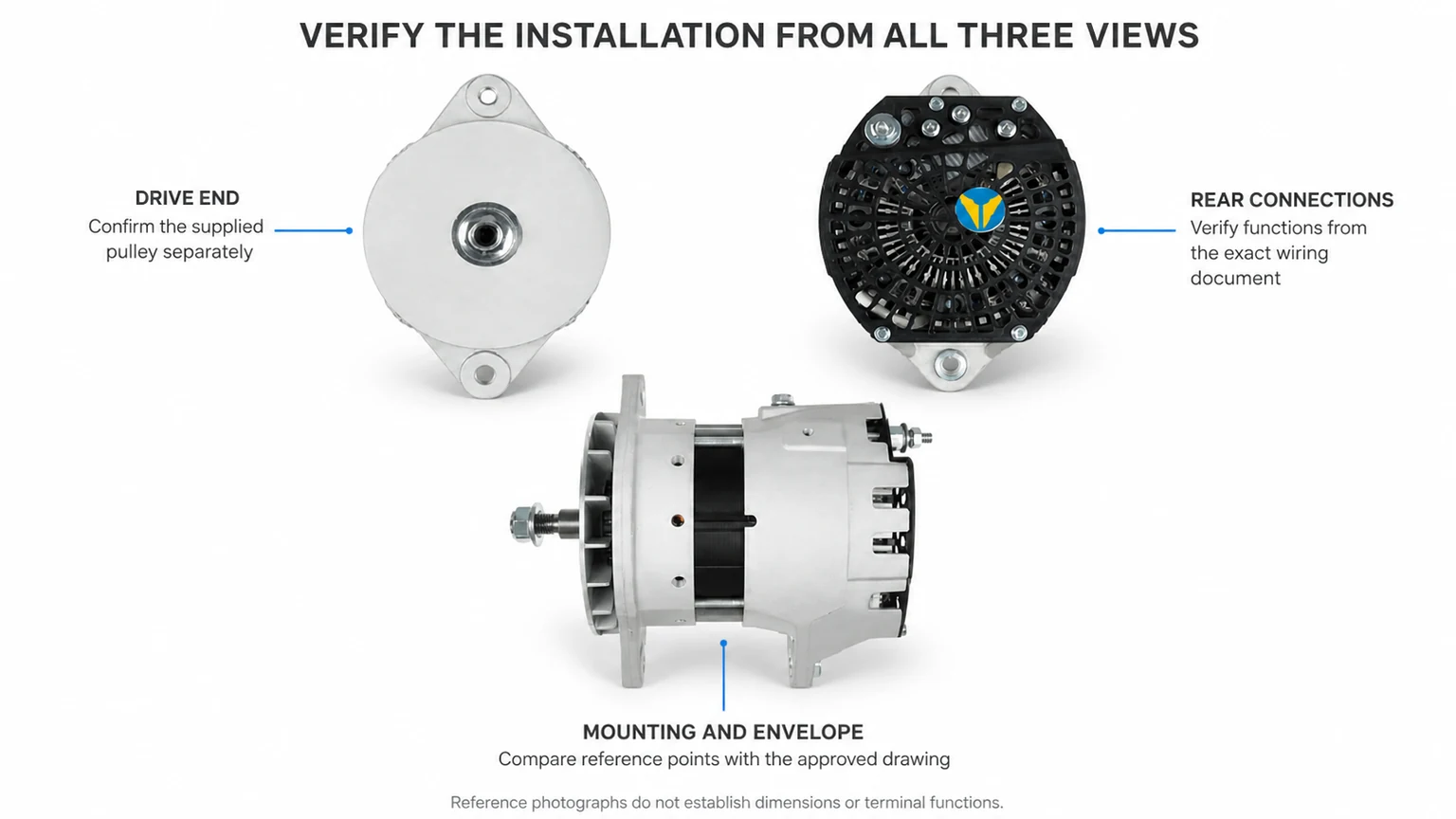
Photographs support interface comparison. Obtain the exact drawing and wiring document; terminal functions and dimensions cannot be inferred from these views.
Delco Remy's Remote Sense explanation describes sensing battery or distribution-point voltage so the regulator can compensate for charging-path voltage drop. That feature is not a substitute for repairing poor connections or an undersized or damaged cable. Follow the exact installation sheet for the alternator and vehicle; terminals with similar letters or positions must not be assumed interchangeable.
Review the charging path when increasing output. The manufacturer's charging-cable guidance demonstrates that current and circuit length, including the ground return, affect cable selection. Its stated assumptions must be respected rather than applying one cable size to every system. The vehicle-specific cable, connection and protection requirements remain the approval basis.
For the installation and commissioning handover, refer to the heavy-duty alternator fitment and commissioning guide. Keep its checks tied to the specific unit's current service documentation.
A “tested” sticker does not tell the buyer what was measured. Request a record associated with the offered part or sample and ask for the test speed, operating voltage, load, relevant temperature condition and acceptance criteria. Where regulation or ripple is being assessed, the method and instrument setup matter. A pass under an unidentified bench condition does not demonstrate loaded-idle performance on the vehicle.
For a thermal-sensitive upgrade, record the exact part number, relevant ambient or heat-soak condition, where temperature was measured, and the output-test basis. If the installation may exceed the proposed unit's stated rating, or the supplier cannot provide comparable hot-output evidence, keep the upgrade unapproved pending manufacturer clarification. Do not use a cold bench result to clear that gap.
Charging diagnosis should also distinguish alternator output from the voltage and current actually reaching the battery. A qualified technician should check the battery condition, drive, connections, control circuit and charging path using current service instructions. Do not replace an alternator solely because the battery is flat, and do not disconnect a battery on a running engine as an improvised test.
For reference documentation, Delco Remy's service instruction sheets provide model-specific installation resources. Select the relevant document rather than treating a procedure for an older conventional alternator as valid for every electronically controlled system.
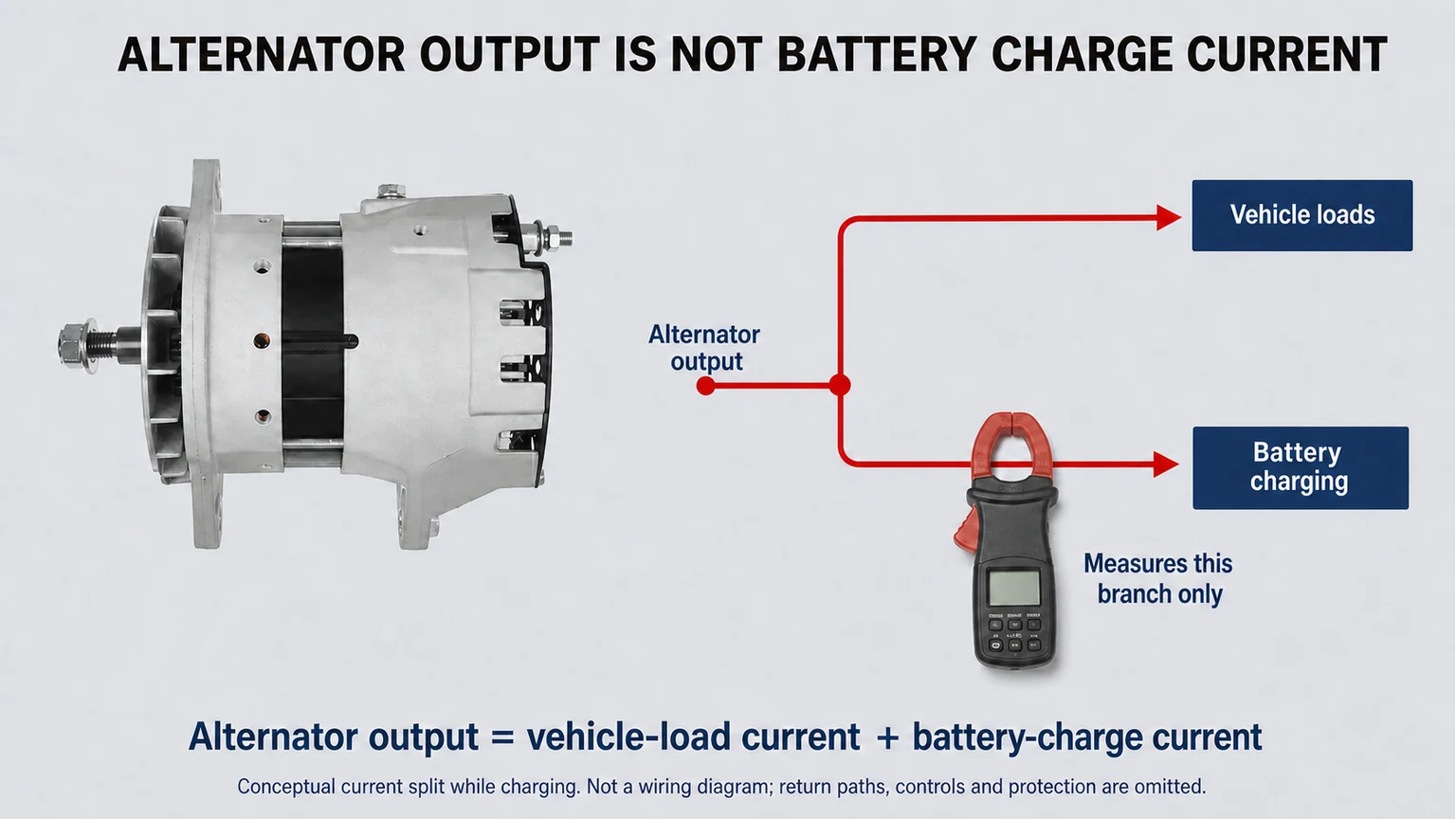
Charging-state current balance only. This is not a terminal wiring diagram; control, protection and return paths are omitted, and no meter reading is claimed.
Record the approved part number, voltage, output requirement, mount, pulley and control arrangement together. A fleet with one truck brand can still require several configurations, especially after engine, accessory or charging-system changes. Consolidate inventory only where an authoritative application record or a properly approved replacement programme supports it.
Start a new configuration with a documented pilot installation. Confirm fitment and operation under the relevant loaded states, retain the results and track the operating conditions during evaluation. A short successful pilot does not establish a universal service-life claim. For repeat orders, make notification of changes to the regulator, pulley, terminals or other approved features part of the supply discussion.
Compare quotations using the same condition, included pulley or accessories, evidence scope, destination and claims process. The B2B alternator price guide can help organise commercial questions, but the actual quotation must establish current price, availability and terms. Do not infer free samples, guaranteed lead times or a warranty programme from this article.
The amperage rating describes output capability, not a constant current forced into the battery. Charging behaviour depends on regulation, battery condition and the electrical system. That does not make any higher-rated unit an acceptable swap: voltage, regulator strategy, battery requirements, cables, protection and belt drive still need approval. If the proposed upgrade changes those conditions, have the charging system reviewed as a system rather than approving it from the nameplate current alone.
The route may combine engine-off loads, short recovery periods and lower available output at idle. First document the charge pattern and check the batteries and charging path; a fault can produce a similar complaint. Compare the verified low-speed output with the loads that actually overlap during the route. If the system is healthy but the duty profile exceeds its recovery capability, a properly evaluated upgrade or a change in the auxiliary-power arrangement may be needed. The symptom does not identify a suitable replacement model by itself.
Yes. Their output curves, thermal conditions, regulation and installation can differ even when the maximum current label agrees. Ask for comparable data at the relevant shaft speed and temperature, then verify the vehicle's drive ratio and control requirements. Also compare whether the published figures concern the same product condition and test basis. Without that context, a claim that one alternator “runs cooler” or “charges better” is not a useful purchasing comparison.
No. Removing brushes from the design does not remove bearings, electronic components, connections, cooling needs or the belt drive. Consider brushless construction as one design characteristic alongside the application's output and environmental requirements. Maintenance and inspection should follow the relevant vehicle and alternator instructions. Do not convert a manufacturer's durability statement into a guaranteed service interval for a different aftermarket product or for a fleet operating under different conditions.
Not on that evidence alone. Establish what the bench test covered, then check the installed control, excitation, sensing and warning-circuit requirements against the correct wiring documentation. A unit can produce current on a bench while still being incompatible with the vehicle's control arrangement, and a vehicle-side fault can also remain after replacement. Record the fault information and measured results before deciding whether the next action is a wiring repair, further diagnosis or a different approved alternator.
Obtain the supersession instructions and identify whether the pulley is supplied, transferred or replaced as part of the approved conversion. Check the specified diameter, offset, groove arrangement and associated installation requirements. Do not send the changed unit under the old stock description without explaining the conversion. If the supporting documentation does not resolve drive alignment and speed limits, keep the proposal separate from the approved direct-replacement stock.
This guide does not design dual-alternator systems, high-voltage electrified drivetrains, marine electrical installations or battery-chemistry conversions. It also does not approve changes that conflict with the vehicle manufacturer's requirements. Those applications need their own engineering and service information. A general fleet replacement guide cannot certify a configuration merely because it uses a familiar alternator family.
Send the installed number and label, vehicle and engine details, nominal voltage, measured duty requirements, mounting and pulley photographs, terminal or connector information, quantity and destination. State whether you need a like-for-like replacement or an evaluated upgrade, and identify any unresolved control or fitment detail.
Ask Elecdura to propose a candidate with its configuration and available supporting information. Require the actual quotation to confirm the offered brand, condition, documents and commercial terms. No manufacturer relationship, test facility, efficiency result or fleet reliability claim for Elecdura is asserted here without product-specific evidence.
Technical source review: Elecdura, 31 August 2026. Manufacturer figures are attributed to their linked documents and should be checked against the exact part and current installation instructions.


