ELECDURA NETWORK

Your Whole New Supply Chain For Heavy-Duty Parts
Whatsapp:
+86 18915027366
Phone:
+86 18915027366
Views: 0 Author: Site Editor Publish Time: 2026-06-03 Origin: Site
Cold cranking amps (CCA) is a rating used to describe a battery's ability to deliver electrical current under specified cold-temperature test conditions. It is an important consideration when selecting a starting battery, particularly for diesel vehicles operating in cold climates.
However, CCA does not measure starter motor torque, and it cannot independently predict whether a heavy-duty diesel engine will start successfully. Starting performance also depends on battery condition, electrical connections, starter motor suitability, engine resistance, and the manufacturer's requirements.
For truck fleets, repair businesses, importers, and distributors, understanding CCA helps separate battery selection from starter motor selection and makes technical discussions more accurate.
CCA stands for Cold Cranking Amps. It describes how much current a battery can deliver under a defined cold-start test.
A CCA rating specifies current delivery at a defined low temperature, for a defined duration and minimum voltage. Check those conditions in the applicable standard and the battery manufacturer's specification; a bare amperage number omits essential context.
SAE International identifies J537_202309: Storage Batteries as a standard for storage-battery testing, written from the standpoint of nominal 12-volt automotive batteries. Its published scope should not be mistaken for a universal test procedure for every heavy-duty 24-volt vehicle system.
A CCA value is therefore meaningful only in relation to its rating standard and battery type. It is not an amp-hour capacity rating, a measurement of the starter's mechanical output, or a guarantee that a particular engine will start under every condition.
A starter motor draws electrical current from the battery and converts electrical energy into mechanical rotation. That rotation must overcome the engine's resistance and turn it fast enough for starting to occur.
Cold conditions can make this task more demanding:
Engine oil may become more viscous, increasing resistance to rotation.
Battery output capability can decrease as temperature falls.
Electrical connections and cables can introduce voltage loss.
A worn, incorrectly specified, or unsuitable starter may not use available electrical power effectively.
Engine condition and the manufacturer's cold-start requirements also influence the result.
A battery with an appropriate CCA rating helps supply the current required by the starting system. But a higher CCA number alone cannot guarantee reliable starting. The battery must also be correctly specified, charged, in suitable condition, and compatible with the vehicle's electrical system.
VARTA's battery specification guidance distinguishes CCA, which describes cold-start capability, from amp-hours, which describe stored electrical capacity. Neither rating replaces the vehicle manufacturer's battery requirements.
Battery labels may show several ratings that are related but not interchangeable.
Rating | What it describes | What buyers should know |
|---|---|---|
CCA | Cold cranking current under a defined test standard | Compare the rating together with the standard used |
CA / MCA | Cranking current under a warmer test condition, commonly 32°F (0°C) for the relevant lead-acid rating | Do not treat a CA value as equivalent to a CCA value |
Ah (amp-hours) | A measure of electrical capacity under specified discharge conditions | Does not directly indicate cold-cranking performance |
Reserve capacity (RC) | The time a battery can supply a specified load under defined test conditions | Provides different information from CCA |
Battery voltage | The nominal electrical system rating | Must match the vehicle's specified electrical architecture |
A CA value is measured under different temperature conditions from CCA. Amp-hours and reserve capacity describe other aspects of battery capability, so comparing these numbers as if they were the same measurement can produce a wrong selection.
For commercial vehicles, the correct battery selection may also involve physical dimensions, terminal layout, mounting, battery-bank configuration, and the vehicle manufacturer's specifications.
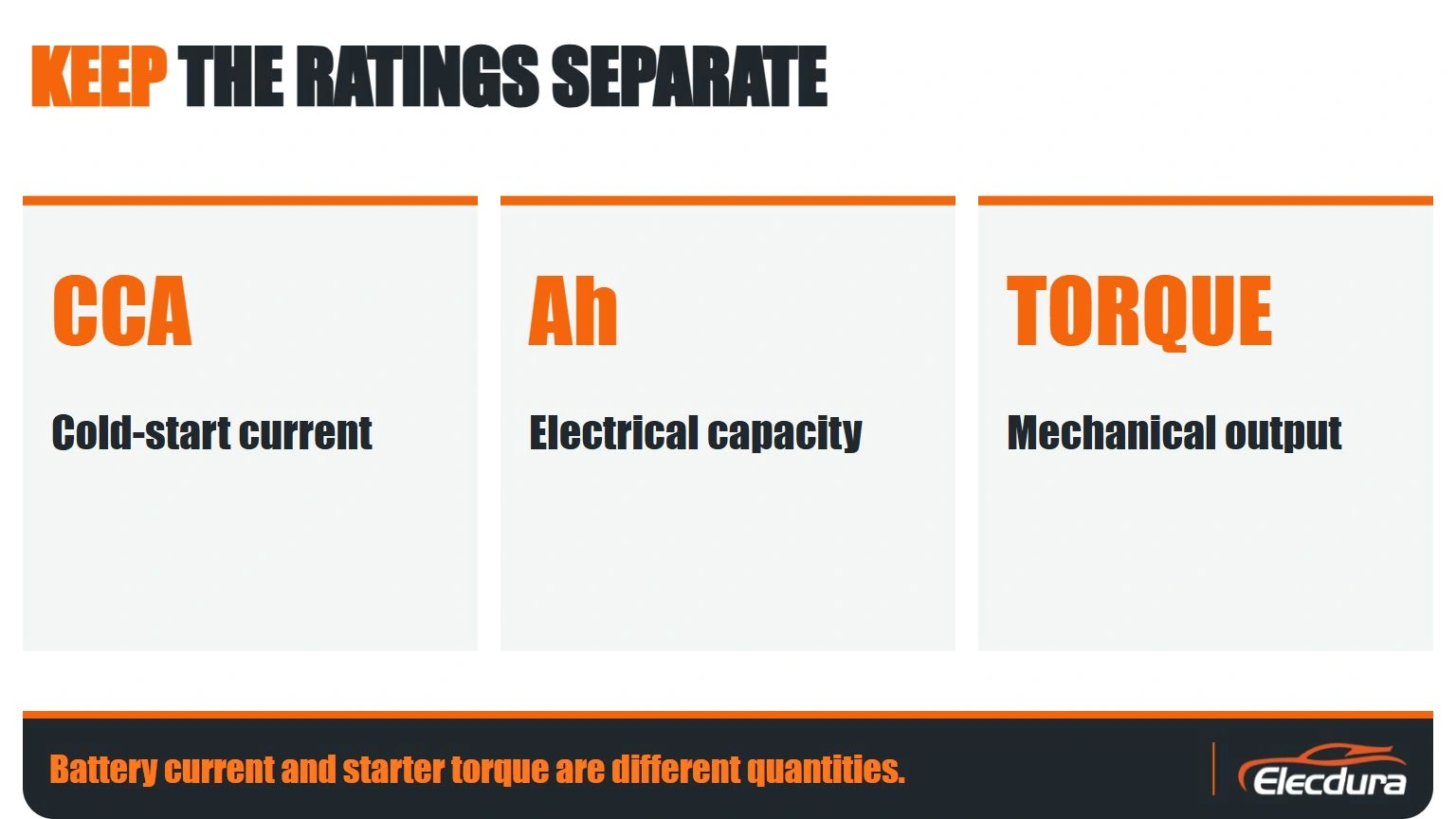
Battery current and starter torque are different quantities.
CCA figures can be misleading when buyers compare ratings without checking how they were established.
SAE, EN, DIN, and JIS methods have different test conditions and acceptance criteria. Depending on the applicable version, differences may include test temperature, discharge duration, and minimum voltage requirements. As a result, the same physical battery can have different numerical ratings under different standards.
Standard or rating | Important consideration | Buyer action |
|---|---|---|
SAE J537 | The familiar CCA method includes a defined cold test for conventional 12V lead-acid automotive batteries | Confirm that the stated rating follows the applicable SAE method |
EN | European battery test requirements use their own defined procedure and acceptance criteria | Read the EN rating and battery specification together |
DIN | Uses a different test method and voltage criteria from the familiar SAE CCA test | Do not assume the number is directly equivalent to an SAE rating |
JIS | Japanese Industrial Standards define their own battery test requirements | Confirm the specific JIS method and battery documentation |
SAE's published J537 scope identifies its automotive storage-battery testing focus. For an EN, DIN or JIS claim, request the applicable standard number, edition and battery test specification before comparing values. Avoid generic conversion factors.
For procurement, the practical rule is simple: compare like with like. If one battery label lists CCA and another lists EN or DIN, do not assume that the larger number represents better performance without confirming the standards and specifications.
Also, do not automatically apply a 12-volt battery's test voltage threshold to a complete 24-volt vehicle system. The applicable battery test standard and the vehicle's battery-bank configuration must be identified separately.
Not necessarily. A higher CCA rating may provide greater cold-current capability within a comparable rating system, but it does not resolve every starting problem.
Consider the following situations:
Situation | Why a higher CCA rating may not solve it |
|---|---|
Battery is discharged or deteriorated | Its actual condition may prevent it from delivering the expected current |
Cable or ground resistance is excessive | Voltage can be lost before power reaches the starter |
Starter motor is worn or incorrectly matched | The starter may not convert available electrical power into suitable mechanical output |
Engine has excessive mechanical resistance | The required cranking load may exceed what the system can deliver |
Battery bank or voltage configuration is incorrect | The battery arrangement may not meet the vehicle's electrical requirements |
When a truck cranks slowly, the battery rating is only one part of the investigation. Battery testing, connection checks, cranking-system measurements, and starter application verification may all be needed.
Do not convert CCA directly into starter torque, power, or a universal engine-displacement requirement. Those relationships depend on the complete system and cannot be reliably determined from the CCA number alone.
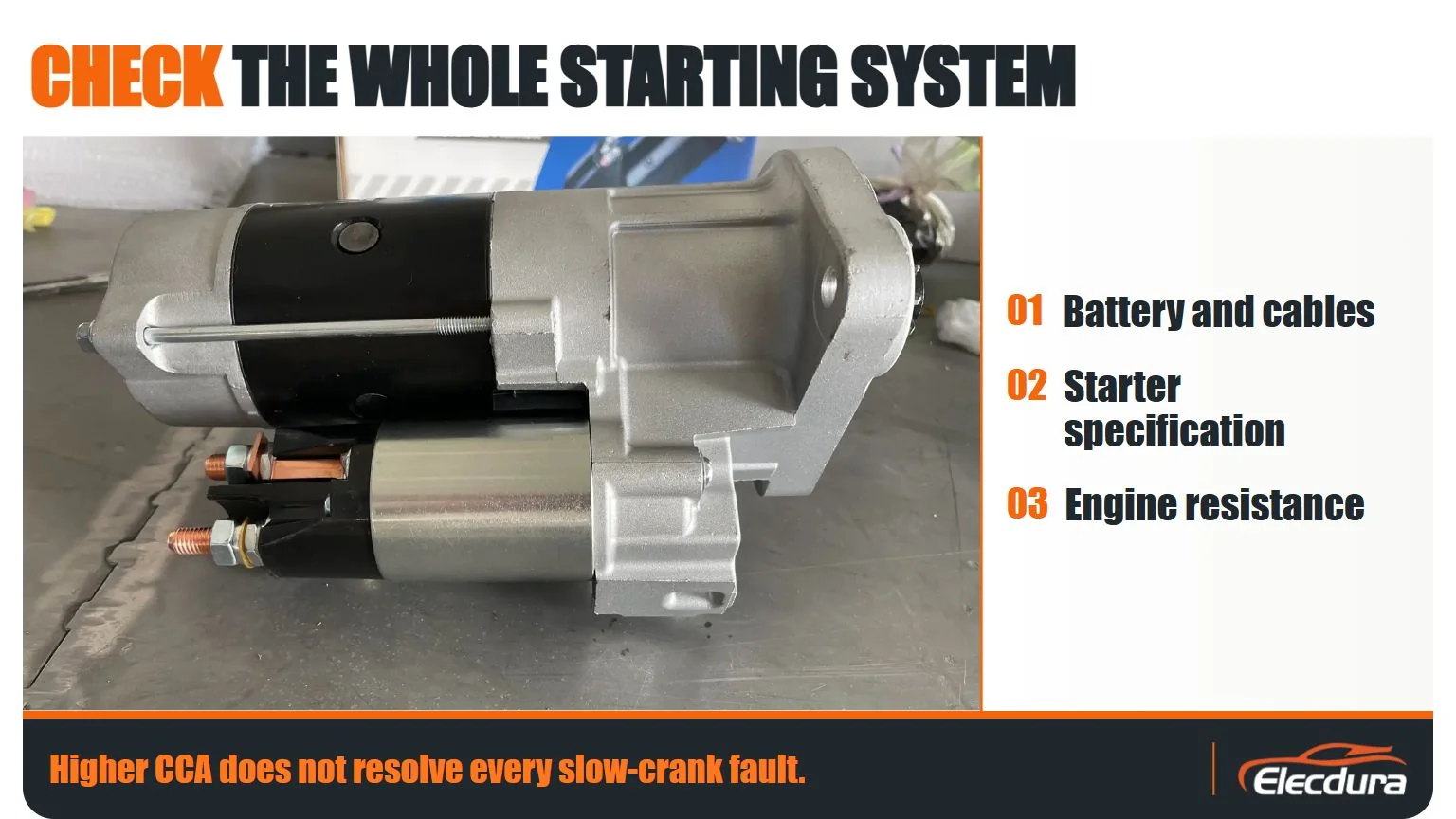
Higher CCA does not resolve every slow-crank fault.
For importers, distributors, and fleet purchasing teams, battery and starter specifications should be considered separately but in the context of the same starting system.
Before confirming a replacement starter motor, gather:
Original starter part number or OE reference.
Vehicle and engine application.
Required electrical system voltage.
Starter power rating and mounting configuration, where specified.
Battery type and the applicable battery requirements.
Information about the actual starting complaint and test results, if available.
When sourcing batteries, confirm the vehicle manufacturer's required rating and the test standard used on the battery label. When sourcing starter motors, verify the starter's own application, electrical specification, and mechanical interfaces.
Elecdura's heavy-duty starter motors category can help buyers compare aftermarket starter requirements. A product's compatibility must be confirmed against the exact vehicle and starter reference; a battery CCA rating does not establish that compatibility.
There is no single CCA value suitable for every diesel truck. The correct rating depends on the vehicle manufacturer's requirements, battery configuration, engine application, operating conditions, and the rating standard.
No. CCA is a battery electrical-current rating under defined test conditions. Starter motor torque is a mechanical output, and no universal conversion from CCA to torque can establish starter suitability.
No. Their test procedures and acceptance criteria differ. Buyers should identify the standard used before comparing the numerical ratings.
Not necessarily. A weak battery, poor connections, voltage loss, an unsuitable starter, or excessive engine resistance may also cause slow cranking. Diagnose the starting system rather than relying on CCA alone.
Do not do so automatically. Identify the relevant battery standard and the vehicle's battery-bank arrangement. A nominal 24V vehicle system may use multiple batteries, and its system-level configuration should not be confused with an individual battery's test conditions.
Cold cranking amps is a useful battery rating for assessing cold-start current capability, but it is not a complete measure of diesel starting performance. The test standard, battery condition, vehicle electrical configuration, starter motor, and engine load all matter.
For heavy-duty aftermarket buyers, the best approach is to use CCA to evaluate the battery against its specified requirements while verifying starter motors independently by their application and technical specifications. This avoids misleading comparisons and reduces the risk of selecting the wrong component to address a starting problem.
If battery and cable checks point to a starter problem, send the starter label, mounting and pinion details for a replacement inquiry. Include system voltage and engine information; CCA alone cannot identify the starter.