ELECDURA NETWORK

Your Whole New Supply Chain For Heavy-Duty Parts
Whatsapp:
+86 18915027366
Phone:
+86 18915027366
Views: 0 Author: Site Editor Publish Time: 2026-07-29 Origin: Site
An A/C compressor clutch transfers drive from the belt-driven pulley to the compressor shaft when its electromagnetic coil is energized and the armature engages the rotor. If the clutch slips, chatters, works only when cold, or refuses to engage, the compressor itself is not automatically at fault. The cause may be an incorrect air gap, a weak or heat-sensitive coil, excessive voltage drop, missing control request, pulley or bearing damage, or excessive compressor torque. Diagnose the electrical command, mechanical condition and clutch interface separately before deciding whether to repair the clutch or replace the complete compressor. This guide applies to compressor designs fitted with an electromagnetic clutch, not clutchless or electrically driven compressors.
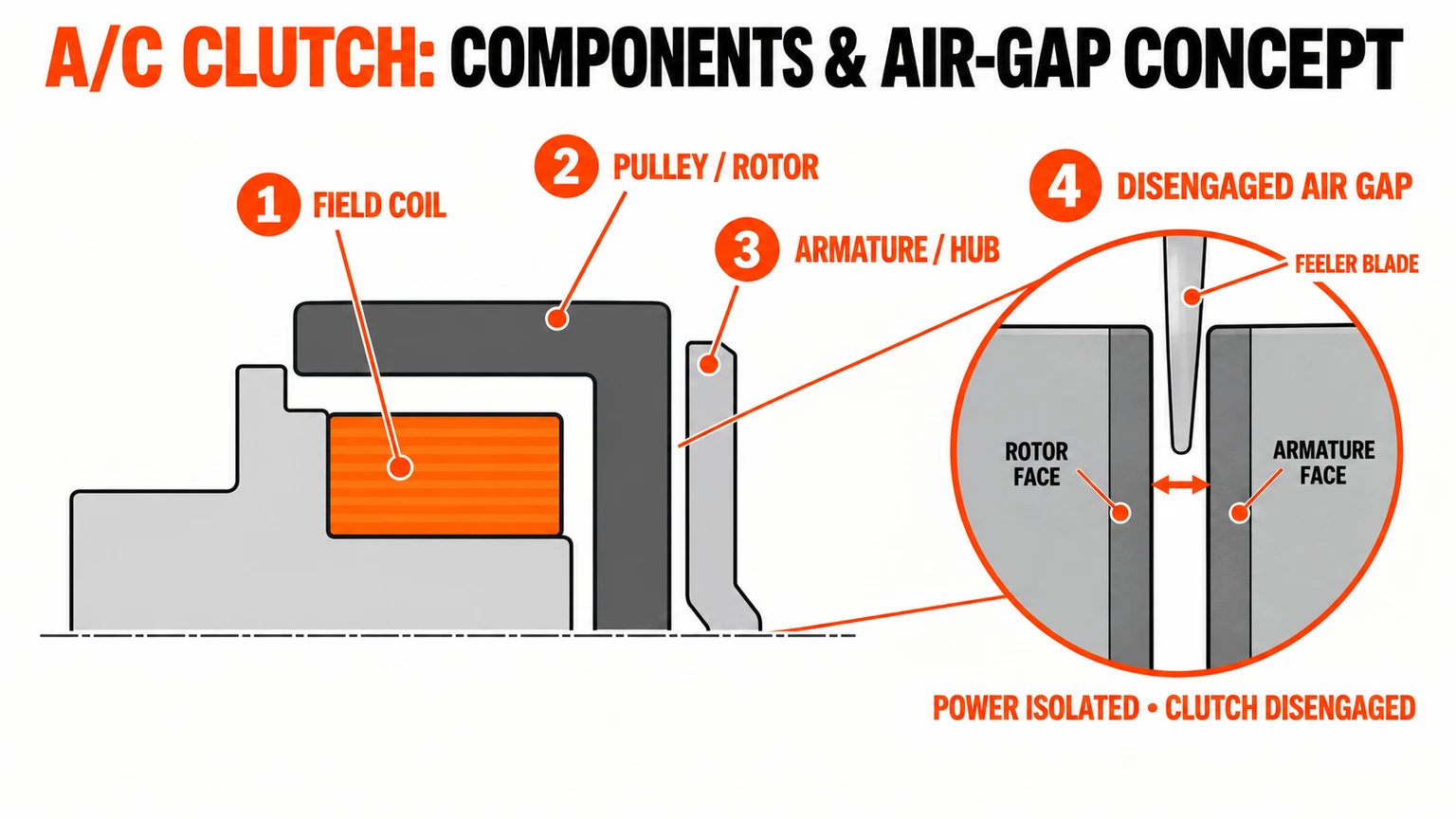
In a conventional electromagnetic-clutch design, the pulley rotates with the engine belt while the clutch is disengaged. When the A/C control system permits compressor operation, electrical current energizes the field coil. The magnetic field attracts the armature plate toward the rotor friction surface, allowing the pulley drive to turn the compressor shaft.
These components have different functions:
Pulley and bearing: support belt-driven rotation while the clutch is disengaged and transmit belt drive to the clutch rotor.
Field coil: generates the magnetic field needed to pull the armature into engagement.
Armature or hub: engages the rotor and transfers torque to the compressor shaft.
Air gap: provides the specified clearance between the armature and rotor when disengaged.
A rotating pulley does not prove that the compressor shaft is being driven. If the armature fails to engage, the pulley can continue turning while the compressor remains disengaged. If the clutch engages but slips, the surfaces may generate intense heat and sustain damage.
Sanden's explanation of clutch slipping and overheating identifies the role of electromagnetic attraction and friction, and lists possible causes including low coil voltage, defective harness connections, contaminated friction surfaces, system overpressure and liquid slugging. These causes can produce similar symptoms, so the diagnosis must establish which condition applies.
First, record what actually happens: no engagement, intermittent engagement, chatter, slipping under load, release after warming, or failure to release. Note ambient temperature, engine speed, A/C demand, time to failure and any relevant fault codes. If the complaint occurs only when hot, measurements taken after the system cools may miss the fault.
Determine whether the control system is requesting compressor operation. Pressure protection, evaporator freeze protection, engine operating conditions, an HVAC control decision or an electrical fault may prevent engagement intentionally. A missing request is not proof of a failed coil.
Identify the circuit from the control source through its fuse, relay or electronic driver, pressure switches or sensors, connector, coil and ground. Verify the circuit design before probing it. Some systems switch the positive side, others switch the ground side, and some use electronic modulation.
Also confirm that the compressor actually uses an electromagnetic clutch. Clutchless variable-displacement designs and electrically driven compressors require different diagnostic approaches.
With the engine safely shut down and the system isolated as required, inspect belt condition, alignment, tension and pulley grooves. Look for contamination, glazing, cracks or signs of belt slip. Follow the equipment manufacturer's procedure before attempting to rotate or inspect the assembly by hand.
Examine the armature and rotor friction surfaces for scoring, discoloration, uneven contact, contamination or damaged components. Check the pulley bearing for abnormal play, roughness or noise using the prescribed inspection method. Record any missing or displaced shims, damaged fasteners or visible distortion.
Heat marks and burnt odour can support a history of slipping, but they do not identify the original cause on their own. Low coil voltage, excessive air gap, contaminated friction faces, excessive compressor torque or system overpressure may all contribute.
If the compressor shaft or driven assembly is mechanically seized or unusually difficult to turn under the approved procedure, do not install a new clutch and assume the problem is solved. Establish whether the compressor itself is serviceable before selecting the repair scope.
The air gap is the clearance between the disengaged armature and rotor. An excessive gap can reduce magnetic attraction at engagement; an insufficient or uneven gap can contribute to drag, heat or premature wear. The correct specification and adjustment method depend on the compressor and clutch design.
Use the specified feeler-gauge method and inspect the gap at the positions required by the applicable service manual. Record the measurement locations, component condition and relevant specification. A single measurement may miss uneven clearance caused by distortion, debris, hub runout or incorrect shim placement.
Do not apply a generic air-gap value from another compressor. Sanden's SD service guide includes separate clutch-inspection and clutch-installation procedures for the models it covers. Its example observations must not be confused with a universal target or adjustment limit.
Adjust the gap only when the exact clutch specification and service procedure are known and the components remain serviceable. If measurements vary significantly around the circumference, investigate alignment, runout, contamination and damage rather than automatically removing shims.
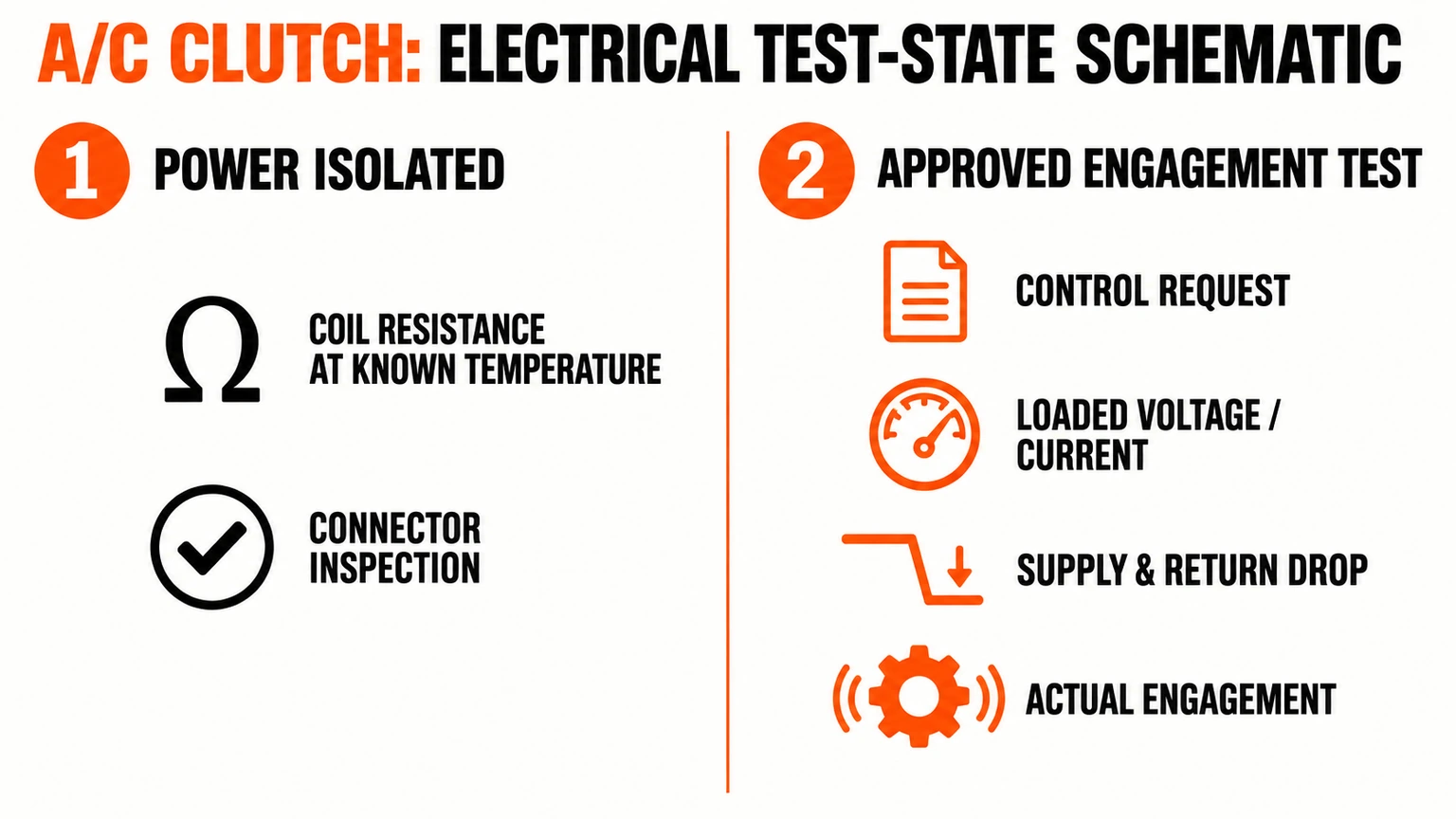
Disconnect the coil as directed by the service procedure and measure resistance with a suitable meter. Check lead resistance and terminal contact so they do not distort the result. Record the coil temperature and compare the reading with the specification for the exact compressor or clutch.
Temperature matters because winding resistance changes as the coil heats. A cold reading within specification may not reveal an intermittent open circuit or another fault that appears only at operating temperature. If the complaint is heat-related, test during or immediately after the fault using an approved method.
Inspect connector retention, corrosion, oil contamination, damaged seals, melted insulation and harness condition. Where an intermittent open is suspected, perform the permitted harness movement test while monitoring the circuit.
Use only the insulation-test method and equipment approved for the particular coil and circuit. Do not apply an arbitrary high-voltage insulation test that could damage the winding or connected electronics. Coil resistance alone cannot establish that the clutch will pull in correctly under load.
When the control system requests engagement, measure voltage at the clutch connector under the actual operating condition. Where the approved procedure allows it, measure coil current with an appropriate current clamp or in-series method. Compare the results with the specifications for the exact application.
Low current can result from inadequate supply voltage, excessive resistance in the wiring or a coil fault. Higher-than-expected current may indicate an electrical problem or an incorrectly specified coil. The interpretation depends on the coil design, supply voltage and control method; do not use one universal current threshold for every clutch.
Observe whether the armature pulls in promptly, remains engaged and rotates in synchronization with the rotor. Chatter or incomplete engagement can be associated with weak voltage, excessive gap, damaged friction surfaces, relay instability or intentional control cycling.
Do not repeatedly force a slipping clutch to engage. Continued friction can increase temperature and damage the armature, rotor, pulley assembly or compressor nose.
A connector may show apparently normal voltage with no load while failing when the coil draws current. Measure the positive-side and ground-side voltage drop during an authorized engagement test, using the method specified for the circuit.
If excessive loss is found, isolate the affected section by checking the relevant fuse contacts, relay, connectors, splices, wiring, module driver and ground points. On an electronically controlled circuit, establish whether pulse-width modulation or another control strategy affects the meter reading before interpreting it.
Do not inject external power into an unidentified control wire or bypass pressure protection to force engagement. Any permitted isolation test must follow the service information and preserve the system's safety controls.
Repair the confirmed electrical defect and repeat the engagement test. Replacing the clutch or compressor before verifying loaded supply and ground conditions can leave the original fault unresolved.
If the clutch works when cold but releases or fails to engage when hot, capture the fault while it occurs. Record coil temperature, connector voltage, current, air gap where specified, pulley and hub condition, compressor pressure data and the controller's request state.
Several conditions can produce similar symptoms: a heat-sensitive coil, a deteriorating connection, insufficient magnetic force, excessive gap, clutch slip, high compressor torque or a protection system removing the command.
Identify which observation changes first, then use it to select the next check:
Observation during the fault | Next investigation |
|---|---|
The controller removes the request | Find the reason for protection or control intervention. |
The request remains, but coil current disappears | Check the electrical supply, connector, driver and coil. |
Current remains present, but the clutch slips | Inspect air gap, friction surfaces and compressor load. |
Use appropriate temperature-measurement tools and keep equipment clear of rotating parts. Stop testing if significant slip, overheating or abnormal mechanical noise develops. Do not continue running a damaged clutch simply to collect additional readings.
A clutch-only repair may be suitable when the compressor is mechanically serviceable, the fault is isolated to a replaceable clutch component, and the correct service parts and procedures are available. Depending on the design, repair may involve the coil, pulley bearing, armature or complete clutch assembly.
Clutch service requires the appropriate removal and installation tools, protection of the compressor shaft, correct retaining hardware, verified shim arrangement, specified air-gap setting and final inspection. Not every compressor supports clutch replacement in the vehicle or offers the same serviceable components.
Consider complete compressor replacement when the compressor is seized, internally damaged, leaking from a non-serviceable area, contaminated or otherwise outside the manufacturer's repair criteria. If internal failure has introduced debris into the refrigerant circuit, determine the required system cleaning and component replacement under the applicable service procedure.
Before ordering a replacement, verify the compressor model, electrical voltage, mounting pattern, pulley and groove configuration, port orientation, rear-head arrangement, refrigerant, oil requirements and vehicle application. A matching clutch connector alone does not establish complete compressor compatibility.
If the repair requires opening the refrigerant circuit, follow the specified recovery, evacuation, oil-handling and charging procedures. A clutch-only repair that leaves the sealed circuit intact does not automatically require refrigerant service. Do not release refrigerant into the atmosphere or use refrigerant addition to force a clutch to engage. Diagnose the reason for a missing command or protective shutdown instead.
Confirm that the clutch engages and releases correctly under the prescribed test conditions. Check the relevant suction and discharge pressures, ambient conditions, vent temperature, condenser airflow, fan operation and control behaviour. A clutch that engages is not proof that the refrigerant system provides correct cooling.
Recheck the electrical and mechanical condition after the system reaches a representative operating cycle. Record any abnormal chatter, slip, bearing noise, excessive heat, unstable engagement or protection intervention. Retain the final test conditions and results with the repair record.
For a replacement enquiry, provide the vehicle or equipment application, engine, compressor identification, OE reference where available, electrical voltage, clutch connector, pulley diameter and groove count, mounting arrangement and relevant photographs. Include the observed failure, air-gap measurements, coil resistance and temperature, loaded voltage and current, voltage-drop results and any relevant pressure or control data.
State whether the requirement is for a clutch assembly, coil, pulley bearing or complete compressor. Confirm whether the proposed replacement includes the required clutch, seals, fittings and other service components. Specify quantity, destination, packaging and any sample or inspection requirements.
An OE reference can help identify the intended application, but it does not prove that an aftermarket replacement is a genuine branded product or that all interfaces are interchangeable. Ask for confirmation of the exact configuration and preserve the approved sample details for repeat orders.
Importers, wholesalers, distributors and fleet maintenance teams can review the Elecdura heavy-duty A/C compressor range and the related A/C clutch coil versus pulley bearing repair guide. For a sourcing enquiry, use the Elecdura contact page and provide the application and diagnostic evidence needed to assess the requested configuration.
No. On an electromagnetic-clutch design, the pulley can rotate while the clutch is disengaged. The armature must engage and transfer drive to the compressor shaft. Confirm engagement and assess compressor operation under the applicable diagnostic procedure.
It can reduce the magnetic force available at the friction surfaces and contribute to non-engagement, but other faults can produce similar symptoms. Measure the gap using the specified method and compare it with the correct clutch specification before adjusting or replacing parts.
Possible causes include a heat-sensitive coil, increased resistance in a poor electrical connection, an excessive air gap, clutch slipping, excessive compressor torque or a control system that removes the request. Capture voltage, current, temperature and control state while the fault is present to distinguish these possibilities.
No. Follow the service procedure to isolate the coil before measuring resistance. Use an approved method for the circuit and account for coil temperature. For an engagement complaint, resistance testing should be complemented by the appropriate loaded voltage, current and functional checks.
That depends on the confirmed failure and the compressor's serviceability. A replaceable clutch component may be sufficient if the compressor remains mechanically sound and the repair procedure permits it. Internal damage, seizure, contamination or a non-serviceable failure may require complete replacement and additional refrigerant-system work.
Do not bypass system pressure protection as an improvised test. The protection may be responding to an unsafe or abnormal operating condition. Diagnose the control request and the reason for shutdown using the manufacturer's approved procedure.
Reliable A/C compressor clutch diagnosis requires the electrical command, air gap, coil behaviour, loaded voltage, mechanical condition and system protection to be evaluated together. A single resistance reading or a visual observation cannot establish that the complete compressor has failed.
For fleet and wholesale purchasing, preserve the failure timeline, measurements, compressor identity, voltage, pulley and mounting details, port arrangement and post-repair acceptance criteria. This evidence supports a more precise aftermarket replacement decision and reduces the risk of ordering a complete compressor when the fault lies in the clutch circuit or another part of the system.