ELECDURA NETWORK

Your Whole New Supply Chain For Heavy-Duty Parts
Whatsapp:
+86 18915027366
Phone:
+86 18915027366
Views: 0 Author: Site Editor Publish Time: 2026-06-17 Origin: Site
A wholesale starter-motor quote is not ready for approval because the supplier recognizes an OE number or sends a matching product photograph. Importers need a traceable chain from the installed application to the quoted reference, dimensional and electrical compatibility, controlled sample evidence, and repeat-order safeguards. This revised guide compresses the decision into five gates: identity, fitment, electrical performance, production control, and commercial release.
The process applies to heavy-duty trucks, buses, agricultural machines, construction equipment and industrial engines. It does not create an interchange from incomplete data, and the illustrations do not certify a factory or product.
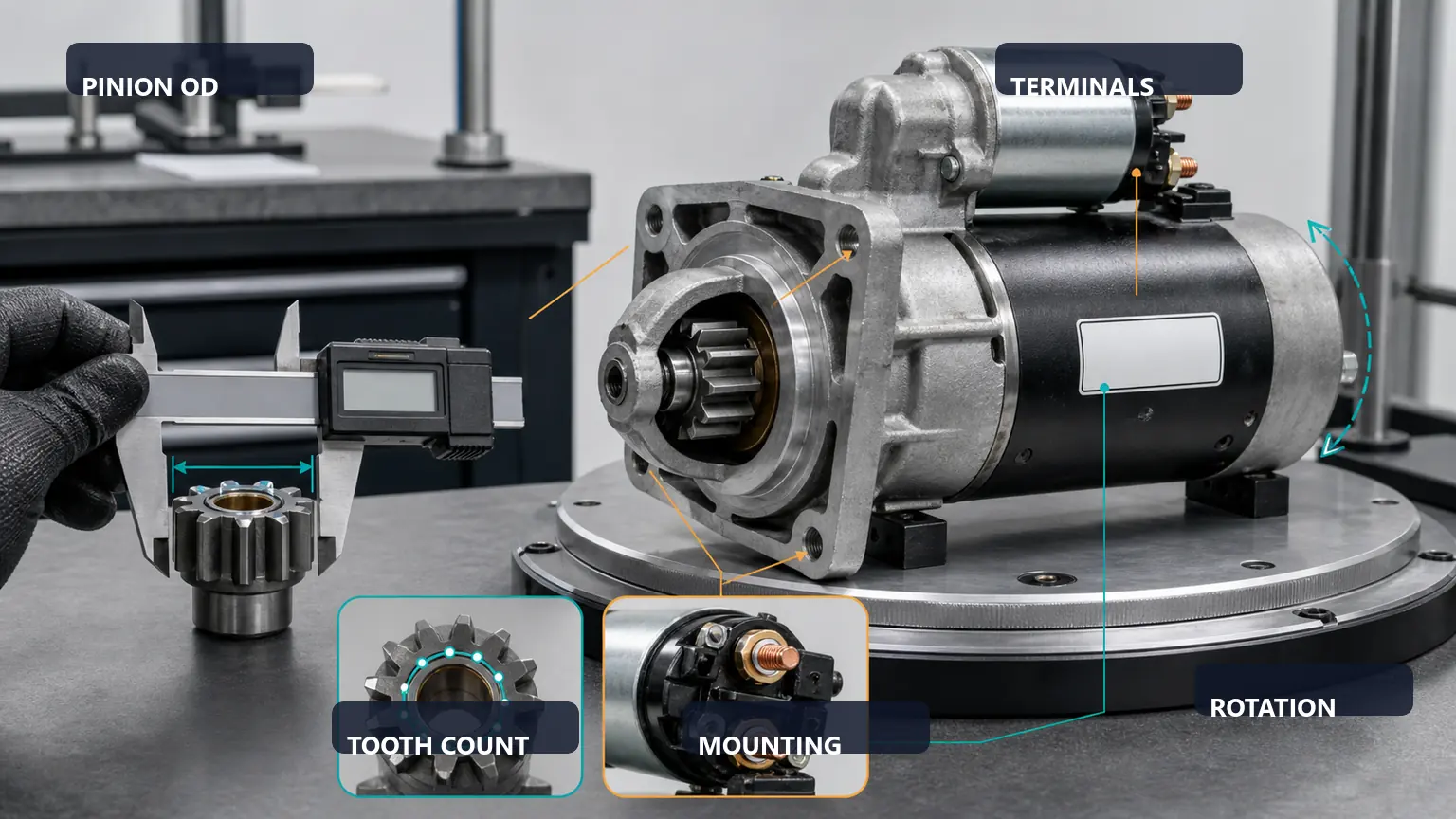
Start with the installed unit and equipment record. Capture every readable number and suffix, the brand and label, equipment model, engine, machine serial range where relevant, system voltage, mounting arrangement, pinion tooth count, rotation, solenoid orientation, terminal map and any spacer or nose-housing detail. Photograph the unit from multiple angles with the label and interfaces visible.
If a number has been superseded, ask for the source, revision date and direction of the supersession. Do not treat marketplace listings or a seller-maintained cross-reference as final proof. When the original unit is damaged or unavailable, mark the missing fields explicitly instead of letting the supplier infer them silently.
RFQ field | Required response | Hold when |
|---|---|---|
Offered identity | Manufacturer reference, condition, revision, declared brand and production site. | The quote only repeats the buyer’s OE number. |
Fitment basis | Cross-reference source, application record and controlled drawing. | Compatibility is based on appearance or an undated list. |
Electrical data | Voltage, power or output basis, rotation, terminal functions and test method. | Only “12V” or “24V” is supplied. |
Mechanical data | Mounting pattern, pilot, pinion, engagement and critical envelope dimensions. | No datum-based drawing is available. |
Supply terms | MOQ, lead time, Incoterm, packaging, warranty, traceability and change notice. | Price is clear but responsibility is not. |
Incoming inspection should reconcile the physical sample with the approved documents. The staged image provides no approved dimensions or supplier evidence.
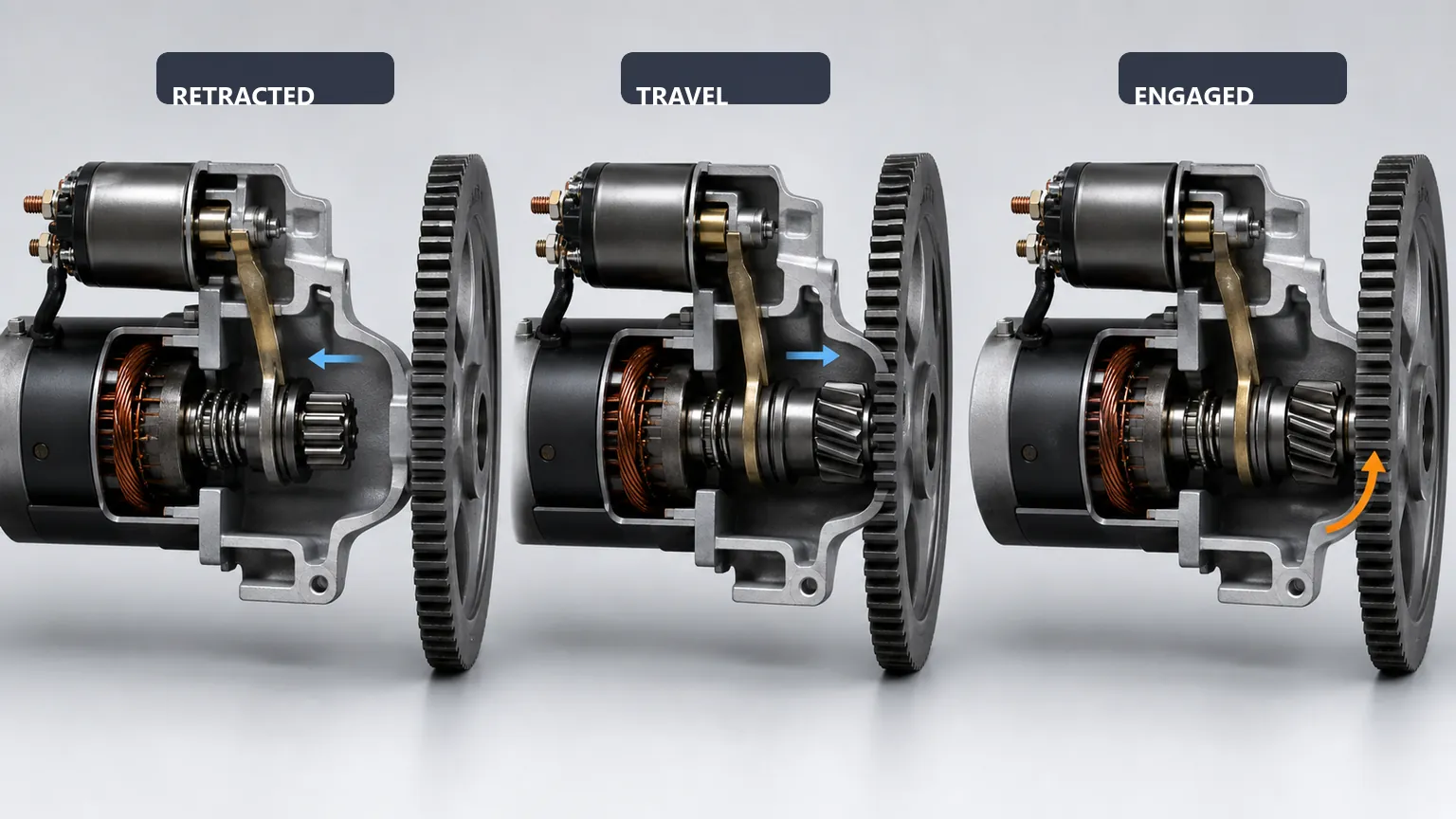
A starter must align the mounting, pilot, pinion and ring gear as a system. Compare mounting-hole size and spacing, flange and pilot geometry, nose-housing clearance, pinion tooth count and profile, at-rest position, travel, rotation and solenoid clocking. Confirm that cables, boots and service tools can reach the terminals without interference.
Measure from defined datums. Two housings can look alike while shifting the pinion or terminal position enough to cause noise, incomplete engagement, damaged teeth, cable strain or installation refusal. Do not grind a housing, force bolts, change a spacer, or swap a pinion to make an unapproved sample fit.
Voltage compatibility is necessary but not sufficient. Confirm the rated system, solenoid coil arrangement, terminal function, rotation, no-load test basis and the manufacturer’s applicable performance specification. On modern equipment, confirm any relay, interlock or control-module relationship before blaming the starter for a no-crank condition.
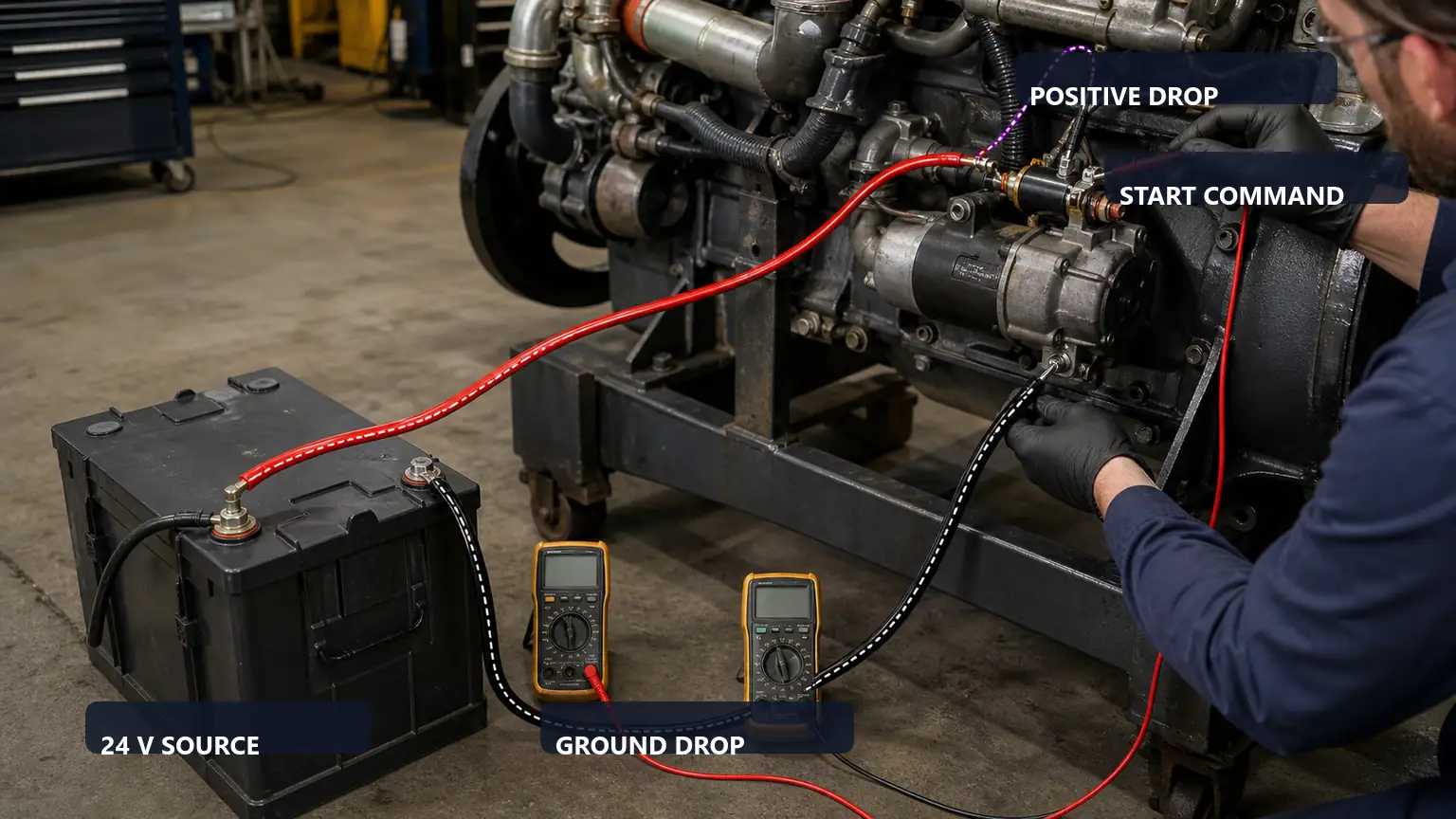
Use voltage-drop testing to separate a starter problem from cable, connection, battery and ground losses. The heavy-duty starter voltage-drop guide explains that diagnostic boundary. A bench result should be recorded with the method, voltage, temperature and instruments; an unlabeled video is not a controlled test record.
A vehicle-circuit check and a supplier sample test answer different questions. Record both without using one to substitute for the other.
First reconcile the supplier, manufacturer, exporter and bank beneficiary. Request the current business registration and quality certificate, then verify the certificate with its issuer and confirm the scope and site. A factory video can help orientation, but it does not prove that the quoted starter or current lot used the shown process.
Ask which operations are performed in-house and which components are purchased: armature, field coil or magnets, commutator, drive, solenoid, bearings or bushings, brushes, housing and fasteners. Require approved-source and change-control rules for critical components. If the supplier will not disclose internal sources, it can still commit to frozen performance, traceability, validation and written change notification.
Approve documents before testing. Assign each sample an ID and record the carton, label, lot code, dimensions, mass and visible workmanship. Check the pinion and one-way clutch without unsafe energization. When bench testing is justified, use guarding, suitable cabling, a defined duty cycle and qualified personnel. Do not run an unsupported starter loose on a bench.
Engagement geometry must match the application. This educational illustration is not a release drawing or a substitute for ring-gear inspection.
Freeze the approved part number, revision, drawing, critical interfaces, electrical requirement, label, packaging, warranty route and sample identity in the purchase specification. Define pre-shipment evidence and the receiving plan. A first order can use tighter sampling while the buyer establishes supplier history.
For repeat orders, compare lot codes, labels, key dimensions and agreed performance evidence with the approved master. Require notification before a regulator, solenoid, drive, armature, housing, supplier, plant or process change. Quarantine an unexplained change even when the unit still looks compatible.
Release stage | Minimum record |
|---|---|
Document review | Identity, fitment source, drawing, electrical data and unresolved-field list. |
Sample receipt | Sample ID, label, packaging, dimensions, visual inspection and discrepancy log. |
Controlled testing | Method, instruments, conditions, results, operator and disposition. |
Order release | Approved revision, quantity, terms, packaging, traceability and change control. |
Receiving | Lot record, sampling result, nonconformance route and retained evidence. |
No. It begins the review. Verify the source, supersession, application, interfaces, electrical specification and sample.
Not as a universal rule. Use the starter manufacturer’s applicable specification and a controlled method. One isolated number does not establish cranking performance or durability.
No. It may support system qualification after validation, but the exact product, process, lot and change controls still require evidence.
Only if the condition is unmistakably separated. Define construction, labels, warranty, core policy, testing and approval for each program.
Review heavy-duty starter categories for orientation, then send Elecdura the installed reference, application, voltage, interface photographs, quantity and destination. Ask what fitment and performance evidence is available for the proposed reference. Keep the order on hold when an important field is unresolved.
Technical review updated September 4, 2026. The workflow is a procurement and verification framework, not an approved application specification. Limits and acceptance criteria must come from the applicable equipment and component documentation.