ELECDURA NETWORK

Your Whole New Supply Chain For Heavy-Duty Parts
Whatsapp:
+86 18915027366
Phone:
+86 18915027366
Views: 0 Author: Elecdura Publish Time: 2026-09-14 Origin: Site
For a U.S. motorcoach buyer investigating a reference written as 0-120-689-566, KIRKS publishes two relevant leads: its KT140A and Prestolite 1277A680SS listings. They are not identical offers, and the reference strings on the page are not identical either. Preserve the exact strings and ask the supplier to confirm their relationship to the installed alternator before comparing the proposed units. This guide explains that narrowly defined buying decision. It does not establish a two-way interchange, recommend a higher-output conversion or rank the products by reliability. A catalogue lead becomes an eligible quotation only after the vehicle and supplied configuration are resolved.
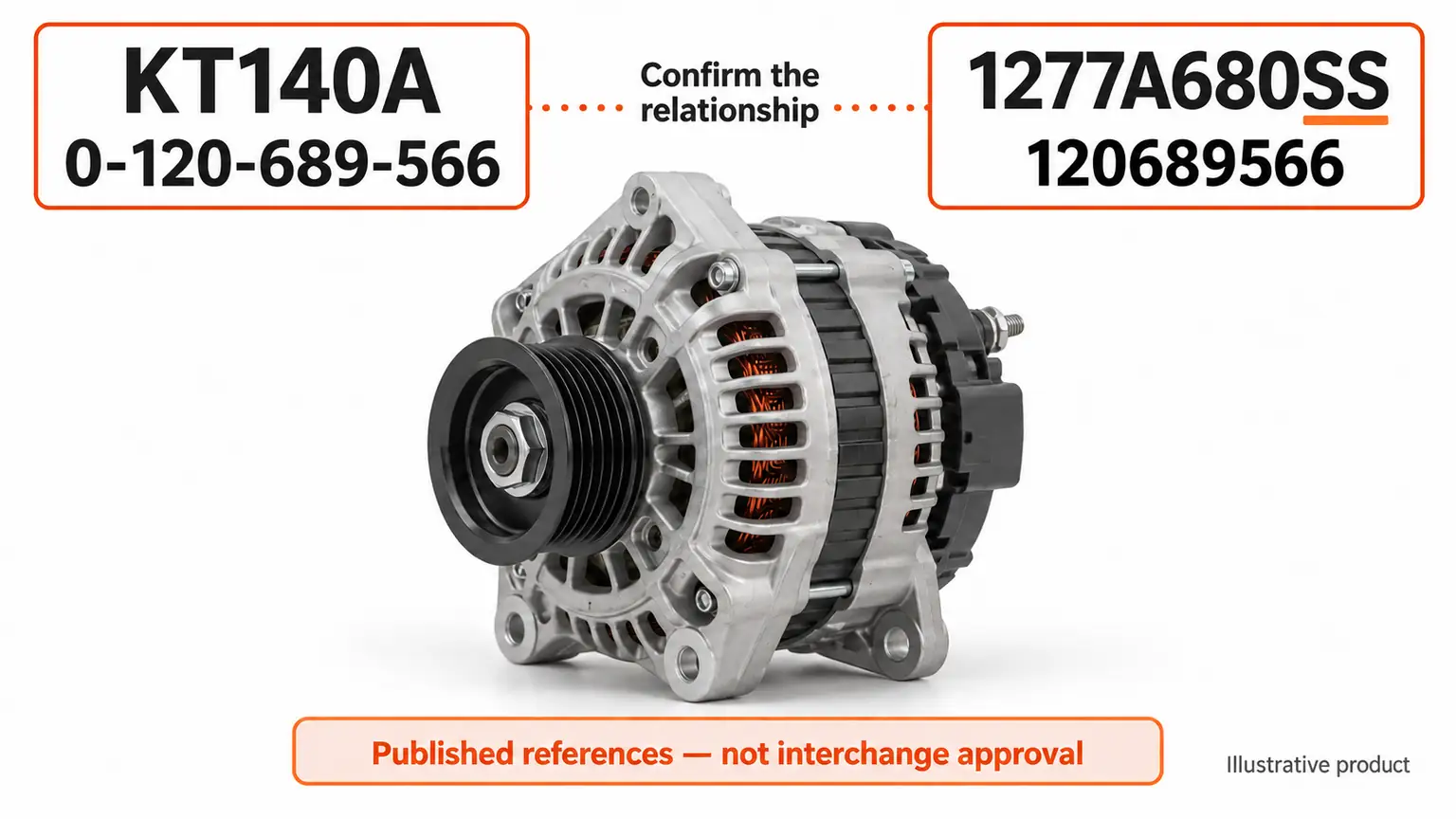
The KIRKS T1 alternator page lists KT140A as 24 V, 140 A for motorcoach applications, including reference 0-120-689-566. It lists Prestolite 1277A680SS as 24 V, 155 A for motorcoach applications, with 120689566 among its references. The strings below retain that difference instead of assuming the missing leading zero is irrelevant.
Offered identity shown | Nominal figures shown | Reference string relevant to this enquiry | Decision still required |
|---|---|---|---|
KIRKS KT140A | 24 V; 140 A | 0-120-689-566 | Confirm the complete proposed assembly for the coach. |
Prestolite 1277A680SS | 24 V; 155 A | 120689566 | Confirm the reference relationship and retain the SS suffix. |
These are two products on one seller's page, not two independently assessed suppliers or factories. KIRKS publishes locations in Detroit, Michigan, and San Leandro, California, which makes it a documented U.S. enquiry route. That does not confirm where either quoted unit will ship from or whether it is available for a particular order.
For a wider aftermarket enquiry, the Elecdura heavy-duty alternator catalogue provides a category entry point. No specific KT140A or Prestolite stock, genuine-brand supply or approved substitute is established by that category link.
Parts systems often separate the number a customer supplied from a normalized search key. That distinction matters here. You may search alternative formatting to find possible records, but retain the original marking and the seller's exact offered reference in separate fields. A search result is a candidate relationship, not the application approval itself.
The reference strings are transcribed from the cited KIRKS listings. The generic illustration is not either listed unit, and the image does not establish interchangeability.
Send the label photograph and both page entries to the supplier. Ask whether the two reference strings identify the same original application in this context and, if so, which exact offered assembly is supported for the identified coach. Request the basis of that match, including any configuration qualification or supersession.
Do not let the request become an unqualified order for “a 24 V motorcoach alternator.” That would discard the evidence that made the comparison useful. Keep the make, model and vehicle identification available, together with the installed alternator markings and any known charging-system changes.
The proposed Prestolite identity in this comparison is 1277A680SS. An offer that omits the suffix, substitutes another suffix or supplies only a family name should return to the clarification stage. Ask the seller to confirm the full supplied reference and explain any difference before ordering. Do not assume that a shorter warehouse description means the missing characters are optional.
Also keep the installed-unit identity separate from a seller's internal stock code. A purchase order should show both when both are needed, with their roles stated. Otherwise receiving may compare the wrong identifier and accept a unit whose application relationship has never been established.
The listed 140 A and 155 A ratings are not a common-condition performance test. They do not tell the buyer what either alternator delivers at the coach's loaded idle, at its operating temperature, or with its actual pulley ratio. A larger nameplate figure therefore cannot resolve an uncertain replacement relationship.
If the request is a like-for-like repair, first ask for the supported replacement configuration. If the request is to change charging capability, state that explicitly and involve the responsible vehicle or system specialist. The second request needs an engineering assessment of the installation and its operating duty; it is not simply the first request with a larger number selected.
A buyer comparing performance evidence should request data for the exact proposed references under comparable speed, voltage and temperature conditions. Keep the measurement basis with the figures. Where the supplier cannot provide comparable output information, mark performance comparison as incomplete instead of assigning a winner from nominal amperage.
The fleet alternator selection guide covers the broader electrical-demand and operating-speed questions. This article's task is narrower: decide whether these two particular catalogue leads can become comparable motorcoach quotations.
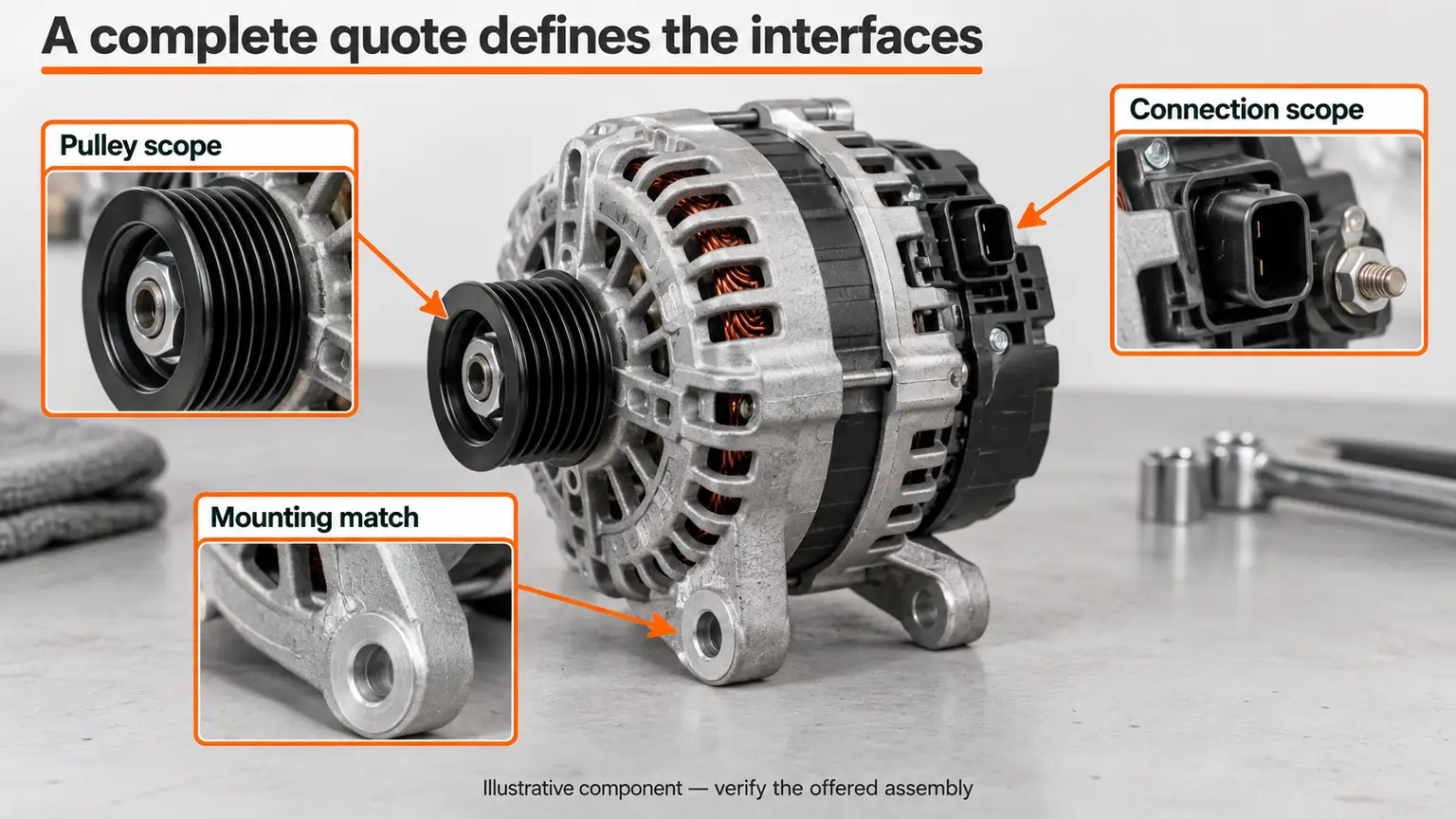
Once the supplier confirms an eligible reference, ask what physically arrives and what the installer must provide or retain. Resolve the mounting arrangement, pulley and connection requirements against the coach documentation and the exact offered unit. Do not infer included accessories or permission to transfer parts from a catalogue photograph.
Generic generated component used to illustrate quotation questions. The actual offered unit and coach documentation must establish each interface and any transferred parts.
Prepare the enquiry in this order:
State whether the job restores the existing configuration or proposes an electrical-system change.
Attach the coach identity and a readable image of the installed alternator label.
Quote the relevant KIRKS page entry exactly, including the reference-string difference and the full Prestolite suffix where applicable.
Ask for the complete offered identity, product condition and documented application basis.
Request the supplied pulley, connection and accessory scope, with any transferred parts explicitly identified.
Give the delivery destination and required date, then obtain current availability and written commercial conditions.
For the commercial comparison, separate the unit price from freight, any core deposit and any required additional parts. Do not assume a core charge exists, and do not assume it does not exist. Ask whether the quote is outright or exchange, which old unit would be eligible if an exchange applies, and who decides acceptance.
Ask the actual seller how an incorrect part or an unresolved application will be handled before it is installed. Keep those terms with the quote. A supplier address or brand name is not a substitute for the applicable return and warranty responsibilities.
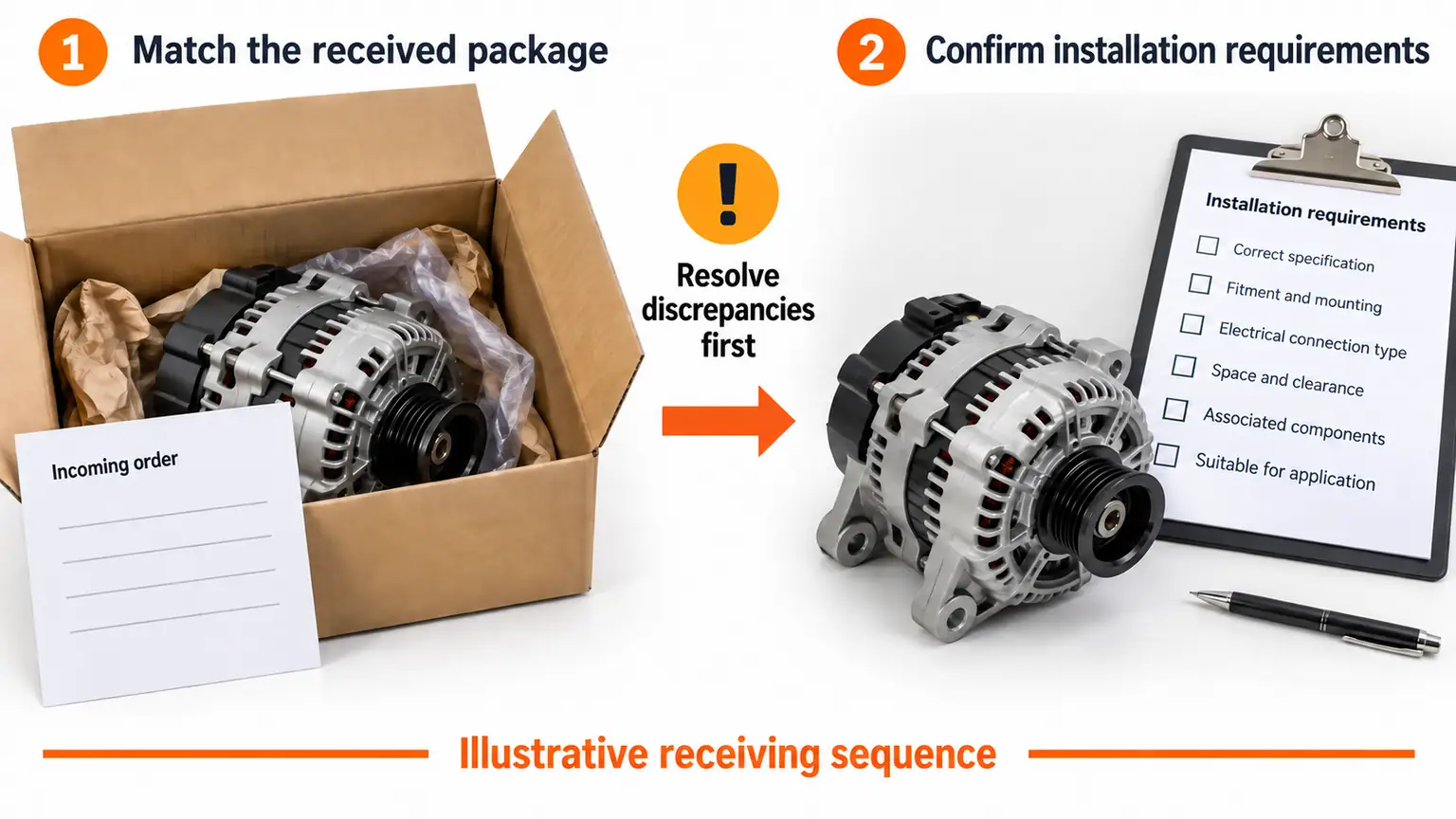
When the package arrives, compare its full identification and supplied components with the confirmed offer before installation. If the unit differs, preserve photographs and packaging and refer the discrepancy to the seller. A receiving check establishes whether the agreed item arrived; the workshop still owns the required installation and charging-system acceptance.
Illustrative receiving sequence. Confirm identity and supplied scope against the agreed offer; installation and charging-system acceptance remain separate workshop responsibilities.
A page containing several alternators is not an application cross-reference for every item on it. This comparison deliberately excludes other models from the seller's catalogue unless their relationship to the identified coach is established. A nearby image, matching voltage or similar rating does not add a third eligible option.
Likewise, do not route an auxiliary-power-unit enquiry through a motorcoach charging comparison simply because both vehicles use alternators. The refrigeration and APU buying-program guide starts with the auxiliary unit and its engine; it addresses a separate application record.
This shortlist also does not diagnose a charging complaint. If the alternator has not been identified as the failed component, the vehicle's battery, connections, controls and operating conditions require the appropriate diagnostic process. Selecting a plausible replacement cannot prove that the original unit caused the fault.
Keep a protected original-reference field or attach the label image and supplier document to the transaction. A normalized key can assist searching, but it should not replace the reference printed on the part or the full offered number. If normalization joins records, require application confirmation before using that joined result to consolidate stock.
Ask for the assembly's supplied scope and the applicable installation instruction. The confirmed number is useful, but it does not answer whether the quotation includes the required pulley or depends on an approved transfer. Do not compare it as a complete ready-to-install package until that boundary is clear. An unresolved pulley arrangement belongs on the quote, not in an assumption made after delivery.
Request output evidence for the actual installed alternator speed, operating temperature and electrical duty during that stop. A nominal maximum does not describe that operating point. If the coach's complaint occurs there, keep the measured system demand and charging behaviour attached to the review rather than replacing an unresolved idle-performance question with a higher headline rating.
Keep the unconfirmed unit outside the approved comparison. Ask whether the remaining eligible offer meets the required supply condition, configuration and delivery terms; do not fill the gap with a nominally similar unit. Another seller may provide a comparable quote when it identifies a supported complete assembly. A second price for an unsupported reference does not create a valid alternative.
Obtain a current quantity and dispatch commitment from the supplying entity first. Ask whether the offer depends on transfer, sourcing or an exchange process, and confirm the delivery destination. A catalogue listing establishes a product lead, not a reservation. Only the seller's order-specific response should support the date communicated to the workshop.
If an aftermarket alternative is permitted, the Request a Quote form below can start a separate Elecdura enquiry. Provide the coach identity, installed reference and unresolved configuration questions, and request the matching basis for any offer. Do not describe an output change as a routine replacement. Elecdura is not represented as KIRKS or Prestolite's authorized agent.
Catalogue review: 9 September 2026. This is an unranked comparison of specific enquiry leads; no bench test, vehicle fitment trial or live-stock verification is claimed.