ELECDURA NETWORK

Your Whole New Supply Chain For Heavy-Duty Parts
Whatsapp:
+86 18915027366
Phone:
+86 18915027366
Views: 0 Author: Elecdura Publish Time: 2025-09-15 Origin: Site
Brazil has documented turbocharger manufacturing and aftermarket operations, but a Brazilian sales address does not prove that a quoted turbo was manufactured in Brazil. For truck, agricultural and industrial replacement orders, establish three things separately: the exact engine application, the organisation responsible for the product, and the route by which the unit will reach your workshop or warehouse. BorgWarner and Cummins publish relevant Brazilian operation details; other brands provide distributor-search routes. Use those sources to investigate suppliers, then compare local delivery, imported supply and repair proposals against the same technical specification. Do not choose from an unsupported “top manufacturers” ranking.
This guide is for fleet purchasers, repair distributors and importers buying for Brazilian installations. It also helps overseas buyers distinguish Brazilian manufacture from goods merely dispatched by a Brazilian trader. To identify product candidates first, consult the complete turbocharger category with the installed assembly number and engine details at hand.
Manufacturer location pages are a better starting point than a directory that labels every seller a factory. The following sources establish a local operation or a way to investigate the distribution channel. They are not a ranking, a stock list or proof of origin for an individual shipment.
BorgWarner's Itatiba location page describes production that includes turbochargers and applications in commercial vehicles, agriculture and construction equipment. Its Portuguese aftermarket turbocharger page provides product and distributor research routes and lists the South/Central American contact in Itatiba. This supports checking BorgWarner's Brazilian channel; it does not establish that every BorgWarner part number offered in Brazil is made at that plant.
The Holset Brazil location record lists Cummins Turbo Technologies in Guarulhos and describes turbocharger manufacture, remanufacture and aftermarket parts supply. Cummins also publishes its Brazilian distribution network. Use the appropriate channel to check an actual Holset assembly and service requirement rather than assuming all units sharing a Holset family name suit the same engine.
Garrett offers a Portuguese-language distributor locator. A supplier found through an official distribution route has a different evidential basis from a company simply displaying a Garrett logo. Verify the particular seller and enquiry through the current manufacturer channel. The locator should not be used as evidence that a listed distributor manufactures turbochargers.
For additional global manufacturer and specialist roles, the turbocharger manufacturer and supplier verification guide provides a separate shortlist. An organisation's global product range still needs to be checked against its Brazilian sales and support arrangements.
These routes solve different purchasing problems. A fleet facing one immobilised vehicle may value a confirmed local replacement and accessible fault investigation. A distributor planning repeat replenishment may be able to approve an imported configuration and organise a longer supply cycle. A qualified repair workshop may retain a serviceable housing or other components, but that is not the same offer as a complete new assembly.
| Proposed route | Question that decides whether it is usable | Information needed from the quotation |
|---|---|---|
| Delivery from stock in Brazil | Is the exact approved configuration physically available for the required destination? | Part number, stock location, dispatch commitment, delivery basis, invoice issuer and local claims contact |
| Imported new replacement | Can the technical and import requirements be resolved before dispatch? | Product identity and condition, origin information, shipment scope, packing details and documents for the responsible import professional |
| Remanufactured or repaired unit | Is the restoration scope suitable, and are any core-return obligations workable? | Retained/replaced components, inspection and calibration evidence, exchange conditions and responsibility for return handling |
Do not label one route universally cheaper or faster. A locally advertised item may still be awaiting overseas replenishment; a low imported unit price may exclude costs that another quotation includes. Ask both sellers to quote the same destination and clearly describe what is included. Treat an unconfirmed dispatch date as an estimate, not available stock.
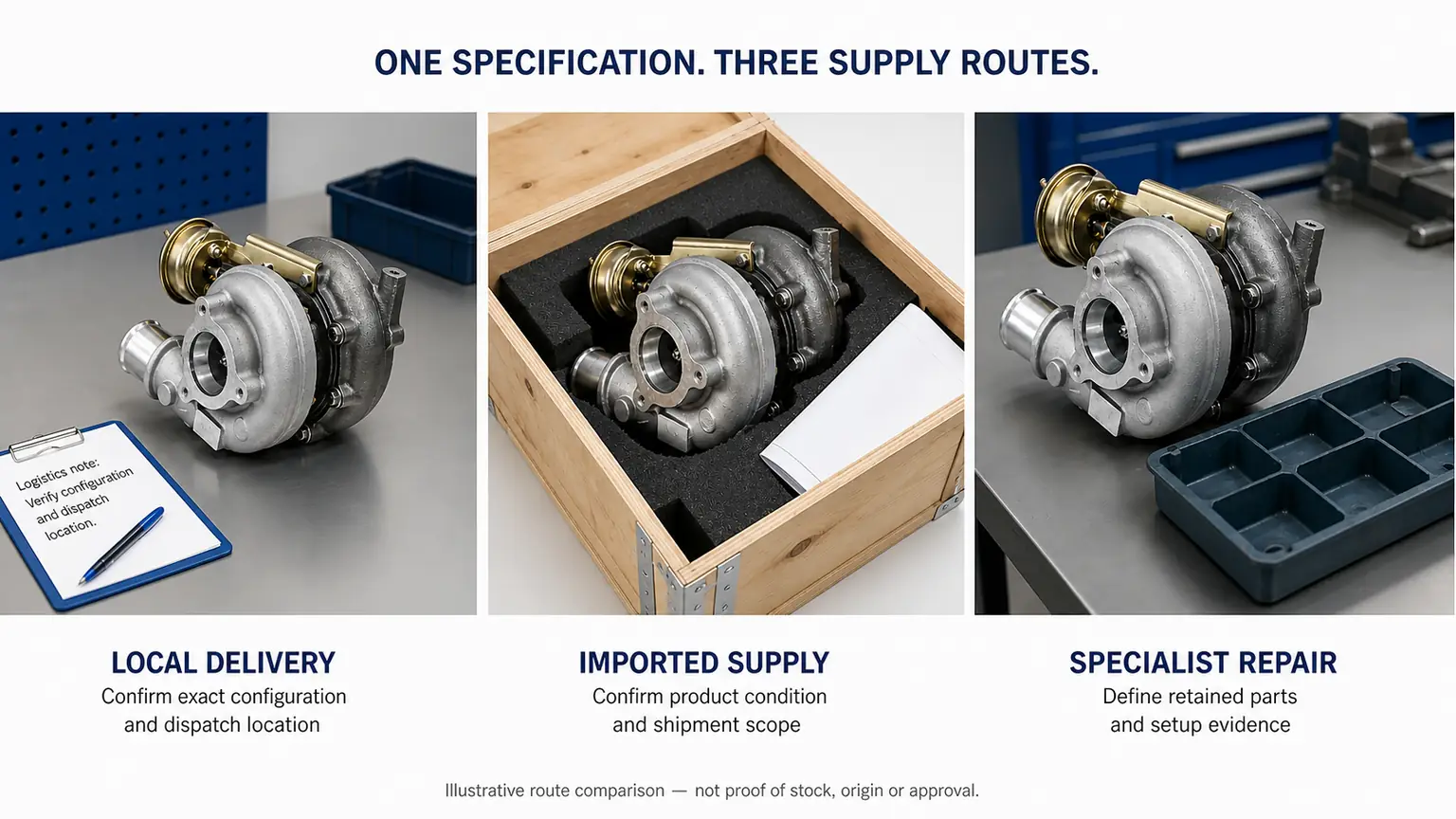
Compare routes against one approved configuration. These scenes do not establish a supplier's stock, origin, workshop capability or packing policy.
Technical ambiguity can enter a transaction when an engine number, turbo family and supplier stock code are all translated as “part number.” Keep each identifier in its own field. Do not translate the characters of a reference number, remove suffixes or replace the manufacturer's number with a local sales code.
| Field for the enquiry | Portuguese label | What belongs in the field |
|---|---|---|
| Turbo assembly identification | Identificação / número do turbocompressor | The complete number from the unit's identification plate, with a legible photograph |
| Engine identification | Identificação e número de série do motor | The actual installed engine's identification and relevant serial information |
| Equipment application | Aplicação do veículo ou equipamento | Truck or equipment model, year and configuration, with any engine replacement noted |
| Product condition | Condição do produto | New, manufacturer remanufactured, workshop rebuilt or another explicitly described condition |
| Actuator and accessories | Atuador e acessórios incluídos | What is supplied, what must be reused and which setup or calibration remains necessary |
| Destination | Local de entrega | The actual receiving city/state and delivery requirements, not simply “Brazil” |
Use the record to reconcile the enquiry, supplier response, purchase order and received label. The Portuguese labels above are communication aids, not a customs classification or a substitute for the terminology required by a particular manufacturer.
If the chassis or machine originally carried another engine, its model year may point to the wrong parts record. Record the installed engine, the removed turbo and any changes to manifolds, oil lines, charge-air piping or controls. Ask the supplier to identify which combination its proposal supports. An aftermarket cross-reference that matches only the original vehicle model cannot resolve a changed installation.
Compare actuator type, electrical connections where fitted, housing orientation, pipe interfaces and any required setup. Mechanical attachment is not proof of control compatibility. If a proposal requires adjusting a linkage, moving a housing or transferring an actuator, get the model-specific procedure and approval basis before ordering. For a workshop considering a component-level repair, review the complete turbocharger versus CHRA decision rather than treating a core as a complete replacement.
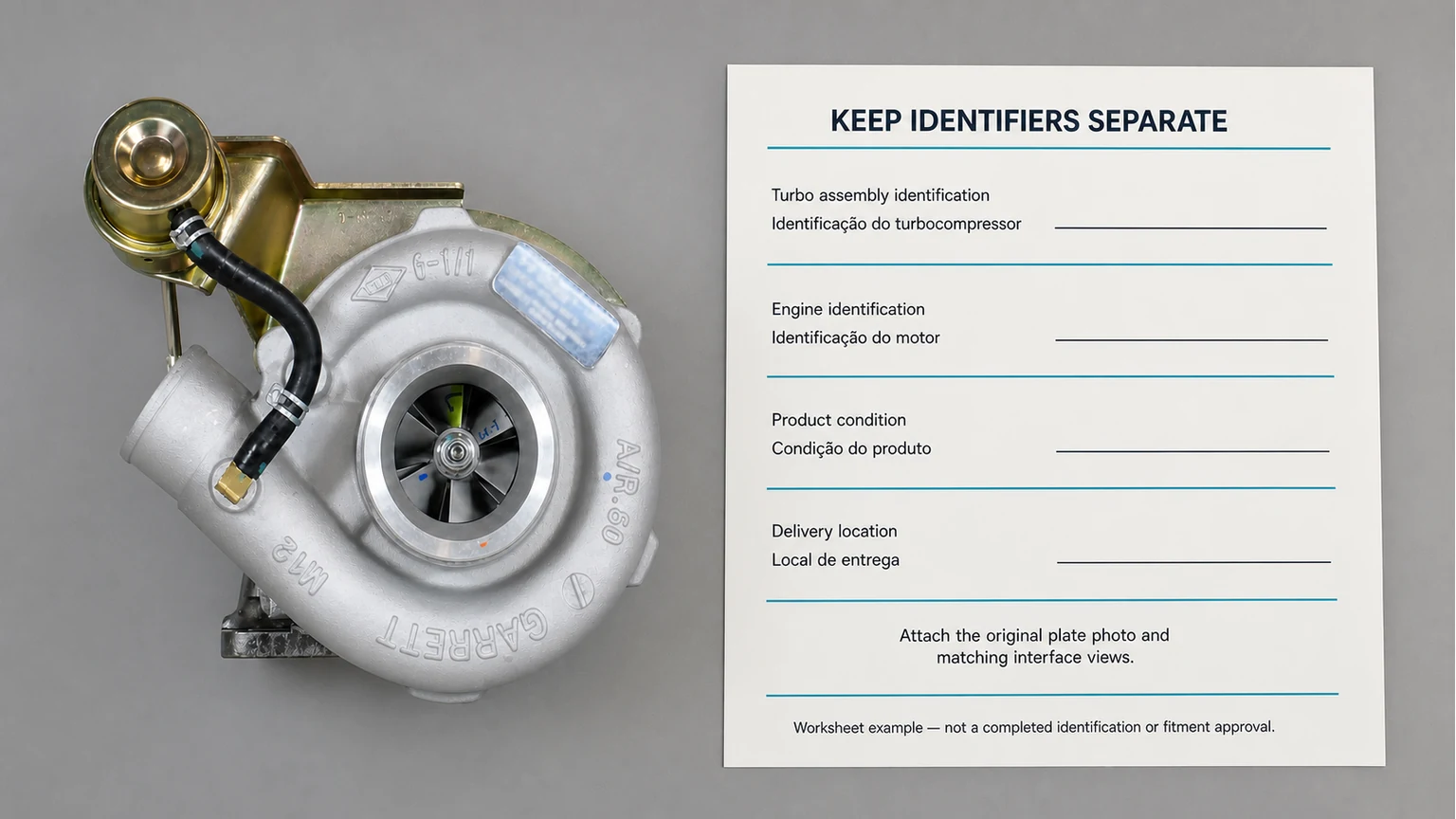
Keep identifiers in separate fields and attach original plate photographs. The illustrated plate is not a readable identity record or evidence of fitment.
For a Brazilian counterparty, use the official Receita Federal CNPJ consultation service to check the registered entity and cadastral information. Compare the company named in the quotation with the entity issuing the invoice and responsible for the agreed support. A registration record helps establish identity; it does not certify product quality, manufacturer authorisation or the seller's current inventory.
Keep manufacture, branding and dispatch origin distinct. A product may be sold in Brazil without being Brazilian-made. Conversely, the existence of a manufacturer's Brazilian plant does not prove that a particular offered unit came from it. If country of origin is a purchasing requirement, ask for the evidence applicable to the exact goods before accepting that claim on your records.
Give the responsible customs professional the accurate product description, complete-unit or component scope, condition, quantity and available origin information. Receita Federal directs users to its NCM and Classif resources for classification research. Siscomex provides current import administrative-treatment guidance and stresses operation-specific checks. Do not copy an NCM code or clearance assumption from a superficially similar shipment.
This article does not assign a tariff code, tax rate, licensing requirement or permission to import a used or remanufactured unit. Those questions require the current rules and the actual transaction. In particular, settle an exchange or cross-border core-return arrangement before paying on the assumption that returning the old unit will be straightforward.
On arrival, compare the unit, labels and documents with the approved record before installation or onward distribution. Photograph the unopened packaging, the protected openings and the unit from the agreed views. Check for handling damage at the housing, actuator, connector, linkage and mounting surfaces without disturbing adjustments or dismantling the product.
If identity, configuration or condition differs, separate the affected unit from approved stock and request a written resolution. Record an unexplained difference as unresolved; do not relabel the goods to make the paperwork agree. A qualified workshop can then perform the relevant installation and functional checks using the correct service information once identification and condition are satisfactory.
Agree how the supplier will investigate a complaint from your actual location. Ask who receives the initial evidence, where the unit would be returned, what authorisation is required before disassembly and which costs the quoted terms cover. These are quotation questions, not promises that any brand or supplier provides free returns, samples or a particular warranty.
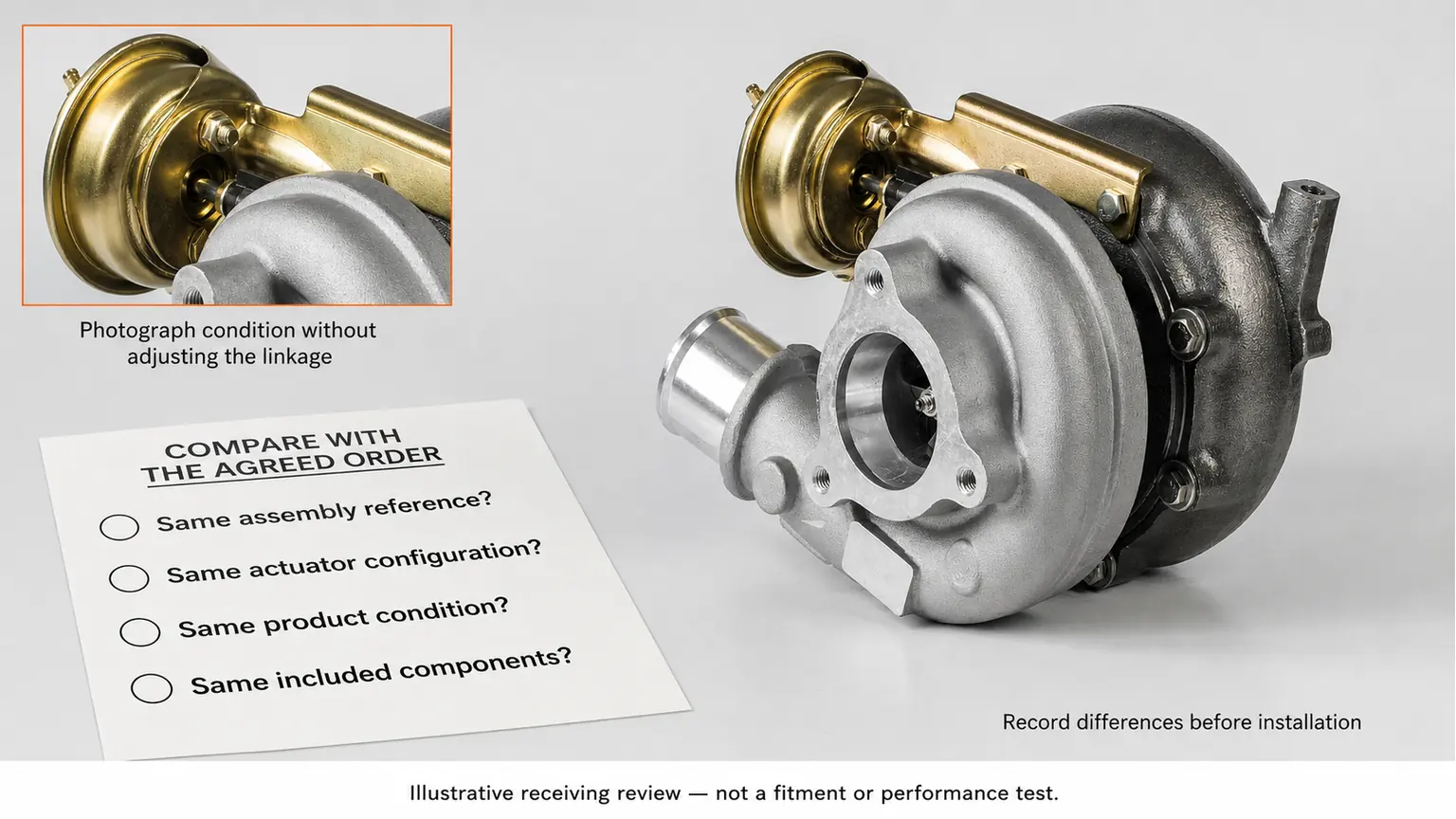
Record the delivered configuration before installation. An intact appearance and an order match do not establish balancing quality or operating performance.
No. It establishes a transaction with the invoicing entity, but a seller can supply goods from a different country of manufacture. If domestic manufacture is a contractual requirement, request the appropriate origin evidence for the specific goods and have the responsible purchasing or trade professional review it. Do not substitute a Brazilian warehouse address, Portuguese packaging or the brand's local office address for that evidence. Keep the origin requirement explicit so the supplier cannot interpret it merely as local delivery.
Only after the cross-reference or supersession relationship and any configuration restrictions have been resolved. Ask each seller for the manufacturer's assembly number as well as its own inventory code, then compare those identities against the installed engine and turbo record. Keep different configurations as separate stock records until equivalence is supported. Otherwise, a warehouse may issue a visually similar unit with a different actuator or pipe interface and pass the matching problem to the workshop.
It can be a route to assess, not an automatic technical recommendation. The workshop must first establish the condition of the retained components and whether it has the correct parts, inspection methods and setup capability for that assembly. Request a defined repair scope and completion estimate rather than assuming a repair is quicker. If the housings, control system or identification cannot be reliably resolved, the apparent time advantage may disappear. Diagnosis of the original failure remains necessary under either route.
A common engine family does not justify that consolidation on its own. Group the fleet by confirmed installed assembly, engine configuration and relevant application restrictions, then identify which groups actually share an approved replacement. Keep exceptions visible in the stock catalogue. Ask the supply channel to confirm any proposed consolidation with application evidence; a lower inventory count is not a benefit if it increases mis-shipments or requires unapproved on-vehicle modifications.
The sample order should define the approval checks and record its limitations. Confirm the exact configuration, documentation, packing and installation conditions that will be assessed. For repeat supply, reference that approved specification and require notification of relevant changes rather than merely repeating the supplier's stock code. If a later delivery changes brand, origin, condition or actuator arrangement, review it as a changed proposal. Sample approval does not create evidence for configurations that were never evaluated.
The route comparison above is for identified heavy-duty replacement needs. It does not approve passenger-car performance conversions, engine power increases or changes to emissions-related configurations. It also cannot replace an OEM-mandated supply route, a customer's approved-source list or transaction-specific import advice. Where those requirements apply, use them as the starting constraint rather than trying to override them with a general supplier comparison.
Bring together the installed turbo and engine identification, interface photographs, condition requested, quantity and receiving location. Add your source restrictions, documentation requirements, sample-approval method and the question of local delivery versus import. Mark unknown details clearly instead of inviting the seller to assume them.
You can send Elecdura the reference list and Brazilian delivery requirements for a matching or sourcing enquiry. Request confirmation of the offered product identity, evidence available and commercial terms in the quotation. Elecdura is not represented here as a Brazilian manufacturer, an authorised distributor of the brands discussed, a certification holder or a provider of unconfirmed free-sample and warranty programmes.
Reviewed by Elecdura on 31 August 2026. Primary manufacturer, distribution and Brazilian government resources are linked where used. Recheck the supply and import position for the actual order.


