ELECDURA NETWORK

Your Whole New Supply Chain For Heavy-Duty Parts
Whatsapp:
+86 18915027366
Phone:
+86 18915027366
Views: 0 Author: Elecdura Publish Time: 2025-08-12 Origin: Site
For a U.S. fleet or heavy-duty parts distributor, turbocharger sourcing starts with the engine and complete turbo reference, not a list of famous brands. First establish the application, then compare a documented new replacement, an eligible remanufactured unit or an independently sourced alternative.
Garrett, BorgWarner, Holset and MAHLE provide official starting points, but the quoted configuration, included components and seller still need checking.
Elecdura is a cross-border aftermarket sourcing and matching option, not a U.S. manufacturer or an authorized representative of those brands. The objective is a quotation that can be checked against the vehicle and received stock.
This guide addresses stock-replacement purchasing rather than motorsport upgrades. “For U.S. buyers” describes the destination and buying context, not the manufacturing origin of every product. The programs below are not ranked, and their inclusion does not establish current stock, local support or suitability for an unlisted application.
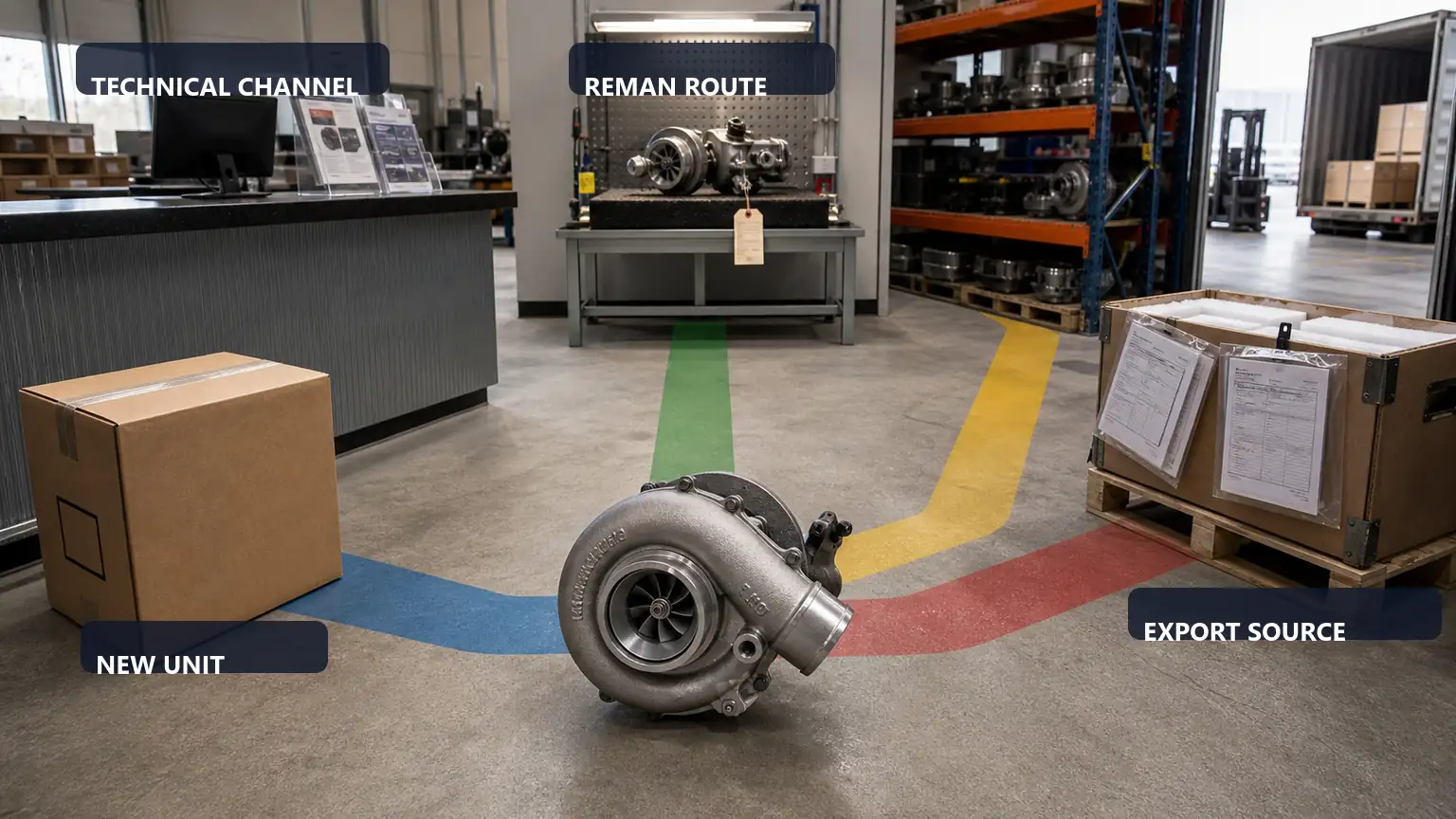
Illustrative sourcing routes. Supply condition and seller role determine which matching, traceability and commercial records to request; the scene is not evidence of a particular supplier's premises.
The Garrett Motion Turbo Replacement page separates aftermarket product ranges and provides catalog and distributor tools. A quotation headed only “Garrett turbo” leaves the purchasing scope incomplete: record the exact range, part number and stated supply condition, then check the applicable catalog entry.
Do not infer heavy-duty coverage from the breadth of the overall aftermarket portfolio. Ask the seller to connect the quoted number to the engine and installed turbo reference, including any replacement-number history. Confirm the actuator, installation parts and service requirements separately rather than assuming that the brand name defines everything in the box.
The BorgWarner Aftermarket Boosting Technologies page provides product and distributor searches alongside separate performance and REMAN resources. Select the route that matches the repair task before comparing offers; a performance product and a stock-replacement product are not equivalent simply because they share a brand.
BorgWarner's published REMAN core criteria tie credit to an accepted returned core. The page excludes units from non-genuine OE turbo manufacturers, dismantled turbochargers and units with broken connecting flanges. The accepted reference list matters as well as physical condition.
Before committing to an exchange offer, obtain the seller's applicable core reference, return deadline, inspection conditions, freight responsibility and credit timing in writing. Keep the old unit intact until its acceptance requirements are clear. An advertised price after core credit is not the same as the initial cash payment, and credit should not be treated as certain before acceptance.
Cummins' Holset Aftermarket Turbochargers resource connects buyers to product information and the authorized distributor network. Use that channel to check a genuine Holset offer; a logo in a listing is not evidence of the seller's authorization.
A seller can identify a plausible part number without establishing its supply status. Conversely, an authorized channel still needs the correct engine and turbo information to confirm the application. Record both the application match and the selling entity, then establish which entity handles technical questions, returns and any claim from the U.S. destination.
The MAHLE North American turbocharger literature includes engine-specific data sheets and separate service-kit information. Its Caterpillar and Detroit Diesel entries provide a more useful starting point for a heavy-duty request than a general statement about brand coverage.
For example, the Detroit Series 60 listings distinguish displacement and configurations such as EGR, internal wastegate and external wastegate. Those distinctions must remain attached to the quote. A shared engine-family name does not establish interchangeability; match the listed configuration and complete reference before considering a substitution.
Collect the complete OE and turbocharger numbers, engine and equipment identity, and clear nameplate photographs. Add views of the compressor and turbine connections, actuator, connector, oil and coolant ports, and housing orientation. A shortened number or similar silhouette is insufficient where several configurations share a housing family.
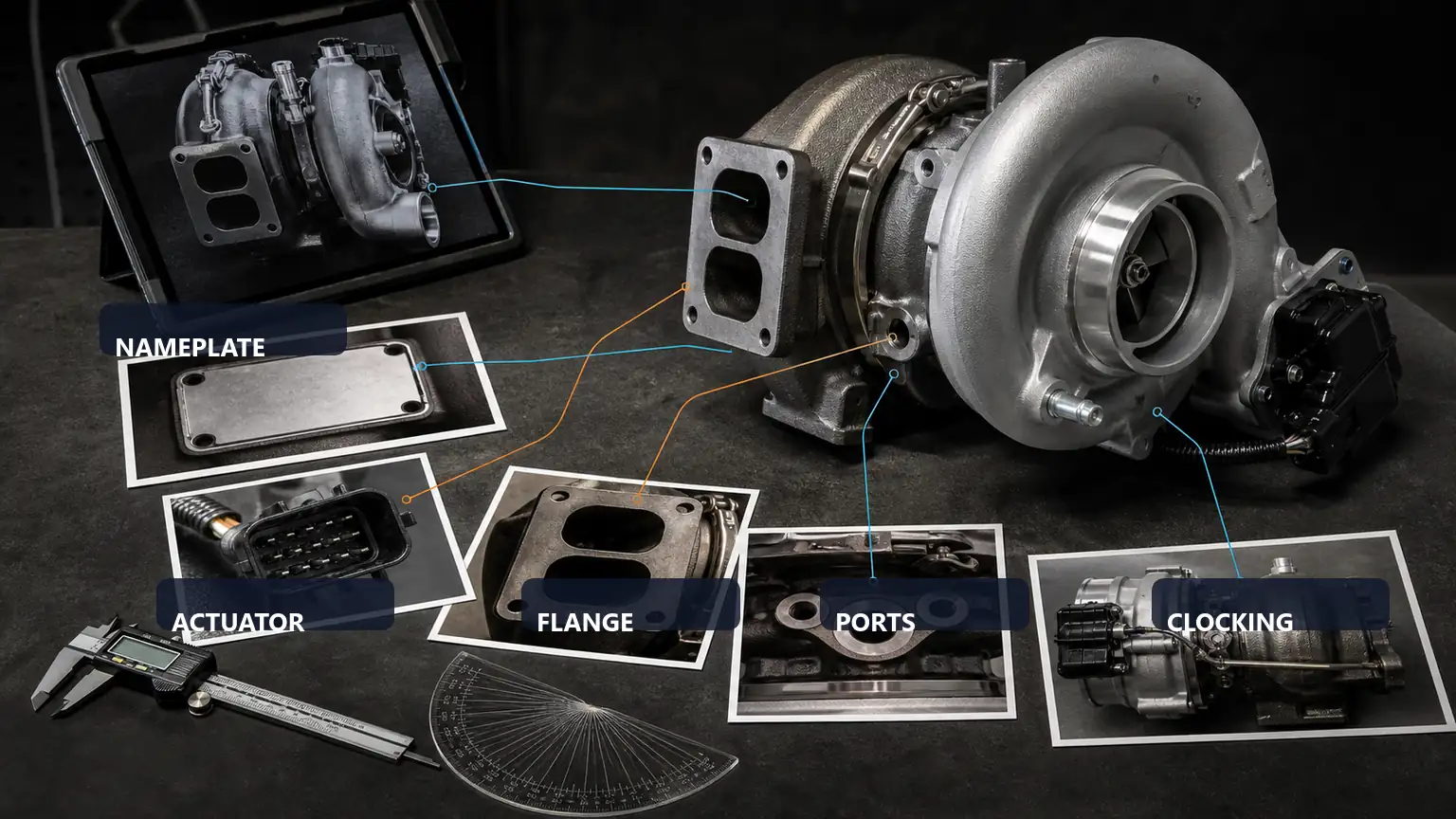
Illustrative identification points, not a model-specific drawing. The quotation must agree with the buyer's actual photographs and documented references.
Specify whether the actuator is included, supplied separately or intended for reuse. Ask which setup or calibration remains the installer's responsibility and which part-specific instructions govern it. Do not equate a matching connector with confirmed control compatibility, or a complete-looking assembly with a completed installation procedure.
New, remanufactured, repaired and upgraded describe different supply conditions. Complete turbocharger, actuator-only and CHRA describe different component scopes. Put both fields on the quotation so a lower price is not simply the result of omitted components or a different condition.
For a CHRA or core-only offer, a competent repairer must determine whether the existing housings and actuator are suitable for reuse. Define who is responsible for assembly, setting and final checks. A complete-unit procurement decision cannot be replaced by a core quotation without accounting for that remaining work.
For an independent aftermarket alternative, request the supplier's own part number, written cross-reference, traceability method and the inspection evidence available for that reference. A cross-reference is a matching claim to evaluate, not proof that the alternative was made by, endorsed by or authorized by the OE brand.
Performance suppliers can be relevant when the job is an engineered upgrade. That is a different task from replacing a failed stock unit: the buyer needs an agreed operating target, installation scope and appropriate engineering review. Do not treat a power claim or compressor size as a substitute for documented stock fitment.
TiAL illustrates why the exact product matters. Its Can-Am X3 XR4351S X2C page lists a full turbocharger assembly, while its TR6051S Supercore page states that the turbine housing is purchased separately. Neither example establishes heavy-duty fleet fitment. They show why a supplier's name alone cannot tell the buyer whether an offer is a complete assembly, a component or an application-specific upgrade.
An urgent fleet replacement, an exchange program and a distributor's replenishment order have different acceptance criteria. Define the required condition, application range, order quantity, delivery model and claim process before requesting prices. For repeat purchasing, establish whether later batches must match an approved sample, a controlled technical record or both.
Compare freight, applicable import costs, core charges, protective packaging, receiving inspection and any separately required installation or calibration work. Keep confirmed charges separate from estimates. Obtain a dispatch commitment and delivery basis for the actual destination instead of treating a general catalog availability statement as a delivery promise.
The dispatch location, core-return destination and claim-handling location may differ. Record each one, who pays the relevant freight, and what evidence must accompany a mismatch or damage report. For cross-border supply, an agreed shipping term does not by itself answer the technical acceptance or warranty questions; those belong in the written order terms.
Keep the supplier's answers with the quotation and approved matching evidence. The receiving team should be able to check the delivered unit without reconstructing an informal sales conversation.
Which supplier part number and OE references will appear on the quotation and label?
What are the supply condition and complete component scope?
Which actuator, gasket kit, fasteners, plugs and accessories are included?
What application evidence supports the proposed match?
Which inspection or test records are available for this part number, and what do they cover?
How do serial, batch and carton labels connect to the shipment?
What is the written process for a sample mismatch, transit damage or warranty claim?
What order quantity, dispatch timing, shipping term, packaging and destination requirements have been agreed?
Compare the shipment with the approved sample or technical record. Check labels and references, housing and flange geometry, port and connector positions, actuator identity and supplied accessories. Inspect for shipping damage, corrosion and missing protection before installation or onward dispatch.
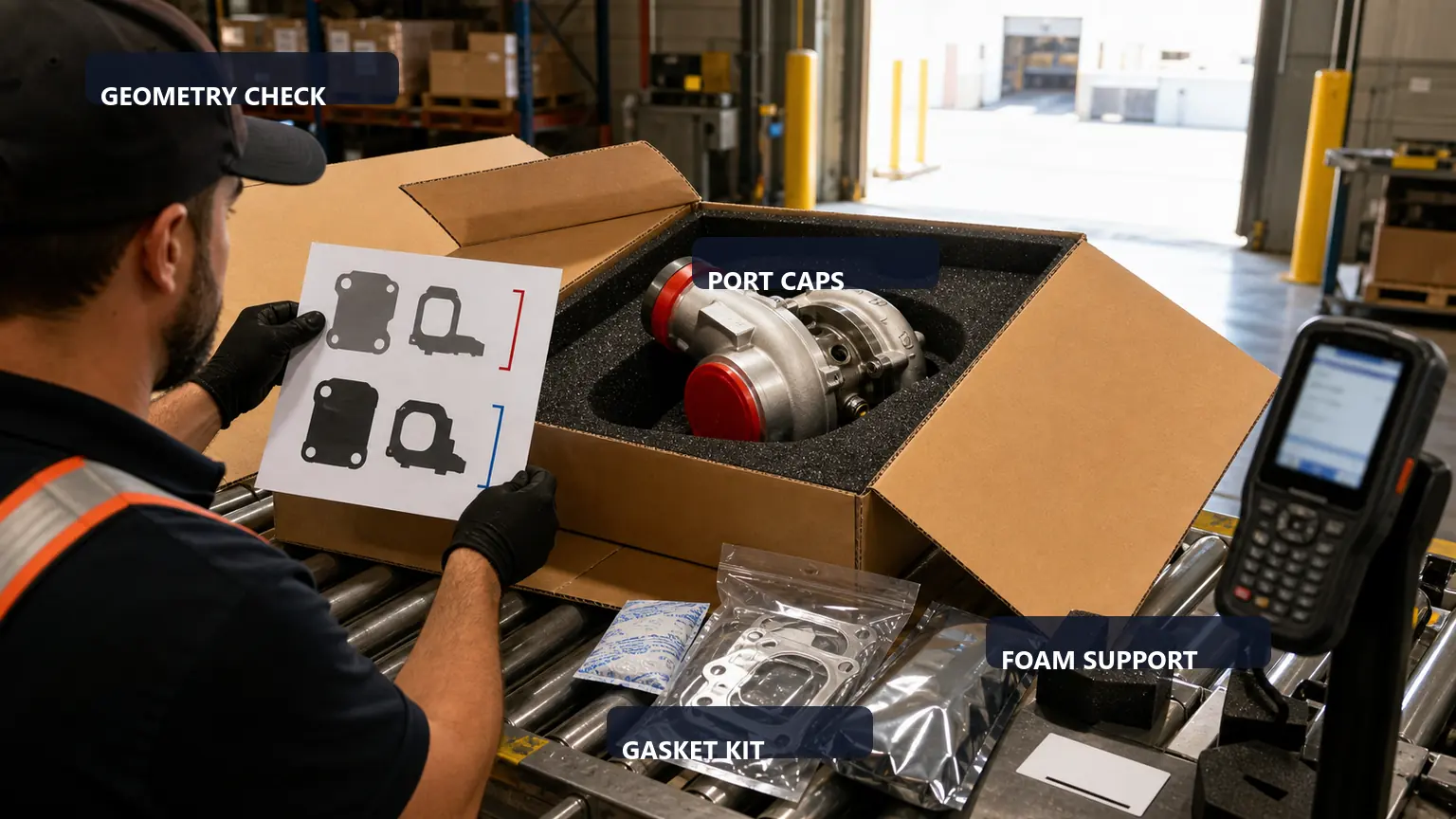
Illustrative receiving checks, not a record of a specific warehouse or shipment. Supplied components and packaging must be compared with the actual purchase agreement.
Photograph the discrepancy, retain the labels and packaging, and ask the supplier to reconcile the delivered configuration with the approved record. A visual check cannot establish balance or actuator calibration. Free rotation is not proof of either process, and an identification mismatch should not be accepted merely because the turbo appears undamaged.
Elecdura is a B2B aftermarket sourcing and matching option for buyers seeking complete heavy-duty turbochargers or turbo cores against documented references and application evidence. An inquiry does not establish stock, brand authorization, manufacturing origin or an agreed warranty; the specific offer must state its own scope and terms.
Browse the heavy-duty turbocharger category or the turbo core/CHRA category. To request a quotation, contact Elecdura with complete OE and turbo numbers, engine and equipment details, nameplate and connection photographs, actuator type, quantity, destination, packaging needs and requested delivery date. Specify complete assembly, actuator-included assembly or core-only scope, and identify uncertain fields rather than filling them with assumptions.
Choose the supply route after the application and condition are clear. Official programs provide catalog and channel references; reman offers add a core-acceptance decision; independent alternatives need their own matching and traceability evidence. Keep performance projects separate unless an upgrade is the actual requirement. The useful outcome is a defensible order and receiving record, not the longest supplier list.


