Views: 0 Author: Site Editor Publish Time: 2026-04-14 Origin: Site
In heavy-duty applications, cooling trouble rarely starts with one dramatic failure. More often, it begins in smaller, less obvious ways. A truck starts running a little hotter than usual. Temperature control feels less stable in traffic. Idle cooling becomes weaker. Then, before long, what looked like a routine replacement turns into a bigger problem involving downtime, repeat maintenance, and unnecessary after-sales pressure.
That is exactly why choosing the right heavy duty radiator cooling fan matters more than many buyers first expect.
For distributors, importers, fleet buyers, and aftermarket sourcing teams, a radiator cooling fan is not just another catalog item. It is part of the broader cooling logic of the vehicle. If the fan is not properly matched, the issue is not limited to installation. Poor airflow, unstable temperature control, repeat replacement, and customer complaints can all begin with the wrong selection.
At Elecdurauto, this is something we see quite often in real B2B communication. Buyers usually start with a reference number, a photo, or a basic application note. But what they really need is not just a similar-looking part. They need a clearer decision path—one that helps confirm whether the fan is suitable for the truck, the cooling demand, and the real working environment.
That is the point of this guide. Instead of giving a basic product definition, it focuses on how buyers can choose a heavy duty radiator cooling fan more carefully and more practically, especially when the application involves trucks, fleets, and aftermarket volume purchasing.
A heavy duty radiator cooling fan helps move air through the radiator so heat can leave the engine cooling system more effectively. That sounds simple, and in one sense it is. But in heavy-duty truck applications, the fan plays a much more important role than many buyers first assume.
The cooling fan supports engine temperature control when natural airflow alone is not enough. At steady road speed, incoming air may help the radiator do its job. But once a truck slows down, stops, idles, or works under greater thermal load, the fan becomes much more important. At that point, it is not just helping in a general way—it is actively supporting cooling stability.
That matters because heavy-duty trucks often operate in conditions where the cooling system has less room for compromise. A fan that looks acceptable on paper may still create problems if it cannot support the real airflow demand of the application.
Airflow becomes especially important when a truck is operating at low speed or is not moving fast enough to generate strong natural airflow through the radiator.
This is commonly seen in situations such as:
low-speed operation
idle condition
traffic delays
loading and unloading scenarios
Under those conditions, the cooling fan takes on more responsibility. If airflow support is weak or mismatched, cooling performance may become unstable. That is often where the difference between a part that simply fits and a part that actually performs starts to show.
For that reason, buyers should think beyond part appearance and basic dimensions. A truck radiator cooling fan is not only there to complete an installation. It has to support real cooling behavior under real working conditions.
Heavy-duty trucks operate under a different thermal reality from light-duty vehicles. Because of that, cooling fan selection cannot be approached in exactly the same way.
Heavy-duty trucks usually work under greater heat demand. Engines operate longer, loads are heavier, and the cooling system is often under more pressure. That means the fan has less margin for error.
Many heavy-duty vehicles spend long hours on the road or in active service. This extended operation increases the need for stable and consistent cooling support. The fan is not serving a short or occasional use pattern. It is supporting long work cycles where reliability matters.
Heavy-duty applications also tend to face tougher conditions. Heat, dust, vibration, repeated stop-and-go work, and more demanding routes all put extra pressure on the cooling system. In these environments, the fan needs to be selected with actual working conditions in mind, not just part similarity.
When a cooling issue appears in a light-duty vehicle, the result may be inconvenient. In a heavy-duty truck, the consequences are often more serious. Downtime, delayed schedules, added repair cost, and customer dissatisfaction can follow quickly. That is one reason radiator cooling fan selection deserves more attention than many buyers initially give it.
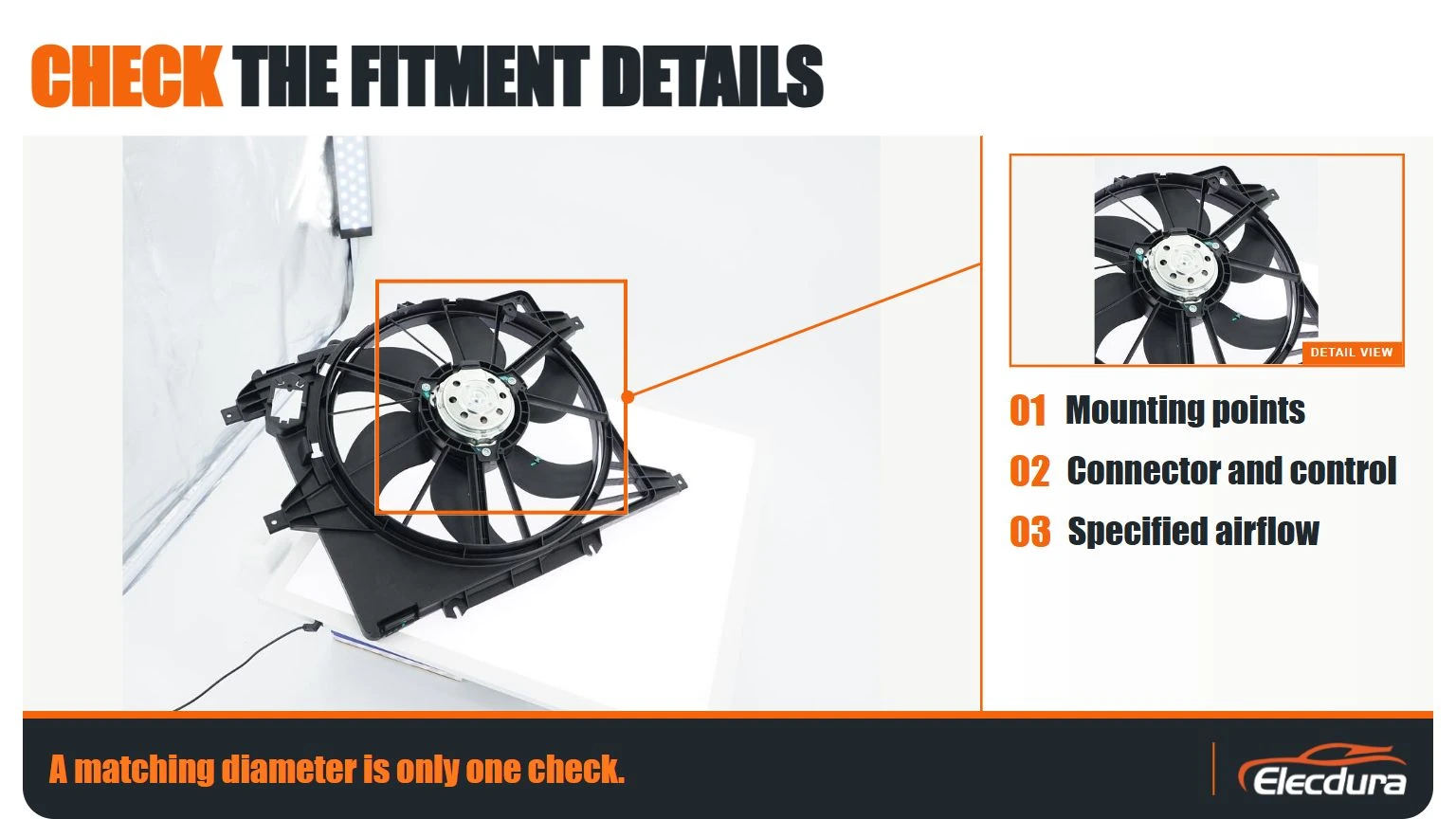
Most buyers already understand that incorrect fitment is a problem. If the fan does not match the intended application, installation issues can happen right away. Mounting points may not align. Clearance may be off. Connector logic may not match expectations.
But fitment problems are only the first layer. They are the obvious part of the risk, not the full picture.
This is where things often get more expensive than expected. A cooling fan may install physically and still fail to deliver the airflow performance the truck actually needs.
That gap becomes more visible under hot conditions, idle operation, slow movement, or sustained load. In those situations, a fan that looks “correct enough” may still produce weak cooling results if airflow behavior does not properly match the application. So yes, fitment matters—but fitment alone is not the same as correct performance.
A wrong fan choice does not just create technical inconvenience. It also creates commercial cost.
If the part needs to be rechecked, replaced, or reworked after installation, downtime increases. Maintenance schedules get interrupted. Extra labor is involved. Communication takes longer. What looked like a straightforward replacement decision quickly becomes more costly than the original quote suggested.
In heavy-duty aftermarket work, that kind of mistake tends to grow fast.
For a one-time replacement, a bad selection is frustrating. For wholesalers, distributors, and fleet buyers, it can become a repeated operational problem.
One wrong order can affect multiple vehicles, multiple customers, or multiple follow-up claims. That is why experienced B2B buyers usually take more time at the confirmation stage before moving too quickly into quotation or volume discussion.
Even a small mismatch can lead to additional installation work, extra checking, or a complete pause in the repair process. That adds cost that no one wanted at the start.
When cooling performance feels unstable or the installation process becomes uncertain, customer complaints are usually not far behind. In B2B supply, those complaints can easily spread beyond a single order.
Wrong-match orders often result in returns, warranty discussions, and extra handling work. In many cases, the real problem started much earlier—with insufficient selection review.
This point matters more than it sometimes appears. In repeat business, trust is difficult to build and very easy to weaken. If the same type of selection problem keeps happening, buyers do not just lose time. They also begin to lose confidence in the supply relationship.
Not all heavy-duty applications create the same cooling demand. That sounds obvious, but in sourcing work it is surprisingly easy to overlook. Buyers often begin with a part number, an old sample, or a basic vehicle description, and that can make different truck types look more similar than they really are.
For on-highway heavy trucks, cooling fan selection usually needs to support long operating hours, steady thermal management, and reliable airflow under continuous use. These vehicles may spend long periods on the road, which means the cooling system has to remain stable over time, not just during short working intervals.
In these applications, the wrong fan may not fail immediately. Instead, it may show its weakness gradually—less stable cooling behavior, reduced performance under heat stress, or growing dissatisfaction over time. That is one reason buyers sourcing a heavy duty radiator cooling fan for highway truck applications should think beyond basic compatibility and focus on longer-term operating suitability.
Urban fleet vehicles create a different kind of challenge. They may spend more time in traffic, at loading points, or in repeated low-speed movement. In these conditions, the cooling system often depends more heavily on fan-assisted airflow than it does in steady-speed operation.
That difference matters. A fan that performs reasonably well in one duty pattern may not feel adequate in another. Stop-and-go use puts more attention on low-speed cooling support, idle performance, and thermal consistency across repeated short cycles.
For fleet buyers, this is where real use conditions start to matter more than catalog assumptions. The application is still “heavy-duty,” but the cooling demand profile is not exactly the same as long-haul truck use.
Construction and off-highway conditions push the discussion further. These environments are often harsher, dirtier, and less forgiving. Dust, vibration, uneven terrain, and harder working cycles all place additional pressure on the cooling system.
In these applications, fan selection is not just about whether the part fits or cross-references correctly. Durability, structural stability, and real suitability under rough conditions all become more important. A cooling fan that looks fine in a catalog may not be the right answer if the environment is substantially more demanding than standard road use.
Some heavy-duty vehicles do not fit neatly into either long-haul or general fleet use. Vocational trucks, utility vehicles, municipal service trucks, and similar work platforms often operate under unique cycles that combine idle time, repeated low-speed movement, and application-specific thermal stress.
This is exactly where oversimplified selection starts to create problems. Buyers may assume that because the application is “still a truck,” the cooling demand will follow the same logic as another heavy-duty platform. In practice, that is not always true.
The usage pattern of the truck changes how the cooling system behaves. Long-haul driving, urban stop-and-go use, heavy loading, and rough-duty operation do not place the same demand on airflow support. That is why fan selection should start with actual use, not just product appearance.
A one-size-fits-all approach sounds efficient, but it often creates unnecessary risk. Heavy-duty trucks may share broad category labels, yet their cooling demands can still differ in meaningful ways. Buyers who take vehicle type and duty cycle seriously usually make more reliable decisions.
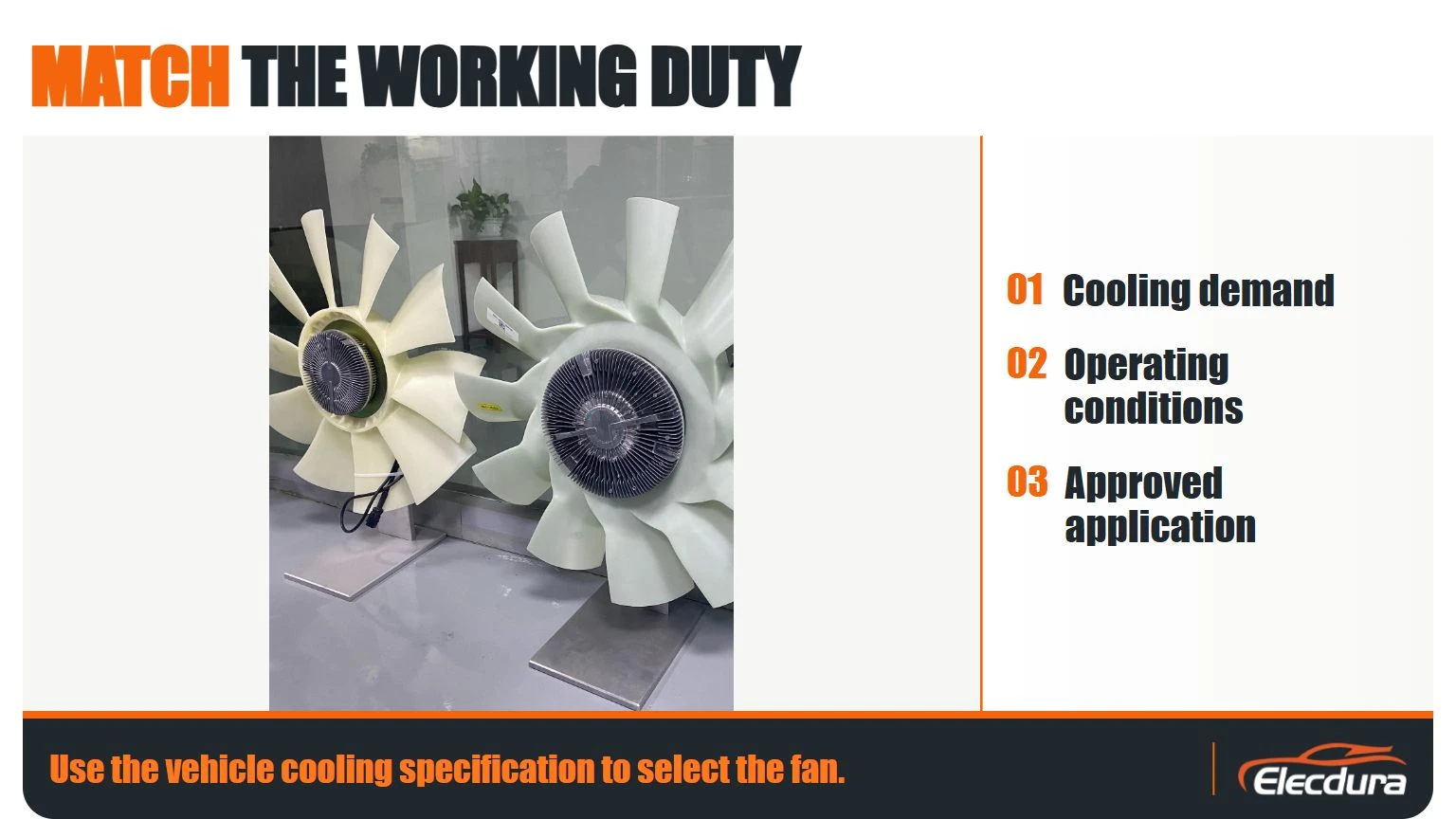
Another area where selection can drift off course is product type. Buyers may begin with the general idea that they need a radiator cooling fan, but that description can cover more than one replacement logic.
Mechanical fans and electric fans are not interchangeable in the way some fast-moving sourcing conversations make them sound. Each involves a different operating logic, different fitting considerations, and sometimes a different replacement approach entirely.
From a purchasing perspective, what matters is not simply knowing the product name. What matters is understanding what type of cooling setup the target vehicle actually uses and what the replacement requires.
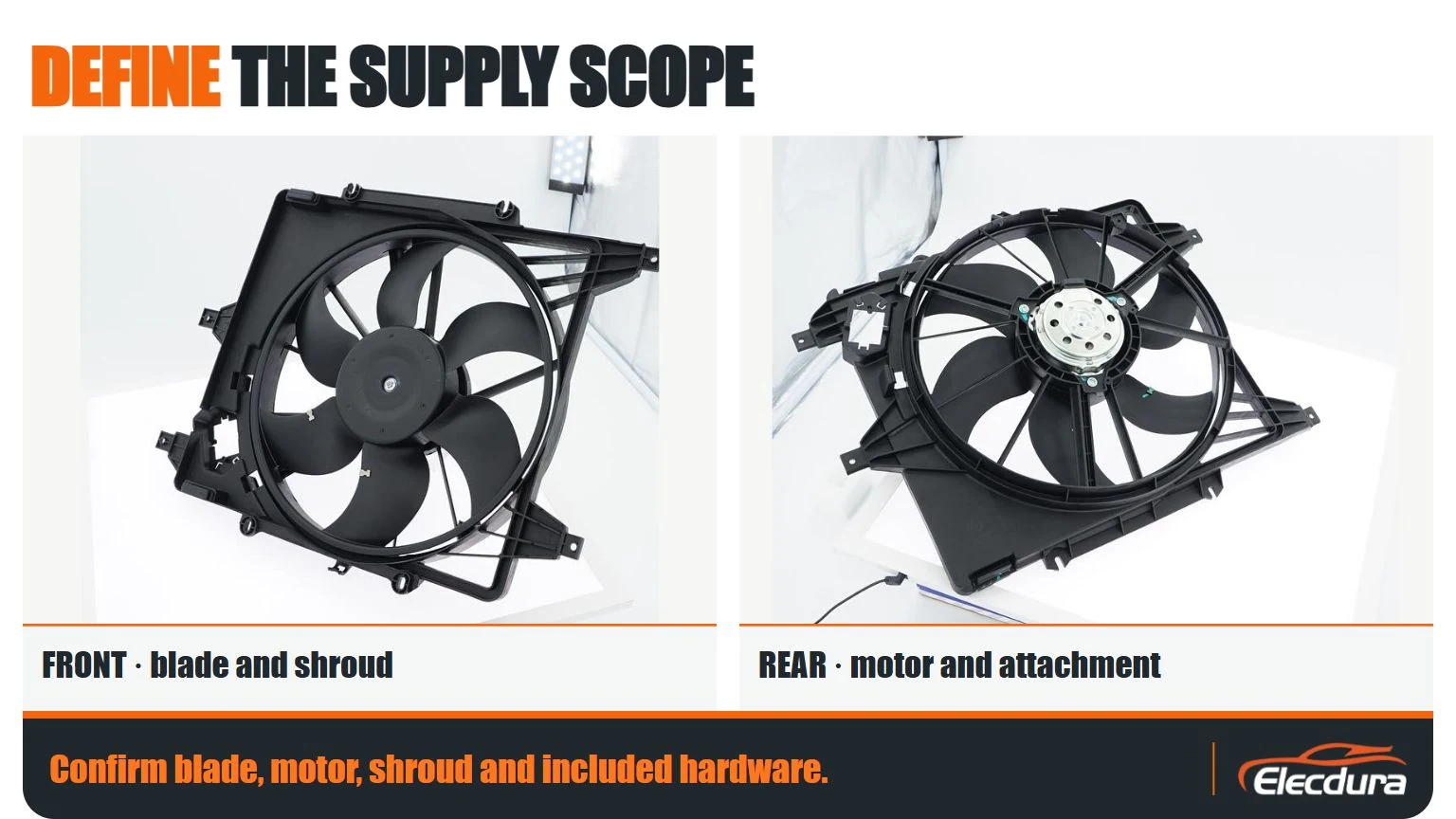
There is also the question of whether the buyer needs a standalone fan or a more complete assembly. In some cases, only the fan itself is being replaced. In others, the buying decision needs to consider a larger grouped solution.
This distinction matters because replacement assumptions can shift very quickly if the original request is too broad. A buyer asking for a fan may actually be dealing with a broader cooling system issue or an application that requires more careful confirmation than a single part name suggests.
This is where professional sourcing usually separates itself from shortcut buying. It is easy to focus on the part name because it feels concrete. But in real heavy-duty replacement work, the configuration of the system matters more than the label used in the inquiry.
A mechanical fan, an electric fan, and a fan-related assembly may all sit near the same application discussion, but they are not the same decision. Buyers who focus only on the name of the part often end up confirming less than they think they are confirming.
Suitability depends on the actual vehicle, the cooling arrangement, and the working conditions involved. That is why the right question is not “Which option is better in general?” The better question is “Which option matches this application correctly?”
Different fan types may support airflow in different ways depending on the setup. That is one reason buyers should not reduce the decision to part similarity alone.
Installation requirements can vary significantly depending on the type of fan involved. A sourcing decision that ignores installation logic may look efficient at the start and still create unnecessary complications later.
Different replacement approaches can also lead to different maintenance outcomes. For repeat B2B orders, this matters because long-term supply stability often depends on choosing the right replacement logic from the beginning.
Where electric setups are involved, electrical details become part of the buying decision. This is one more reason why product type should be clearly confirmed before a quotation moves too far ahead.
Once buyers move beyond general product type, the next step is getting more precise. That starts with the actual application.
Truck model, engine information, use pattern, and general operating scenario should all be checked early. A fan that works well for one vehicle type or duty cycle may not be the best fit for another, even when some reference details seem similar.
This sounds basic, but it is still where many sourcing mistakes begin. Buyers move too quickly into part matching before fully reviewing how the vehicle is actually used.
OE number and cross reference are important, sometimes very important. They help narrow the search and give the inquiry a clear starting point. But they should not be treated as the full answer.
In aftermarket work, a matching reference often helps guide the decision, but it does not always remove the need for further confirmation. That is especially true in heavy-duty applications, where operating demands are higher and the cost of a wrong decision is greater.
Dimensions should always be taken seriously. Diameter, overall shape, and visible structural details all influence whether the fan is likely to fit and function as expected.
A part that appears correct in a listing may still create trouble if the key measurements are not aligned. And in B2B volume orders, even a small dimension mismatch can quickly turn into a larger operational issue.
Buyers sometimes focus on major dimensions and forget that blade design also matters. Blade count and blade profile can affect how the fan behaves in actual use.
This does not mean every inquiry has to become overly technical. But it does mean buyers should avoid assuming that all visually similar fans perform in exactly the same way. In real applications, that is often not the case.
Rotation direction is one of those details that can be missed when the sourcing process moves too quickly. Yet it matters. A fan that looks close to the original part may still be unsuitable if the rotation logic does not match the application.
This is the kind of detail that tends to be ignored right up until it becomes a problem.
Where electric fan setups are involved, voltage and electrical details need to be reviewed carefully. Visual similarity does not confirm electrical suitability. If that part of the check is rushed or skipped, the buying process may look fast at first and become much slower later.
Mounting style also deserves close attention. Even if the fan itself appears broadly compatible, connection details and fitting logic can still create avoidable installation issues.
That is one reason product photos, measured details, and clear part information remain so useful in real B2B communication. A short description often does not show enough on its own.
Finally, buyers should think about durability expectations in relation to the actual use environment. Heavy-duty applications often place more pressure on the part than standard replacement logic assumes.
That does not mean every order needs the most aggressive specification available. It means the buyer should ask a simple but useful question: is this part suitable not only for the application reference, but also for the actual working demands behind it?
OE number helps reduce uncertainty, but it does not always eliminate it. The more demanding the application, the more important it becomes to confirm beyond the reference itself.
Even when the listing looks right, dimensions should still be checked. Assumptions are one of the fastest ways to create problems in aftermarket sourcing.
Blade design influences airflow behavior, and airflow behavior influences cooling performance. That chain is simple, but it is often underappreciated during fast purchasing decisions.
Small connection differences can delay installation, create confusion, or lead to incorrect ordering. In B2B purchasing, those small details rarely stay small for very long.
In heavy-duty aftermarket sourcing, one of the most common misunderstandings is the idea that a fan is “correct” as long as it fits. That sounds practical, and sometimes buyers are under enough time pressure that this becomes the main checkpoint. But in real applications, fitment alone does not guarantee correct performance.
A radiator cooling fan can install physically and still fail to support the airflow the system actually needs. That is where the real selection risk often begins. The part may look right in the box, align reasonably well during installation, and still produce disappointing results once the truck is operating under real thermal demand.
This is why experienced buyers do not stop at basic compatibility. They know the better question is not only whether the fan can be fitted, but whether it can do the job properly after fitting.
Size matters, of course, but it does not tell the whole story. Buyers sometimes place too much confidence in diameter and general shape because those details are easier to compare quickly. The problem is that airflow behavior is influenced by more than basic size.
A fan can share similar dimensions with another part and still behave differently in actual use. That is one reason why sourcing based on appearance or rough similarity can become risky in heavy-duty applications. The system may demand a certain level of airflow support, and the part that “looks close” may not be the part that performs correctly.
Blade count, blade angle, overall fan profile, and surrounding layout all play a role in how airflow behaves. This is not just a technical side note. It has practical consequences in replacement decisions, especially when trucks operate under tougher conditions.
For B2B buyers, the point is not to turn every inquiry into a design analysis. The point is simply to avoid oversimplifying the part. A heavy duty radiator cooling fan is not just a circle with blades. It is part of a cooling system that depends on airflow behavior working the way the application expects.
One reason airflow mismatch gets missed early is that it may not appear equally in every condition. A truck may seem acceptable during initial review and still show weakness later when the operating environment becomes more demanding.
When a truck is idling or moving slowly, natural airflow drops and the fan has to do more of the work. If airflow support is not properly matched, temperature control may become noticeably less stable.
Under heavier thermal load, the cooling system has less room for compromise. Weak airflow performance that might go unnoticed in lighter conditions can become much more obvious once the vehicle is working harder.
Hot-weather operation often exposes cooling weaknesses more quickly. A part that appears acceptable in a milder environment may not provide the same confidence when outside temperatures rise.
Some applications leave less margin in the overall airflow path. In these cases, the fan’s real performance becomes even more important because the system cannot easily compensate for mismatch elsewhere.
Operating environment changes the meaning of “suitable.” In hotter regions, cooling systems face extra pressure almost by default. That means fan selection should not be based only on part similarity or general fitment logic.
When the vehicle is expected to work consistently in high ambient temperatures, buyers need to think more carefully about cooling stability over time. A part that looks fine in a moderate climate may not deliver the same level of confidence in a hotter one.
Long-idle fleet applications create another type of demand. Service vehicles, urban trucks, and operational fleets with repeated stops often rely more heavily on fan-assisted airflow than highway-only vehicles.
This matters because it shifts the selection logic. The question is not just whether the fan belongs to the application range, but whether it supports the cooling behavior required during prolonged idle and low-speed use.
Heavy-load transport increases thermal demand and reduces the system’s tolerance for mismatch. In these applications, the cooling fan has a more demanding role, and buyers usually need to pay closer attention to practical performance rather than relying on quick reference confirmation alone.
This is one reason heavy-duty cooling fan selection should always stay tied to the real working conditions of the vehicle, not just to the vehicle name itself.
Harsh environments such as construction-related work, rough routes, or dust-heavy operations create extra strain on the cooling system. In these situations, durability and real-world suitability become more important.
A fan that seems acceptable in cleaner, more stable use may not be the right choice where working conditions are more aggressive. This is where buyers benefit from a slightly more cautious review before moving ahead with an order.
Some cooling issues become more visible only when seasonal pressure increases. During warmer periods, borderline cooling performance often turns into obvious customer concern. That is why certain parts appear acceptable for a while and then suddenly become problematic when operating conditions shift.
Higher outside temperatures often reveal weaknesses that were easier to ignore in cooler conditions. Fan selection that felt “good enough” earlier may no longer feel sufficient.
The harsher the climate, the less margin there is for a weak match. Selection errors become easier to notice and more costly to manage.
Fleet buyers, especially those dealing with multiple operating patterns, should think beyond catalog fitment and consider the actual duty cycle, climate, and usage pressure behind the order.
This is one of the most common mistakes, and it happens for understandable reasons. Buyers work quickly, older samples may be incomplete, and visual comparison feels efficient. The problem is that appearance alone does not confirm true suitability.
A part can look very close to the original and still create issues in fitment, airflow behavior, or long-term use.
OE number is valuable, but treating it as the whole answer is risky. It is a strong checkpoint, not always a final conclusion.
In heavy-duty sourcing, the more demanding the application, the more important it is to confirm dimensions, structure, and practical compatibility instead of assuming the reference alone has solved the problem.
Another common mistake is focusing on physical installation and overlooking cooling behavior. Buyers may confirm that the fan appears to fit but fail to ask whether it supports the airflow the truck actually needs.
That kind of oversight often stays hidden until the part is already in use, which is exactly when fixing it becomes more expensive.
Heavy-duty applications are less forgiving than lighter ones. That should affect how replacement decisions are made. Buyers who apply light-duty shortcut logic to truck and fleet sourcing often underestimate the importance of airflow, durability, and operating conditions.
Details that look small during early sourcing discussions can cause outsized trouble later. Voltage, connector style, and rotation logic are all examples of things that are easy to skip in a hurry and frustrating to correct afterward.
Bulk orders create their own risk. A buyer may feel pressure to move quickly from inquiry to quotation, but if the application review is incomplete, the order can multiply the original mistake instead of solving it.
Visual similarity creates false confidence. It feels efficient, but it often hides the differences that matter most later.
Catalog shortcuts may save time at the inquiry stage, but they can increase return, complaint, and rework risk once the order is delivered.
A mistake in one replacement job is frustrating. A mistake repeated across volume purchasing becomes a much larger commercial problem.
Price always matters in B2B purchasing. No serious buyer ignores it. But the lowest unit price does not always lead to the lowest actual cost.
If the part creates installation trouble, unstable cooling behavior, or repeated after-sales handling, the original savings can disappear very quickly. That is why experienced buyers usually hesitate before choosing solely on price.
Durability becomes more important when the application is demanding, the work cycle is longer, or the buyer is managing repeated supply. In heavy-duty and fleet environments, a weak product choice rarely remains a small issue for long.
That is why durability should be evaluated as part of the sourcing decision, not treated as a secondary concern after pricing is already agreed.
Fitment usually deserves priority because it protects the order itself. A low-cost fan that does not fit correctly—or fits but fails to perform—creates risk from the very start.
For buyers sourcing a heavy duty radiator cooling fan, correct application matching should come before aggressive cost reduction. Otherwise the order may look cheaper on paper while becoming more expensive in practice.
Better selection does more than reduce complaints. It improves the efficiency of the supply relationship. Orders become smoother, communication becomes more focused, and repeat purchasing becomes easier to manage.
When the wrong part delays repair or forces rework, downtime cost starts rising quickly.
Returns take time, coordination, and extra labor. Even when they are manageable, they reduce efficiency.
Warranty discussions often begin with poor upfront confirmation. Better selection reduces the likelihood of these problems before they develop.
For B2B buyers, reputation matters. Repeated mismatch problems can weaken customer confidence even when the original order looked commercially attractive at first.
A surprising number of RFQs begin with very limited information. Sometimes the buyer only sends a photo. Sometimes there is a vehicle description, but no part reference. Sometimes there is an OE number, but no confirmation of whether it is complete, current, or tied to the actual truck configuration.
This is one of the most common reasons why sourcing conversations become slower than they need to be. The supplier may have a broad product range, but without enough reference detail, the matching process becomes less precise and more dependent on back-and-forth confirmation.
Dimensions are often left out even when they should be easy to provide. Buyers may assume that a part number or photo already says enough. In practice, key measurements and visible blade details can help reduce uncertainty much faster than a short text description on its own.
Where a fan is involved, size alone is not always enough. Blade count, profile, and general structure may also matter, especially in heavy-duty applications where airflow performance is part of the decision.
Photos remain one of the most useful parts of an RFQ, and yet they are often missing. A clear photo from the right angle can save a lot of time. It can help confirm part style, mounting logic, and visible structural details that are difficult to explain in a short message.
When buyers skip this step, matching becomes slower and the chance of assumption gets higher.
A basic vehicle name is helpful, but it is not always the whole story. Application background matters too. Is the truck used for highway transport, urban stop-and-go work, or harsher vocational service? Is the request for one replacement or a repeat wholesale program?
The more useful the background, the more practical the supplier’s recommendation can be.
Where relevant, voltage and connector details should be shared early. These are easy to overlook in a fast inquiry, but they can affect matching significantly. Small missing details at the RFQ stage often turn into bigger delays later.
RFQs also often leave out the commercial side. Buyers may ask for a part without clarifying expected order size, packaging requirements, or whether the project is intended for sample review, stock supply, or private label.
That matters because the supply approach is not always the same.
A supplier can only quote efficiently when the request is clear enough to quote with confidence. The less complete the RFQ, the more time is spent on clarification instead of moving the project forward.
When key data is missing, assumption fills the gap. And in heavy-duty aftermarket sourcing, assumption is usually where wrong-match risk begins.
A serious buyer does not need to send every possible document, but they should provide enough to make the inquiry practical: part reference, application, photos, useful dimensions, and a basic idea of purchasing intent.
Before ordering, buyers should provide any OE number, product label reference, or clearly readable marking that can help confirm the part. These details create a stronger starting point than general wording alone.
Truck model and application information remain essential. Where possible, engine details and working scenario should also be included. The more complete the context, the lower the chance of mismatch.
Photos from multiple angles are especially useful when the request involves fitment uncertainty, incomplete reference data, or sample comparison. Good images can often clarify things that text alone cannot.
Dimensions should be shared where possible, especially if the original part is available for checking. Where the application involves electrical details, connector information should also be confirmed before the order moves too far ahead.
Once the technical side is clear, the commercial side should also be communicated properly. Buyers should let the supplier know whether the project is for trial quantity, regular stock, wholesale distribution, or a private label program.
That one step often improves the efficiency of the discussion more than buyers expect.
For sample orders, the priority is usually confirmation. The buyer should focus on giving enough detail to verify whether the selected part is suitable before thinking too much about scale.
For bulk orders, the confirmation standard should be even stronger. The cost of small mistakes becomes much larger once the quantity increases.
Private label projects need both technical and commercial clarity. Product confirmation alone is not enough. Packaging, branding, and supply expectations should also be discussed early.
One of the most common bulk-order mistakes is assuming that one reference can safely cover a wider range of applications than it actually does. This may feel efficient at the start, but it often leads to trouble once the parts are in use.
Heavy-duty applications are not always as broad or interchangeable as buyers hope.
Another common risk is moving too quickly into price discussion before the fitment review is truly complete. That may create the feeling of progress, but it can also push the project toward the wrong decision faster.
Sample approval is important, but sample approval by itself is not always enough. If the review is too superficial, the buyer may approve a part that still has unresolved fitment or performance questions.
In bulk orders, packaging and label consistency matter more than many buyers first expect. Problems in this area may not affect fitment, but they can still affect customer confidence, warehouse handling, and downstream distribution.
A lot of after-sales trouble starts before the order is ever placed. Incomplete checking at the beginning tends to show up later as complaint handling, return discussions, or repeated communication pressure.
Pre-order confirmation should cover the application, the reference logic, the visible product details, and the intended use scenario.
Sample-stage confirmation should not be rushed just because the part appears generally acceptable. This stage exists to reduce larger future risk, not just to move the process forward quickly.
Shipment-stage confirmation should make sure the approved product logic is consistent with the goods actually being supplied. In bulk projects, this final step matters.
A supplier should be able to do more than say whether a part exists. Fitment support matters. Buyers need a supplier that can help review application details, product references, and practical matching logic where necessary.
Heavy-duty aftermarket supply is not just about having inventory. It is also about understanding how OE replacement logic works in real sourcing situations. A supplier should know the difference between a broad reference match and a more reliable application confirmation.
Consistency matters in repeat business. A supplier may look attractive on the first quotation, but if supply stability is weak, the long-term value becomes less convincing. For distributors and importers, this point matters a great deal.
Speed matters, but empty speed is not enough. Buyers benefit more from a supplier that responds clearly and usefully than from one that replies quickly without solving the real question.
For B2B projects, the supplier should be able to support more than one-time shipment. Wholesale logic, ongoing communication, and repeat-order coordination are all part of real partnership value.
Where applicable, private label and packaging support can also matter. Even when the initial order is simple, future cooperation may depend on whether the supplier can grow with the buyer’s needs.
Importers usually care about consistency, documentation clarity, fitment confidence, and reduced after-sales risk.
Fleet buyers tend to focus more on practical suitability, maintenance stability, and reduced downtime pressure.
Beyond unit price, buyers often care about whether the supplier helps reduce risk, improve efficiency, and support repeat cooperation with fewer problems.
Elecdurauto focuses on OE-grade aftermarket replacement support for serious B2B buyers. That means the goal is not just to offer a product, but to support a replacement path that makes sense for the application and the purchasing context behind it.
For buyers looking for a heavy duty radiator cooling fan in wholesale quantities, supply capability matters just as much as product availability. Elecdurauto supports wholesalers, distributors, and importers that need more than one-off supply.
The matching process matters. In many aftermarket projects, buyers come with partial information, older samples, or incomplete references. That is why application-based support remains important. The goal is to reduce wrong-match risk before the order moves too far.
Where the project requires private label or more customized commercial handling, flexibility becomes part of the service value. This is especially relevant for buyers building long-term aftermarket programs rather than occasional purchases.
Good supply support is not limited to quotation. It also depends on how clearly the communication works before and after confirmation. In practical B2B cooperation, this often makes a bigger difference than people expect.
The more clearly fitment is reviewed before quotation, the lower the chance of misunderstanding later.
Bulk projects require stronger coordination than small trial orders. That is why order logic, consistency, and confirmation steps should all be handled more carefully.
Long-term cooperation is built on more than price. It depends on fitment confidence, communication quality, stability, and the ability to support repeat business with fewer surprises.
The best starting point is to confirm the OE number, application, visible product details, and any useful dimensions available. A proper match should be based on more than a quick appearance check.
OE number is important, but not always enough on its own. In heavy-duty sourcing, it is often best used as a strong starting point rather than the only confirmation point.
Diameter, general structure, and any key visible dimensions should be checked where possible. If electrical details are involved, those should also be reviewed early.
Because physical fit and airflow performance are not exactly the same thing. A fan may install correctly and still fail to support the cooling behavior the vehicle actually needs.
Heavy-duty applications usually involve longer operating hours, greater thermal load, and less tolerance for mismatch. That makes the selection process more demanding.
Not always. Even where references look similar, application details may still differ in ways that matter. Confirmation should not be skipped just because the general category looks close.
Useful reference numbers, truck application, product photos, dimensions if available, and any important connector or structural details should all be shared where possible.
Yes. For buyers looking for a heavy duty radiator cooling fan in aftermarket or private label projects, supply support should include both technical matching and commercial coordination.
MOQ depends on the project and product arrangement, but serious wholesale inquiries usually move more efficiently when the buyer shares expected volume early.
The best way is to improve confirmation before ordering. Clear reference data, good photos, proper application review, and careful sample-stage checking all help reduce future risk.
Choosing the right heavy duty radiator cooling fan is not only about finding a part that can be installed. It is about confirming whether the fan is suitable for the truck, the working conditions, and the commercial demands behind the order.
That is why basic fitment should be treated as the starting point, not the final answer. Airflow behavior, application background, operating conditions, and supplier support all matter more than many buyers first expect.
For wholesalers, distributors, importers, and fleet buyers, the smarter approach is usually the same: confirm more carefully before ordering, especially when the project involves repeat supply or volume purchasing. That extra care at the beginning often saves much larger cost later.
And in practical B2B sourcing, that is where the real value often is—not just in finding a part, but in choosing a heavy duty radiator cooling fan that makes sense for long-term aftermarket use.
How to Choose the Right Heavy Duty Radiator Cooling Fan for Trucks and Fleets
Heavy Duty Truck AC Not Blowing Cold Air? 7 Signs Your AC Compressor Is Failing
Top 15 Turbocharger Manufacturers in 2025: An Importer's Guide
OEM vs Aftermarket Heavy Duty Turbochargers: A Buying Guide for Importers and Distributors
Best Turbocharger Brands & Manufacturers 2025: The Ultimate B2B Buyer's Guide