ELECDURA NETWORK

Your Whole New Supply Chain For Heavy-Duty Parts
Whatsapp:
+86 18915027366
Phone:
+86 18915027366
Views: 0 Author: Elecdura Publish Time: 2026-09-14 Origin: Site
Electric-bus HVAC buyers in Italy should compare compressor platforms only after establishing who can approve the system configuration. An existing vehicle repair normally starts with the approved HVAC assembly and service reference; a new system project can evaluate different compressor architectures, drives and installation envelopes. BITZER ELH/ELA horizontal scrolls and Danfoss BOCK HG mobile semi-hermetic compressors provide two documented starting points for the latter discussion. They are not interchangeable replacement units. This guide focuses on non-R744 mobile platforms and the engineering responsibilities needed to assess them, rather than a manufacturer ranking, a ready-to-fit compressor recommendation or a separate CO2 heat-pump selection.
For parts teams working across conventional trucks and electric buses, the Elecdura A/C compressor catalogue is an aftermarket sourcing entry point. Conventional belt-driven catalogue coverage does not establish coverage for either electric-bus platform discussed here. Identify the actual requirement before asking whether a specific item can be quoted.
Begin with the bus and HVAC-unit identification, compressor label and service requirement. Ask the responsible vehicle or HVAC supplier for the current approved replacement and any associated instructions. A component manufacturer's broad bus portfolio is useful research, but it does not authorize replacing the installed unit with a different architecture.
Where a fleet has an established maintenance arrangement, identify the party responsible for the HVAC system before circulating alternative-part requests. The price of an independently sourced compressor cannot be compared fairly with a service offer if the two carry different installation, fault-resolution and acceptance responsibilities.
A vehicle builder, HVAC integrator or authorized engineering team may have a different task: select a compressor as part of a system under development. That comparison needs a defined thermal duty, refrigerant, available space and electrical architecture. It should also identify who selects the drive, implements control and protection, and validates the completed installation.
Do not assume a compressor's electric motor includes the vehicle-side drive electronics or control integration. Conversely, do not describe a platform as requiring a particular external-drive arrangement unless the exact selected product's current documentation says so. The supplied scope must come from the proposal, not from a general contrast between two brands.
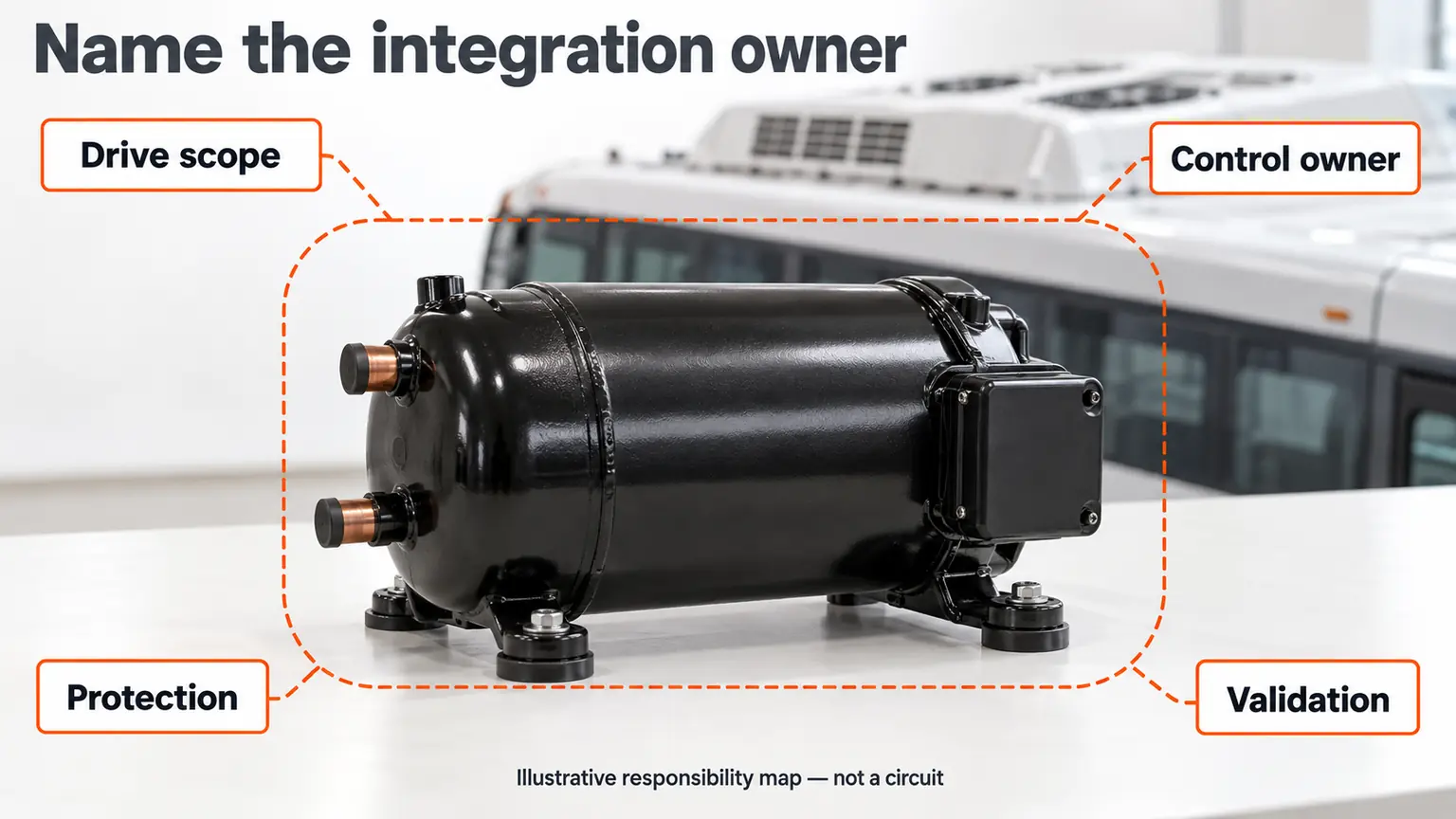
Illustrative responsibility map using a generic compressor and bus context, not a real installation or wiring schematic. Dashed boundaries identify scope to assign: drive, controls, protection and validation. Actual interfaces come from the selected product documentation and responsible integrator.
The following is a platform-level comparison, not a common-capacity product test. Neither platform is nominated for an unidentified bus. Each manufacturer must return an eligible model and its operating data against the same project requirement.
Platform route | Documented architecture | Question for the project team |
|---|---|---|
BITZER ELH / ELA | Horizontal hermetic scroll family for transport air conditioning, including electric buses. | Does the selected compressor fit the required orientation, envelope and operating points with the proposed drive? |
Danfoss BOCK HG mobile | Semi-hermetic mobile reciprocating range, including lightweight aluminium configurations. | Which exact mobile model, motor and valve configuration meets the duty and installation requirements? |
The architecture names describe how the compressor is built, not which option is better. They influence the documentation and integration questions. A catalogue description such as compact or lightweight is not a project-specific packaging assessment, and a broad application claim is not an approval for a particular roof unit.
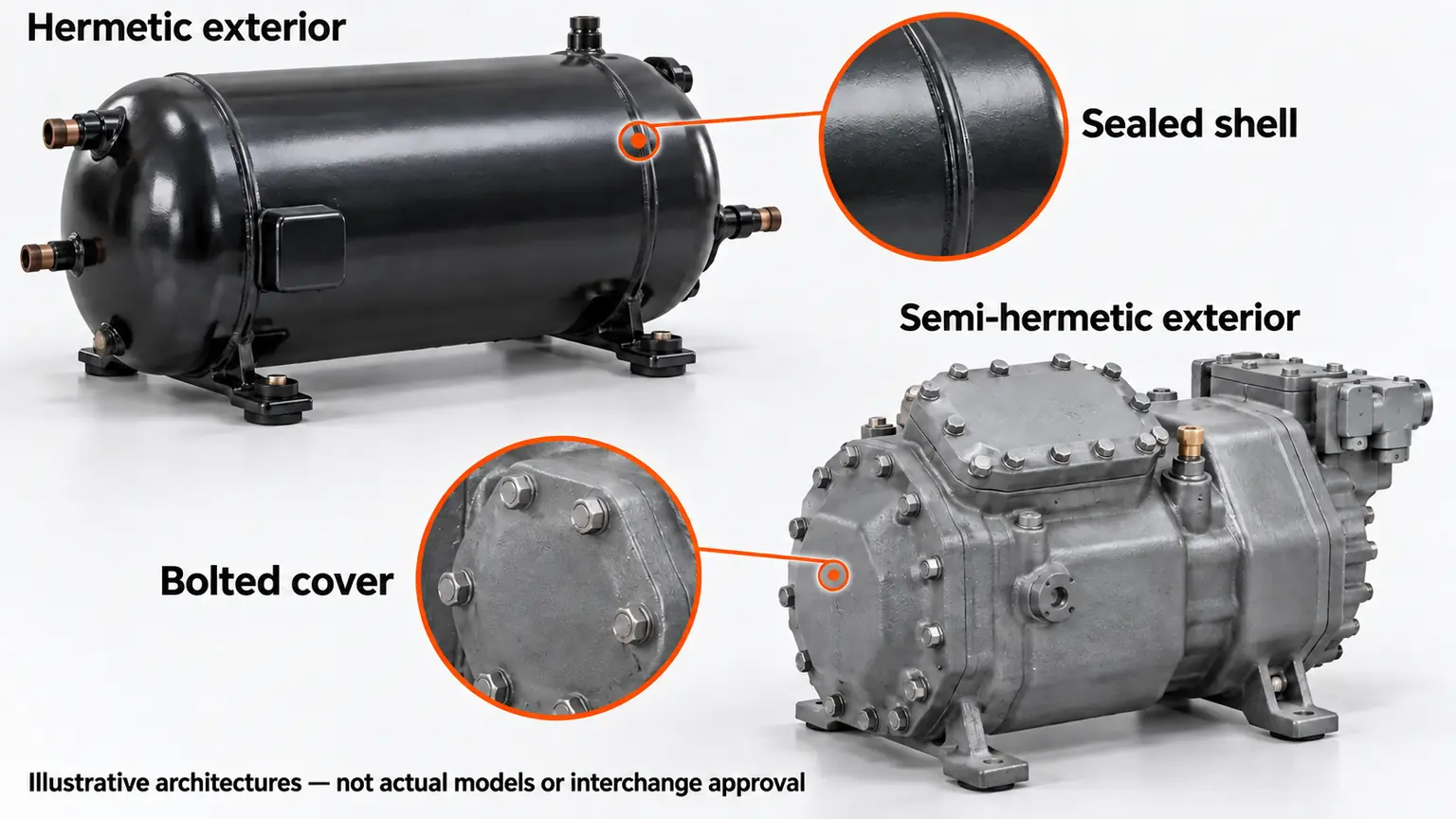
Generic exterior illustrations distinguish sealed hermetic and bolted semi-hermetic construction; these are not photographs of BITZER ELH/ELA or BOCK HG models. They are not to scale and do not prove interchangeability, service permission or project suitability.
BITZER's current ELH/ELA product page identifies a horizontal scroll family for transport air conditioning and electric-bus use. It lists ELH725(Y), ELH730(Y), ELH736(Y) and ELA743(Y), with links to technical data and selection software. That supports a specific model-selection enquiry rather than a request for any compressor bearing the BITZER name.
Ask the proposing team to identify the complete selected model and motor version, then provide the selection conditions behind it. Retain the required mounting orientation and the total installation envelope, including connections and access. A unit that fits the nominal compressor space may still require a different pipe route, support arrangement or service clearance.
Keep the compressor proposal connected to its drive and protection requirements. The project record should show the intended electrical supply at the compressor, supported operating range, protection responsibilities and the documents used to establish them. Do not infer a direct battery connection from the phrase electric-bus application.
Older literature may help explain the technology, but check its date and product status. A development reference in a historical brochure should not become an available production option in today's quotation. Likewise, an older list of refrigerants is not the project's final refrigerant selection or a statement of current regulatory suitability.
Danfoss's Italian transport-compressor overview separates mobile HG semi-hermetic products from FK vehicle compressors and StarCO2 products. These are different portfolio routes. Their presence on one page does not make them a single pool of equivalent electric-bus replacements.
The specific BOCK HG mobile page describes mobile reciprocating configurations, different motor choices and the K-valve design for bus air-conditioning duty. It also directs users to the VAP mobile selection tool. Use that route to request a configured selection, not to attach a family-level performance statement to every HG compressor.
The enquiry should preserve the exact model, mobile configuration and motor selection. Ask for the relevant operating envelope, installation orientation, lubrication requirements and protection documentation. When a proposal relies on a particular valve or motor arrangement, keep that arrangement on the approved specification so a later offer cannot silently revert to another version.
Do not use portfolio-wide weight or capacity claims as a measured advantage over the BITZER proposal. A valid comparison needs the selected assemblies, matching operating points and a defined supplied scope. Product-family marketing does not supply that common test basis.
The useful output from the two enquiries is not a list of brochure maxima. It is a pair of selections that answer the same thermal requirement. Give each proposing team the project conditions it needs, then retain the calculation or selection record returned with the exact model.
Before comparing results, check that the two responses describe the same refrigerant, cooling task, temperature conditions and relevant speed or frequency basis. If a proposal uses a different condition, ask for a comparable selection or explain why the project requires separate cases. Missing data should remain visible rather than being filled by an assumed conversion.
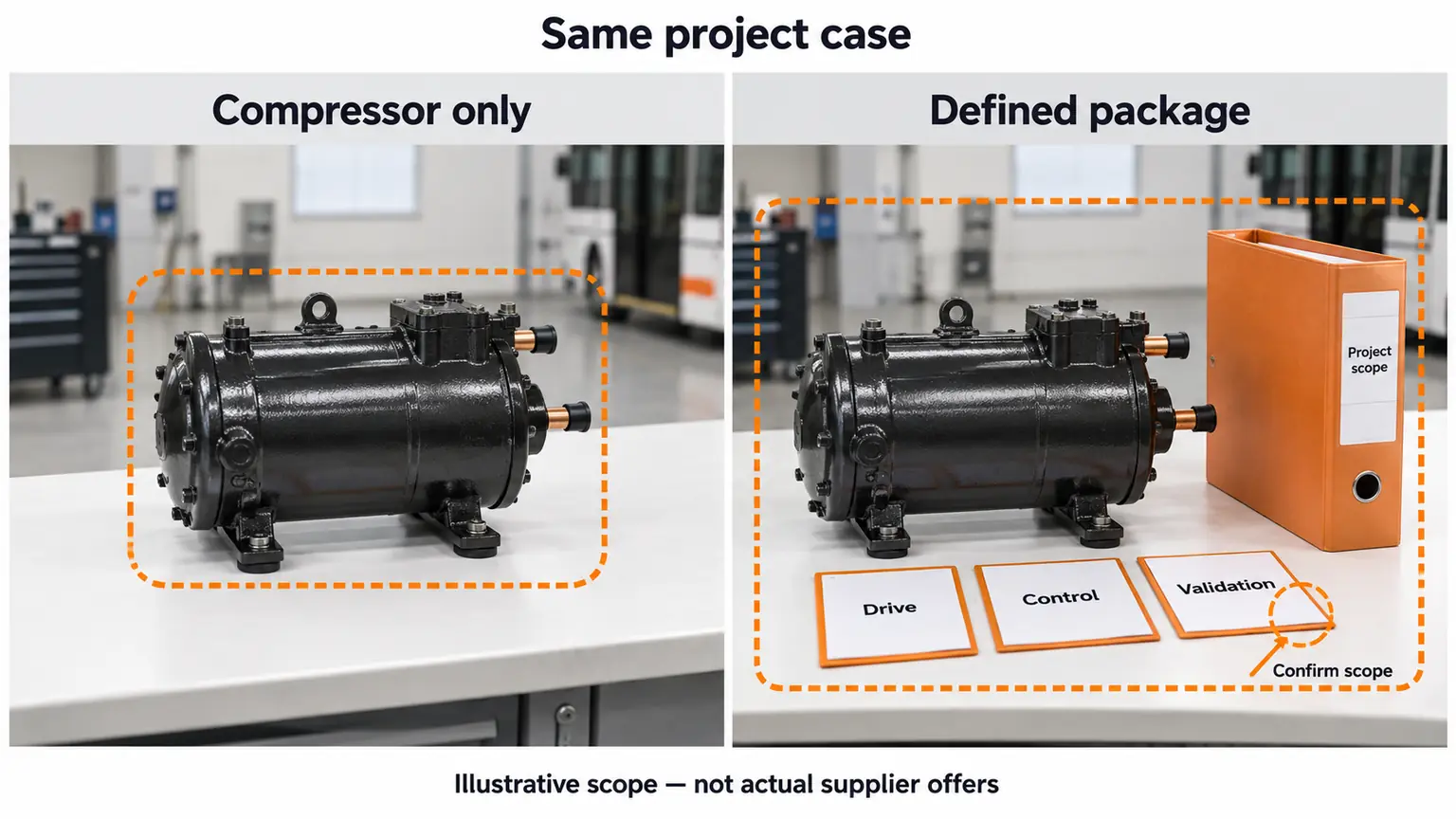
Next compare the complete installation implications: compressor envelope and mass, supports, refrigerant connections, drive components, electrical protection, controls and service access. Assign an owner to each interface. This is especially important when one supplier quotes a compressor alone and another proposes a wider package.
Illustrative quotation scopes using the same generic compressor, not actual supplier offers or manufacturer model photographs. A defined package must state drive, control and validation responsibilities; a wider boundary alone does not mean the system has been approved.
A simple project register can use these fields:
The operating case and the person responsible for its thermal requirement.
Selected compressor identity and the dated selection output.
Included drive, controls and protection, with exclusions stated.
Approved installation drawing and any unresolved packaging or service-access issue.
System-validation scope, acceptance responsibility and required supporting documents.
Supply entity, Italian project destination, technical-support route and quoted delivery conditions.
These are proposed project-control fields, not results from an Elecdura test. They help expose a price comparison in which the two offers contain different amounts of engineering work. A cheaper compressor-only line is not necessarily a cheaper accepted HVAC installation.
BITZER provides an Italian contact route, while Danfoss publishes the mobile programme in its Italian product information. These are practical starting points for discussing local project responsibility and support. They do not prove Italian manufacture, immediate inventory or supply to a named Italian bus fleet.
For the actual job, establish which entity will quote the component, which team will answer engineering questions, and which organisation will handle the installed system. Ask whether the quotation is a component supply, a configured package or a service replacement. Preserve the answer with the project record before comparing commercial terms.
A conventional compressor purchasing checklist can help organise identity and interface information. The A/C compressor RFQ evidence guide covers that baseline. For an electric-bus project, it must be supplemented by the actual drive, controls and system-validation responsibilities described above.
This is not an R744 compressor or CO2 heat-pump comparison. A project requiring that refrigerant and system architecture needs its own qualified selection; it should not use the non-R744 platform discussion as an interchangeable alternative list. Nor does this article recommend changing refrigerant in an existing system.
It is also not a high-voltage service procedure, a wiring guide or permission to open a compressor. Work on the installed system must follow the responsible vehicle and HVAC documentation and be performed by appropriately qualified personnel. A purchasing comparison cannot establish that a vehicle is safe to service or ready to return to operation.
First ask the vehicle or HVAC-system responsible party for the approved replacement or documented alternative. A delay does not establish technical eligibility for a different platform. If an alternative requires engineering changes, identify who can approve and validate them before treating it as a repair option. Keep an unapproved proposal separate from the normal service order.
No. Determine the permitted service scope for the exact compressor and installed HVAC system, the workshop's capability and the available approved parts and procedures. An architecture description does not establish an economical or authorized repair path. Compare an actual supported repair proposal with a supported replacement proposal before deciding.
Not as a direct performance ranking. Retain both condition sets and ask for results under a shared project case where possible. If the project genuinely contains different operating cases, evaluate each eligible selection against those cases rather than merging unlike figures. The model name and calculation conditions must travel together into the technical review.
The project still has an unassigned integration task. Ask the HVAC integrator or responsible engineering team to define control ownership, interfaces and acceptance before approving the package. Buying the two components does not close that gap. Keep the missing scope explicit so it is not discovered only when the installation is being commissioned.
No exact branded stock or application approval is claimed. An enquiry must identify the requested part, system and required supply status, then obtain an explicit response on what can be offered. If genuine brand supply or an approved service route is mandatory, state that requirement at the start rather than assuming a general aftermarket offer satisfies it.
Begin an Elecdura sourcing discussion in the Request a Quote form below by stating whether this is an approved service replacement or a platform investigation. Include the HVAC-unit identity and exact component requirement, and identify which engineering decisions remain with your system team.
Manufacturer sources reviewed on 9 September 2026. The shortlist describes documented platforms and questions for project selection, not an independent quality ranking or an approved interchange.