ELECDURA NETWORK

Your Whole New Supply Chain For Heavy-Duty Parts
Whatsapp:
+86 18915027366
Phone:
+86 18915027366
Views: 0 Author: Site Editor Publish Time: 2026-09-14 Origin: Site
An ISB 6.7 engine description is not enough to combine every school-bus starter order into one stock line. The replacement program may cover the engine while a particular assembly differs in its ground-stud arrangement or installation requirements. For a US fleet buyer, the useful comparison is between confirmed assemblies for the buses actually operated, not between brand names alone. This guide examines Delco Remy 31MT and Prestolite PowerPro Extreme 5 examples, showing where their published references overlap and where purchasing must keep an application question open. It is a practical shortlist, not a measured ranking of quality or service life.
Both manufacturers publish school-bus application material, but they organize replacement evidence differently. Delco Remy provides a school-bus application brochure alongside current part records. Prestolite lists HM95 assemblies with specifications, cross-references and linked technical bulletins. US seller KIRKS also separates school-bus starter applications within its commercial catalog. These sources make the programs relevant to this comparison; they do not establish that a particular seller has stock or that either assembly is approved for every bus carrying the same engine badge.
The comparison below starts with new assemblies. It does not compare a new part against an unidentified rebuilt unit, an isolated starter drive or a magnetic switch. Those are different purchase lines. Nor does it assume that a product offered in the USA was manufactured there. The task is to establish which complete assembly a supplier is quoting for a defined installation.
Program | Representative references | Useful published distinction | Purchase boundary |
|---|---|---|---|
Delco Remy 31MT | 61006211 and its listed 61006210 alternative | The current replacement options distinguish no ground stud from a replacement with a ground stud. | Retain the exact suffix and installation requirement; do not order only by 31MT. |
Prestolite PowerPro Extreme 5 / HM95 | M95303H / HM95R2003SE | A fixed-flange assembly with published Delco reference overlaps. | Use the application and product record together; a broad cross-reference is not a fleet-wide approval. |
Another branch of the same Prestolite program | M95307H / HM95R2007SE | Blue Bird cross-references and bulletin-qualified replacement rows distinguish this branch. | Do not count it as a third brand or merge it with M95303H without resolving the installation difference. |
A fleet shortlist can therefore contain two programs but more than two approved purchase lines. That is not unnecessary duplication. It preserves a distinction that may matter when the warehouse selects a unit for a specific bus. Reducing the number of stocked references is useful only after the application evidence supports the consolidation.
The current Delco Remy 61006211 record identifies an active new 31MT starter: 12 V, SAE 1 mounting and a 10-tooth pinion. Its over-crank protection field is “No.” The replacement-options area identifies 61006211 as having no ground stud and describes 61006210 as a replacement with a ground stud. Those notes are more useful for an actual quotation than a statement that both parts belong to a heavy-duty family.
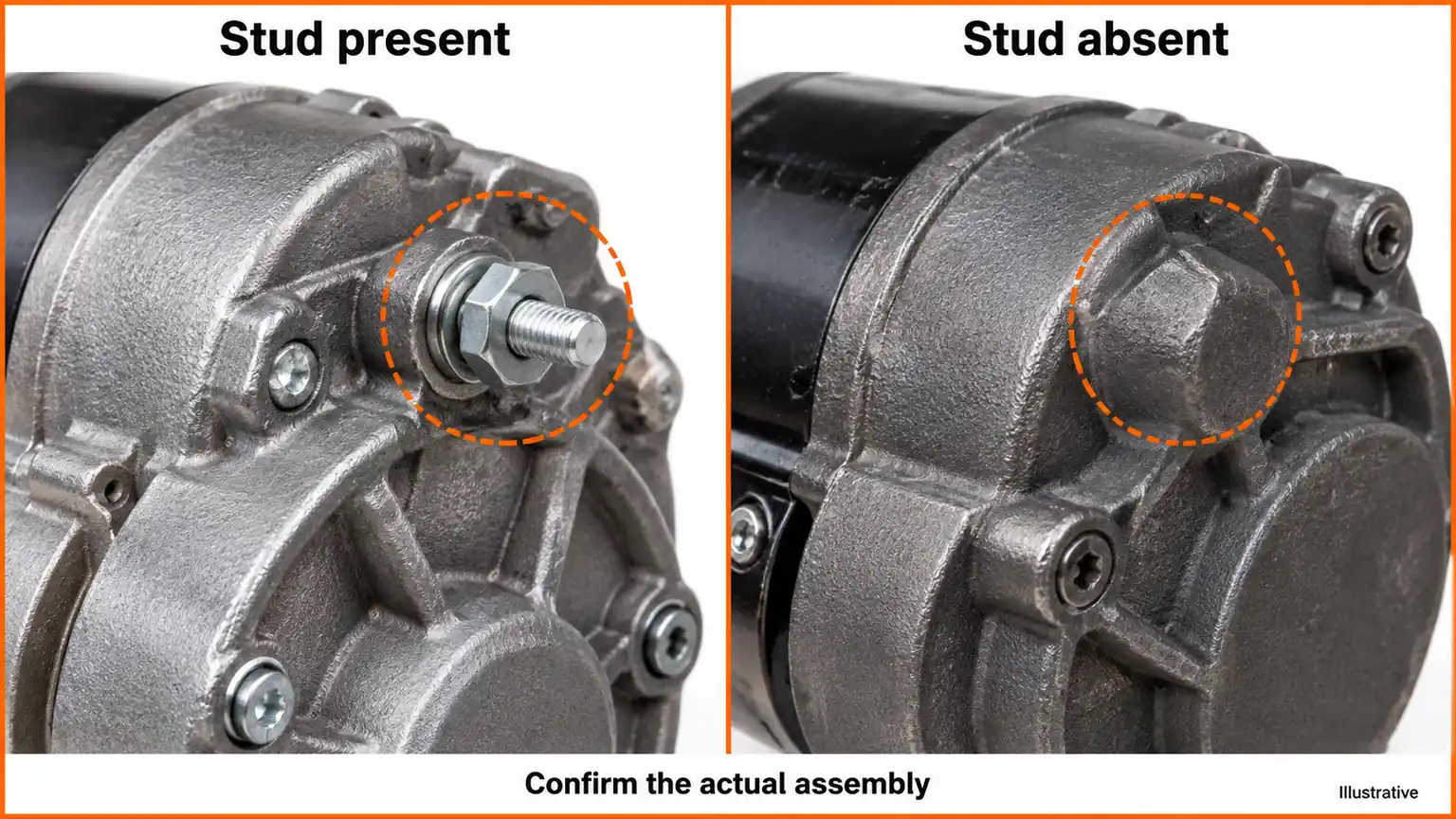
Do not confuse grounded polarity with the presence of a particular external connection point. The catalog can describe grounded polarity while separately distinguishing physical ground-stud arrangements. Purchasing should carry the actual installation requirement into the offer, leaving cable connections and any required service procedure to the responsible technician and manufacturer instructions.
The Delco school-bus application brochure, with a March 2024 footer, separates Thomas Built and IC Bus ISB 6.7 entries. It also lists a Thomas Built low-profile-turbo, no-ground-stud branch against 61006209. That is a reason to retain the chassis and installation description, not to generalize one number across the fleet.
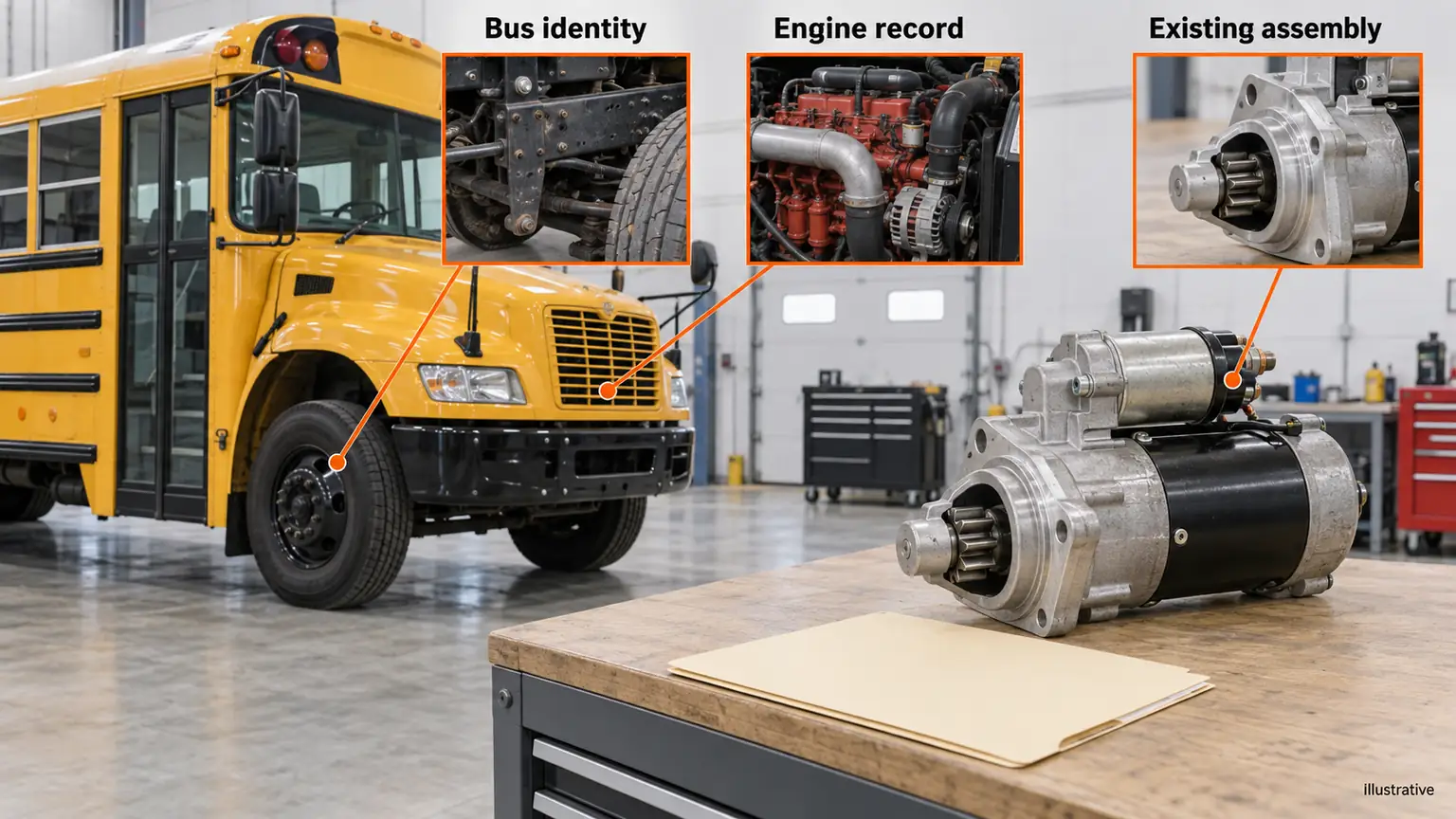
Before a purchase line is consolidated, the fleet record should identify the bus, engine and existing assembly, then state whether a ground-stud or clearance exception remains unresolved. The supplier's proposed number belongs beside that record. A shared engine designation must not replace the installation description that originally separated the two orders.
Illustrative application record, not an actual bus, VIN, branded starter or approved replacement.
The manufacturer record for HM95R2003SE / M95303H identifies a new PowerPro Extreme 5 starter with a fixed flange, 12 V supply, 5 kW output and a 10-tooth pinion. Its cross-reference table includes both Delco 61006211 and 61006210. The page also links school-bus technical and application publications. These are manufacturer-level sources, not an inference drawn from a similar product photograph.
The US KIRKS school-bus listing identifies M95303H for Cummins ISB 6.7. It separately describes M95307H for Blue Bird and other applications requiring an additional ground stud. A seller listing supports a real commercial route to investigate, while the manufacturer record supplies technical identity. Neither alone establishes the current stock, order terms or final match for a particular vehicle.
The manufacturer page for HM95R2007SE / M95307H includes Blue Bird 00108907 and 10062038 among its cross-references. Its Delco 61006210 row explicitly points readers to TSB-1180 and TSB-1187. The presence of those references matters: the buyer should request the applicable instructions and confirmation, not strip the bulletin note from a copied cross-reference list.
This guide does not reproduce the bulletin procedures or claim that a particular modification is required. The source page and bulletin reference identify a question for the supplier and technician to resolve. Keep their answer with the quoted assembly so a later warehouse substitution does not silently undo it.
Illustrative physical-feature comparison only. These are not Delco Remy or Prestolite model photographs, wiring guidance or an interchange approval.
One important case is the Prestolite M95303H cross-reference list, which includes Delco 61006209 as well as the other references discussed above. Meanwhile, the Delco school-bus brochure singles out a low-profile-turbo installation. The two sources operate at different levels of detail. Their overlap is not enough to conclude that every physical installation exception has disappeared.
Send the exact vehicle and installation description with the proposed cross-reference and ask whether the offered assembly is suitable without an unapproved change. If the reply refers to a bulletin, retain the bulletin number and the application-specific answer. If it only repeats the broad engine family, the original question remains unanswered.
A useful response identifies the offered part, the particular installation it covers and any applicable instruction. An answer that establishes one bus does not automatically establish every bus in the depot. This is especially important when the removed starter may itself be a previous replacement rather than the vehicle's original assembly.
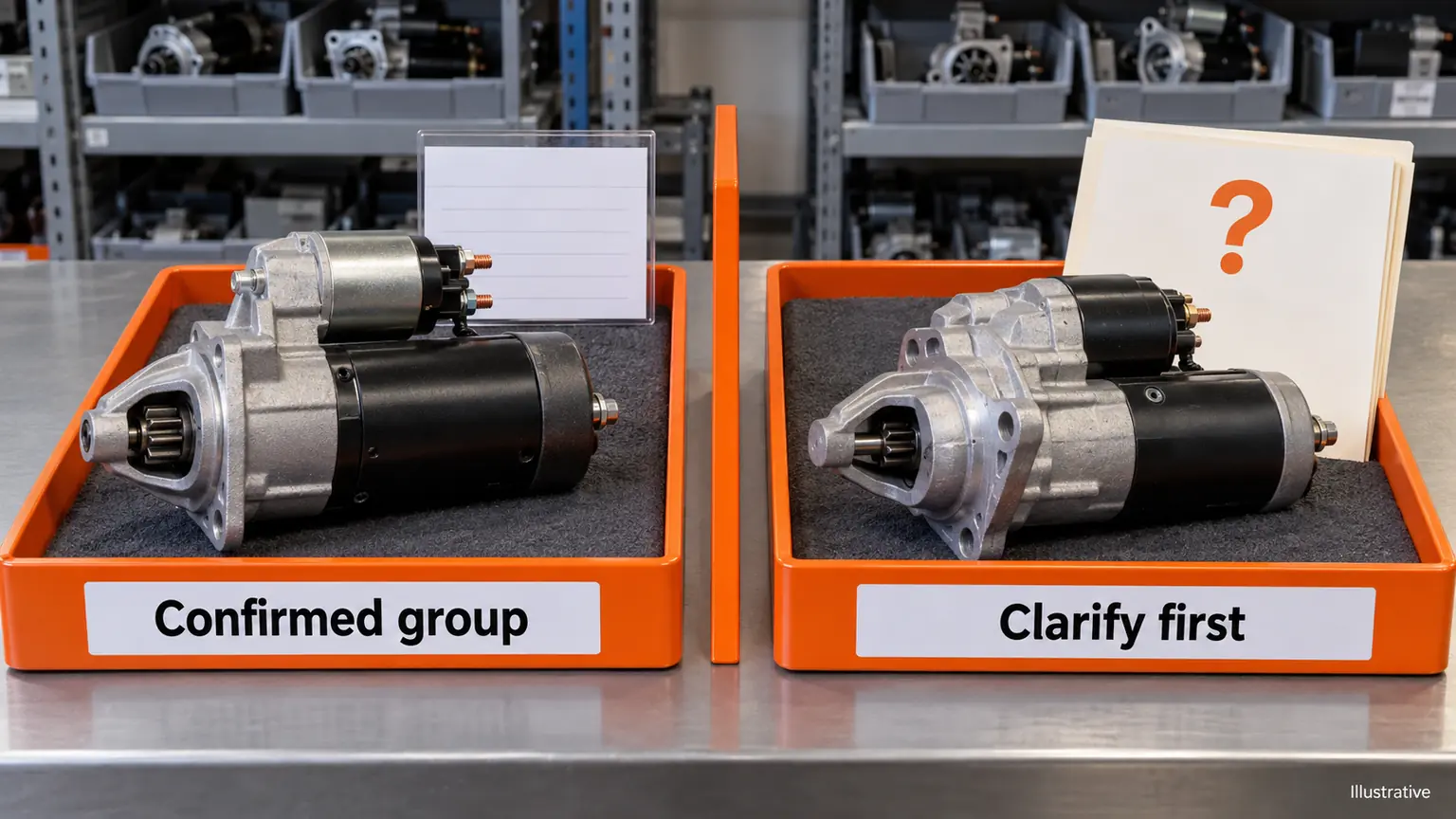
Keep confirmed application groups and unresolved offers in separate records. The purpose is not to reject every cross-reference, but to prevent a supplier's general interchange list from becoming an unsupported instruction to consolidate different fleet installations.
The approved record should connect the exact manufacturer reference to the fleet's installation group. Include the alternative only when its own fitment answer is complete. A purchasing system that stores both references under one loose description can otherwise make an unresolved alternative appear approved during replenishment.
What the team knows | Appropriate purchasing treatment |
|---|---|
The exact offered assembly is confirmed for a documented installation group. | Use that reference for the approved group and retain the confirmation with the stock record. |
A second program is supported, but its ground-stud or bulletin question is open. | Keep a separate conditional offer line; do not permit an automatic substitute. |
Only “ISB 6.7 school bus” appears on the request. | Obtain the missing chassis and installation record before combining demand. |
The delivered reference differs from the approved quotation. | Review the difference before releasing that unit to the intended application group. |
The fleet can choose more than one program for its confirmed installations. The important condition is that the approved reference follows the order into the warehouse and workshop. Keep price and availability beside the reference, but do not let a temporary stock shortage transform an unapproved part into an equivalent.
Illustrative stock-control decision, not a real inventory, supplier approval or actual shipment. Open application questions stay separate.
Detailed generic identification inputs are covered in our Delco Remy cross-reference guide. Use that guide for the underlying reference packet; use this comparison to preserve the specific school-bus branches rather than recreating another broad fitment checklist.
After the assembly question is resolved, confirm who is supplying it, its condition and the actual fulfilment commitment. A manufacturer's product record is not a warehouse availability statement. A US distributor address also does not establish manufacturing origin or authorize claims about every product that distributor lists.
Our USA starter supply-channel guide addresses the broader choice between manufacturer programs and purchasing routes. This article's narrower decision remains which school-bus assembly the quote covers. Keeping those questions separate helps a buyer change sellers without losing the application specification.
For an Elecdura enquiry, send the confirmed reference or unresolved application branch through the inquiry form on the starter-motors page. State the required condition and delivery market. Request an accurately identified offer; this comparison does not claim that Elecdura is an authorized Delco Remy or Prestolite distributor, or that every referenced assembly is currently available from Elecdura.
No. The published examples distinguish chassis and ground-stud or installation branches. Start from the actual bus record and proposed assembly rather than treating engine displacement as the complete fitment answer.
No. If the manufacturer's row includes a bulletin note, that note remains part of the evidence to review. A bare part-number match should not discard qualifications attached to the source record.
The Delco replacement record lists 61006210 with a ground stud, while 61006211 has none. Treat it as a documented alternative to assess, not an automatic fleet-wide substitute. Have the supplier and responsible technician confirm the exact bus installation supports it, then preserve the full offered reference and ground-stud condition in the approved purchase line.
Keep that application branch separate until its installation question is resolved. Delco's school-bus brochure identifies a Thomas Built low-profile-turbo, no-ground-stud branch against 61006209. Although M95303H lists 61006209 among its cross-references, that overlap alone does not resolve the more specific installation exception. Request a written answer for the actual bus before combining demand or releasing the offered alternative to that application group.