ELECDURA NETWORK

Your Whole New Supply Chain For Heavy-Duty Parts
Whatsapp:
+86 18915027366
Phone:
+86 18915027366
Views: 0 Author: Elecdura Publish Time: 2026-09-17 Origin: Site
For Australian Kenworth starter replacement, compare a vehicle-verified like-for-like supply, the OEX application-specific assembly and a Mitsubishi Electric Australia alternative with the relevant application footnote retained. None is a universal winner: engine, build date, required earth arrangement and what the quotation includes decide which route is supportable.
The crucial check is whether the offered complete assembly preserves the truck's approved electrical arrangement. A familiar voltage label, a 39MT family name or two visible studs cannot settle that question. This is a conditional shortlist of purchasing routes, not a manufacturer ranking or an instruction to modify vehicle wiring.
This guide focuses on Australian Kenworth procurement, especially where Cummins applications appear in the published references. Buyers preparing an enquiry can use the heavy-duty starter motor range as a product-selection entry point; its general catalogue does not establish that a named option below is stocked or approved for a particular truck.
On smaller screens, swipe the comparison table horizontally to view every column.
Purchasing route | Useful when | Decision still required |
|---|---|---|
Vehicle-verified, like-for-like configuration | The approved installed specification and any supersession can be established. | Confirm what the current supply replaces and whether the truck has been altered. |
OEX documented Australian application | The vehicle falls within the relevant published conditions and the supplier can identify the complete offered assembly. | Confirm the local configuration, not merely a standard family name or an exterior stud count. |
Mitsubishi application-table alternative | The engine and build information can be matched to an applicable table row. | Resolve every relevant footnote and obtain current approval for the complete supply. |
The order of these routes is not a performance score. A well-supported alternative may be suitable, while a familiar genuine-branded listing may still lack enough information for an unidentified truck. Conversely, an alternative is not automatically better because its description adds an engineering feature. The buying decision follows the documented application, the supplied configuration and the party responsible for confirming the match.
A country label becomes useful only when it changes the evidence required. Here, Australian supplier literature describes particular Kenworth applications and earth-connection arrangements. That is a substantive local distinction. It does not justify a general claim that every Australian truck uses the same system, that overseas starters are unsuitable, or that a starter sold locally was manufactured locally.
Start with the vehicle's build information, not the date on its registration paperwork alone. If a published condition uses a manufacturing window, a later registration year cannot answer that condition. A buyer who knows only “2016 Kenworth” should therefore resist choosing a convenient side of a date boundary. The useful next step is to establish the underlying vehicle and engine record through the appropriate parts or service channel.
The installed starter is important evidence, but it is not an infallible record of original specification. An older truck may have received a replacement, an approved conversion or a repair whose documentation no longer accompanies the vehicle. A visible cable arrangement can show what is present today without explaining why it is present. Ordering an apparently identical unit may preserve a legitimate change, or may repeat an earlier mistake.
This leaves two records to reconcile: the truck's approved requirement and the assembly currently installed. When they agree, procurement becomes simpler. When they disagree, the difference should be explained before an alternative is selected. A workshop should not be asked to resolve a supplier's undocumented interchange claim by improvising after the new starter arrives.
Keep this investigation proportionate. The buyer does not need to commission a new engineering programme for every repeat order with a stable, approved configuration. The extra work belongs where a material uncertainty exists: missing identity, an unexplained terminal arrangement, an unverified supersession or a vehicle close to a source's date boundary. Those are reasons to hold the affected application, not to freeze unrelated fleet purchases.
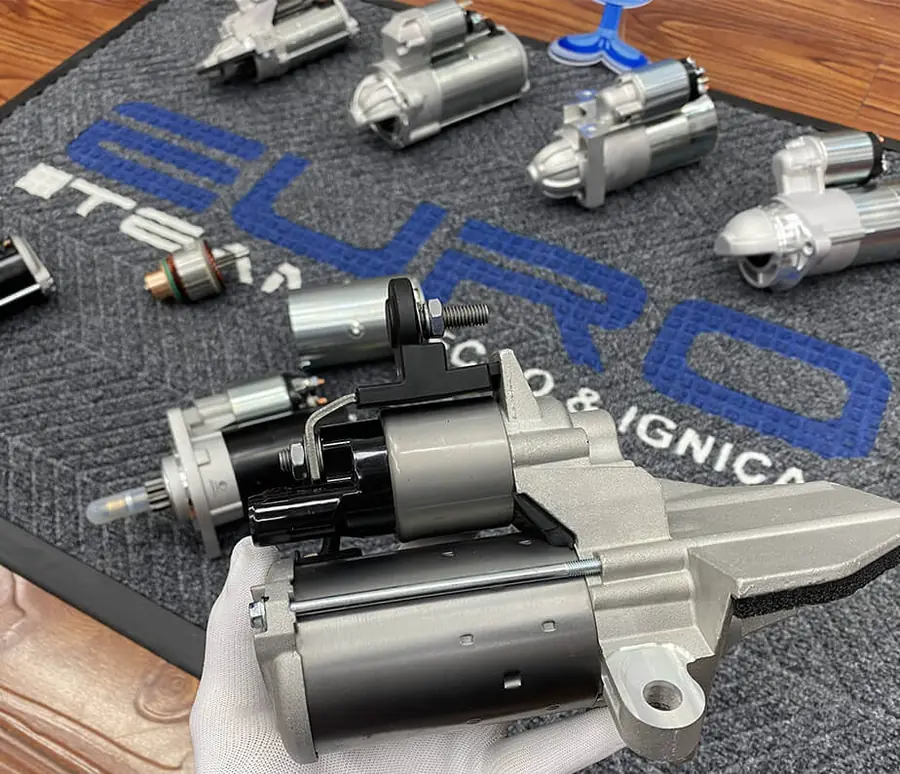
Reference photograph of a starter sample, showing external connections and mounting features. This photo does not establish any named-brand, part-number or Kenworth application match.
In the catalogue pages checked on 15 September 2026, PACCAR Parts Australia listed D61-1004-004 as a PACCAR Genuine starter. That snapshot also contained a separate Delco Remy 8202308 dual-earth entry, described as 12 V, 7.8 kW for Australian Kenworth/Cummins applications from 2009 to 2016. These are identifiable local catalogue records, not a reason to collapse the two products into one replacement choice.
This route is strongest when the vehicle record, the currently approved configuration and the supplier's proposed part can be connected without an unexplained jump. The buyer is then purchasing a specified replacement, rather than asking a warehouse to select something from a broad engine-family description. A confirmed supersession can belong to this route, but the supersession must actually be established; a different number on a search result is not enough.
The broad wording on a catalogue page should not do more work than it can support. A statement covering post-2016 Kenworth production is useful as a lead, but does not explain every engine variant, subsequent vehicle alteration or relevant qualification. It should be reconciled with the truck record instead of used to override a more detailed application condition found elsewhere.
The advantage of this purchasing approach is a narrower approval question: what is the current approved supply for this known configuration? Its limitation is that the answer may require information the buyer does not yet have. A premium logo does not remove that limitation. Nor does a complete-looking product photograph establish what mounting, terminal or connection variation will be shipped against a particular quotation.
Separate catalogue identity from commercial readiness. A listed part may still require a dealer enquiry for actual stock, shipment timing and applicable terms. If an older number is no longer offered, the correct response is a documented replacement path, not a silent substitution described only as “same as original.” Ask the seller to identify the change and explain whether it affects the assembly, the associated hardware or the installation approval.
The engineering note linked from OEX's starter range identifies DXS9169 as a 12 V, 11-tooth, 7.3 kW, clockwise 39MT-style dual-earth starter. It describes an additional negative-current path that does not pass through the engine block, and a strengthened brush-holder arrangement. Its named Australian Kenworth/Cummins ISX, ISXe5 and Signature application window is January 2011 to January 2016.
Read the OEX engineering note as a source-specific application reference, not universal Kenworth approval.
The procurement significance is the complete described assembly. A quote for a standard starter family with an added external feature is not automatically a quote for that assembly. The supplier should be able to identify what is being offered and how its configuration relates to the documented local application. That explanation must precede any assumption that two visible negative posts settle the whole question.
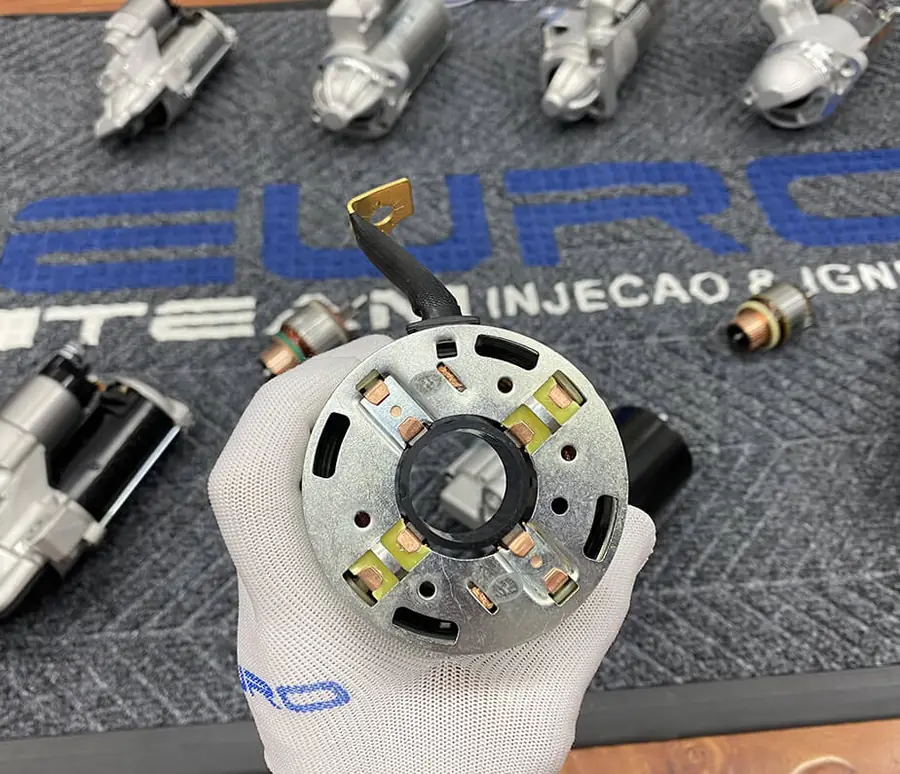
An external photograph cannot establish the construction of a concealed brush holder or the internal relationship between connection points. It can help identify a discrepancy worth asking about, but cannot prove compliance with the engineering note. Equally, a photograph of a loose internal component does not prove that component is fitted to the offered starter. Images become useful technical evidence when their part identity and relationship to the quoted unit are established.
Do not convert the note into workshop modification instructions. It describes a supplier's product configuration; it is not permission for a buyer to add a stud, change a current path or adapt another starter by visual imitation. If the offered unit differs from the documented arrangement, the seller needs to explain the approved basis of that difference. The workshop should not be left to infer it.
This route deserves consideration where its conditions genuinely match the vehicle. It does not deserve automatic preference merely because “Australian engineered” sounds reassuring. The comparison remains between identifiable assemblies with supportable applications. Historical promotional warranty wording also needs a current commercial check; it should not be copied into a purchase order as though the supplier has already accepted those terms for today's transaction.
Visible brush-holder assembly from the supplied photo library, not a verified OEX or Delco Remy part. It illustrates the kind of internal evidence an exterior product image cannot provide.
Mitsubishi Electric Australia links to an application flyer printed in October 2022. Its Kenworth table includes PCA0479 high-output DP60 and PCA1479 Standard105P entries. The Cummins ISX/ISM 2011–December 2015 row carries a condition requiring an insulated earth stud to be fitted.
A later PCA0479 row associates ISX/ISM/X15 with an 11-tooth configuration and a 2016–Current label.
The table separately includes a 12-tooth PCA2679 entry for ISL. Consult the dated official flyer rather than lifting a part number out of its row.
A footnote that changes the required configuration belongs to the purchasing decision, not to optional reading after delivery. A seller may quote a complete suitable assembly, a supply requiring a specified additional item, or an alternative whose current approval supersedes the older reference. Those are different offers. The buyer needs to know which one is on the table and who is responsible for resolving the condition.
The phrase “to be fitted” alone does not tell the buyer whether today's quoted starter arrives with the required item already installed. It also does not establish the exact contents of an accessory package or authorise a generic modification. Those are questions for the supplier's current application and installation documentation. If the answer is unclear, the quote remains incomplete for the affected vehicle, even when its main part number appears in the correct family.
Date language needs the same discipline. A document printed in 2022 may label a range as “Current.” That describes the document's contemporary boundary, not a rolling approval automatically extended to every later truck. For a newer vehicle, obtain a current application confirmation. For an older one, retain the relevant historical condition unless a documented update explains why it no longer applies.
It would also be misleading to treat the Mitsubishi insulated-stud condition and the OEX local dual-earth arrangement as two names for a proven interchangeable modification. The sources describe their own applications and products. Neither establishes that one can be substituted for the other by changing visible connections. The Mitsubishi route is therefore a conditional alternative to evaluate as a complete proposal, not a shortcut around understanding the existing system.
A common purchasing trap is to assemble a specification from several pages: take the part number from one, the output figure from another and the application dates from a third. The result can look more complete while describing no verified product. This matters when a retailer groups references together but the primary documents retain different ratings, date windows or assembly descriptions.
The OEX note and dated PACCAR dual-earth entry provide a practical example. Their different product identifiers and power labels must remain visible in the comparison. The difference does not by itself prove an error, an upgrade, a supersession or a different test method. Any of those explanations would need evidence. Until the relationship is documented, do not publish a combined specification or award an order on the assumption that the higher number means better starting performance.
Nor should a familiar family name settle the issue. Delco Remy's 39MT family information describes multiple configurations. Family membership is useful for organising an enquiry, but not an Australian application certificate. The existing 39MT application and fitment guide explains the wider mechanical and electrical matching problem; this comparison concerns the additional local application conditions.
Resolve a disagreement by asking a focused question. Is the new number an approved successor to the old one for the identified truck, or simply another part that appears in a retailer's interchange field? Does the quotation cover the same complete configuration, or a base unit with work or accessories still required? These questions produce an actionable answer. A longer list of websites repeating the same unqualified cross-reference does not.
A newer page is not automatically the document that resolves every difference. It may be a current sales listing with less application detail than an older technical note. Conversely, an old note should not be treated as permanently controlling if the responsible supplier has issued a specific, applicable update. The useful distinction is between a general publication date and an actual revision to the requirement in question.
When a supplier says an old condition no longer applies, ask what changed and which applications the change covers. The answer might identify a revised complete assembly or a documented application update; this article does not assume either has occurred. Until that explanation is available, silence about a footnote on a shorter product page is not evidence that the condition has been withdrawn. This avoids both blindly preserving obsolete instructions and casually discarding a still-relevant qualification.
Keep the answer with the order that relies on it. A supplier's clarification is most useful when it identifies the quoted unit and the vehicle condition being addressed. A general assurance that the business sells many Kenworth starters is not equivalent. Once a specific relationship is established, future repeat orders can use that approved record; there is no need to reopen the same unresolved web comparison every time a depot requests a spare.
Consider a hypothetical Australian fleet enquiry for a Kenworth with a confirmed 2013 build and a Cummins engine relevant to the published application discussions. This is a decision exercise, not a reported customer case. Assume the removed starter has a readable label, but the service history does not yet explain whether the present electrical arrangement is original or an approved later change.
The first supplier offers a direct replacement for the removed unit. That can be a sensible starting point, but it leaves the history question open. If the installed specification is subsequently confirmed as approved, this offer can be assessed as a repeat of a known configuration. If the existing unit was an undocumented substitution, reproducing it may not solve the underlying application problem. The label is evidence of what was installed, not proof of what should have been installed.
The second supplier proposes the OEX documented local route. The build information makes that proposal relevant enough to investigate; it does not finish the approval. The buyer asks whether the quoted supply is the complete described configuration and whether the supplier has checked the specific engine and vehicle information. If the answer refers only to a generic 39MT or to two studs in a photograph, the central question remains unanswered.
The third supplier proposes a Mitsubishi table-based alternative. Here the important issue is not whether the manufacturer's name is familiar. It is whether the applicable row and condition have been addressed in the actual quotation. A price for a bare unit cannot be compared fairly with a price for a complete approved supply when required associated hardware or preparation remains undefined.
At this stage the correct result may be that none of the three offers is ready for award. That is not evidence that all three products are unsuitable. It means a common piece of vehicle information and some route-specific details remain unresolved. The buyer can send the same confirmed vehicle information to each supplier, then ask only the questions that distinguish their proposals.
Suppose the vehicle record subsequently confirms the existing arrangement, and one seller supplies a clear application confirmation while another continues to rely on an unqualified interchange list. The better-supported offer has become easier to approve even without a claim about superior motor quality. The decision is based on a resolved match. There is no need to invent an expected service-life advantage to justify it.
Alternatively, the records may reveal a prior change that needs review by the appropriate technical party. Then the purchase should remain linked to that review, rather than allowing the cheapest available starter to determine the vehicle's electrical design. Procurement can still establish stock and reserve quotation validity while clarification proceeds, but availability should not be mistaken for engineering approval.
There is also a scope choice. Restoring this one truck to its confirmed approved configuration is a different project from introducing a new starter arrangement across the fleet. An urgent repair order should not quietly become the evidence for that wider change. If the buyer wants to evaluate a new standard, define that evaluation separately, with its own application group and technical acceptance. The immediate repair can then be judged on the information needed for the affected vehicle, without promising fleet-wide compatibility or benefits that have not been demonstrated.
Now consider a second hypothetical situation: a parts buyer wants to reduce the number of starter descriptions used across an older and a newer Kenworth group. Both operate in Australia, but the records show different engine or build information. A shared badge and similar external housing are not enough to justify one unrestricted shelf code. The consolidation proposal must demonstrate that the complete approved configuration is genuinely common.
Begin by separating confirmed common applications from unresolved ones. A vehicle with missing history should not inherit approval from a better-documented neighbour. Likewise, a later build should not be pulled into an old flyer solely because the printed range ends with “Current.” This creates a small exception group that needs attention, while allowing stable repeat applications to continue through their established purchasing route.
The store description should retain the condition that prevents the wrong issue. A reference number can be concise, but a generic label such as “Kenworth starter, heavy duty” removes information the workshop may need. If two approved supplies differ in their connection arrangement or required associated hardware, those differences should remain visible in the store record even when a supplier markets them under one broad family.
This is also where substitution control becomes practical rather than bureaucratic. An approved alternate should be tied to the applications for which it has been accepted. It should not automatically become an alternate for every vehicle linked to the original supplier's brand. A purchasing system can distinguish “approved for this application group” from “possible replacement awaiting confirmation,” instead of forcing both into the same available-stock category.
A central warehouse and a regional workshop may have different immediate priorities. The warehouse wants fewer confusing descriptions; the workshop wants a unit it can use without discovering an unresolved condition at the vehicle. Those aims are compatible if consolidation follows confirmed compatibility. They conflict when a reduction in stock codes is treated as evidence that the underlying configurations are identical.
Review changes when something material happens: a supplier supersedes a number, an application record changes, a new vehicle joins the group or a delivered assembly differs from the approved example. Do not require a fresh broad market survey for an unchanged repeat order. The purpose of the record is to preserve a resolved decision and expose meaningful changes, not to create a growing archive of interchangeable-looking product pages.
A useful request for this comparison preserves four details that a generic price enquiry can lose:
The confirmed engine and build information, including whether a source's earlier production window applies.
The installed reference and any unresolved difference between the vehicle record and the present connection arrangement.
The precise offered assembly, with any application-specific earth hardware or preparation identified as included, separately supplied or unresolved.
The supplier's current application confirmation, its relevant document date, and who must resolve a remaining condition before release.
Once a route is technically supportable, compare what each supplier is actually committing to deliver. For this application, the decisive distinction may be whether the identified assembly already satisfies the relevant connection condition, or whether a separately specified item and approved preparation are still required. That is part of the product definition, not a minor note to settle after payment.
Make responsibility clear without inventing installation instructions. The seller should identify the basis of application confirmation and the configuration supplied. The workshop should follow the applicable approved service information. The buyer coordinates those responsibilities; it should not translate a catalogue footnote into its own wiring method. Where a required condition has no identified owner, the offer is not yet complete.
Brand identity also needs a clean distinction. A genuine-branded part, an aftermarket replacement and a product described only by an interchange number are not the same commercial offer. None becomes the other because a retailer places several references in one field. The order should describe what will arrive, while any approved interchange relationship is recorded separately as the reason it can serve the application.
Price comparisons should then use the same scope. A lower unit price may exclude something another offer includes, but the buyer should not assume that it does. Ask for the inclusion or exclusion to be stated. Equally, do not assign a financial penalty to an alternative merely because its route has a footnote. Once the complete requirements and responsibilities are known, a fair comparison becomes possible without speculative costs.
Local availability must be specific enough to support the planned repair. A catalogue page, a store-location list and stock allocated to an order are different states. Establish the dispatch point, the expected shipment event and what happens if a proposed substitute is offered before release. An urgent enquiry can justify a faster response; it does not justify leaving the substitute's application approval unstated.
Obtain the current terms attached to the quotation, including how an incorrect supply or a configuration disagreement will be handled. Historical brochures and generic website warranty phrases are context, not a substitute for the applicable sale terms. This is especially important when the disagreement would concern whether a complete conditioned assembly was supplied, rather than a simple defect in an otherwise correctly identified product.
Receiving should confirm that the delivered supply matches the approved proposal. For this article's applications, the important exceptions are an unexpected part identity, a changed visible connection arrangement or missing items that the agreed route required. A goods-received record should not release those discrepancies merely because the carton carries a familiar brand or the starter appears mechanically substantial.
Keep any separately supplied, application-specific hardware linked to the unit or order it belongs with. An apparently minor loose item can become a significant ambiguity if it is separated from its instructions or mistaken for optional packing material. The buyer need not infer its function from appearance; the packing list and approved supply definition should explain why it is included.
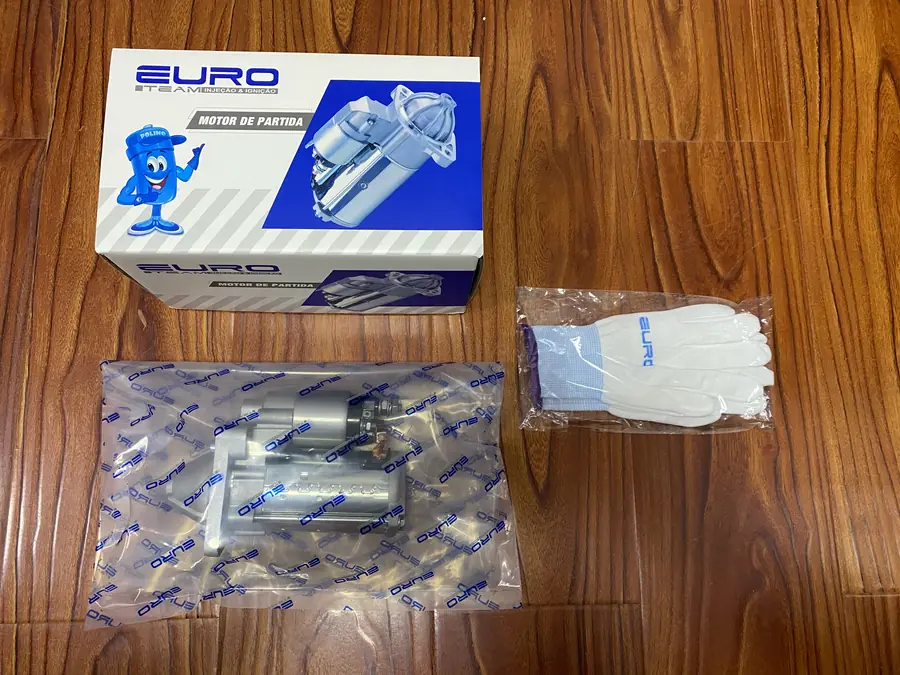
A packaging photograph can support a discussion about protection, but its limits matter. Seeing a bag and a carton does not show every internal restraint, confirm the contents of an accessory pack or prove a transport test. Request additional evidence only when it resolves a concrete uncertainty in the order. Do not turn an attractive packing image into a claim that the product is ready for every Australian freight route.
A bagged starter and carton in the supplied materials. The image does not prove internal restraint, transport testing, destination, included connection hardware or Kenworth fitment.
The receiving team is confirming a purchasing decision, not creating a new application approval. If an unexpected feature appears, hold the affected unit for clarification against the accepted specification. Do not ask the store or workshop to make a convenient adaptation simply to close the order. Once the discrepancy is resolved, retain the answer so that the same uncertainty does not reappear with the next delivery.
A suitable replacement does not establish why the old starter failed to crank the engine. An application decision and a fault diagnosis answer different questions. This guide cannot determine whether a particular complaint originates in the starter, its supply or control circuits, the battery system or another vehicle condition. A qualified workshop should resolve the fault using the applicable service information before an unnecessary replacement or unapproved change is made.
For the buyer, the final rule is straightforward: choose the route that can be connected to the identified Australian vehicle and a complete, currently supported supply. Keep source dates, product identifiers and connection conditions intact. Do not rank by a combined web specification, assume a visible stud proves internal construction, or treat a shared brand name as a fleet-wide interchange approval. A shortlist is useful when it narrows the next decision, not when it hides the conditions that still need an answer.
First establish whether a return is required by the particular sale and what identification evidence will be lost when the unit leaves. Keep readable label and connection photographs, and obtain the relevant approval before losing access to a disputed assembly. This does not assume that every offer has a core-return condition; the terms and timing must come from the actual supplier.
Only if the reply explicitly covers the revised supply or a documented approved replacement relationship connects the numbers. A reply for the previous quotation should not silently approve a new unit. Ask the supplier to identify whether the change is administrative or affects the complete assembly, and retain the answer with the revised quotation. Do not assume that either type of change has occurred from the number alone.
No. The Mitsubishi flyer includes other engine rows, but this article's developed comparison concerns the stated Cummins-related Australian evidence. For a Caterpillar application, return to its exact engine and build row and obtain a separate current match. A shared Kenworth heading above a table does not transfer the conditions of one engine row to another.
The buyer can identify the vehicle and engine, establish the build record and request the appropriate parts-channel lookup. Exterior photographs can support that enquiry without being treated as a substitute for the missing reference. If those records still leave the earth configuration unresolved, keep the order conditional. Do not select a convenient DXS9169 or PCA0479 reference merely because it appears elsewhere in this guide.
For an Elecdura starter enquiry, share the vehicle, engine, installed reference and unresolved configuration question through the starter motor product and enquiry route. Include the exact option you want evaluated and ask for a clearly identified proposal before treating it as an approved replacement. This article and its sample photographs establish no Elecdura compatibility with the named products, current stock position or delivery commitment.