ELECDURA NETWORK

Your Whole New Supply Chain For Heavy-Duty Parts
Whatsapp:
+86 18915027366
Phone:
+86 18915027366
Views: 0 Author: Site Editor Publish Time: 2026-09-16 Origin: Site
Cleanfix and Flexxaire offer documented starting points for Canadian forestry buyers considering a reversible cooling-fan retrofit. The useful comparison is how each program evaluates an existing machine, defines the installation package and supports it after delivery. A customer story or factory-installed fan does not establish that a retrofit kit fits your machine. Begin with its serial number, installed cooling arrangement and recorded cleaning problem, then request a written application decision. This guide compares program entry and responsibilities, not national market share, measured brand superiority or guaranteed savings. Neither program is presented as an approved substitute for the other on an unidentified machine.
That distinction matters before a parts desk orders hardware. An ordinary replacement fan and an engineered reversing retrofit solve different purchasing tasks. The Elecdura cooling-fan category provides a separate aftermarket sourcing entry point; it is not evidence that Elecdura is an authorised Cleanfix or Flexxaire dealer, has either kit in stock, or can approve a cooling-system redesign.
Both named programs belong on a research shortlist because they publish retrofit entry points and Canadian contacts. Their public information can help a buyer start an application enquiry. It does not support an orderable, side-by-side kit comparison for a machine that has not been identified.
Program | Documented enquiry path | Decision still required |
|---|---|---|
Cleanfix | Machine-tailored retrofit enquiry; local-dealer or sales-partner route; Canadian contact in Stratford, Ontario | Whether the exact machine can use a defined kit, and which mounting, actuation and control items that quotation includes |
Flexxaire | Retrofit brand/model selector; contact route for an unlisted model; installation-document and dealer-assistance offer; Edmonton, Alberta contact | Whether a listed result covers this machine configuration, or whether application engineering is needed before a kit can be quoted |
The table is not a ranking. A program that cannot confirm one machine may remain suitable for another. Obtain comparable application responses before comparing price; otherwise, one quote may cover a complete retrofit while the other covers only a fan or an engineering review.
Cleanfix publishes Canadian customer accounts from Delaney Forest Products and Tru-Way Enterprises. The accounts describe debris-related cooler cleaning in their own operations. They are useful leads for understanding the work environment, but they remain manufacturer-published testimonials, not controlled comparative tests. This guide does not transfer their reported cleaning intervals or temperature improvements to another fleet. The Cleanfix program and customer account page also identifies its Ontario contact.
There is independent equipment-sector context as well. Deere's November 2024 Langley forestry-production announcement describes an expansion involving purpose-built tracked forestry equipment in British Columbia. It supports the relevance of a Canadian forestry buying discussion, not a claim that either fan program is approved for Deere machines or that the announced production plan has been independently audited here.
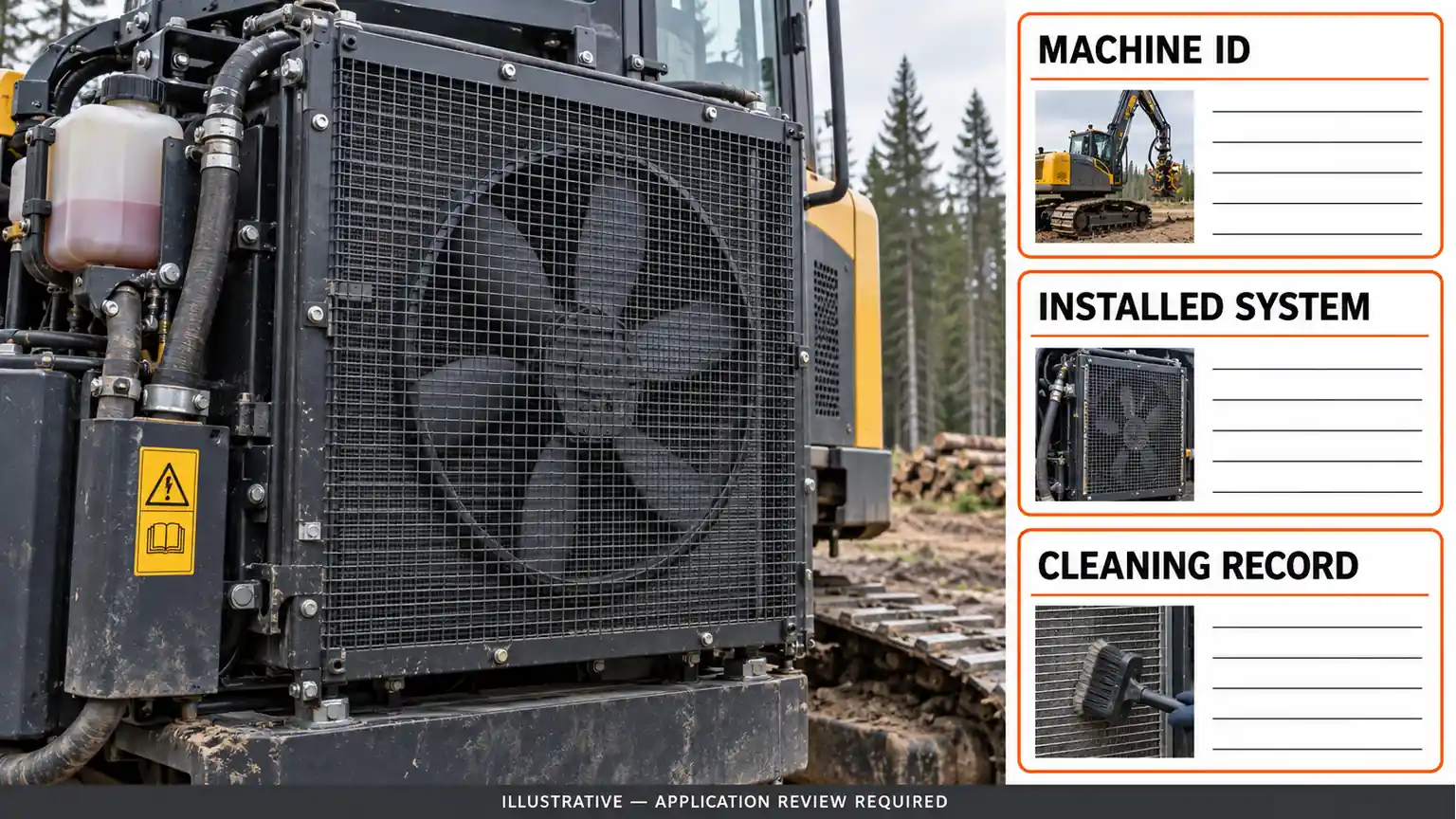
For your own operation, replace broad descriptions such as “dusty Canadian conditions” with a short maintenance record. Identify where material accumulates, which work stage precedes cleaning, how the machine is cleaned and whether a service investigation has found another cooling fault. Record the season and attachment in use. A loading operation, tracked harvesting task and stationary processing task should not inherit the same cleaning assumption merely because all are forestry work.
Keep field observations separate from the proposed benefit. A dated image of a blocked screen documents that screen at that time. It does not establish the required fan specification, quantify lost production or prove that airflow reversal will remove every deposit. Those are different questions for the equipment owner, service provider and retrofit program.
Illustrative procurement record, not a Cleanfix or Flexxaire application approval or a named customer's machine. Follow the actual equipment procedure for cleaning; the inset is not a prescribed method.
The Cleanfix installation and purchasing FAQ describes adapter-flange mounting, pneumatic or hydraulic actuation, and enquiries for unlisted machines. Treat these as program-level descriptions. Do not copy the page's generic clearance or installation-duration figures into a work order for an unidentified machine.
Ask the quotation contact to identify the applicable machine record and supply a revision-controlled installation document. The response should distinguish the fan, mounting arrangement, reversing actuation and operator/control equipment. If one item must be retained from the original installation, have that dependency named. “Retrofit possible” is useful at enquiry stage, but it is not a complete bill of materials.
The Flexxaire retrofit page provides brand and model selection and invites enquiries for models not listed. It also offers supporting installation documents and assistance with the buyer or dealer. Record the selected model and any resulting reference, then have the supplier confirm that result against the machine's serial identity and existing arrangement.
A model-family result should not erase differences introduced by serial breaks, prior repairs or changed cooling components. If the installed fan, drive or shroud differs from the expected configuration, disclose the difference before requesting a firm kit quote. A parts-desk match based on the machine badge alone is not enough to resolve an altered installation.
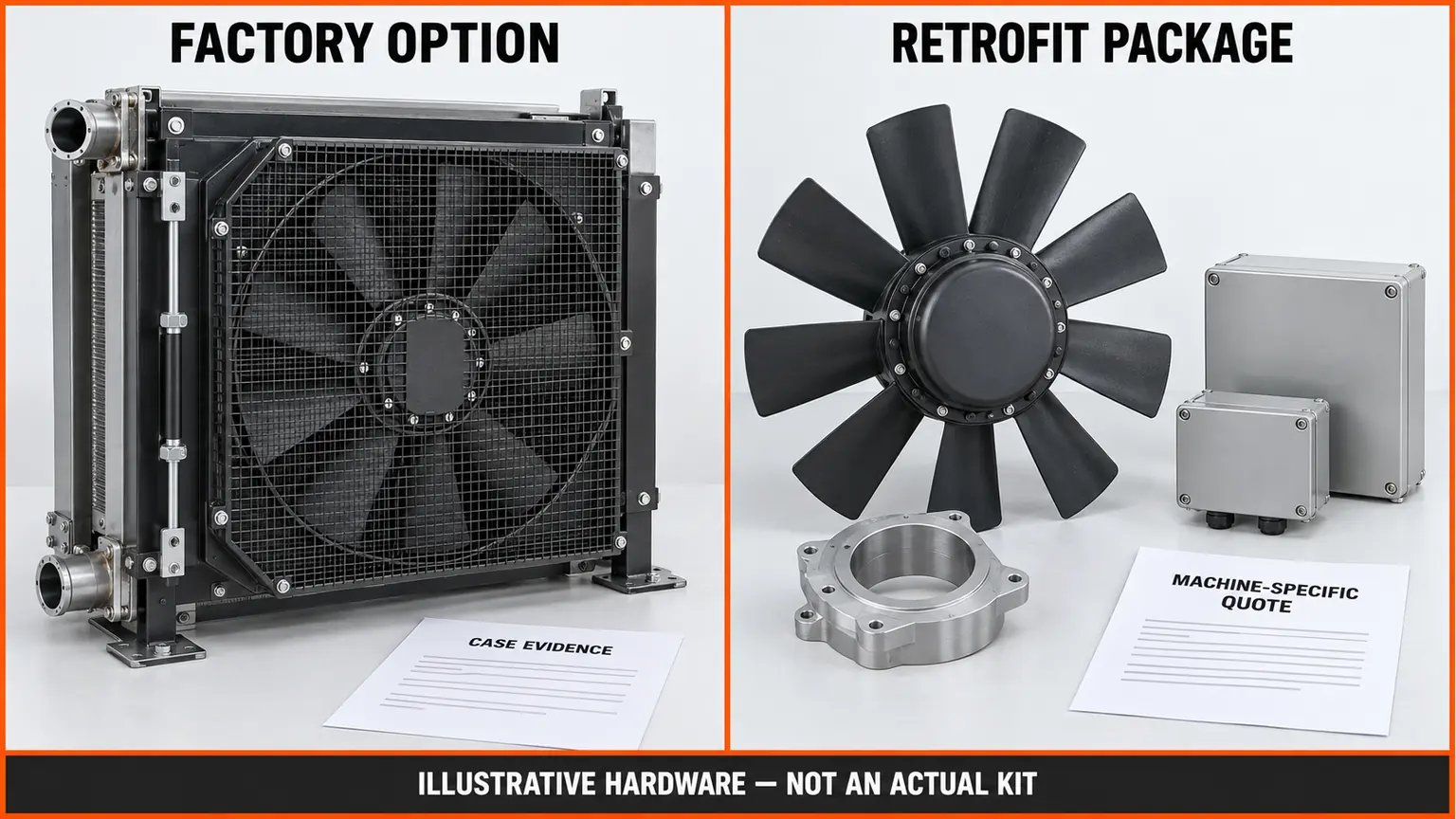
Flexxaire's customer-story index separately labels OEM applications, including Caterpillar 548/558 forest machines. An OEM-labelled case shows a different evidence category from a retrofit kit offered for an existing machine. It should not be used as a purchase reference for a used machine without a separate application response.
Keep three records apart: the machine you own, the factory-installation example you found, and the retrofit package actually offered. Only the last record can define the proposed purchase, and it still needs the first record's application confirmation.
Illustrative distinction between an OEM case and a retrofit quotation; the pictured items are not an actual kit or an approved installation.
An empty selector result is not proof that a program has no solution. Equally, a contact form inviting custom enquiries is not proof that development will be practical or commercially available. Send the machine information once and ask which of the following outcomes applies.
An existing kit is confirmed for the documented configuration. Request its exact reference, included items and installation-document revision.
An application review is required. Ask what information or inspection is missing, who will assess it, and whether development or installation costs remain unquoted.
The program cannot support the application. Keep the reason with the machine record rather than substituting a visually similar fan.
Do not turn the third outcome into an improvised workshop conversion. An answer from one program also does not establish the other program's suitability. Each needs to assess the same installed machine and provide its own response.
Where the enquiry needs basic orientation and mounting evidence, use the separate radiator-fan rotation, pitch and shroud-matching guide to organise photographs and measurements. Those observations support an application review; they do not approve a new reversing envelope, drive load or control strategy.
A useful Canadian support contact is one that can direct this installation to an identified responsible party. An Ontario or Alberta address alone does not establish local inventory, a field technician near the work site, warranty coverage or a response deadline. Clarify the service arrangement for the machine's operating location before committing to a downtime window.
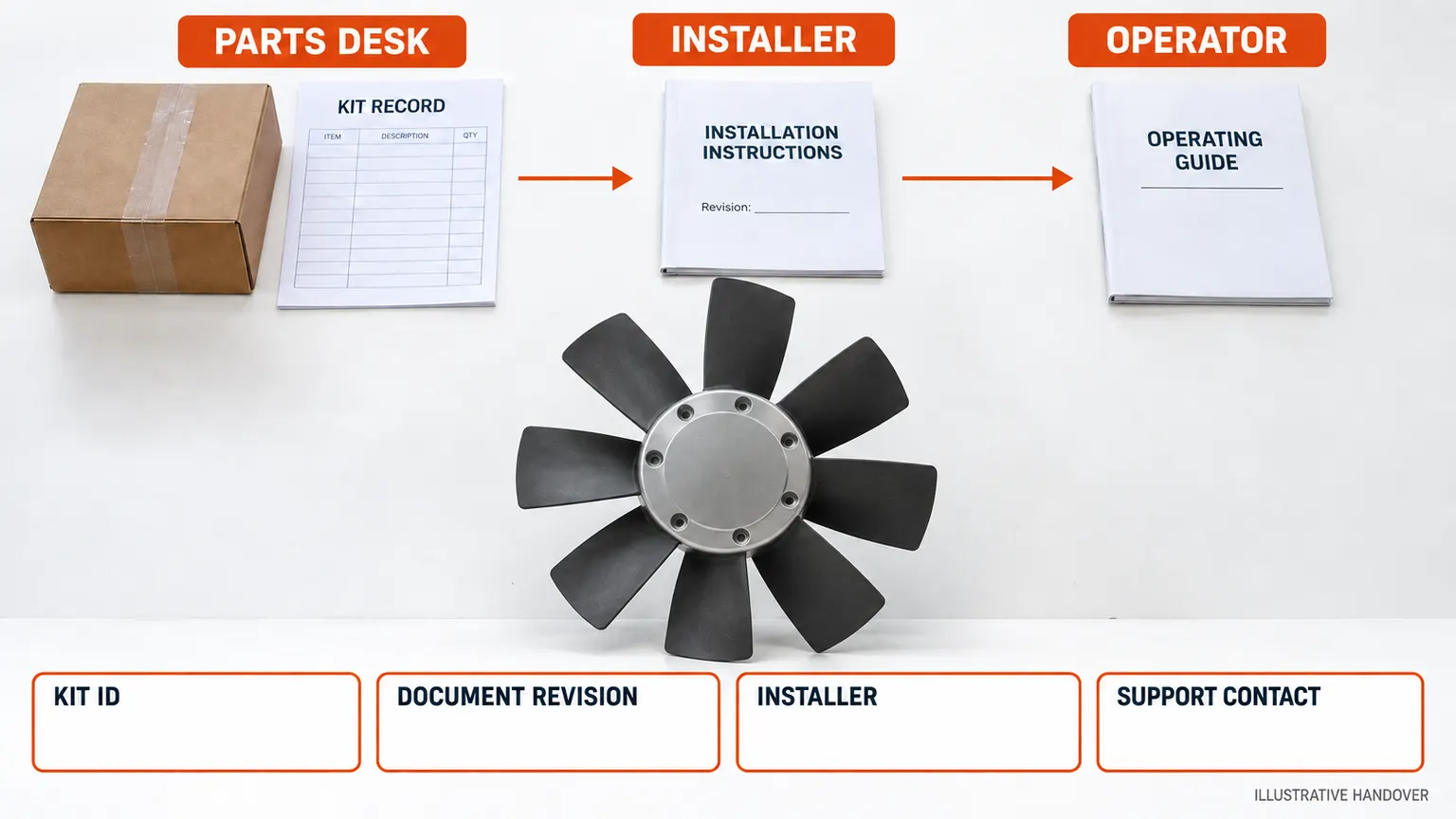
The parts desk should retain the quoted kit reference and complete supply scope. The installer should receive the correct instructions and resolve mounting, guards, controls and commissioning requirements with the authorised technical contact. The operator should receive the approved operating and maintenance instructions. If those responsibilities sit with different companies, record how unresolved questions move between them.
Discuss replacement parts as a distinct after-sales question. Ask which fan or control identifiers must accompany a later parts request, where the installed kit identity will be recorded and who handles a damaged or malfunctioning component. Do not assume a later replacement can be selected from blade diameter or the original machine number alone.
Before accepting the quotation, put the kit identity, installation-document revision, installer and support contact together in one handover record. Leave unanswered fields visibly open. A purchase order should not silently convert an unresolved engineering question into the installer's responsibility.
Illustrative responsibility handover. Blank fields must be completed from the actual quotation and installation documents; no approved job is shown.
Build the request around what the reviewer needs to decide, rather than a promised saving. Include the following information:
Machine model and serial identity, engine information, operating location and a contact who can inspect the installation.
The recorded cleaning problem, current maintenance method, work task and relevant changes to the machine.
Existing fan and drive identifiers, overall cooling-package photographs and any configuration differences already found.
The requested deliverable: confirmed kit, engineering assessment or an explanation that the application is unsupported.
The proposed installer, preferred downtime window and questions about supply scope, documentation, replacement parts and service support.
If a savings comparison is needed, ask what must be measured on the same machine before and after installation. Distinguish a reduction in manual-cleaning time from changes in fuel use or production output. Different attachments, ambient conditions or work intensity can make two operating periods poor comparisons. A testimonial cannot fill the missing baseline.
Send a named-program retrofit enquiry through that program's own confirmed route. If the decision instead becomes sourcing an aftermarket replacement fan or another identified cooling component, use the enquiry form on the Elecdura cooling-fan page and specify that separate requirement. Do not describe a general aftermarket quote as a Cleanfix or Flexxaire quotation unless the quoted identity and supply relationship have been established.
This comparison does not authorise bypassing a cooling fault, removing guards, altering control interlocks or fitting an unconfirmed assembly. Where the equipment service process identifies a different fault, complete that diagnosis first. Where the machine already has a reversible system, identify and service that installed system before treating the requirement as a fresh conversion.
It also does not select a universal replacement fan clutch, approve a specific kit for every forestry machine, or establish a guaranteed cleaning interval. The practical output is a documented program response for one machine and a defined next action—not permission to modify equipment from a general article.
Only after the program confirms the relevant serial and configuration range. Build a machine list that notes existing fan/drive identifiers and alterations, and ask whether one kit reference genuinely covers that list. Group confirmed matches together; keep exceptions separate. A shared model name may simplify the enquiry, but it should not hide differences that change the supplied package or installation instructions.
A preliminary hardware comparison is possible, but a final cost comparison needs a defined installation scope. Ask which items and labour are included, who resolves application questions and what the commissioning handover requires. A cheaper fan-only line cannot be compared directly with a supported retrofit package. Do not infer an installation price or time allowance from a general website statement.
No. Obtain the proposed retrofit details and ask the appropriate equipment and program contacts how that particular change is treated. Keep their written responses with the quote. A factory-integrated application, an aftermarket kit and an existing-machine alteration are not the same transaction. This article neither grants warranty coverage nor determines the effect of a modification on a specific agreement.
Ask for the application basis, operating limits and a way to compare the relevant maintenance task on your machine. Record what was cleaned, how often and under which working conditions before judging the result. Reduced cleaning effort would not by itself prove adequate cooling under every load, remove routine inspection obligations or establish fuel savings. Keep each claimed benefit tied to its own evidence.