ELECDURA NETWORK

Your Whole New Supply Chain For Heavy-Duty Parts
Whatsapp:
+86 18915027366
Phone:
+86 18915027366
Views: 0 Author: Elecdura Publish Time: 2026-09-04 Origin: Site
A cellulose-versus-synthetic label does not, by itself, tell a heavy-duty buyer which diesel fuel filter is correct. The useful decision comes from the complete application specification: filter position, efficiency at a stated particle size, test method, water-separation duty, initial restriction, dirt capacity, fuel compatibility, dimensions, seals, and the supplier's evidence for the exact part number. Synthetic or composite media may support higher-efficiency or demanding service designs, while treated cellulose can be appropriate in other approved primary or secondary applications. Do not substitute one construction for another only because its material name sounds more advanced.
This guide turns the media discussion into an RFQ and sample-release process. It does not assign universal performance to every cellulose or synthetic filter, and the illustrations do not certify a product or supplier.
First identify what the element must do in the actual fuel system. A primary filter or fuel-water separator may be expected to manage coarse contamination and free or emulsified water before the fuel reaches the next stage. A secondary filter near a high-pressure system may have a different cleanliness and restriction requirement. Some assemblies combine separation, filtration, heating, sensing, and priming functions. The media is only one part of that system.
Record the engine or equipment identity, installed filter reference, filter-head reference where available, primary or secondary position, suction- or pressure-side location, rated flow information, fuel type, water-in-fuel sensor, drain and heater requirements, and the service environment. If the supplier cannot connect the proposed element to this application packet, the media comparison is premature.
The existing primary-versus-secondary diesel fuel-filter guide explains stage assignment and restriction budgeting. This article addresses a different question: which material and performance evidence should a buyer request after the stage is known?
Media descriptions vary by manufacturer. “Synthetic” may describe a melt-blown layer, a fully synthetic element, a proprietary composite, or a branded multi-layer construction. “Cellulose” may be treated, blended, resin-bonded, or combined with another layer. Therefore, a quotation should not reduce the specification to a single material word.
Evidence field | What to request for the quoted reference | What not to infer |
|---|---|---|
Particle efficiency | Efficiency percentage, particle size and the stated test method or product-data source. | A nominal micron number is not a complete efficiency statement. |
Water management | Separator role, free- or emulsified-water claim, applicable method and operating conditions. | Every treated paper or synthetic layer does not provide the same separation behavior. |
Restriction and capacity | Initial restriction, recommended flow range, capacity or service-limit evidence relevant to the application. | Finer media is not automatically safer if system flow and restriction are unresolved. |
Fuel compatibility | Compatible diesel and blend information, seals, adhesives and temperature limits for the exact element. | The media name alone does not prove compatibility with every fuel formulation. |
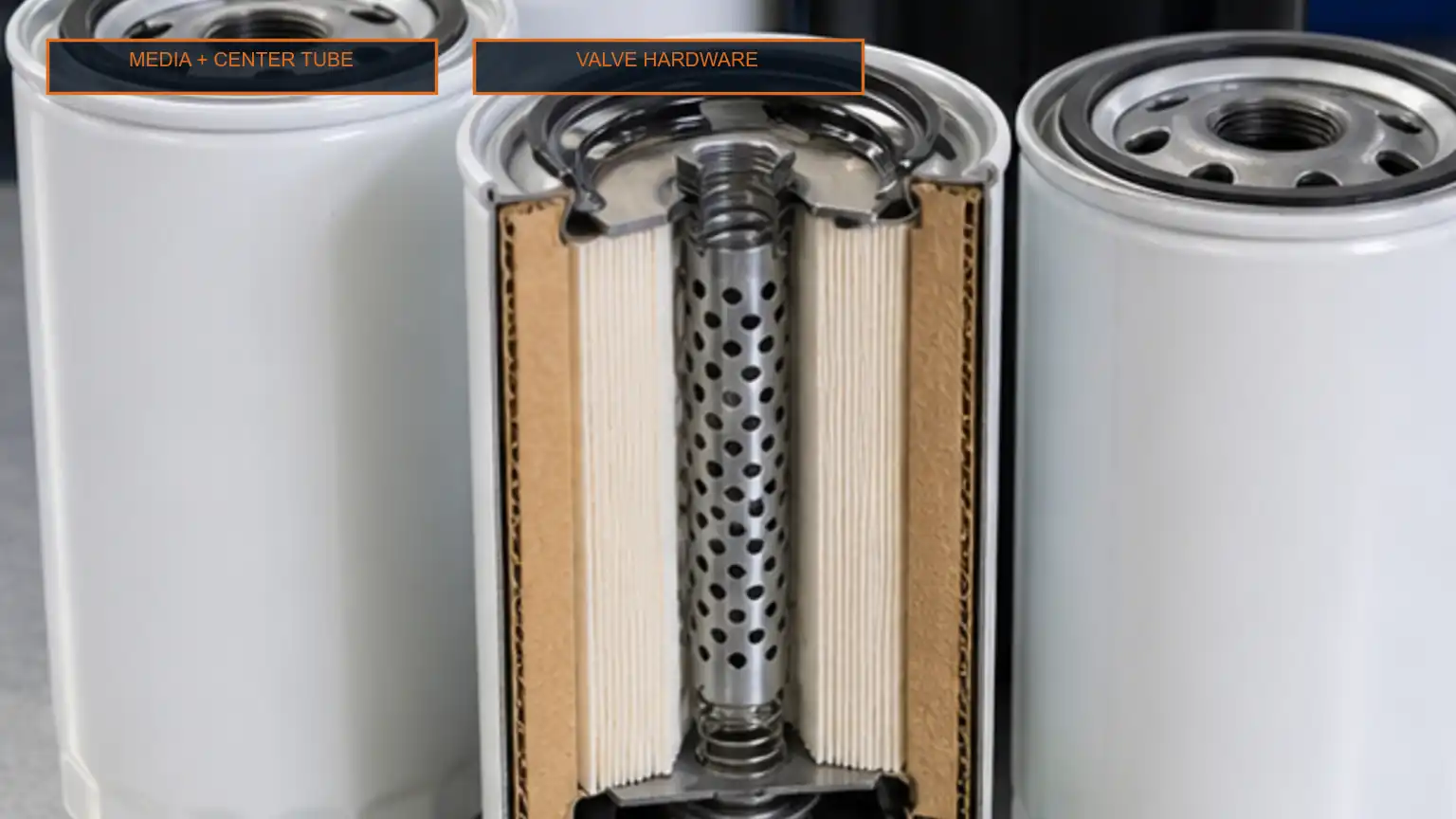
Construction control | Pleat support, center tube, end-cap bond, bypass or anti-drainback function where applicable, and lot traceability. | A cutaway photograph does not prove production consistency. |
Media works with structural and sealing components. The illustration identifies areas to discuss with a supplier; it is not a validated construction drawing or proof of filtration performance.
Cellulose media remains used in many diesel filtration products, but the application and treatment matter. Donaldson's engine-liquid filtration guide describes treated cellulose fuel-water-separator media for removing water and coarser particulate in primary, often suction-side, service. The same guide also lists cellulose options in product selection tables for different filtration duties. That evidence supports a limited conclusion: cellulose is not automatically an obsolete or low-quality choice. It must still be the approved construction for the reference and duty.
A buyer considering a cellulose element should ask how the media is treated, which efficiency and water-separation statements apply, whether the filter belongs on the primary or secondary side, and how its flow and restriction limits match the system. Ask for the current product data, not a family-level brochure detached from the quoted part number.
Cellulose may be a reasonable controlled choice when the equipment specification, filter position, fuel compatibility, service interval and supplier evidence align. It should be held when a seller offers only “paper filter” as the specification, cannot identify the performance basis, or substitutes a different construction without application approval.
Synthetic and composite constructions can be engineered for demanding particle control, water management, dirt-holding or service requirements. Donaldson describes one primary fuel-water-separator construction that combines cellulose with a melt-blown synthetic layer, and a separate synthetic formulation for high-performance secondary filtration. Parker Racor describes engineered media that combines contaminant removal and water rejection in its fuel-filter water-separator products. These are manufacturer-specific designs; they do not prove that every generic synthetic element has the same characteristics.
For a synthetic or multi-layer offer, request the same evidence fields used for cellulose. Then ask whether the quoted performance is tied to the whole element, the media sheet alone, or a different family. Confirm that the seals, adhesive, center tube and end caps remain compatible with the fuel and temperature range. A strong media layer cannot compensate for an incorrect thread, unstable gasket, damaged bond, restricted flow path or unverified bypass function.
A higher purchase price may be justified by documented performance or a longer controlled service strategy, but it should not be justified by the word “synthetic” alone. Compare cost per approved operating period only after the application, interval and failure-disposition rules are defined.
A buyer often receives three separate claims: a micron rating, a water-separation statement and a long-life promise. They must be reviewed together. A media change can affect the way particles are captured, the way water droplets coalesce or are repelled, the initial pressure drop and the capacity before restriction reaches a service limit. The engine's pump arrangement and filter location also change what acceptable restriction means.
Use the fuel-filter micron-rating guide to separate a particle-size label from a complete efficiency statement. For water-control questions, compare the exact separator design, bowl, drain and sensor provisions rather than assuming the media alone performs every task. If the system uses biodiesel blends or other changing fuel conditions, request the manufacturer's applicable compatibility and service guidance instead of extending a conventional-diesel claim by assumption.
Do not create a universal acceptance threshold from one brochure. The equipment maker, filter manufacturer or qualified system supplier should establish the applicable limit. The purchaser's job is to make the quoted evidence traceable to the exact element and to keep unresolved fields visible.
A usable media quotation should arrive as a small evidence pack, not only a price and photograph. The document set may vary, but the comparison sheet should force each supplier to answer the same questions.
RFQ line | Required response |
|---|---|
Identity | Quoted part number, manufacturer or declared brand, country-of-origin statement if offered, condition and revision. |
Application basis | Exact cross-reference or equipment application used, including any supersession and the source date. |
Media construction | Cellulose, synthetic or composite description tied to the part number; proprietary trade name only with supporting data. |
Performance | Particle efficiency, water-management claim, flow, initial restriction and capacity or service information with methods and conditions where provided. |
Interfaces | Thread or center-tube geometry, gasket dimensions, ports, drain, bowl, sensor, heater and priming features as applicable. |
Supply control | MOQ, lead time as quoted, packaging, label and lot traceability, sample availability, change-notification process and discrepancy route. |
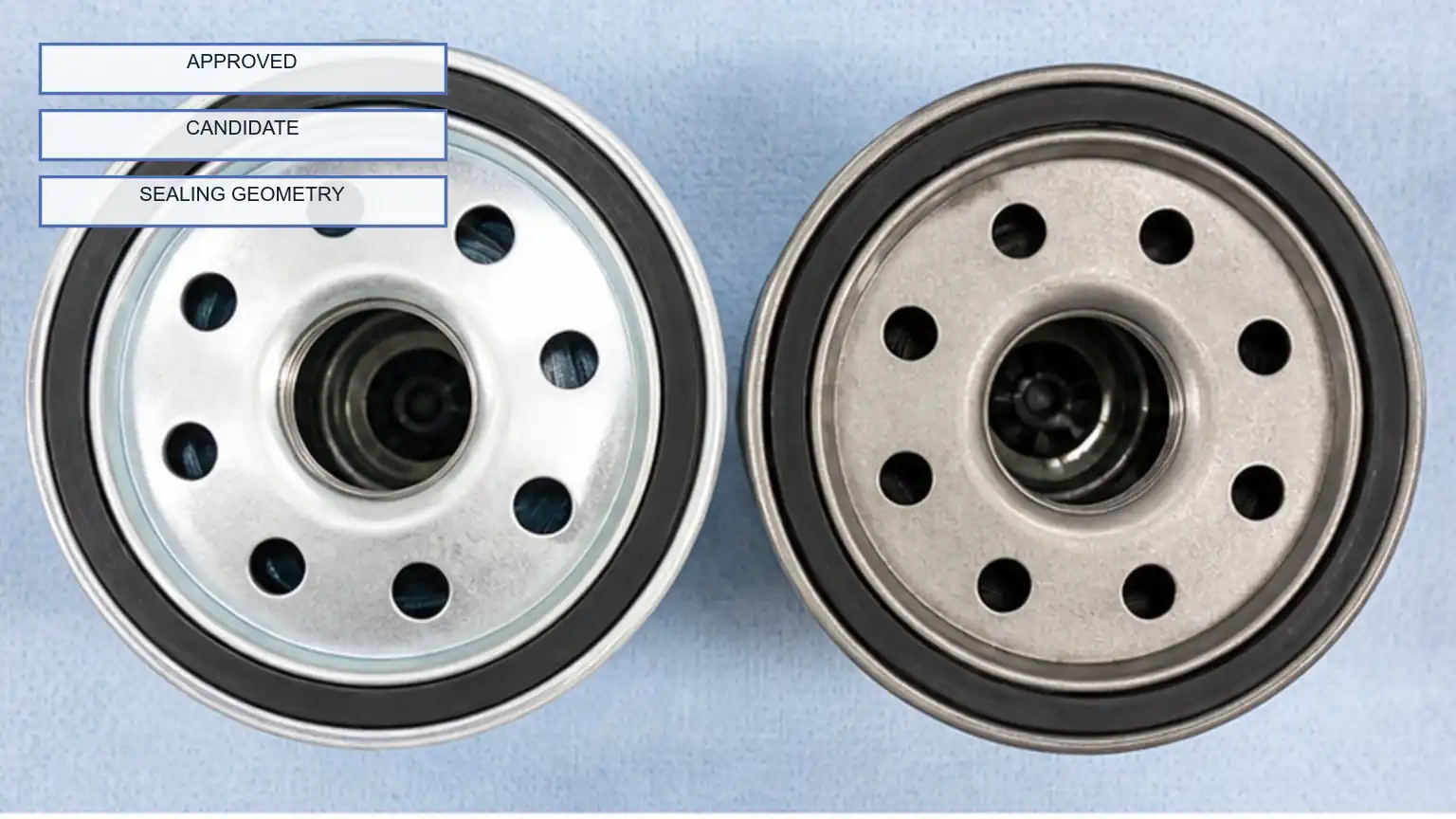
If a seller proposes an equivalent, use the fuel-filter cross-reference validation checklist. A matching thread and gasket do not prove matching media performance; matching media language does not prove physical fit.
Physical-interface comparison and media-performance review are separate gates. This staged image provides no approved dimensions or interchange authorization.
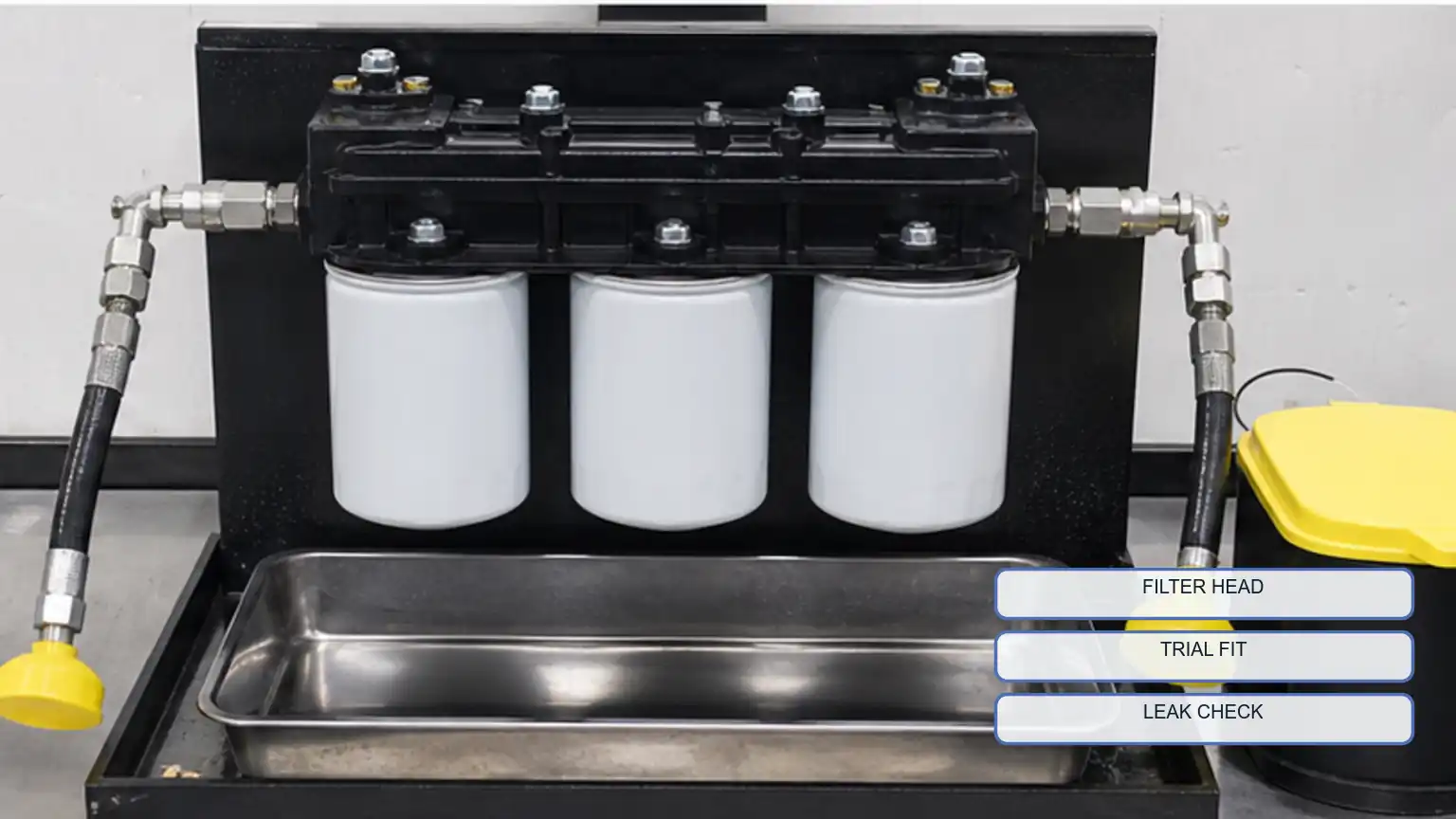
Incoming inspection can verify label identity, packaging, visible damage, cleanliness, interfaces and lot consistency. A controlled fixture may support a limited leak, flow or restriction check when the method and safety controls are defined. A destructive sample audit may confirm internal component presence, pleat condition and assembly consistency. None of those checks alone proves full efficiency, capacity, water separation or field life.
Before testing, freeze the approved reference and evidence pack. Record sample IDs and lot codes. Inspect the gasket, thread or center tube, baseplate, drain and connector features without forcing the element onto an uncertain head. If a controlled test is justified, use clean compatible fluid, calibrated instruments, a guarded fixture and a written procedure. Quarantine the sample if it leaks, binds, shows unexplained construction changes or conflicts with the approved documentation.
A fit or leak fixture can answer a defined receiving question. It cannot replace the manufacturer's filtration-performance data or a properly designed validation program.
Place the media decision on hold when the supplier's document refers to another part number, a family with several constructions, an obsolete revision or a media sheet that has not been validated as the complete element. Also hold when the quoted reference changes after sample approval, when packaging and product labels disagree, when a shipment mixes unexplained lot markings, or when the supplier cannot state whether the element is cellulose, synthetic or composite.
A material substitution is a controlled change, even if the external can remains identical. Require written notification, the new performance basis, compatibility confirmation and a new sample-release decision. For repeat wholesale orders, retain the accepted reference, evidence revision and batch record together. This prevents a purchasing team from approving an unreviewed change because the carton and price remained familiar.
No. Specific synthetic or composite designs can provide useful performance, but the correct choice depends on the approved application, stage, test data, restriction, water duty and compatibility. Compare exact element evidence rather than material names.
Only when the proposed reference is approved for the application and its complete fit and performance specification is acceptable. A shared thread, can size or cross-reference list is not enough.
Not by itself. Ask for efficiency at that particle size, the test method, flow and restriction conditions, capacity, filter stage and compatibility with the fuel system.
Keep the approved part and revision, application basis, media and performance documents, sample and lot records, supplier change-notification agreement, receiving results and discrepancy history.
For a wholesale fuel-filter enquiry, send the installed reference, equipment and engine information, filter-head details, stage and system location, fuel and environment, quantity and destination. State the evidence fields that must accompany any equivalent. Review available fuel-filter product categories only as a starting point; a category page does not approve an application.
If you need a reference comparison, send Elecdura the identification packet and required quantities. Elecdura should confirm what evidence is available for the proposed reference rather than treating “cellulose” or “synthetic” as a universal quality grade.
Technical source review: Donaldson Engine Liquid Filtration Product Guide, including its fuel-media overview and selection tables; Parker Racor fuel-filter water-separator product information and engineered-media descriptions. Sources reviewed September 4, 2026. Manufacturer-specific claims remain limited to the cited product families and do not establish universal performance for other filters.