ELECDURA NETWORK

Your Whole New Supply Chain For Heavy-Duty Parts
Whatsapp:
+86 18915027366
Phone:
+86 18915027366
Views: 0 Author: Site Editor Publish Time: 2026-07-24 Origin: Site
An alternator rebuild may be appropriate when the original unit's housing, mounting interfaces and major components remain serviceable and the identified faults can be corrected within the manufacturer's repair limits. A damaged alternator does not automatically need to be replaced as a complete assembly, but cleaning, repainting or restoring unloaded voltage alone does not establish that a rebuilt unit is fit for service.
The decision should follow inspection of the old unit, identification of failed components, confirmation of application compatibility, and evidence from the required electrical and mechanical tests. For heavy-duty fleets, repair shops, importers and distributors, the comparison should also include labor, downtime, core-return requirements, repeat-failure exposure and the traceability of the finished unit. Rebuilding is not automatically cheaper or more reliable than a new replacement.
An alternator converts mechanical energy into electrical output. Its main assemblies include the rotor, stator, bearing system, rectifier, voltage regulator, housing, pulley and electrical connections. A rebuild requires assessing the condition and compatibility of these components rather than simply replacing whichever part appears visibly damaged.
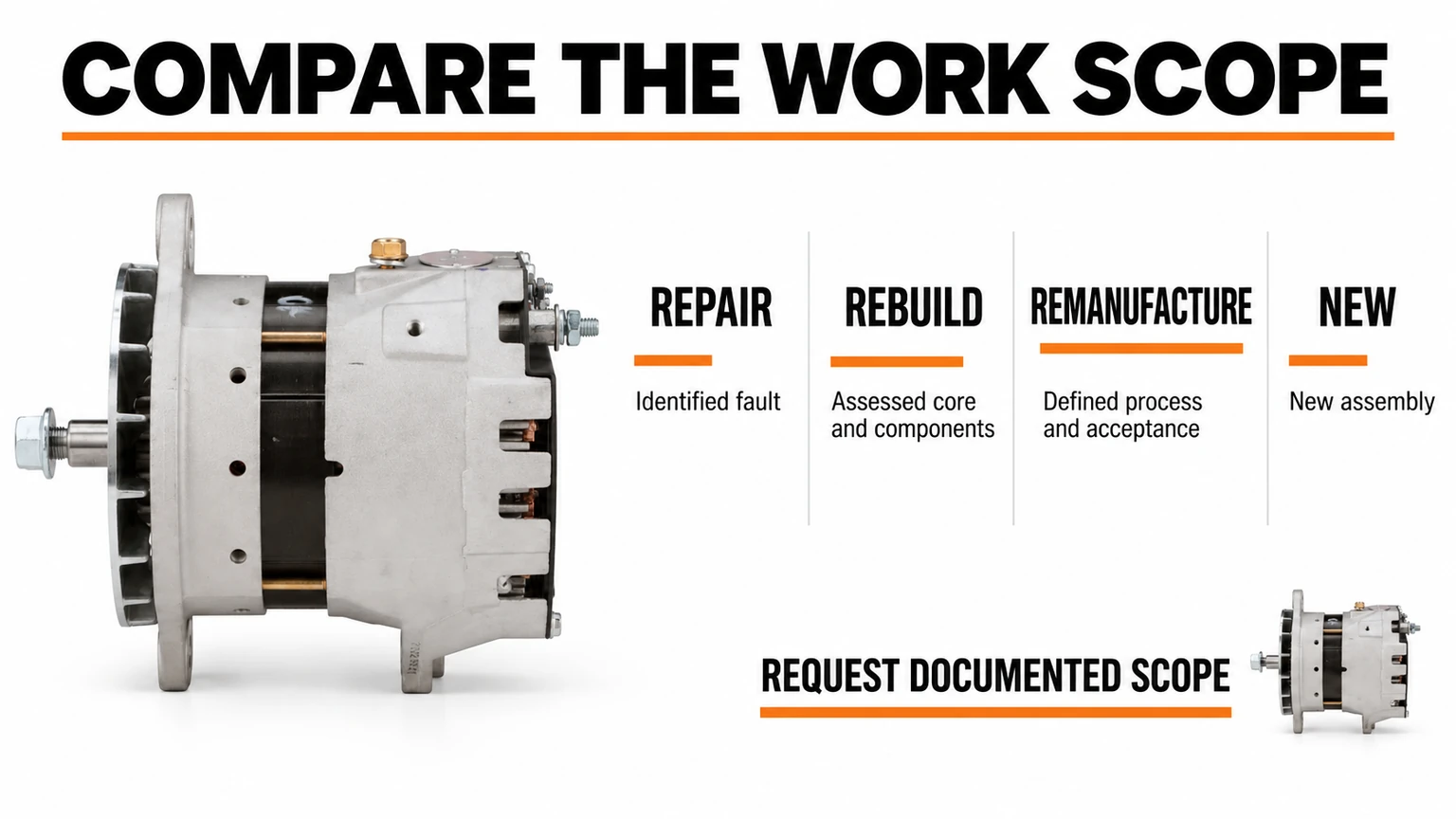
Terminology varies between repairers and suppliers, so ask what work was actually performed instead of assuming that the product label defines a universal process.
Term | Typical meaning | Evidence to request |
|---|---|---|
Repair | A specific fault is corrected, potentially with limited disassembly and component replacement. | Identified fault, work performed, replaced parts and relevant post-repair checks. |
Rebuild | The unit is disassembled and inspected, with worn or failed components repaired or replaced according to the service scope. | Inspection findings, component replacement details and final functional test results. |
Remanufactured | A used unit is processed through a defined remanufacturing procedure. The scope and acceptance criteria depend on the provider and product program. | Documented process, specified component treatment, acceptance criteria and traceability. |
New | A newly manufactured alternator rather than a rebuilt used core. | Product identity, application specification, supplied configuration and applicable warranty terms. |
These descriptions are practical distinctions, not universal legal definitions. A supplier's use of the word "rebuilt" or "remanufactured" should be supported by its actual process and product documentation.
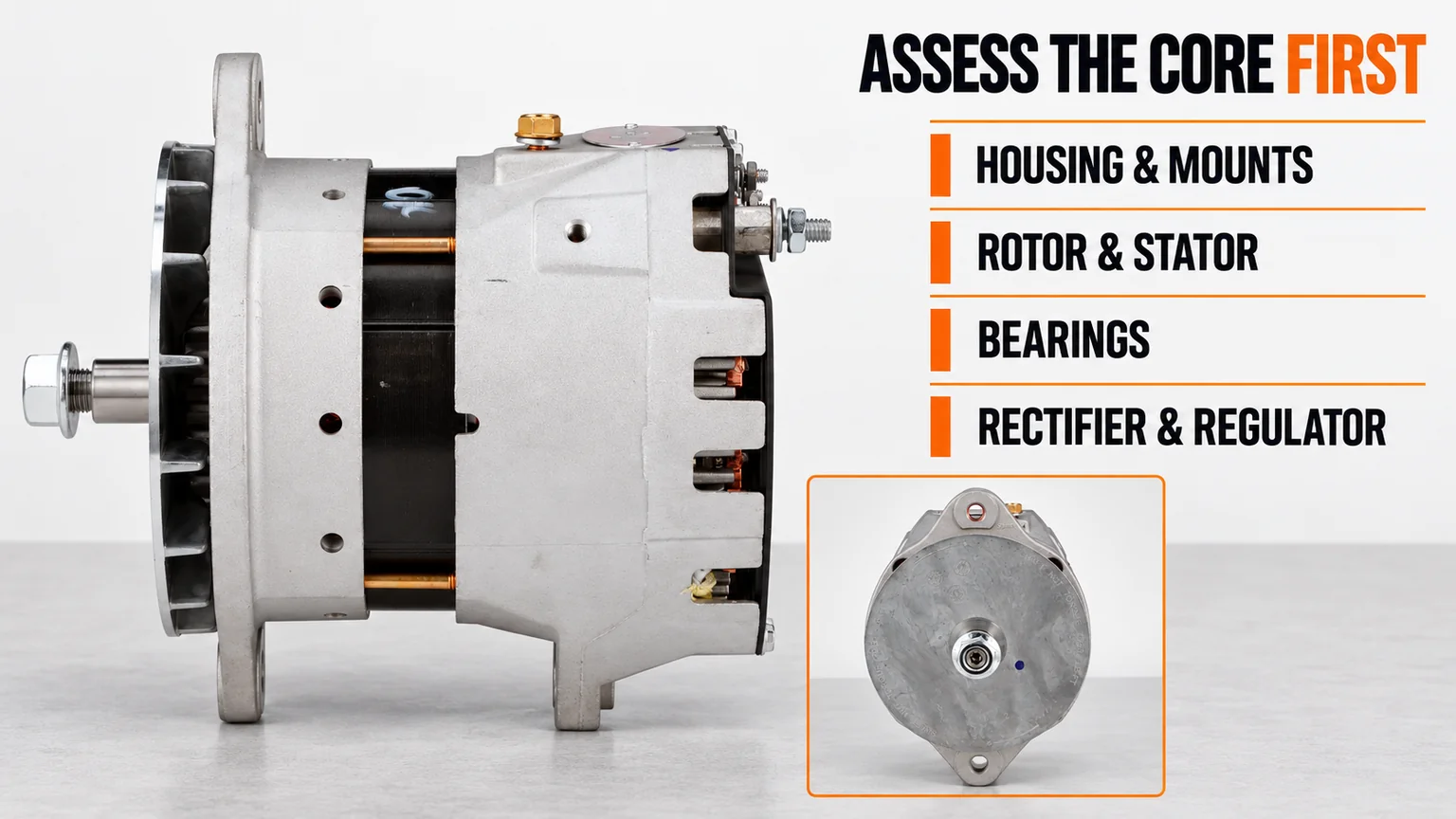
The old alternator must be evaluated before its rebuildability can be established. External appearance alone is insufficient: a clean housing may contain electrical damage, while superficial corrosion does not necessarily make every internal component unusable.
Component or area | What to inspect | Decision significance |
|---|---|---|
Housing and mounting points | Cracks, deformation, damaged threads, bearing-seat condition and mounting alignment | Structural damage or out-of-specification mounting interfaces may make the core unsuitable for rebuilding. |
Shaft and bearings | Wear, abnormal play, rough rotation, shaft damage and bearing-seat condition | Determine whether serviceable parts can be restored or replaced within the model's limits. |
Rotor and slip rings | Winding condition, insulation faults, slip-ring wear and shaft condition | Electrical and dimensional checks are needed; visual inspection alone cannot establish serviceability. |
Stator | Winding damage, insulation condition, overheating and evidence of short circuits | Specialized electrical tests help determine whether repair or replacement is appropriate. |
Rectifier and regulator | Diode function, heat damage, regulation behavior and control compatibility | A faulty component may be replaceable, but the finished assembly must still pass the required tests. |
Pulley and external connections | Wear, damage, alignment, terminal condition and connector compatibility | Incorrect interfaces can cause installation or charging problems even if the core generates output. |
Professional disassembly and testing may be necessary to evaluate bearing seats, winding insulation, rotor condition, rectifier performance and regulator behavior. These checks require the appropriate equipment and model-specific limits. Do not declare a core rebuildable merely because it can be disassembled or because the housing looks intact.
External and internal categories for alternator core assessment.
A rebuild becomes less suitable when major components are damaged beyond the manufacturer's service limits, essential interfaces cannot be restored, or the required components and qualified repair process are unavailable. Severe housing damage, irreparable shaft or bearing-seat damage, or extensive electrical winding damage may justify rejecting the core.
Contamination and overheating also require investigation. A failed rectifier or regulator may be a repairable fault, but repeated electrical failure can reflect an unresolved wiring, battery, grounding, cooling or application problem. Rebuilding without addressing that cause risks repeating the failure.
The correct rejection criteria depend on the alternator design. A professional repairer should compare measured condition with the relevant service specifications and explain which components can be reused, repaired or replaced.
Option | Potential advantages | Main risks or questions |
|---|---|---|
Repair or rebuild the original unit | May preserve a suitable core and address a known component fault. | Core condition, parts availability, repair scope, test evidence, labor and downtime. |
Remanufactured unit | May follow a defined inspection and component-replacement process with documented acceptance criteria. | Confirm what is renewed, what is reused, how it is tested and how the core-return process works. |
New replacement unit | Provides a newly manufactured assembly and may simplify planning when the old core is unsuitable. | Application matching, actual product specification, availability, price and applicable warranty terms. |
No option is automatically best for every fleet. A rebuild may be attractive when the original core is serviceable and the repair process is well documented. A remanufactured unit may suit a buyer who wants a defined processing program. A new unit may be more practical when the old core is damaged or a repair cannot be completed within the required downtime window.
Work scope differences among repair, rebuild, remanufacture and new replacement.
A meaningful comparison includes the entire repair event rather than only the quoted alternator price.
Initial repair, rebuild, remanufactured-unit or new-unit cost.
Removal and installation labor.
Inspection, testing, shipping and any core-return deposit or freight.
Downtime, recovery or scheduling costs relevant to the fleet.
Additional repairs needed to correct the original failure cause.
Warranty conditions, documentation and the process for handling a repeat fault.
A low initial rebuild price may not represent the lowest total cost if the core requires additional work or a repeat repair creates further downtime. Conversely, a new unit is not automatically more economical if a suitable core can be repaired successfully. Compare documented scope, evidence and commercial terms rather than assuming one option always costs less.
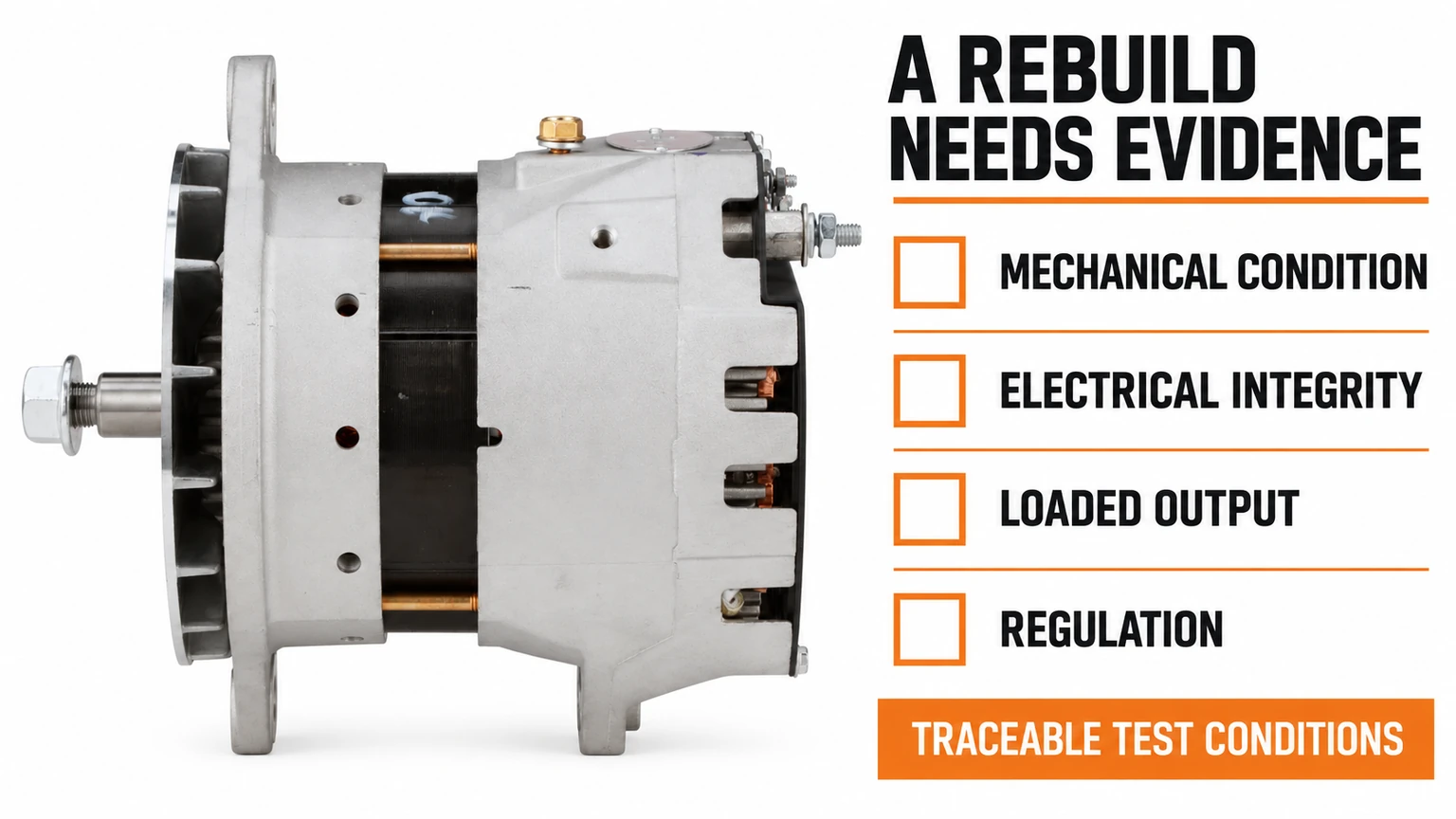
A cleaned and repainted alternator is not necessarily a functional alternator. Likewise, an unloaded voltage reading alone cannot establish that the unit can deliver the required current or regulate output correctly under the intended conditions.
Acceptance evidence | What it helps establish | Important limitation |
|---|---|---|
Mechanical inspection | Assembly integrity, bearing condition, pulley installation and freedom from obvious mechanical defects | Does not prove electrical output or regulation. |
Electrical integrity checks | Condition of windings, rectifier, insulation and relevant internal circuits | Must use the correct procedure and limits for the model. |
Loaded output test | Whether the alternator delivers output under the specified test conditions | Results depend on test speed, load, temperature and the manufacturer's acceptance criteria. |
Regulation and functional checks | Whether output regulation and applicable control functions behave as specified | Does not establish compatibility with every vehicle's wiring or charging strategy. |
Traceable test record | Links the tested unit to its reference, repair scope and recorded results | A report is only meaningful when its criteria and results are identifiable and relevant. |
Acceptance should follow the alternator manufacturer's service specifications and the repairer's documented process. Output, regulation, temperature and test speed must be interpreted in the context of the specific model. Do not apply a universal current threshold or assume a test result for one alternator proves another model's suitability.
Acceptance evidence required for a finished alternator rebuild.
Whether the buyer chooses a rebuilt, remanufactured or new alternator, the replacement must match the intended application. Verify the original reference, system voltage, rated output, regulator and connector arrangement, mounting geometry, pulley configuration, rotation requirements and any remote-sense or electronic-control functions.
A successful bench test does not prove that an alternator fits every truck. It establishes only what the test procedure actually measured. Vehicle-specific compatibility must be checked separately.
For application checks after selecting a unit, see the heavy-duty alternator replacement and commissioning guide. If the reason for considering a rebuild is insufficient capacity for auxiliary loads, consult the high output alternator selection guide before assuming that rebuilding or replacing the original specification will solve the operating problem.
Not necessarily. The terms are used differently by providers. A rebuild often involves disassembly, inspection and replacement or repair of selected components; remanufacturing usually refers to a defined process with specified inspection, component treatment and acceptance criteria. Ask for the actual scope and test records rather than relying on the label alone.
It depends on the type and extent of damage and the manufacturer's service limits. Cosmetic marks may not affect serviceability, but cracks, deformation, damaged threads or compromised bearing seats can make a core unsuitable. A qualified repairer must inspect the housing and relevant interfaces before approving reuse.
No. Cleaning and repainting are cosmetic or preparatory steps, and an unloaded voltage reading does not establish current-delivery capability under load. Acceptance should include the model-appropriate mechanical, electrical, loaded-output and regulation checks, with identifiable test conditions and results.
No. Compare the total cost, including core condition, parts, labor, testing, shipping, downtime, core-return requirements and the possibility of repeat work. A rebuild may be economical for a suitable core, but extensive damage or limited parts availability can change the decision.
Ask for the work scope, components inspected and replaced, applicable acceptance criteria, loaded-output and regulation test results, unit identification, warranty terms, and core-return conditions. The documentation should identify the tested unit and should not imply vehicle compatibility beyond the applications actually confirmed.
Before requesting a quotation, prepare the original alternator reference, vehicle and engine application, system voltage, rated output where known, connector and regulator details, and photographs of the mounting and pulley arrangement. If considering a rebuild, include the known failure, inspection findings, and whether the old core is available for assessment.
Review the heavy-duty alternator category for the relevant product range, then submit the available references and requirements through the Elecdura contact page for application review. The appropriate option, compatibility and availability must be confirmed for the specific requirement; this inquiry does not establish a rebuild service, stock status or guaranteed fitment.