ELECDURA NETWORK

Your Whole New Supply Chain For Heavy-Duty Parts
Whatsapp:
+86 18915027366
Phone:
+86 18915027366
Views: 0 Author: Site Editor Publish Time: 2026-09-14 Origin: Site
A 50DN alternator replacement can become a fleet-renewal decision when the original unit or its service parts are difficult to support. For a US transit operator, the useful comparison is between retaining a documented remanufactured legacy configuration and adopting an air-cooled replacement engineered for the actual bus. Neither route wins simply because it is newer or carries a larger amperage label. Start with the installed 50DN or 50DN+ identity, the bus configuration and the remaining service plan. Then compare who will support the existing system, what a conversion changes, and which evidence will authorize the first bus and subsequent spare units.
This shortlist compares support routes, not manufacturer rankings. It covers KIRKS' published reman and KA-series programs and a documented Almott procurement proposal through Romaine Electric. The US focus comes from an actual transit-agency procurement record, not from adding a country name to a general alternator list. For a separate sourcing enquiry, the Elecdura heavy-duty alternator category provides a starting point; it does not establish that Elecdura stocks or represents any named program.
The Niagara Frontier Transportation Authority's July 24, 2025 board packet contains a concrete example. Staff proposed Almott alternators from Romaine Electric for 68 Nova buses because the original ACDelco units were unavailable and service parts were becoming obsolete. The proposal favored an air-cooled approach requiring comparatively limited changes to that fleet. Its bid analysis identifies a Delco 50DN+ retrofit and reference 25AT-221711-231.
That is a historical procurement proposal with a stated period ending July 31, 2026. The packet does not establish that every retrofit was completed, how the units performed afterward, or whether the same terms remain available. It also does not approve the specified part for another operator's buses.
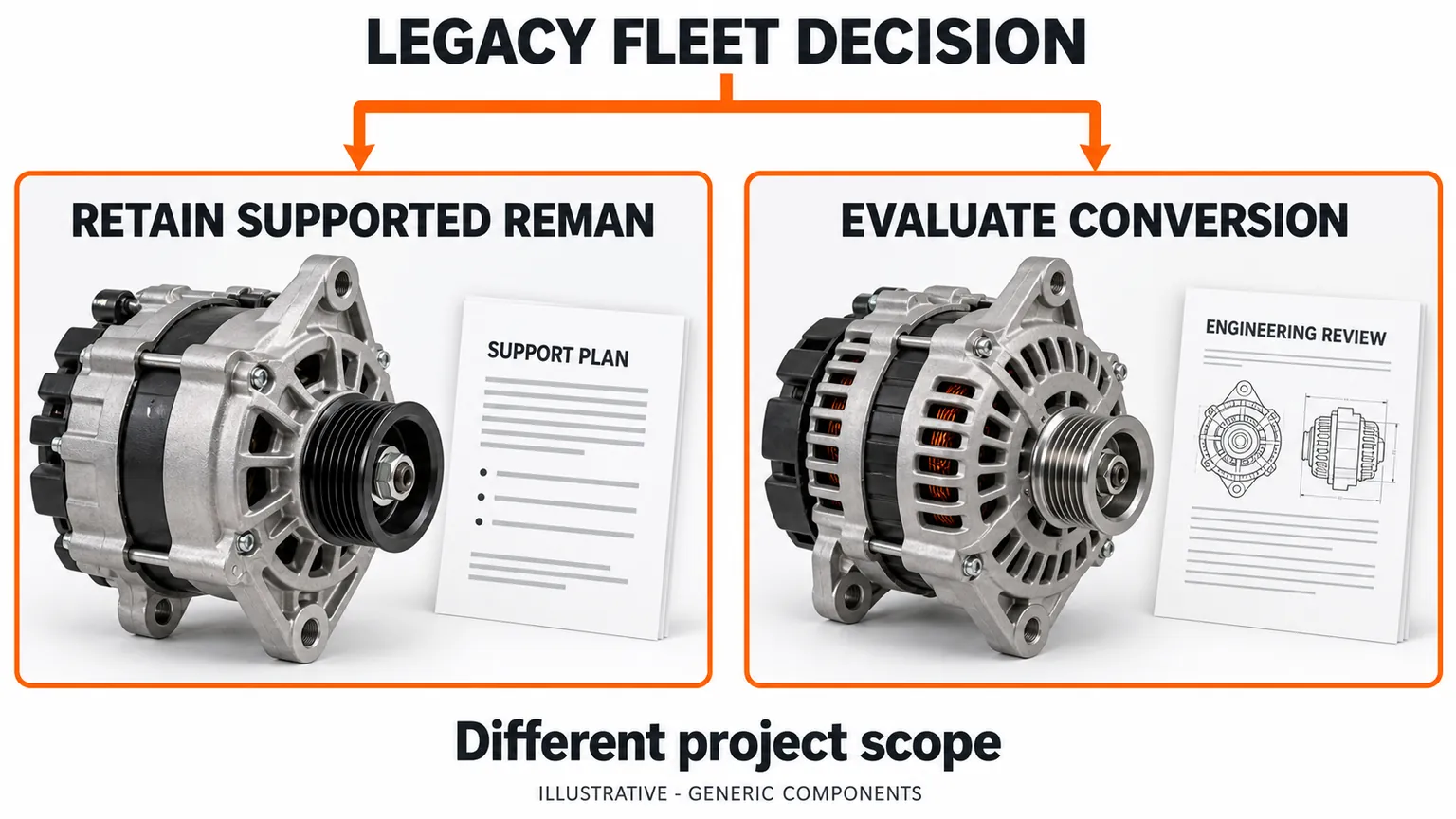
The purchasing lesson is the change in scope. A fleet facing a single failed unit may need a serviceable spare. A fleet losing its repair supply chain may need a supported replacement architecture, workshop instructions and a controlled transition of stock. Treat these as different projects before comparing quotations. Otherwise a low unit price can conceal engineering work, while a conversion proposal can be unnecessary for a bus already close to retirement.
Illustrative purchasing routes using generic components, not photographs of 50DN, KA-series or Almott assemblies. Neither route is approved for a specific bus by this image.
KIRKS states in its 50DN history article, updated in June 2024, that it continues to remanufacture the 50DN after the original program's phase-out. Its separate high-output remanufacturing explanation includes the 50DN+ and describes inspection, replacement of rejected or wear components, assembly and load testing. These are supplier-published program descriptions, not an independent audit of a particular delivered unit.
Use those descriptions to request a current answer for the precise removed assembly. Ask whether the offer is an exchange unit, remanufacture of the operator's own core, or another service arrangement. Establish what happens if the core is damaged beyond acceptance, which identification must remain with it, and whether a replacement can be supplied while the returned unit is inspected. A broad “50DN supported” statement does not settle these commercial details.
The retaining route is worth evaluating where the surrounding installation remains suitable and its servicing can be sustained. It avoids treating every failure as a conversion opportunity. However, retaining the old architecture does not remove the cause of the previous failure. The workshop still needs to address the vehicle-side condition identified by the applicable service procedure, including any relevant oil-system, drive or charging-system issue.
Make the reman quotation describe a maintainable configuration, not merely a freshly painted alternator. Request the offered assembly identity, test-record scope, replaceable service items, repair support and current claims arrangements. Record the proposed turnaround separately from the fleet's available spare coverage. No turnaround, warranty duration or service-life advantage is assumed here.
The KIRKS KA-series page lists KA500 and KA535 air-cooled programs. Its option table distinguishes air-inlet arrangements, isolated grounding and noise suppression. For example, KA500 references 500-001 and 500-003 both have a four-inch inlet, but the latter adds isolated grounding and noise suppression. They should not become one purchasing description.
The page's KA535 introductory paragraph names the 50DN+, while a specification line names the 50DN without the plus sign. Have the supplier resolve that wording against the installed assembly and bus before approval. Do not infer interchangeability from the family heading.
Ask for the configuration-specific installation package with the quotation. The useful answer identifies the replacement assembly, required surrounding parts, retained connections and any changes that the fleet must perform. A catalogue's “drop-in” description should be tied to that written scope, rather than interpreted as permission to fit any listed variant to any bus carrying a 50DN-family unit.
The NFTA proposal identifies both the product maker, Almott, and the proposed seller, Romaine Electric. Keep those roles separate when discussing a similar requirement. A manufacturer's catalogue identifies product variants; the selling party must establish the actual offered package, delivery scope and support arrangements for the purchaser.
Almott's 24V catalogue listings distinguish ducted and ductless cradle-mount designs, different ratings and noise-reduction variants. The reviewed listing does not verify the NFTA bid's exact 25AT-221711-231 configuration. Similar-looking numbers elsewhere in the catalogue are not substitutes for that missing exact match.
For a new project, ask the proposed seller to explain the offered number from its own current documentation. Do not place an order by copying a historical transit bid number and assuming that the installation scope travels with it. A usable proposal should identify which vehicle group it covers and which parts, instructions and engineering responsibilities are excluded.
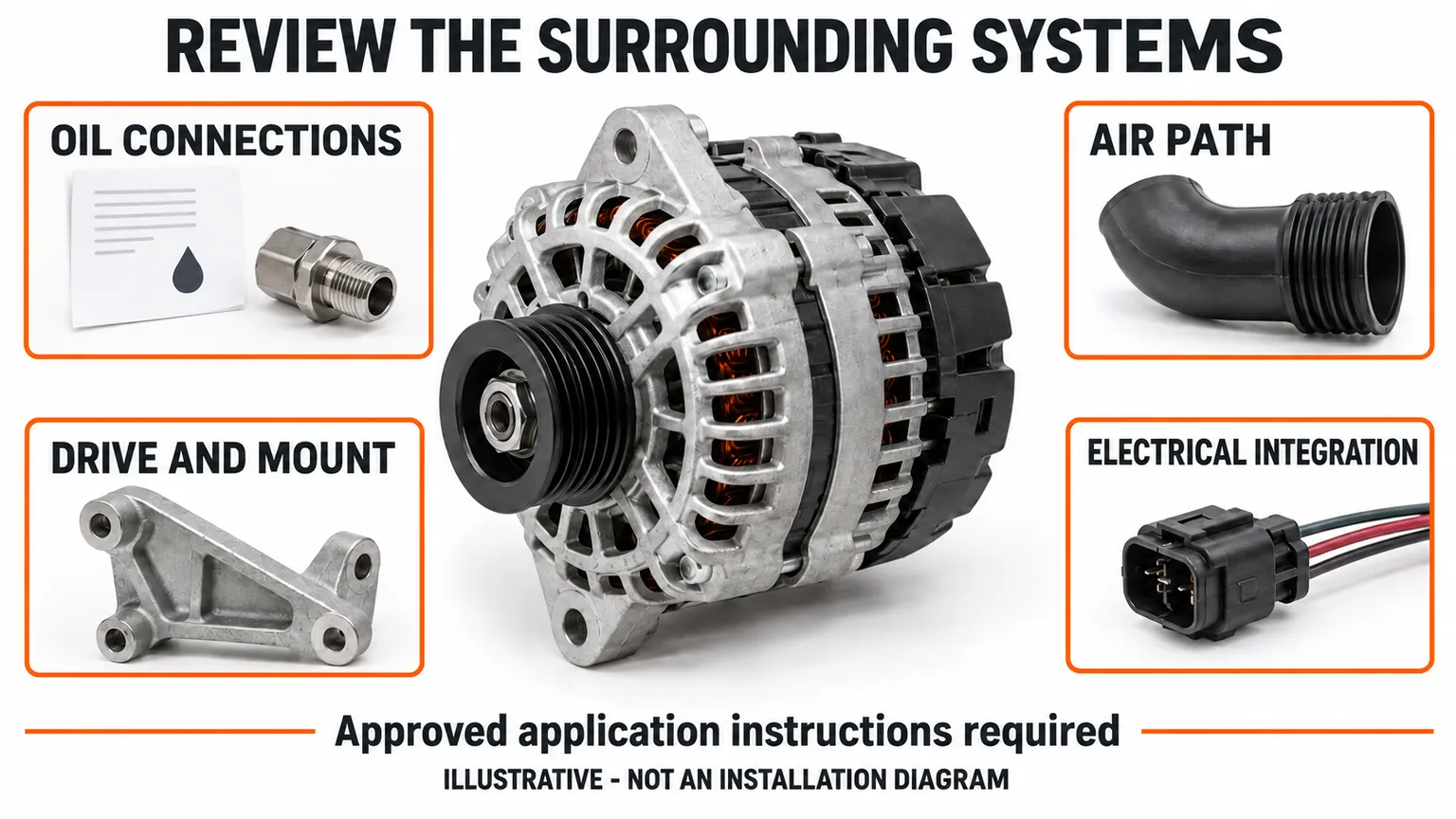
Changing from an existing oil-cooled arrangement to an air-cooled proposal is not just a decision about the alternator casing. The fleet needs an approved treatment of the previous connections and a suitable environment for the replacement. The following comparison defines questions for the responsible workshop and supplier; it is not an installation procedure.
Project boundary | Retain the confirmed legacy configuration | Evaluate an air-cooled conversion |
|---|---|---|
Existing oil connections | Confirm their condition and the requirements of the supported assembly. | Obtain an application-specific treatment of connections no longer used; do not improvise closures or routing. |
Cooling arrangement | Retain and service the specified system. | Identify the intended air source, inlet or duct configuration, clearances and maintenance access. |
Mechanical installation | Verify the supplied assembly against the approved retained arrangement. | Document every changed mount, drive component, clearance and fastener requirement. |
Electrical integration | Preserve the correct control and grounding configuration. | Resolve regulation, terminal functions, grounding and any noise-related requirement for the exact option. |
Future service | Confirm ongoing reman, core and component support. | Define replacement stock, service instructions and the party responsible for conversion support. |
Do not combine an inexpensive bare alternator with an unpriced assumption that the workshop will “make it fit.” Separate the assembly price, conversion materials, engineering support and commissioning work. The operator should know which party must resolve a missing instruction before a bus is dismantled.
Generic project-scope illustration. It is not an oil-line, terminal-wiring or installation diagram; the exact conversion needs approved application instructions.
Where a proposed number is described as an equivalent rather than an approved conversion, use the alternator cross-reference validation guide for the basic identity check. This article adds the fleet-transition question: what has changed in the service system, and how will that change be maintained?
Build the pilot around a defined bus configuration, not just one vehicle brand. Record the fleet group, installed assembly, previous alterations and proposed replacement package. If two groups use different controls, air-inlet arrangements or mounting details, keep them separate until evidence supports a common approved configuration. A successful installation on one group should not silently authorize the other.
Agree on the pilot's acceptance plan before the supplier delivers the sample. The plan should address the actual operating duty, charging behavior, thermal conditions and integration concerns identified for that bus. Name the responsible technical reviewer and the evidence to retain. Use the alternator fitment and commissioning guide alongside the current vehicle and replacement instructions, not as a substitute for them.
The pilot should produce a service record that the next technician can use: approved assembly and option, conversion-kit revision if applicable, retained parts, modified connections, inspection points and replacement instructions. Keep removed-unit identification with the bus history. An alternator that operates after installation is not, by itself, evidence for long-term reliability or a fleet-wide maintenance interval.
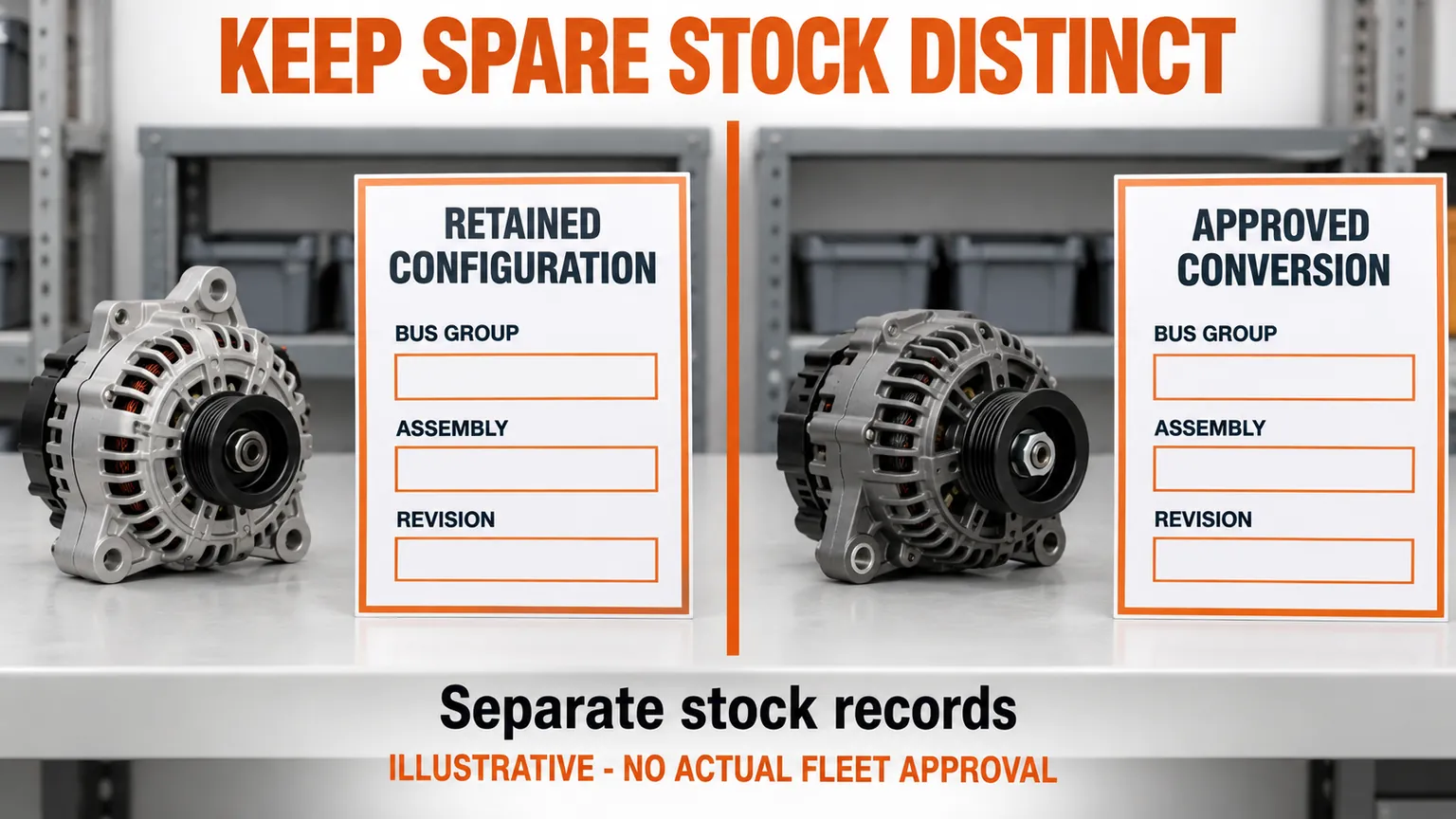
Only release a common spare number after the configuration is approved. Store an unchanged reman spare and a conversion assembly under distinguishable descriptions, even if both orders began with “50DN replacement.” Otherwise a stores technician may issue the wrong type after the engineering discussion has been forgotten. Repeat orders should reference the approved package revision, not only the supplier's family name.
Illustrative stores-control example. The blank records do not represent actual fleet approvals, part numbers or supplier stock.
For a bus group scheduled to leave service soon, a confirmed reman supply and a manageable spare pool may be the practical route. For a group expected to remain in service longer, loss of repair support may justify evaluating a conversion. These are planning judgments, not universal economic conclusions. Compare the alternatives over the fleet's own remaining service period, with actual quotations and workshop capacity.
Include the transition costs that a unit-only comparison omits: duplicate stock while both configurations operate, technician familiarization, documentation changes and the disposition of returned cores. Ask how the replacement will be serviced after the initial order. A proposal that depends on one unsupported special item may move the obsolescence problem rather than resolve it.
For an Elecdura enquiry, send the installed identification, bus group, relevant photographs, desired route and expected order pattern through the alternator sourcing enquiry. State clearly whether you want to retain the existing arrangement or assess a conversion. Request confirmation of any candidate's actual brand, condition and application evidence. The named programs above are research examples; no distribution relationship or confirmed supply capability for those programs is asserted for Elecdura.
Not from the family names alone. Keep each installed assembly and bus configuration identifiable, and obtain written confirmation for the proposed common replacement. If the source description drops or adds a plus sign, resolve that discrepancy before the stores description is simplified. A common replacement may be possible in a defined program, but it needs its own application evidence.
No. It identifies an inlet arrangement, not permission to ignore the installation environment. Ask for the option's approved air path, clearances, temperature conditions and inspection requirements. Do not remove a duct from a ducted unit or choose a different rear cover simply because another model is sold as ductless.
No. It documents a specific agency's proposed procurement and fleet need in 2025. It is useful evidence that an obsolescence-driven conversion was a real purchasing issue. It is not your vehicle's application approval, a completed field-performance report or a current open procurement opportunity.
Make the configuration visible in the vehicle and stores records. Technicians need to know which instructions and spare package apply before removal begins. Retain the conversion revision and approval record with each affected bus, and prevent an old reman assembly from being issued automatically against a bus that has moved to a different approved arrangement.