ELECDURA NETWORK

Your Whole New Supply Chain For Heavy-Duty Parts
Whatsapp:
+86 18915027366
Phone:
+86 18915027366
Views: 0 Author: Site Editor Publish Time: 2026-09-15 Origin: Site
For a USA fleet buying portable diesel fuel equipment, the useful shortlist depends on the job: DAVCO Shop Pro FXP for a powered workshop, Shop Pro ST for service-truck work, or AXI MTC-1000 for mobile storage-tank polishing. These are not interchangeable purchases, and higher flow does not establish better engine-priming capability. Compare the exact supplied configuration, supported fuel, work location and service package before comparing price. This guide selects documented options by assignment, not by market share or an invented quality ranking. It is for equipment purchasing; connection, priming and fuel-handling procedures remain with the manufacturers and qualified personnel.
The USA scope is practical: DAVCO supports its equipment from Michigan and publishes both workshop AC and service-truck DC configurations; AXI has a Florida contact route and specifies a 120 V, 60 Hz MTC-1000 variant. That is a basis for a US purchase inquiry, not proof that every unit is US-made, locally stocked or suitable for every site. The DAVCO options serve multiple engine-service tasks; the AXI option addresses tank maintenance.
“Top” here means worth shortlisting against a defined assignment. Inclusion requires a named complete system, an official description of its task, identifiable power requirements and a route to obtain configuration support. The table is organized by use, not a first-to-third performance ranking. If your order is for replacement heavy-duty onboard fuel filters, keep that separate: these carts are external service equipment, not replacements for the engine's specified filtration stages.
Purchase assignment | Documented option | Published configuration | Question that decides inclusion |
|---|---|---|---|
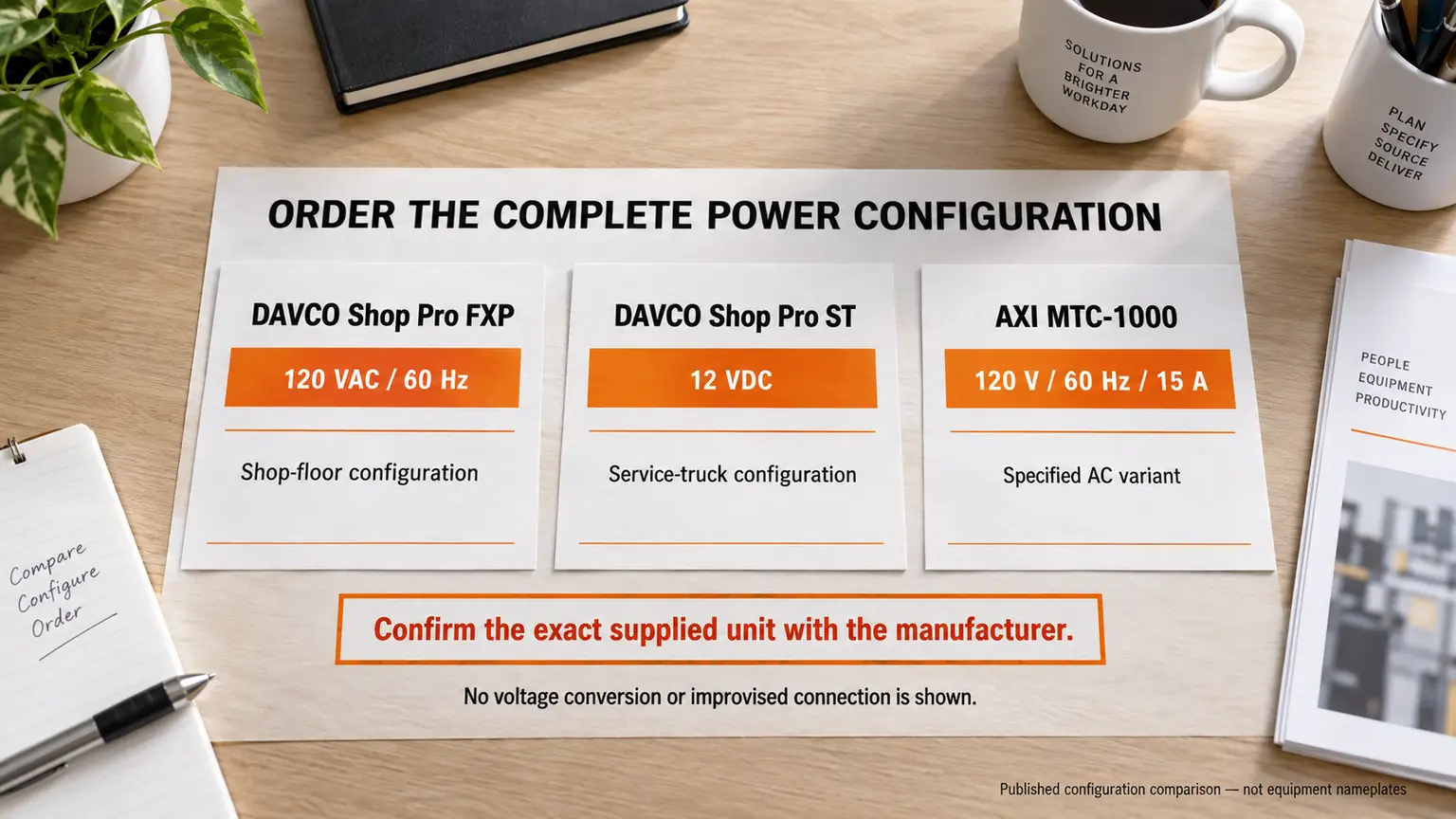
Workshop engine service with fuel transfer and tank-cleaning tasks | DAVCO Shop Pro FXP | 120 VAC, 60 Hz; 150 GPH maximum; 74 lb | Is the quoted regulator and adapter package approved for the engines serviced? |
Service-truck diesel work away from the shop bay | DAVCO Shop Pro ST | 12 VDC; 91 GPH maximum; 35 lb | Does the complete supplied DC configuration suit the service vehicle and its work? |
Moving between storage tanks for fuel polishing | AXI MTC-1000 | 15 GPM nominal; specified 120 V, 60 Hz, 15 A option; approximately 160 lb | Does the supplier's proposal cover the actual tanks, fuel condition and access? |
Specifications are those published in the official sources reviewed for this guide, not measured fleet results. Availability, supplied accessories and application approval must appear in the current quotation.
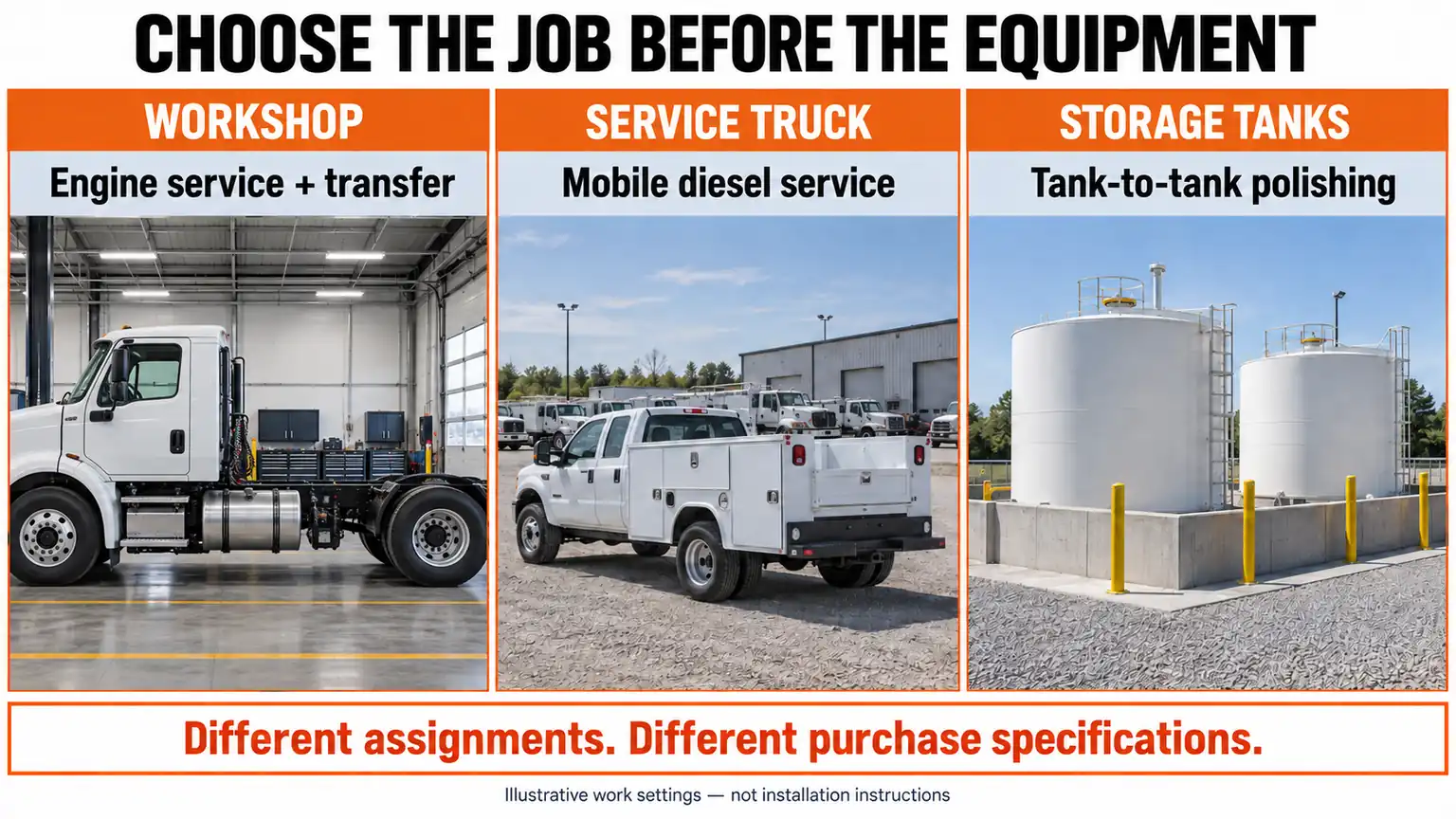
Illustrative work settings, not actual customer sites or installation examples. Moving equipment between tanks is a different purchase assignment from an approved engine-service tool.
The official Shop Pro FXP product page identifies engine priming, tank cleaning and filtered transfer as its jobs. Its AC configuration makes it a relevant starting point when the equipment will normally remain in a properly equipped workshop. The FXP data sheet updated October 7, 2025 lists different regulator packages and ordering references. “Shop Pro FXP” alone is therefore an incomplete order description.
Ask the workshop manager to name the engines the equipment must support before asking a seller for its cheapest FXP. The useful deliverable is a written match between those applications, the ordered unit and its supplied accessories. A catalog family name is not permission to apply the same priming setup to every engine.
The Shop Pro ST product page describes a compact service-truck tool. Its October 2025 Rev C data sheet identifies the unit as 772050DAVH01-07 and specifies a 12 VDC supply. This is a separately specified product, not an FXP that purchasing should make mobile by improvising its electrical supply.
Before selecting it, resolve where it will be transported, how the approved equipment will be secured and handled, and who will maintain its hoses, seals and filter. Published weight is only one part of that review. A compact unit is useful only if the service crew can deploy the complete approved package at its actual jobs.
The task boundary matters more than a winner label. A fleet with frequent workshop engine service may prioritize the FXP package. A service-truck operation may prioritize ST. Neither preference establishes that the other system is inferior at its intended assignment.
The official AXI MTC-1000 specification describes a wheeled system for contaminants in storage tanks, with multistage filtration, a fine-filter bypass and a drip tray. AXI lists 15 GPM nominal flow and alternative fine-filter or water-block configurations. Its 120 V, 60 Hz, 15 A option is distinct from the separately listed 230 V, 50 Hz version. Specify the required supplied variant; do not assume that the two are field-convertible.
This route belongs on the shortlist when the recurring purchase is tank-maintenance capacity. Supply the tank sizes, fuel specification, access constraints and the available condition assessment to the system supplier. Request a proposal for that workload, including filter servicing and the criteria used to judge completion. A flow figure does not tell purchasing how much sludge is present or whether the chosen access reaches the problem.
AXI's Fort Myers support contact gives US buyers a direct configuration-inquiry route. This article does not certify the unit for a particular facility or establish engine-priming approval. If both tank polishing and engine service are needed, ask separate scope questions instead of assuming one purchase must cover both.
Published configuration comparison, not manufacturer nameplates or permission to convert equipment. Confirm the complete supplied model and approved power provision with its manufacturer.
Start with units. FXP's 150 gallons per hour equals 2.5 gallons per minute; ST's 91 GPH is approximately 1.52 GPM. MTC-1000's 15 GPM equals 900 GPH. These arithmetic conversions help compare catalog entries, but they do not predict actual cleaning time, application suitability or output under a particular hose arrangement and filter condition. Keep “maximum” and “nominal” labels attached to the figures.
Next, separate filtration descriptions from verified performance. DAVCO's current ST sheet states 7 microns, while its FXP sheet describes 10-micron filtration. Do not copy the FXP sheet's broad family wording across to ST or declare either one better solely from those numbers. Ask for the performance basis, replacement element reference and applicable operating conditions for the exact quoted system.
Document versions also affect engine-service purchasing. DAVCO's FXP web summary and its linked data sheet do not describe every regulator application in identical language. Where a seller's offer, product page and manual differ, have DAVCO resolve the ordered configuration and engine applicability in writing. This guide intentionally does not supply a universal priming-pressure setting.
Finally, separate equipment capacity from a successful outcome. A quotation may state what the machine is designed to do; a completed job needs its own appropriate assessment. Do not accept a catalog flow rate, a clear sight bowl or a photograph of clean-looking fuel as a substitute for that assessment.
Donaldson's Clean Diesel Kits and Carts information distinguishes outlet-filtration kits from self-contained carts. A kit can be the appropriate purchase when an existing dispensing arrangement needs its specified filtration package. It should not be counted as a competing complete pump-and-cart system just because it appears on the same product-family page.
Donaldson also lists real diesel carts, so the exclusion is about scope, not the brand. Its family page does not by itself settle the exact regional model and supplied power configuration needed for this shortlist. Ask for a current complete-cart offer if that route is relevant; do not substitute an older EMEA cart sheet for US configuration evidence.
For an inlet, breather or dispensing-system decision, the separate bulk diesel filtration guide covers those control points. The primary-versus-secondary filter guide addresses the engine's staged filtration. This article starts after the buyer has identified an external service-equipment assignment and needs to compare purchases.
Ask each shortlisted supplier to answer the same purchase scope. A short, concrete packet is more useful than a request for “your best fuel polishing machine.” Include:
The main paid-for task: workshop engine service, mobile service-truck work or storage-tank polishing; list any secondary tasks separately.
The fleet engines or tank group concerned, supported fuel and blend, known condition evidence, and the actual US destination.
The complete model and power configuration requested, with manufacturer confirmation of application limits and required site provisions.
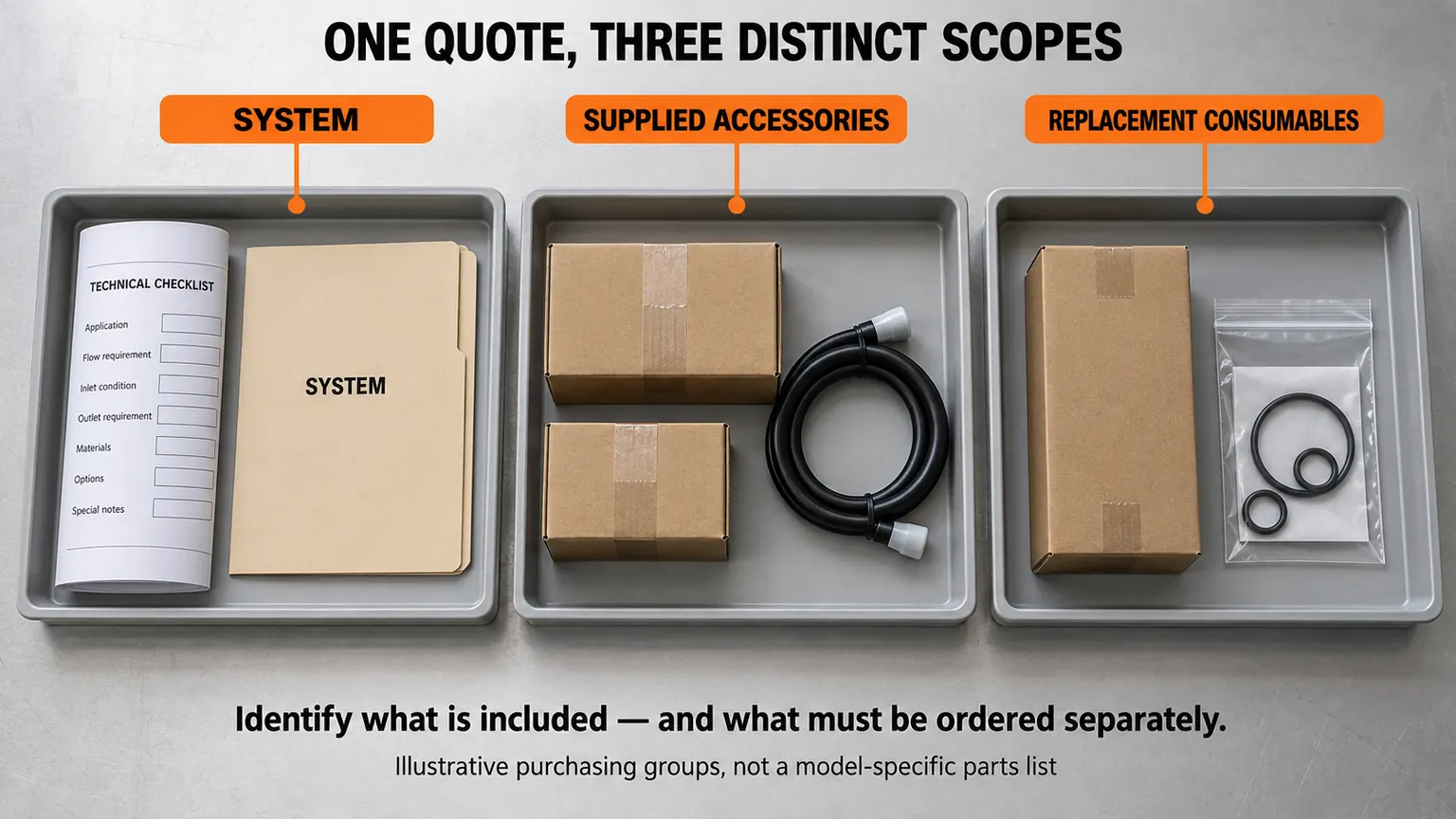
An itemized supplied-accessory list, including which hoses, adapters, wands, monitoring provisions and documents are included or optional.
Replacement-filter, seal and other service-item references, quantities for the opening order, and how their current supply will be supported.
Separate prices and terms for equipment, accessories, consumables, freight, training, service support and any proposed commissioning.
Request current warranty and return terms for the actual buyer and order, including how a configuration dispute is handled. Do not reduce the comparison to a headline warranty period. Responsibility for the cart, motor, pump and service items may differ; a seller should explain the relevant written coverage rather than leave purchasing to combine statements from several brochures.
On receipt, compare the nameplate, supplied parts and documentation with the agreed offer before releasing the unit for use. An unexplained model, supply rating or accessory substitution should return to the supplier for resolution. Arrival at the depot does not establish application approval.
Illustrative purchasing groups, not a model-specific parts list. Generic cartons, a capped hose and rings do not establish what fits or ships with any of the compared systems.
This is not a design for permanent automated filtration, a gasoline-service recommendation, an electrical adaptation guide or a tank-remediation procedure. A diesel description must not be extended to another fluid without the exact manufacturer's approval. Nor does “portable” establish that a system is suitable for every hazardous location or operating environment.
Use the current equipment manual, engine instructions and qualified site personnel for operation. DAVCO's ST technical manual explicitly limits fluid use, requires manufacturer priming guidance and warns against unattended operation. This comparison does not authorize voltage converters, improvised leads, changed pressure settings or temporary plumbing.
Not from flow rate or a diesel-fuel label alone. Ask both the engine maker and equipment supplier for the approved application and complete configuration. If that evidence is absent, keep the tank-polishing purchase separate from the priming requirement. A unit can be suitable for recirculating stored fuel without being approved to connect to an engine's service circuit. Keep that boundary visible in the purchase order.
First compare the assignments, not the number of depots. Record whether each location needs engine service, tank maintenance or both, along with its approved power provisions and transport constraints. Standardize only where one documented configuration meets the relevant requirements. Buying different equipment for different jobs can be a clearer purchase than demanding a universal machine and leaving crews to adapt it.
No. Obtain the exact element's performance basis and the system's approved fuel and duty limits, then agree how the fuel condition will be assessed for the intended use. Particle size alone does not describe every fuel problem. If the condition assessment identifies a problem beyond the equipment's stated capability, the purchase and treatment scope must be reviewed rather than declaring success after filtration.
Send cart configuration and cart-consumable questions to the equipment supplier. For an onboard filter order, provide the vehicle or engine identity, installed element references, quantity and destination through the Elecdura heavy-duty filter category and inquiry form. Keep those references separate from the service cart's own consumables. This comparison does not claim that Elecdura manufactures, stocks or represents DAVCO, AXI or Donaldson equipment.