ELECDURA NETWORK

Your Whole New Supply Chain For Heavy-Duty Parts
Whatsapp:
+86 18915027366
Phone:
+86 18915027366
Views: 0 Author: Site Editor Publish Time: 2026-09-15 Origin: Site
A replacement heavy-duty starter can match the engine and still leave an unresolved guarding question. On agricultural tractors and relevant off-road machines, a shield over the starter terminals may serve an anti-bypass function, not merely keep dirt away. Before ordering, establish what protection the machine requires, whether the quoted starter includes it, and whether a separate service kit or documented reuse is appropriate. Do not interpret “Jump-Start Protection” as permission to start at the solenoid, or assume that an insulating boot, over-crank protection and a terminal guard are interchangeable. The purchasing objective is a supported replacement configuration, with no protective parts lost between removal, delivery and core return.
In this context, Jump-Start Protection, or JSP, concerns physical guarding associated with the starter system. It is not a portable battery booster or a promise of protection against incorrect booster-cable use. The public scope of SAE J1493_202412 addresses the risk of unintended machine movement when normal starter controls are bypassed. Its stated applications include agricultural tractors and specified off-road, self-propelled work machines where that hazard can arise.
SAE identifies the December 2024 edition as current. Its published rationale describes a limited revision and reaffirmation, not a newly introduced guarding concept. The public page establishes scope; it does not provide enough information to assess a homemade guard, approve an installation, or claim that every starter carrying a familiar family name conforms. Use the applicable machine documentation and an appropriately supported replacement specification.
The safety concern also explains why a successful engine start is an inadequate acceptance test. A machine may crank while a protective component is missing. The agricultural safety resource on preventing tractor runovers recommends retaining or adding appropriate starter shielding, maintaining electrical systems and not defeating original interlocks. Starting and service checks belong with trained personnel following the machine's instructions, not an improvised test at the parts counter.
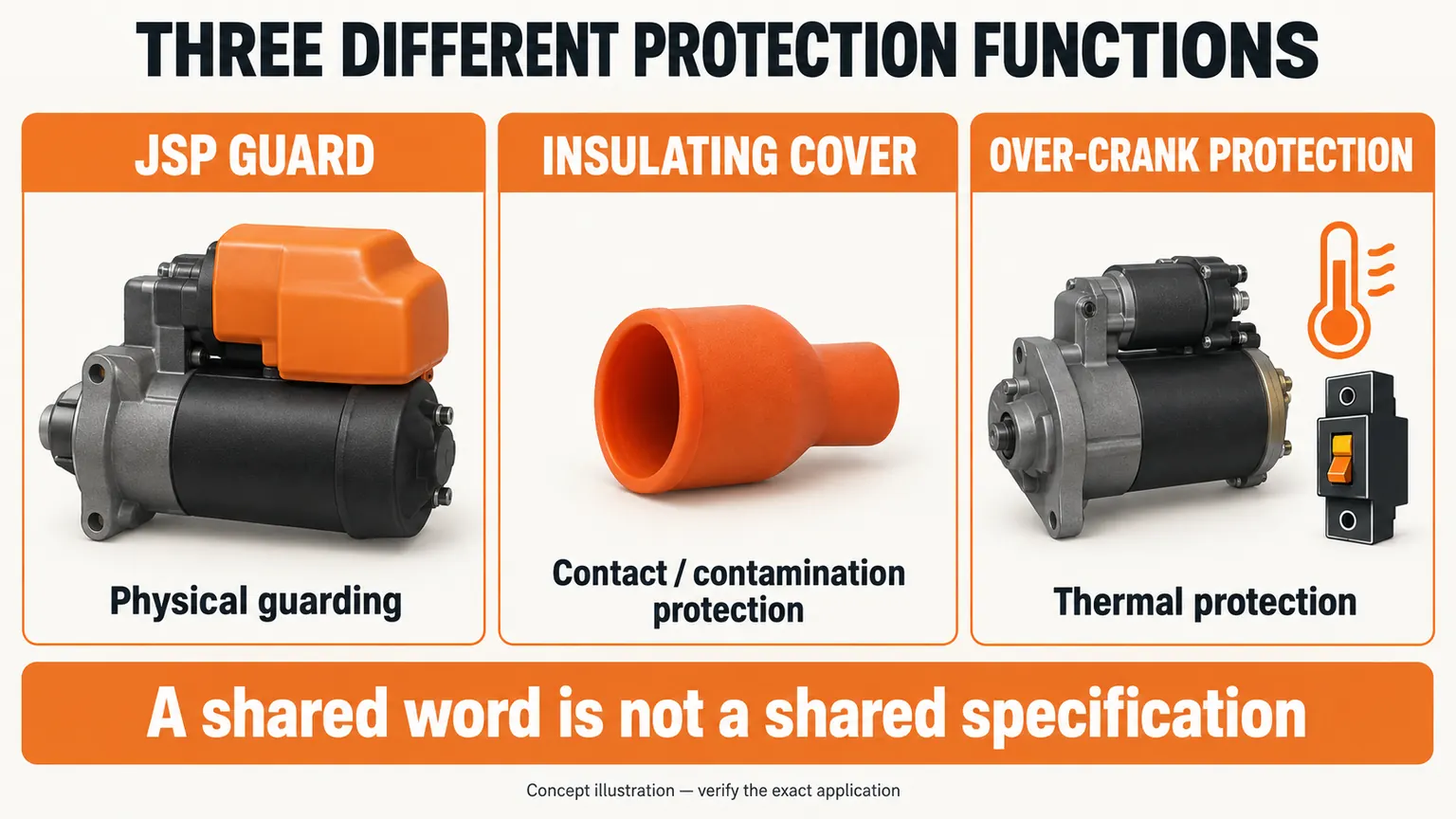
“Protection” is too broad to use as a single purchase-order field. It may describe different components addressing different hazards. Keep the claimed function beside the exact item, rather than treating a photograph of any cover as proof that the guarding question has been answered.
Item or feature | What to establish | What it does not establish by itself |
|---|---|---|
JSP or anti-bypass terminal guard | Application-supported physical guarding and the specified supplied configuration | Correct engine fitment, starter condition or functioning machine interlocks |
Terminal insulation cover | The cover's stated purpose and compatibility | Anti-bypass suitability merely because the terminals are covered |
Over-crank protection | The exact starter's thermal-protection feature | The presence of a physical terminal guard |
IMS or another control component | The specified control arrangement | Interchangeability with a guard, boot or thermal device |
For example, Cat's 9X-4824 terminal-cover listing describes protection against corrosion and shorting. That is useful product information, but the description alone is not evidence of a particular anti-bypass guarding specification. This is a limit of the evidence, not a claim that the Cat part fails a standard.
Delco Remy's 39MT family page lists JSP meeting SAE J1493 as an optional feature, separately from over-crank protection. It describes the latter as thermal protection. “Optional” matters: a family overview is not a packing list for the unit on a supplier's shelf. Electrical control questions remain separate; see our starter solenoid wiring guide for that boundary.
These functions address different questions. Concept illustrations are not an application-approved guard design or electrical schematic.
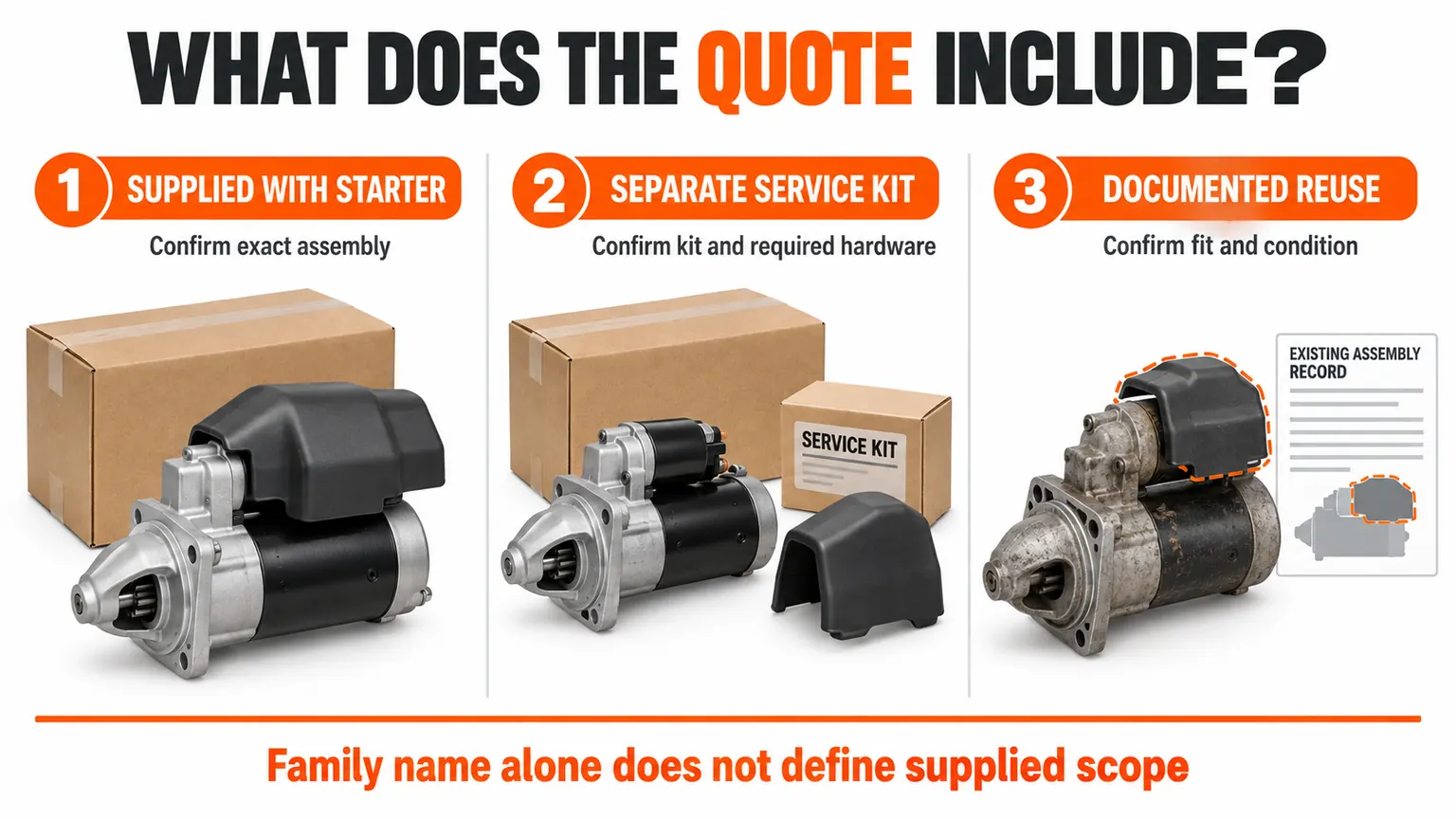
The commercial question is not simply whether the seller supplies a complete motor. It is whether the offer accounts for the application-specific guard and its required supporting parts. A complete starter assembly, a separate shielding kit and reuse of an existing approved shield are different supply arrangements. None should be silently substituted for another.
There is a documented example of this distinction. Delco Remy's 2014 heavy-duty catalog, service note 9, discusses certain 39MT replacements where the original JSP shield is transferred or a separate shield is purchased. This historical note illustrates why a replacement package and the original installation can contain different items. It is not blanket authorization to move any old cover onto any modern starter.
The current Delco Remy catalog separately identifies 10511411 as an active 39MT Jump Start Protection kit, classified as a part. That confirms a service-part identity, not stock availability, universal 39MT compatibility, a complete kit-content list or approval for your machine. Ask the selling channel to resolve those details against the exact replacement reference.
Use three explicit quote outcomes: supplied with the starter; supplied separately under an identified service item; or retained from the existing installation under a documented service decision. If none is confirmed, leave guarding unresolved. A note saying “accessories not included” is particularly important when comparing prices: the cheaper motor-only offer may not cover the same required scope.
These are alternative supply arrangements, not installation steps. Confirm the exact supported configuration and kit contents for the application.
Begin with the machine model and serial identity, engine identification and complete removed-starter reference. Then add information that a general starter enquiry often misses: an exterior view of the existing guard in place, any readable guard identification, its observed condition and the source of the machine's guarding requirement. Obtain photos only within the site's safe service arrangements; do not expose energized terminals to make a better product photograph.
Ask the supplier to answer the following points together:
Which exact starter reference and configuration is offered?
What document supports the intended guarding arrangement on this application?
Is the guard installed, separately packed, excluded, or expected to be retained?
If a kit is separate, which kit and supporting hardware are specified?
If reuse is proposed, who confirms compatibility and serviceable condition?
This is a guard-specific addition to an established fitment record, not a substitute for one. Mounting, pinion, voltage and other application details still need their normal checks. Our 39MT application and fitment guide covers that broader identification task. Here, the unresolved question is whether the protective configuration survives the replacement transaction.
For repeated orders, keep the response with the exact stock reference. Avoid a warehouse description such as “39MT with protection” when it could mean different optional features. A clear accessory field also allows the next buyer to see whether a previous price included a kit or depended on reuse at a particular workshop.
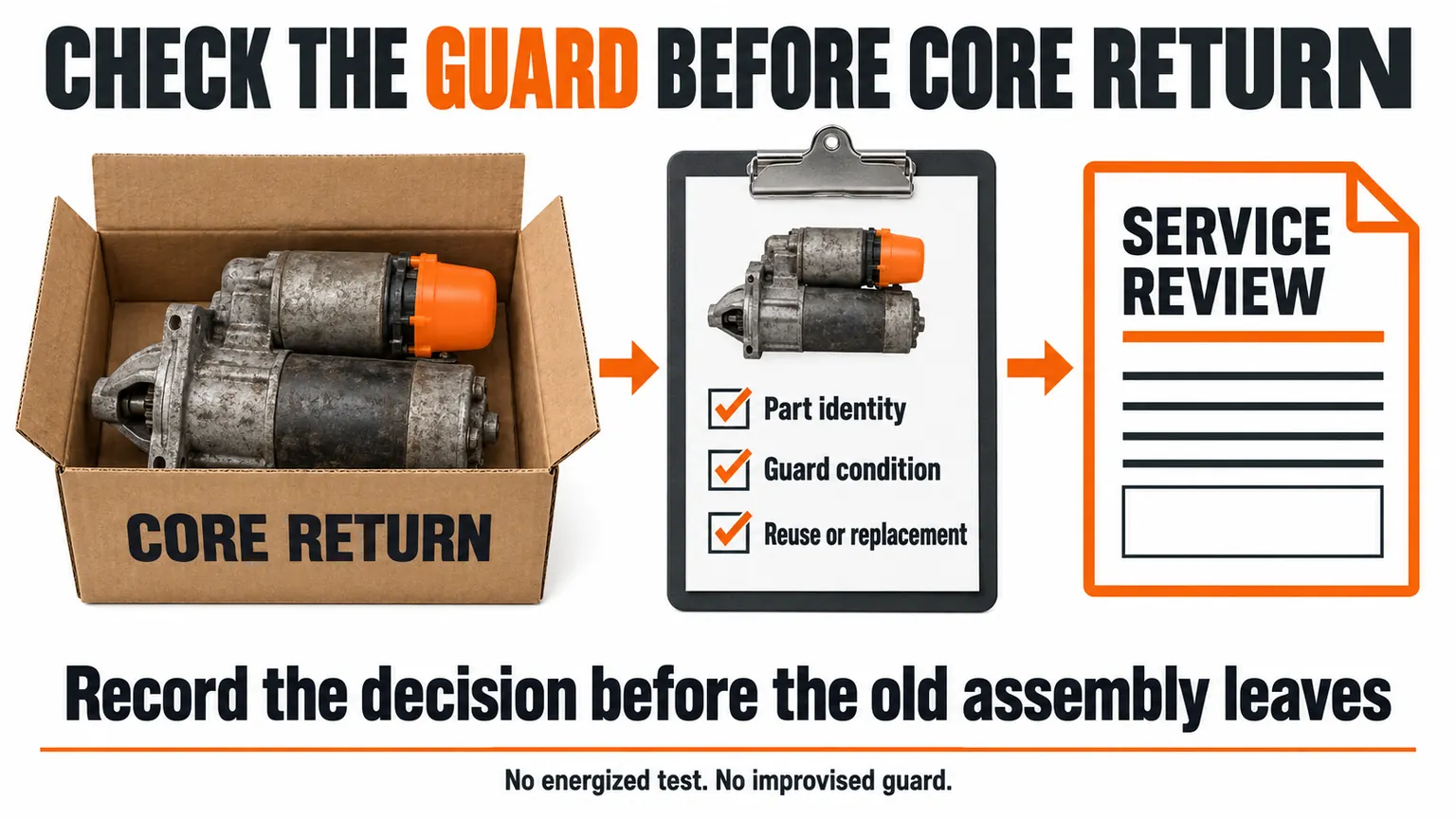
A remanufactured exchange creates an additional handoff: the old starter may leave the workshop before the replacement's supplied scope is understood. Record the existing protective parts before approving the return shipment. Agree with the service team and seller which components must accompany the core and which, if any, are authorized for retention. Do not remove parts contrary to the seller's core conditions or assume that a refundable core charge grants permission to keep accessories.
If the old guard is damaged, missing or of uncertain origin, “reuse existing” is not a resolved order instruction. Identify the correct replacement route with the equipment or starter supplier. Equally, an absent guard on the removed unit does not establish that the machine never required one; previous repairs may have changed the installation.
At receipt, compare the shipment with the recorded arrangement. A separately packed kit should have an identifiable place in the workshop handoff, rather than remaining loose in discarded packaging. Record missing items and disagreements before the starter is released for installation. Warehouse receipt is not a conformity assessment: a qualified service review must still establish that the specified protection is correctly present on the finished machine.
A conceptual handoff checklist, not a completed service record. Resolve approved retention and the seller's core requirements before the old assembly leaves.
The buyer can ensure that a quote is complete and that supporting documents travel with the parts. The buyer should not approve a modified guard, improvise attachment hardware, or declare a machine safe from a supplier photograph. If the supported arrangement cannot be established, keep the affected replacement out of service pending the appropriate technical decision.
Guarding also does not excuse a defective starting-control system. Michigan Farm Bureau's jump-start safety guidance emphasizes starting from the operator's station and appropriate anti-bypass provisions. A guard is not permission to defeat an interlock or work around a no-start fault. This article deliberately provides no bypass procedure, energized test sequence or guard-construction instructions.
For an aftermarket enquiry through Elecdura's heavy-duty starter range, include the guard question with the confirmed application, required quantity and delivery destination. Ask for the offered product identity and supplied scope in writing. A category listing alone does not establish that Elecdura supplies an application-approved JSP kit or a certified guarded assembly.
No. It describes availability within a product family, not necessarily the configuration of an individual part number or shipment. Ask for the exact offered unit's specification and packing scope.
Physical fit alone is insufficient. The supported application, condition and current service instructions must also agree. A historical transfer recommendation for a defined replacement is not universal reuse approval.
Not automatically. A documented separate service item may resolve a missing protective component when the starter itself is serviceable. Diagnosis and application approval should determine the repair scope; do not assume either a whole-unit purchase or a universal cover is appropriate.
No. The cited standard's public scope is bounded by machine type and the potential for hazardous movement. Other equipment may have different protective requirements. Use its own documentation rather than extending this tractor and off-road discussion to every engine installation.
No. A photograph can document what arrived, but it cannot establish all applicable requirements or verify the installed machine. Keep product-specific support and qualified service acceptance separate from the warehouse's record of supplied items.