ELECDURA NETWORK

Your Whole New Supply Chain For Heavy-Duty Parts
Whatsapp:
+86 18915027366
Phone:
+86 18915027366
Views: 0 Author: Site Editor Publish Time: 2026-08-26 Origin: Site
Indonesia can be a useful market to investigate when a distributor, fleet operator, or equipment-parts buyer needs a heavy-duty starter motor supply route. It is not, however, a shortcut around technical identity. A 24-volt starter for a truck, generator set, agricultural machine, or construction unit can pass through several commercial hands before it reaches Indonesia. The correct buying question is therefore not simply “Who is a manufacturer?” It is “Which candidate can document the exact starter, the route of supply, and the release evidence for this application?”
Before a buyer requests quotations, compare the removed unit against Elecdurauto’s heavy-duty starter motor category. A practical comparison file should hold the OE or reference number, system voltage, flange pattern, pinion data, terminal layout, engine or machine application, and clear photographs. That record makes a country-specific conversation more useful than a brand-name-only inquiry.
The twenty names below are starting-system manufacturers, aftermarket brands, or commercial routes worth screening for an Indonesia requirement. They are not ranked by output, reliability, local capacity, or price. The list does not assert that every company manufactures starters in Indonesia, has current Indonesian stock, or authorizes every reseller. Those facts must be confirmed for the exact part number and delivery destination before a purchase order is issued.
The local planning record contains a CBC Indonesia catalogue reference and an Indonesia automotive starter-motor market-analysis listing. Together, they support a narrow proposition: Indonesia has a visible commercial context in which a heavy-duty starter sourcing route can be investigated. They do not verify a supplier’s factory location, ownership, authorization, warranty responsibility, or fitment for a particular engine. This article keeps that boundary visible so a buyer does not turn a search result into an unsupported supplier claim.
The retained local record captures the core keyword starter motor in the US Semrush desktop database at 5,400 monthly searches, 53,100 global monthly searches, KD 45, and informational plus commercial intent on 2026-08-24. It is evidence of real search demand, not a claim about Indonesia-specific volume. The Indonesia focus rests on the commercial-route sources above and must still be matched to the buyer's current application and delivery requirements.
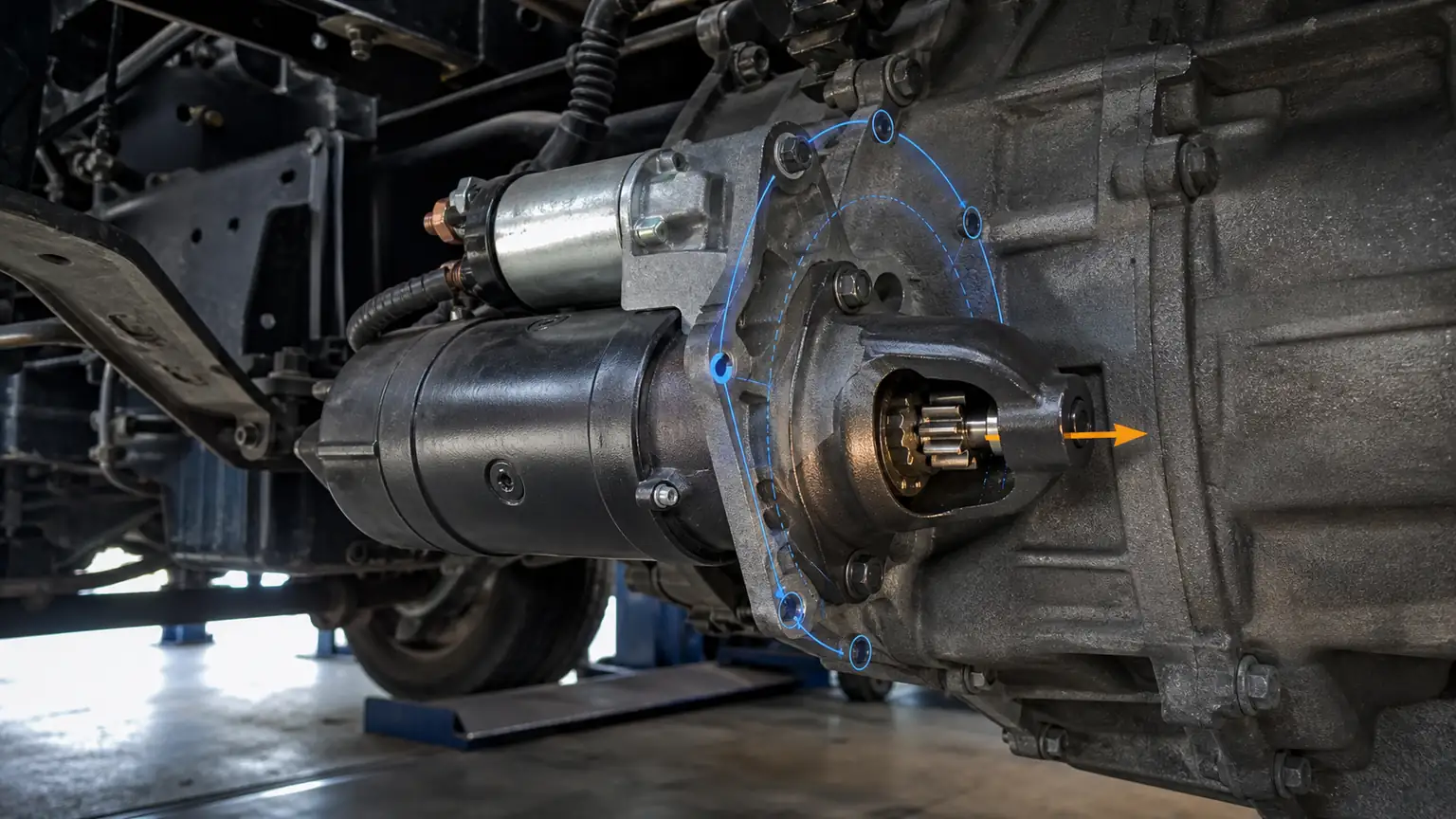
Fitment starts at the bellhousing: lock the mounting pattern and pinion-engagement direction before comparing an RFQ.
Use this table as a controlled first-pass index. “Role to verify” deliberately describes a question, not a conclusion. A buyer should ask each candidate or channel partner to identify the legal seller, source factory or brand, origin, delivery route, and warranty owner for the quoted unit.
No. | Candidate or route | Role to verify | Indonesia RFQ question |
|---|---|---|---|
1 | CBC Indonesia catalogue route | Regional catalogue and distribution route | Which original manufacturer, starter series, and commercial channel sit behind the quoted listing? |
2 | Delco Remy | Heavy-duty starting-system brand route | Can the seller document the precise starter reference, source channel, and Indonesia delivery support? |
3 | Prestolite Electric | Heavy-duty rotating-electrical manufacturer route | Which voltage, duty cycle, and mounting evidence accompanies the quoted assembly? |
4 | Lucas TVS | Starting-system manufacturer candidate | Is the offered unit configured for the required truck, engine, or off-highway application? |
5 | SEG Automotive | Starting-system manufacturer route | Can the offer be tied to a documented OE-reference or dimensional cross-reference? |
6 | Bosch | Global electrical-system brand route | Who owns authorization, origin declaration, and warranty handling for this exact quote? |
7 | DENSO | Global OE-reference and aftermarket route | Is the quotation for a complete starter motor rather than a service component or look-alike assembly? |
8 | Mitsubishi Electric | Rotating-electrical brand route | Can the supplier show flange, pinion, and terminal data before commercial terms are agreed? |
9 | Hitachi Astemo | Electrical-system sourcing route | What engine, flywheel, and ring-gear information supports the claimed application? |
10 | MAHLE | Aftermarket and OE-reference procurement route | Is the product new, remanufactured, or an aftermarket equivalent, and how is that condition recorded? |
11 | MAHLE Letrika | Starter-motor brand route | Does the source provide the intended vehicle or equipment segment together with the part reference? |
12 | Valeo | Rotating-electrical brand route | Are the solenoid, drive gear, nose housing, and mounting configuration supported by the application file? |
13 | Mando | Electrical-component manufacturer route | Which batch-identification and validation documents travel with the proposed supply? |
14 | WAI Global | Aftermarket starter sourcing route | Which OE references, dimensions, and duty details are covered by the seller’s SKU? |
15 | Cargo by Holger Christiansen | Aftermarket electrical-parts route | Is the quote for a complete unit, a remanufactured route, or a repair-level component? |
16 | AS-PL | Aftermarket rotating-electrical route | Can the source provide electrical and dimensional evidence before shipment approval? |
17 | Unipoint | Rotating-electrical sourcing candidate | What inspection record identifies the offered unit and its intended application? |
18 | Nikko | Heavy-duty electrical brand route | Can the seller identify an authorized distribution or export route for the Indonesian destination? |
19 | AutoStart India | Cross-border auto-electrical manufacturer/exporter route | Does it have a traceable Indonesia supply path for the required starter, rather than only a general catalogue presence? |
20 | New Indo Trading Company | Cross-border heavy-duty electrical distributor route | Can it confirm current authorization, origin, and an accountable warranty channel for an Indonesia-bound order? |
The table is deliberately mixed: a buyer may investigate a manufacturer, a brand, a distributor, or an export route. The procurement decision should not treat those roles as interchangeable. A brand may have strong technical documentation but no local route; a distributor may have stock but no authority to resolve a warranty claim; an exporter may quote a part number but not prove the starter’s physical configuration.
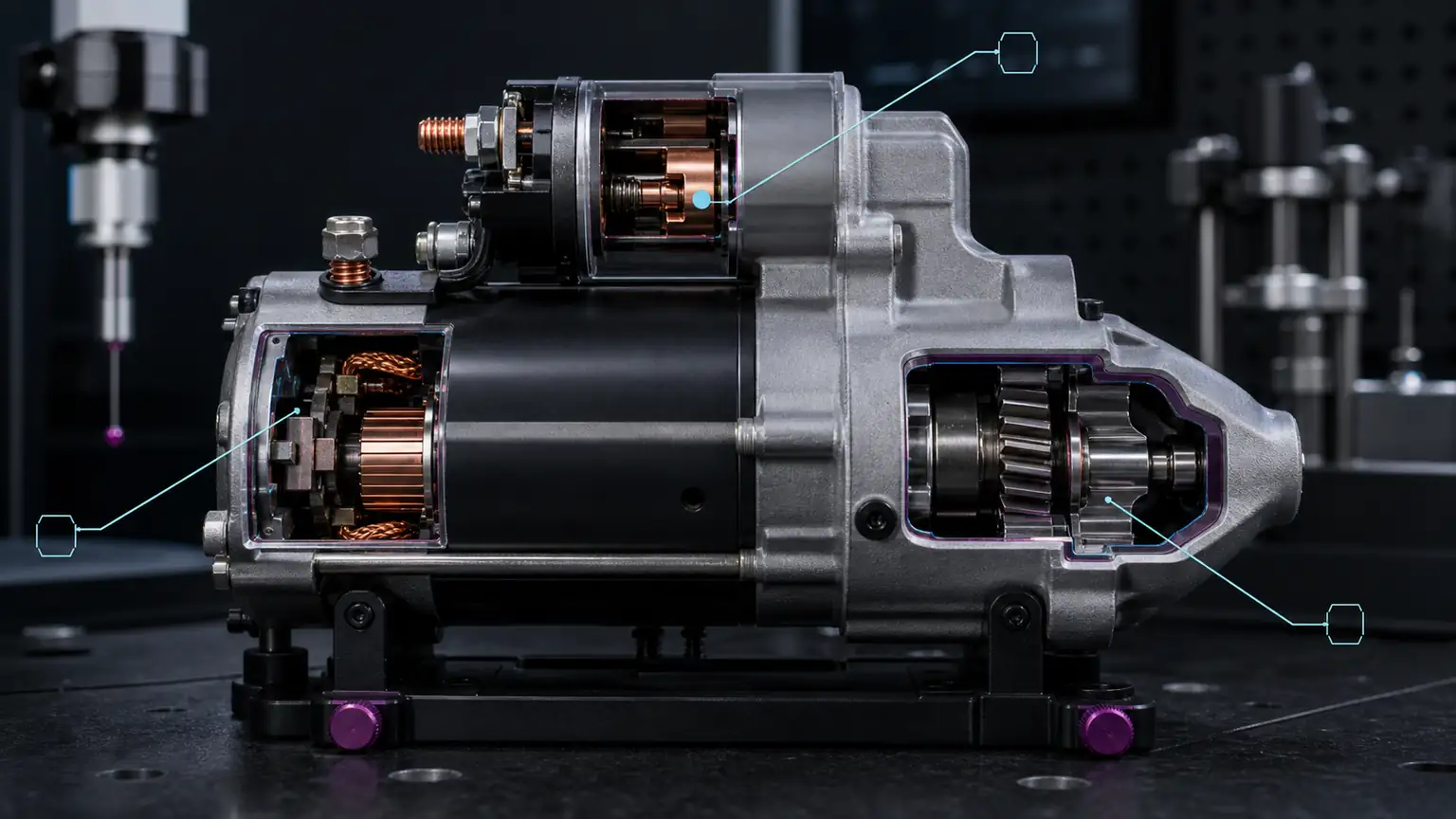
A restrained cutaway makes the internal quality questions concrete: solenoid action, brush condition, armature path, gears, and pinion drive.
A starter can look correct in a thumbnail while carrying the wrong drive gear, nose-cone profile, terminal clocking, or mounting depth. Ask the service team or end user for photographs of the label, drive end, mounting face, solenoid terminals, and the complete unit next to a scale. Record the engine model, machine model, voltage, tooth count if available, and any OE or reference number. This package is more defensible than a request that says only “starter motor for a truck.”
Hard matches are engineering gates: voltage, rotation where relevant, flange geometry, starter engagement, pinion specification, terminal layout, and clearance around the installed unit. Commercial preferences come afterward: minimum order quantity, available stock, payment terms, transit time, label language, and warranty period. Combining these categories too early creates a familiar failure mode: the lowest quote wins before the part is proven to fit.
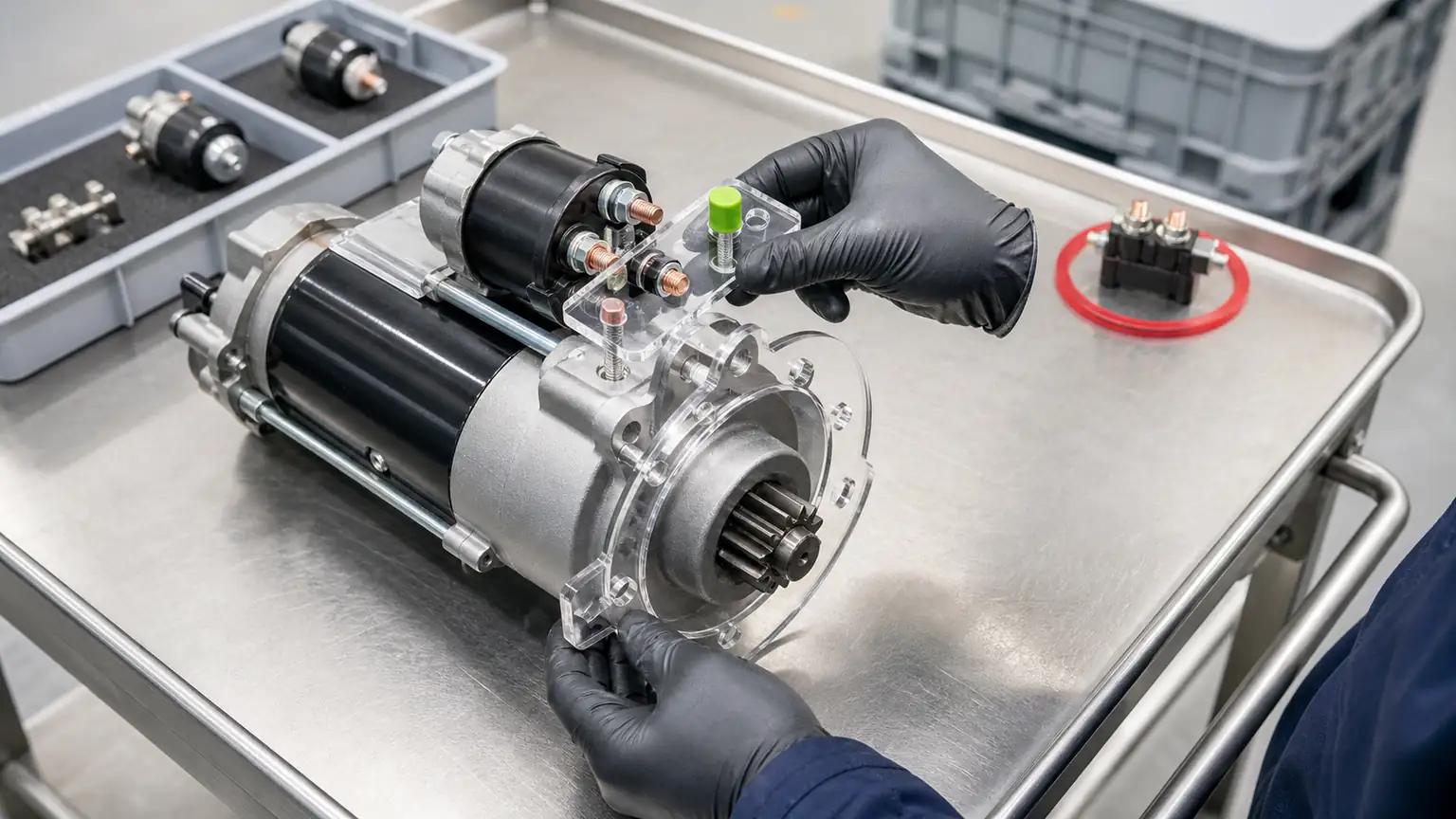
Confirm terminal clocking and mounting geometry on the actual unit before a cross-reference is treated as an approval.
An OE number can be an efficient starting reference, but it may point to a supersession, a family, or a reference copied into another database. Keep it in the identity file together with photographs and measured features. If a candidate offers an aftermarket equivalent, ask the supplier to state exactly which features it has matched and which configuration assumptions still need approval.
A useful bench-test record begins with the starter number, lot or serial identifier, test voltage, fixture arrangement, date, and operator or station reference. The record should describe whether the solenoid engages cleanly, whether the drive moves as expected, what current and voltage observations were made, and whether abnormal sound, heat, or intermittent operation was noted. It should also identify the test conditions rather than presenting a number without context.
For a 24-volt heavy-duty unit, a buyer should request confirmation that the voltage source, cabling, protective guarding, and measurement instruments suit the unit under test. That is not a demand for a single universal current limit. Starter current varies with the design, fixture, battery condition, and test method. The goal is a repeatable record that lets the buyer compare like with like.
A starter that fails to crank may be blamed for a weak battery, high cable resistance, poor ground, damaged ring gear, a control-circuit fault, or an installation error. The incoming inspection file should therefore travel with basic vehicle evidence: battery condition, voltage at the starter during cranking, ground-path condition, cable condition, and application history. A supplier test result and a field circuit record answer different questions; together they make a warranty discussion more productive.
A one-off emergency replacement may need a narrow but disciplined inspection. A distributor launch, fleet tender, or mixed-container order deserves a more complete pilot sample and documented release criteria. The more difficult a claim will be to recover after delivery, the more important it is to agree on evidence before the shipment leaves the source.
Every quotation should state who sells the goods, who provides technical support, who owns the warranty obligation, who declares origin, and who manages a return if the starter is found to be incorrectly configured. Those answers may come from different companies, but they should never be implied. Elecdurauto’s company information is a useful example of the type of supplier identity a buyer should keep with a technical comparison file.
Ask the proposed route to distinguish local stock from factory production, and a direct manufacturer relationship from an unaffiliated trading path. None of these routes is automatically unsuitable. The problem arises only when they are hidden, because hidden roles make stock continuity, technical escalation, and warranty recovery difficult to manage.
Place each candidate’s offer into the same comparison sheet: exact starter identity, condition, origin statement, pack quantity, gross weight, carton dimensions, test evidence, warranty owner, Incoterm, lead time, payment term, and quote validity. If one supplier reports a complete new unit while another quotes a remanufactured unit or a component-level repair alternative, show that difference prominently. A clean comparison sheet protects both the purchasing team and the supplier from an unfair price-only comparison.
A heavy starter motor concentrates weight in a compact assembly. A carton should prevent the drive end from taking an impact, protect exposed terminals, stop loose hardware from damaging the housing, and keep moisture-control materials in the agreed position. The external label should connect the carton to the internal unit through a readable part number and lot or serial trace. Packaging is not merely a freight concern; it preserves the evidence needed for a receiving decision.
At receipt, compare the carton label, packing list, unit label, terminal orientation, mounting face, pinion condition, and visible damage with the approved identity file. Photograph discrepancies before installation. If a mixed shipment is planned, set aside the first sample of every part number for a technical check before it enters general stock. This small discipline prevents a correct-looking carton from becoming a wrongly catalogued replenishment item.
A pilot order should answer the questions that a spreadsheet cannot: does the starter arrive in the stated condition, match the approved configuration, install without interference, perform correctly on the intended electrical system, and generate a clear response when a technical issue appears? Capture the result against the exact part number and lot. Do not treat one acceptable sample as proof that every future substitution will be equivalent.
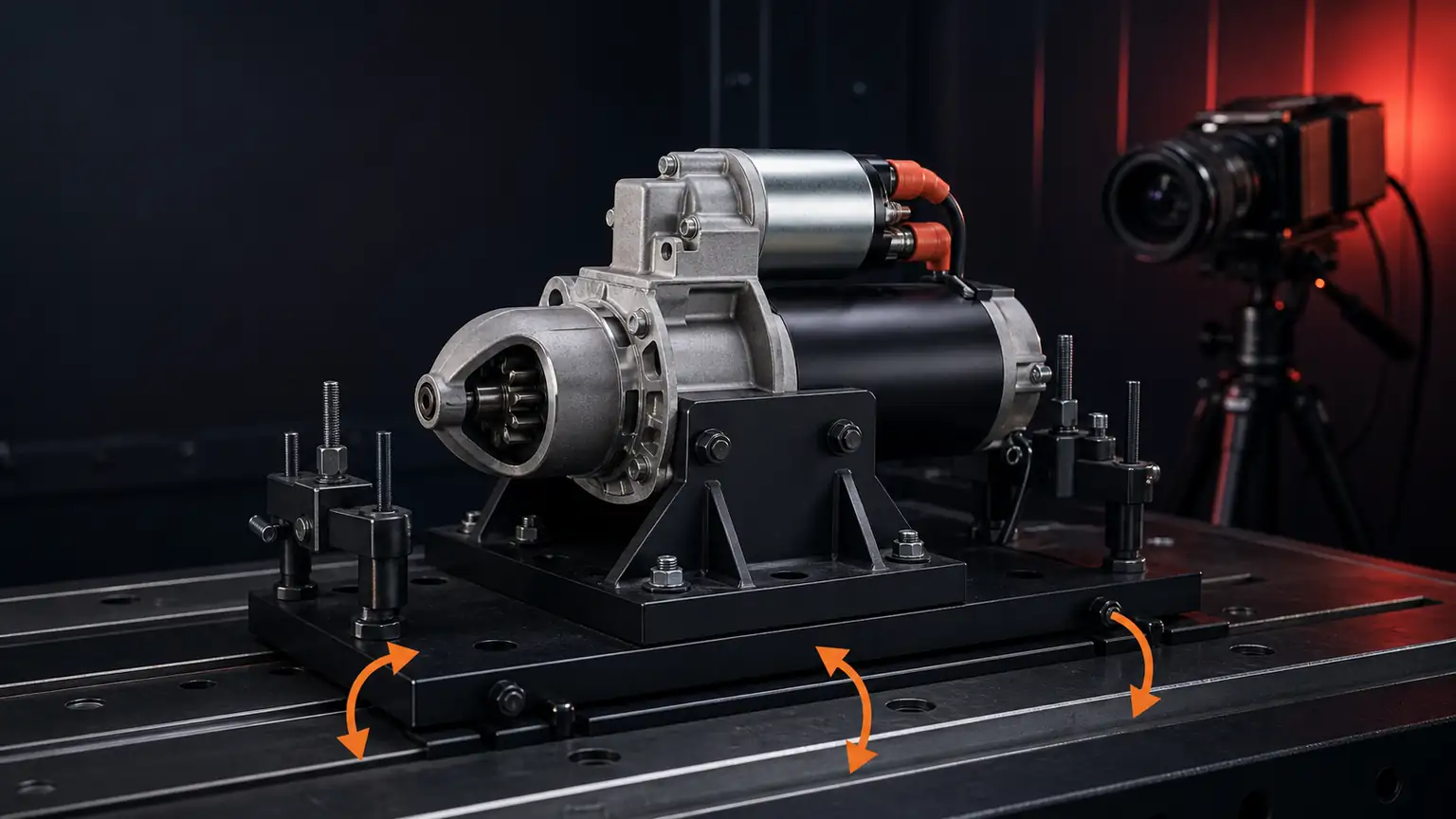
A pilot can expose an overlooked mounting problem: verify bracket rigidity, support points, and clamp loading before a repeat order is released.
When a supplier changes a factory, terminal design, solenoid, drive gear, packing method, or label format, ask for a change notice before the next shipment. Reopen the identity file and decide whether another sample needs approval. This approach is slower than an informal substitution, but it is far less expensive than discovering a change after stock has already reached a fleet workshop or a downstream distributor.
A commercial description such as “starter assembly” is not enough to compare offers. The buyer should state whether the intended purchase is a complete new unit, a remanufactured unit, or a repair-level component route. A remanufactured unit may be suitable for a controlled service program, but it should not be priced as though it carries the same condition, traceability, and warranty basis as a new complete assembly. Repair components can be valuable for a workshop that has proven rebuilding capacity, yet they are not a substitute for a ready-to-install starter motor.
For an emergency field replacement, the first priority may be a verified configuration and a transparent delivery commitment. For a planned distributor order, buyers can add sample release, carton verification, part-number labelling, and replenishment controls. For a fleet or equipment operator, the order file may also need the service location, equipment population, failure history, and desired warranty response. These are different supply conditions, and a supplier should know which one applies before a quotation is judged.
Record the approved starter data, the released sample, the seller, the source route, the packing standard, and the warranty contact in one controlled file. That file turns a successful first order into a repeatable stock decision. It also makes it easier to spot an unintended change when a later quote looks similar but offers a different configuration or commercial path.
A useful Indonesia shortlist does not promise that twenty names are interchangeable manufacturers. It gives a B2B buyer a disciplined route to identify a technically correct starter, verify the commercial chain, request a comparable test record, and protect the receiving decision. Once those controls are in place, the country page becomes a procurement tool rather than a ranking page with unsupported claims.
Use the shortlist to decide what evidence is missing, then obtain that evidence from the seller before the order changes hands. If a candidate cannot identify the exact unit, explain the supply route, or accept a clear release standard, move it out of the active RFQ group. This is a stronger outcome than filling a ranking table with claims that cannot be checked after the shipment arrives.
For a cross-reference review or an RFQ built around the installed application, send Elecdurauto the starter reference, engine or machine data, photographs, voltage, and delivery destination. Adding annual quantity, target delivery date, and any known field symptom will help separate a matching question from a commercial quotation question.
CBC Indonesia catalogue — used only as a regional catalogue and commercial-route signal.
Indonesia automotive starter-motor market-analysis listing — used only as a market-topic signal.
Delco Remy starter and alternator education — used as a technical product-family reference, not proof of Indonesian manufacture or authorization.