ELECDURA NETWORK

Your Whole New Supply Chain For Heavy-Duty Parts
Whatsapp:
+86 18915027366
Phone:
+86 18915027366
Views: 0 Author: Site Editor Publish Time: 2026-07-26 Origin: Site
Top 20 Heavy-Duty Turbocharger Manufacturers in Poland addresses the point where a maintenance decision becomes a purchasing decision. In Polish heavy-duty diesel aftermarket sourcing, a reference number may help identify a starting point, but it cannot replace evidence from the installed part, the engine or vehicle application, and the operating duty. The practical goal is to reduce repeat work, protect uptime, and give fleet, workshop, and distributor teams a record they can use for the next order.
Elecdurauto positions its support around clear aftermarket and OE-reference matching rather than unsupported genuine-brand claims. Buyers can begin with the heavy-duty turbocharger category and then use the information below to build a fitment and sourcing file that reflects Polish turbocharger supplier evaluation, actuator compatibility, and complete-assembly control.
The article is deliberately written for commercial vehicles, diesel equipment, fleet maintenance, repair networks, importers, and distributors. It does not assume that a light-vehicle repair rule or a consumer catalogue result is enough for a heavy-duty replacement decision.
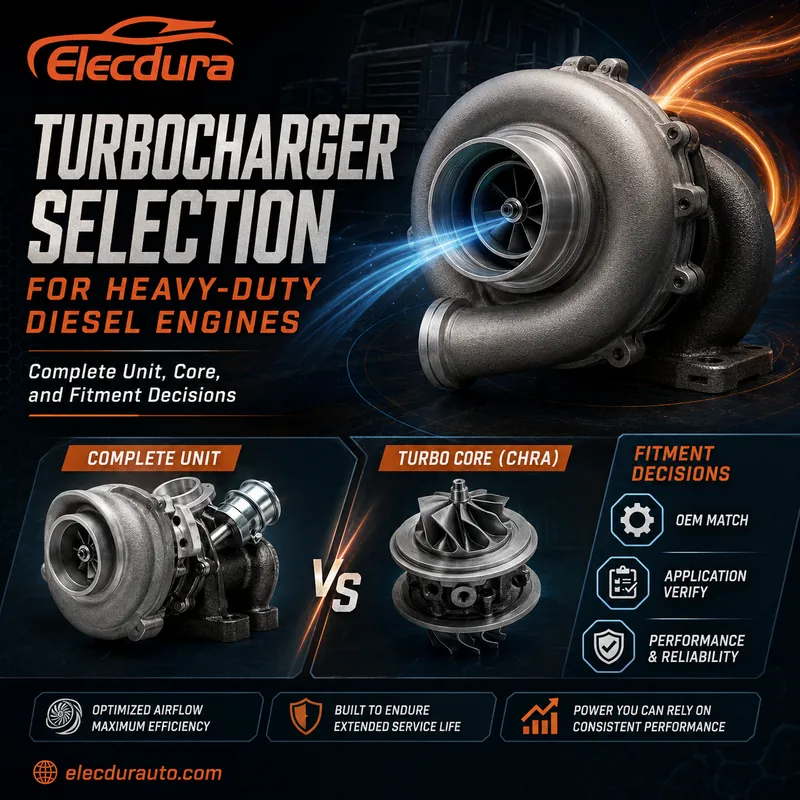
heavy-duty turbocharger manufacturers decisions should distinguish a complete assembly from a cartridge, core, repair kit, or look-alike housing before a supplier enters the Top 20 shortlist. This is not paperwork for its own sake: the details establish whether the item can be installed, whether it will perform in the intended duty cycle, and whether the supplier can support the same specification when stock is reordered. The procurement file must state the complete-unit reference and actuator requirement.
For define the complete turbocharger requirement before comparing brands, a useful record brings together the removed-part markings, the equipment platform, measured interfaces, operating symptoms or demand profile, and photographs taken before the component leaves the vehicle. That combination is stronger than a broad web search because it makes the technical question visible to every person who will quote, receive, install, or support the order.
State that the required item is a complete turbocharger assembly. Apply this at control point 1 while the team works through distinguish a complete assembly from a cartridge, core, repair kit, or look-alike housing before a supplier enters the Top 20 shortlist.
Record actuator type and connector before sourcing alternatives. Apply this at control point 2 while the team works through distinguish a complete assembly from a cartridge, core, repair kit, or look-alike housing before a supplier enters the Top 20 shortlist.
Compare oil-feed and drain interfaces with the removed unit. Apply this at control point 3 while the team works through distinguish a complete assembly from a cartridge, core, repair kit, or look-alike housing before a supplier enters the Top 20 shortlist.
Preserve full-unit markings and orientation photographs for approval. Apply this at control point 4 while the team works through distinguish a complete assembly from a cartridge, core, repair kit, or look-alike housing before a supplier enters the Top 20 shortlist.
For define the complete turbocharger requirement before comparing brands, the team should document the result in the technical file before moving to quotation. This separates an evidence-backed replacement decision from a loose reference-number substitution.
Once the define the complete turbocharger requirement before comparing brands checks are complete, the buyer can compare quotations on a like-for-like basis. Price then becomes one part of an informed decision alongside technical fit, quality controls, packaging continuity, delivery reliability, and the supplier's ability to answer a specific application question without turning a reference system into an unverified claim.
At this point, the decision team should write a short acceptance note for define the complete turbocharger requirement before comparing brands: what was checked, which result was acceptable, what evidence is retained, and who owns the next action. That note is useful when the vehicle returns months later, when a distributor has to replenish stock, or when a new buyer must understand why this heavy-duty turbocharger manufacturers was approved. It also distinguishes a controlled aftermarket replacement decision from a loose catalogue substitution.
The define the complete turbocharger requirement before comparing brands discipline supports better communication between workshop, purchasing, and supplier teams. Instead of asking whether a part is simply available, the inquiry can state the application, interfaces, operating conditions, sample status, and required delivery or packaging controls. This makes the quote easier to evaluate and reduces the chance that an urgent order is filled with an item that is only superficially similar to the approved component.
Close this part of the review by recording the observed condition and the evidence that still needs to be obtained. A deliberate hold can protect fleet uptime when a reference looks plausible but a key physical or operating detail remains unresolved.
heavy-duty turbocharger manufacturers decisions should compare compressor and turbine housing orientation, wastegate or VGT control, oil connections, and engine-platform mapping. This is not paperwork for its own sake: the details establish whether the item can be installed, whether it will perform in the intended duty cycle, and whether the supplier can support the same specification when stock is reordered. A correct-looking turbine housing does not prove the assembly will calibrate or install correctly.
For evaluate air-side, turbine-side, and actuator evidence together, a useful record brings together the removed-part markings, the equipment platform, measured interfaces, operating symptoms or demand profile, and photographs taken before the component leaves the vehicle. That combination is stronger than a broad web search because it makes the technical question visible to every person who will quote, receive, install, or support the order.
State that the required item is a complete turbocharger assembly. Apply this at control point 1 while the team works through compare compressor and turbine housing orientation, wastegate or VGT control, oil connections, and engine-platform mapping.
Record actuator type and connector before sourcing alternatives. Apply this at control point 2 while the team works through compare compressor and turbine housing orientation, wastegate or VGT control, oil connections, and engine-platform mapping.
Compare oil-feed and drain interfaces with the removed unit. Apply this at control point 3 while the team works through compare compressor and turbine housing orientation, wastegate or VGT control, oil connections, and engine-platform mapping.
Preserve full-unit markings and orientation photographs for approval. Apply this at control point 4 while the team works through compare compressor and turbine housing orientation, wastegate or VGT control, oil connections, and engine-platform mapping.
For evaluate air-side, turbine-side, and actuator evidence together, the team should document the result in the technical file before moving to quotation. This separates an evidence-backed replacement decision from a loose reference-number substitution. When a part-specific question remains, use related turbocharger manufacturer research with the application details instead of relying on an unverified cross-reference.
Once the evaluate air-side, turbine-side, and actuator evidence together checks are complete, the buyer can compare quotations on a like-for-like basis. Price then becomes one part of an informed decision alongside technical fit, quality controls, packaging continuity, delivery reliability, and the supplier's ability to answer a specific application question without turning a reference system into an unverified claim.
At this point, the decision team should write a short acceptance note for evaluate air-side, turbine-side, and actuator evidence together: what was checked, which result was acceptable, what evidence is retained, and who owns the next action. That note is useful when the vehicle returns months later, when a distributor has to replenish stock, or when a new buyer must understand why this heavy-duty turbocharger manufacturers was approved. It also distinguishes a controlled aftermarket replacement decision from a loose catalogue substitution.
The evaluate air-side, turbine-side, and actuator evidence together discipline supports better communication between workshop, purchasing, and supplier teams. Instead of asking whether a part is simply available, the inquiry can state the application, interfaces, operating conditions, sample status, and required delivery or packaging controls. This makes the quote easier to evaluate and reduces the chance that an urgent order is filled with an item that is only superficially similar to the approved component.
Use the result to assign one owner for the next check and one date for review. That small control prevents a technical question from being lost between the workshop diagnosis and the purchasing request.
heavy-duty turbocharger manufacturers decisions should look for complete product photographs, OE-reference boundaries, actuator documentation, packaging protection, and warranty handling. This is not paperwork for its own sake: the details establish whether the item can be installed, whether it will perform in the intended duty cycle, and whether the supplier can support the same specification when stock is reordered. Those records reduce risk when a distributor must support a workshop after installation.
For test supplier discipline for heavy-duty diesel applications, a useful record brings together the removed-part markings, the equipment platform, measured interfaces, operating symptoms or demand profile, and photographs taken before the component leaves the vehicle. That combination is stronger than a broad web search because it makes the technical question visible to every person who will quote, receive, install, or support the order.
State that the required item is a complete turbocharger assembly. Apply this at control point 1 while the team works through look for complete product photographs, OE-reference boundaries, actuator documentation, packaging protection, and warranty handling.
Record actuator type and connector before sourcing alternatives. Apply this at control point 2 while the team works through look for complete product photographs, OE-reference boundaries, actuator documentation, packaging protection, and warranty handling.
Compare oil-feed and drain interfaces with the removed unit. Apply this at control point 3 while the team works through look for complete product photographs, OE-reference boundaries, actuator documentation, packaging protection, and warranty handling.
Preserve full-unit markings and orientation photographs for approval. Apply this at control point 4 while the team works through look for complete product photographs, OE-reference boundaries, actuator documentation, packaging protection, and warranty handling.
For test supplier discipline for heavy-duty diesel applications, the team should document the result in the technical file before moving to quotation. This separates an evidence-backed replacement decision from a loose reference-number substitution.
Once the test supplier discipline for heavy-duty diesel applications checks are complete, the buyer can compare quotations on a like-for-like basis. Price then becomes one part of an informed decision alongside technical fit, quality controls, packaging continuity, delivery reliability, and the supplier's ability to answer a specific application question without turning a reference system into an unverified claim.
At this point, the decision team should write a short acceptance note for test supplier discipline for heavy-duty diesel applications: what was checked, which result was acceptable, what evidence is retained, and who owns the next action. That note is useful when the vehicle returns months later, when a distributor has to replenish stock, or when a new buyer must understand why this heavy-duty turbocharger manufacturers was approved. It also distinguishes a controlled aftermarket replacement decision from a loose catalogue substitution.
The test supplier discipline for heavy-duty diesel applications discipline supports better communication between workshop, purchasing, and supplier teams. Instead of asking whether a part is simply available, the inquiry can state the application, interfaces, operating conditions, sample status, and required delivery or packaging controls. This makes the quote easier to evaluate and reduces the chance that an urgent order is filled with an item that is only superficially similar to the approved component.
Before moving forward, compare the proposed replacement against the approved-sample record rather than against memory. This is the point where a distributor can stop an avoidable catalogue or packaging variation from entering routine stock.
heavy-duty turbocharger manufacturers decisions should document application, old-unit markings, full assembly identifiers, installation checks, and pilot feedback. This is not paperwork for its own sake: the details establish whether the item can be installed, whether it will perform in the intended duty cycle, and whether the supplier can support the same specification when stock is reordered. This prevents a broad Top 20 search from becoming an uncontrolled list of non-interchangeable components.
For convert a country shortlist into an approved turbocharger programme, a useful record brings together the removed-part markings, the equipment platform, measured interfaces, operating symptoms or demand profile, and photographs taken before the component leaves the vehicle. That combination is stronger than a broad web search because it makes the technical question visible to every person who will quote, receive, install, or support the order.
For convert a country shortlist into an approved turbocharger programme, the team should define what would prove a correct match and what would expose a false match. The evidence may be electrical, mechanical, thermal, hydraulic, fuel-system, or packaging related, but it must be traceable to the exact application. A clear evidence set also prevents a later warranty discussion from becoming a disagreement about an undocumented sample.
State that the required item is a complete turbocharger assembly. Apply this at control point 1 while the team works through document application, old-unit markings, full assembly identifiers, installation checks, and pilot feedback.
Record actuator type and connector before sourcing alternatives. Apply this at control point 2 while the team works through document application, old-unit markings, full assembly identifiers, installation checks, and pilot feedback.
Compare oil-feed and drain interfaces with the removed unit. Apply this at control point 3 while the team works through document application, old-unit markings, full assembly identifiers, installation checks, and pilot feedback.
Preserve full-unit markings and orientation photographs for approval. Apply this at control point 4 while the team works through document application, old-unit markings, full assembly identifiers, installation checks, and pilot feedback.
Once the convert a country shortlist into an approved turbocharger programme checks are complete, the buyer can compare quotations on a like-for-like basis. Price then becomes one part of an informed decision alongside technical fit, quality controls, packaging continuity, delivery reliability, and the supplier's ability to answer a specific application question without turning a reference system into an unverified claim.
At this point, the decision team should write a short acceptance note for convert a country shortlist into an approved turbocharger programme: what was checked, which result was acceptable, what evidence is retained, and who owns the next action. That note is useful when the vehicle returns months later, when a distributor has to replenish stock, or when a new buyer must understand why this heavy-duty turbocharger manufacturers was approved. It also distinguishes a controlled aftermarket replacement decision from a loose catalogue substitution.
The convert a country shortlist into an approved turbocharger programme discipline supports better communication between workshop, purchasing, and supplier teams. Instead of asking whether a part is simply available, the inquiry can state the application, interfaces, operating conditions, sample status, and required delivery or packaging controls. This makes the quote easier to evaluate and reduces the chance that an urgent order is filled with an item that is only superficially similar to the approved component.
End the module with a release status that everybody can read: approved for the named application, pending further evidence, or rejected. Clear status language avoids a rushed order becoming an undocumented experiment.
The strongest replacement or sourcing result is not simply a component that arrives quickly. It is an approved item supported by application data, inspection evidence, measured interfaces, correct product positioning, and a repeat-order trail. That approach lowers the chance of a second repair and gives distributors a more reliable basis for stock planning.
In Polish heavy-duty diesel aftermarket sourcing, the practical advantage comes from making the next conversation more precise. A technician can explain the observed condition, a buyer can compare the correct commercial controls, and a supplier can answer against a defined application rather than a vague request. That is how a heavy-duty turbocharger manufacturers programme becomes easier to maintain as vehicles, routes, and customer requirements change.
For B2B buyers, the next step is to assemble the old-part information, application details, photographs, and operating observations before requesting a comparison. heavy-duty turbocharger category can provide the right product-family starting point, while Elecdurauto contact support can be used for a focused aftermarket fitment and sourcing discussion.