ELECDURA NETWORK

Your Whole New Supply Chain For Heavy-Duty Parts
Whatsapp:
+86 18915027366
Phone:
+86 18915027366
Views: 0 Author: Site Editor Publish Time: 2026-09-07 Origin: Site
A supplier statement that an injector “passed the bench” is not an acceptance record. A useful report identifies the exact injector and condition, the bench and procedure, fluid and temperature, defined operating points, commanded quantity or pressure, measured delivery and return or leakage, applicable limits and calibration or trim-code result. The buyer should approve the sample against a written revision and then use the same controlled checks for production lots.
This guide is for diesel-injector importers, reman programs and fleet buyers setting a sample approval gate before a production order. It focuses on what a flow report must identify and how that report connects to the physical injector, test procedure, calibration result and future lot, rather than treating a pass stamp as complete evidence.
Delivery, return flow, internal leakage and response are different measurements. Each number needs a commanded condition, pressure or other procedure state, stabilization rule, test fluid and temperature, units, applicable limit and equipment identity. Results copied from another bench or family cannot be reconciled unless the approved method explains their equivalence.
New, remanufactured and repaired injectors can also have different acceptance and traceability requirements. State condition in the RFQ and keep the sample label, report serial, generated calibration or trim code and package together. If the report cannot be tied to the exact injector, it is demonstration material rather than release evidence.
Injector maker number, customer number, suffix and condition
Engine family, emissions stage and control-system application
Bench model, adapter, procedure revision and calibration status
Test fluid, temperature and stabilization condition
Serialized results, trim or calibration code and lot traceability
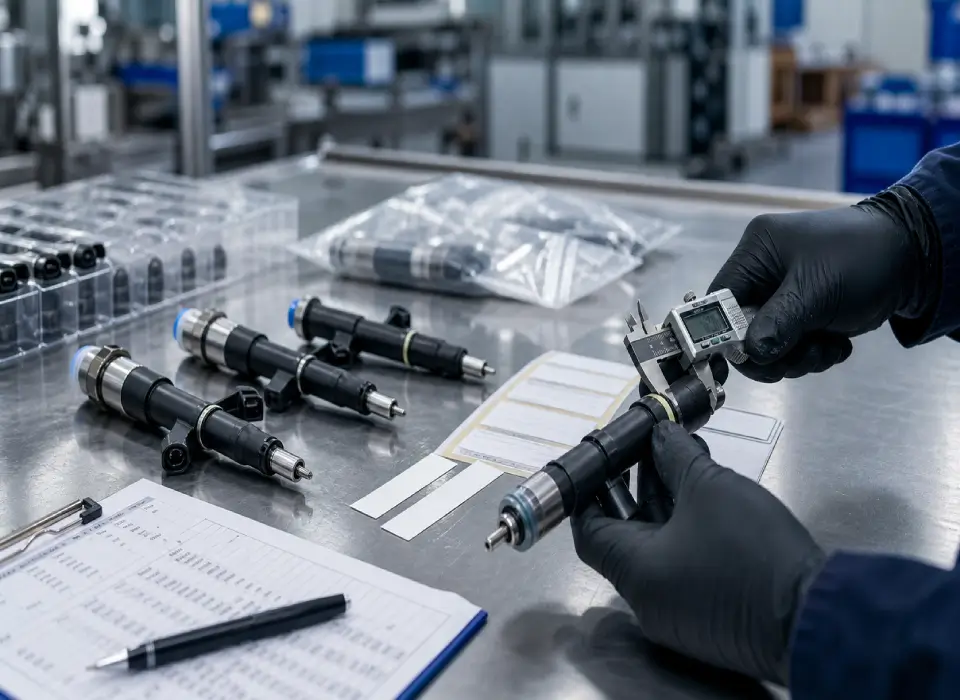
Preserve the installed injector identity and its relationship to the vehicle before cleaning, dismantling or adjustment. Record the operating condition, instrument, datum and procedure behind each observation. That makes the supplier comparison repeatable and prevents an isolated number or photograph from being treated as universal approval.
Record the complete installed-unit and system evidence before choosing a injector replacement. The staged image supplies context, not application-specific limits.
Observed evidence | Possible interpretation | Decision-changing check |
|---|---|---|
Identity gate | Label, number, suffix, connector and nozzle evidence | Wrong family or untraceable sample |
Static integrity | External and internal leakage checks defined by the procedure | Leak path or unsupported result |
Operating points | Multiple commanded conditions relevant to the injector | Single-point “flow” claim |
Coding and release | Generated code, report serial and approved lot link | Code missing, reused or not tied to the unit |
A useful sequence normally covers more than one delivery condition because high-load quantity alone can hide poor low-delivery control, return-flow problems or leakage. The exact points and limits remain family-specific, but the report should make clear which behavior each point examines and whether correction, coding or rejection follows from a failed result.
Ask how the bench is configured for the nozzle, connector, high-pressure inlet and return. Record adapter references and software or procedure revision where available. This prevents an apparent repeat test from using a different fixture or interpretation. The goal is not to force every supplier onto one machine; it is to make the method and its limits auditable.
Define sample quantity and acceptance before the supplier tests it.
Separate new, remanufactured and rebuilt condition in the purchase order.
Require actual values and limits, not only pass stamps.
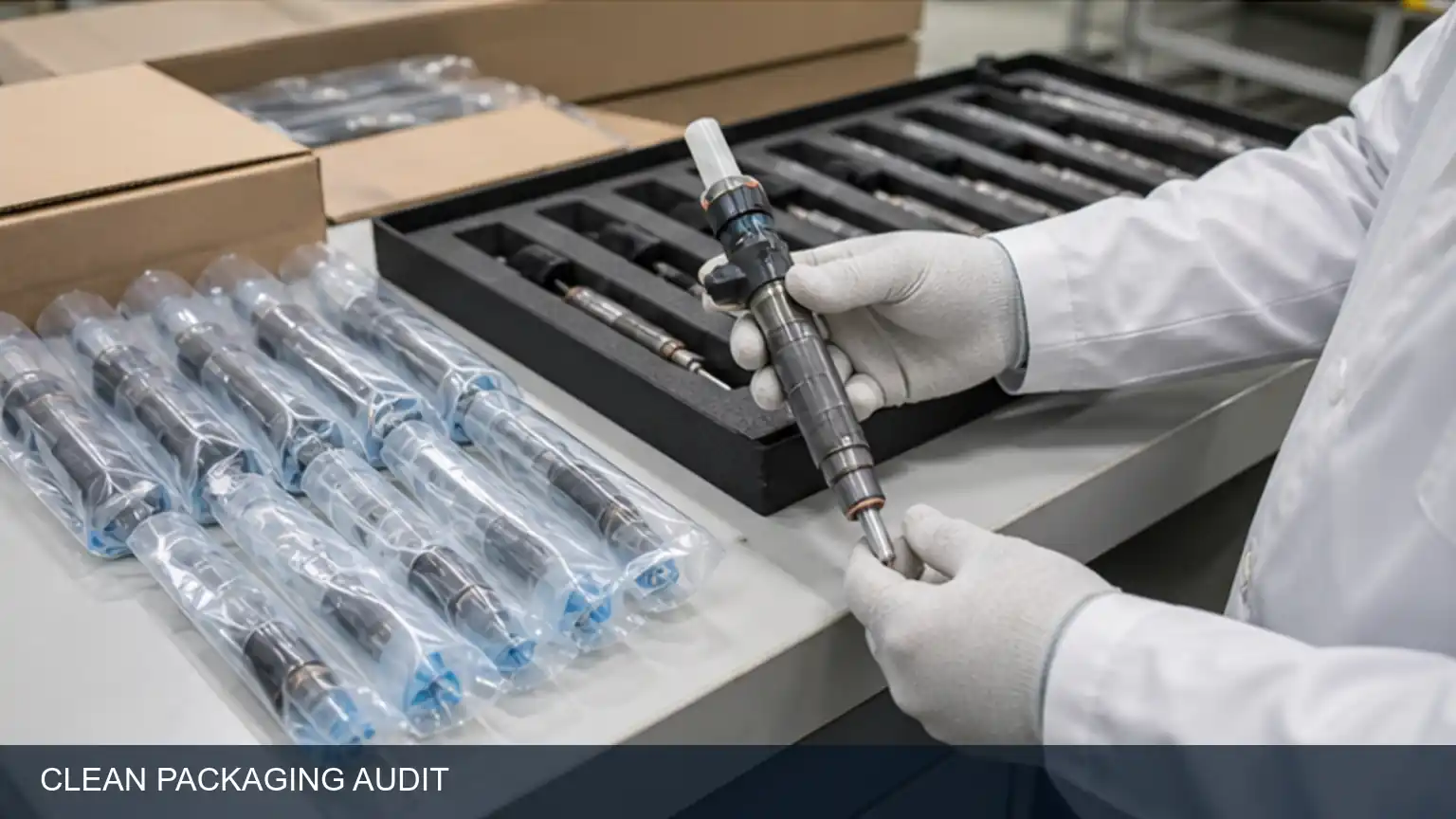
Protect inlet, return and nozzle interfaces during shipment and inspection.
Run installation and engine release under the applicable service procedure.
Use the approved procedure and record the actual condition; appearance by itself is not a pass or fail result for diesel injector flow test acceptance.
Freeze the approved sample revision: maker and complete reference, external interfaces, markings, report layout, calibration-code handling, protective caps and packaging. The purchase order should require notification before any change to source, nozzle or control-valve version, test method, label, packaging or included documents. Otherwise the sample becomes disconnected from later deliveries.
At receiving, select the inspection level before opening the shipment and preserve lot identity. Compare labels and external features, check protection and contamination risk, and reconcile the test-report serials. Quarantine mixed, damaged or undocumented units. Do not install one uncertain injector simply to see whether the engine runs; that can create damage and destroy the evidence needed for a supplier claim.
Send the same revision-controlled packet to every supplier. Require a complete maker reference, condition, application basis, included hardware, specific diesel injector flow test acceptance evidence, traceability, packaging, lead time, warranty and return route. Ask the seller to mark fields it could not verify instead of filling them with a generic direct-replacement claim.
RFQ field | Evidence that can be audited | Reason to hold |
|---|---|---|
Identity | Maker, complete reference, label and proposed condition | Truncated, relabeled or mixed identity |
Application | Vehicle or equipment record plus interface comparison | Visual similarity or unsourced cross-reference |
Functional basis | Named procedure, conditions, actual results and limits | Tested or calibrated without a record |
Commercial scope | Included parts, packaging, warranty and return terms | Condition, core or fulfilment route unclear |
This article does not publish universal flow limits or claim that bench acceptance proves in-engine emissions, combustion balance or long-term durability. Those conclusions require the approved injector specification and engine procedure. A bench record supports a defined purchasing decision only when its method, unit identity and limits are known.
Approve one identified sample revision before scaling the order. At receipt, reconcile the package, label, injector, report and included parts; inspect protection, contamination, corrosion, impact and mixed-lot risk. Quarantine any mismatch. Installation release must correct the confirmed root cause and reproduce the original operating condition under the applicable service procedure.
Connect the exact sample or production lot to the approved application packet and post-install result.
Use the related Elecdura technical guide and Elecdura product category to organize the evidence before contacting Elecdura. For repeat orders, compare the production lot with the approved sample and require notice before a change to maker, reference, interface, test method, label, packaging or supplied hardware.
No. It cannot describe low delivery, pilot behavior, return flow or leakage across the operating range. Record the applicable identity, procedure and result before changing the purchase or repair decision; the observation alone cannot prove every related interface or system is acceptable.
No. It is one calibration output and must be supported by the full test and identity record. Record the applicable identity, procedure and result before changing the purchase or repair decision; the observation alone cannot prove every related interface or system is acceptable.
No. Use the approved specification for the exact family and procedure. Record the applicable identity, procedure and result before changing the purchase or repair decision; the observation alone cannot prove every related interface or system is acceptable.
Set the sample plan from lot size, supplier history, failure consequence and the agreed quality plan before arrival. Record which serials were selected and how a failure changes containment. One passing unit cannot prove the complete lot, while arbitrary retesting after a failure can hide the original nonconformance.
No. External appearance can reveal impact, corrosion, contamination or cap problems, but it cannot quantify delivery, return flow, leakage or control response. Use visual inspection as a receiving gate and the approved bench method for performance. Passing one gate does not erase a failure at the other.
An injector sample is ready for B2B approval only when identity, method, operating points, actual values, limits, coding and traceability form one record. Freezing that record as the lot baseline makes receiving inspection and supplier containment possible without turning a generic bench stamp into evidence it cannot provide.