ELECDURA NETWORK

Your Whole New Supply Chain For Heavy-Duty Parts
Whatsapp:
+86 18915027366
Phone:
+86 18915027366
Views: 0 Author: Elecdura Publish Time: 2026-09-04 Origin: Site
Do not install or bench-test a diesel injector immediately after a carton arrives damaged, wet, open or poorly protected. First preserve the shipping evidence, identify every unit and lot, and inspect protective caps, nozzle, sealing surfaces, connector, return fitting and body for impact, contamination or corrosion. Release only injectors whose identity and protection remain intact for the next controlled test stage. Quarantine units with missing or loose caps, moisture inside a barrier bag, corrosion on precision interfaces, bent connectors, chipped nozzles, mixed identity or unexplained contact marks.
This receiving process is for heavy-duty parts distributors, diesel workshops, fleets and importers. It separates shipping-condition acceptance from calibration or functional acceptance.
Assign a receiving case number and photograph the pallet or parcel from all sides before straps, wrap or cartons are removed. Capture carrier labels, seal condition, crushed corners, punctures, wet areas, retaping, loose cartons and any tilt or impact indicator. Record arrival date, shipment reference, carton count and who accepted custody. If a package is actively leaking fuel or another hazardous substance, follow site and carrier safety procedures before handling.
Open suspect cartons under controlled lighting with a clean work surface. Video may help show the order of discovery, but still images and written notes should identify each layer: outer carton, cushioning, inner box, sealed bag, protective caps and the injector itself. Do not discard packaging until the supplier or carrier disposition is agreed. Packaging damage is not automatic proof that the injector is damaged; it is evidence that the protection system needs closer inspection.
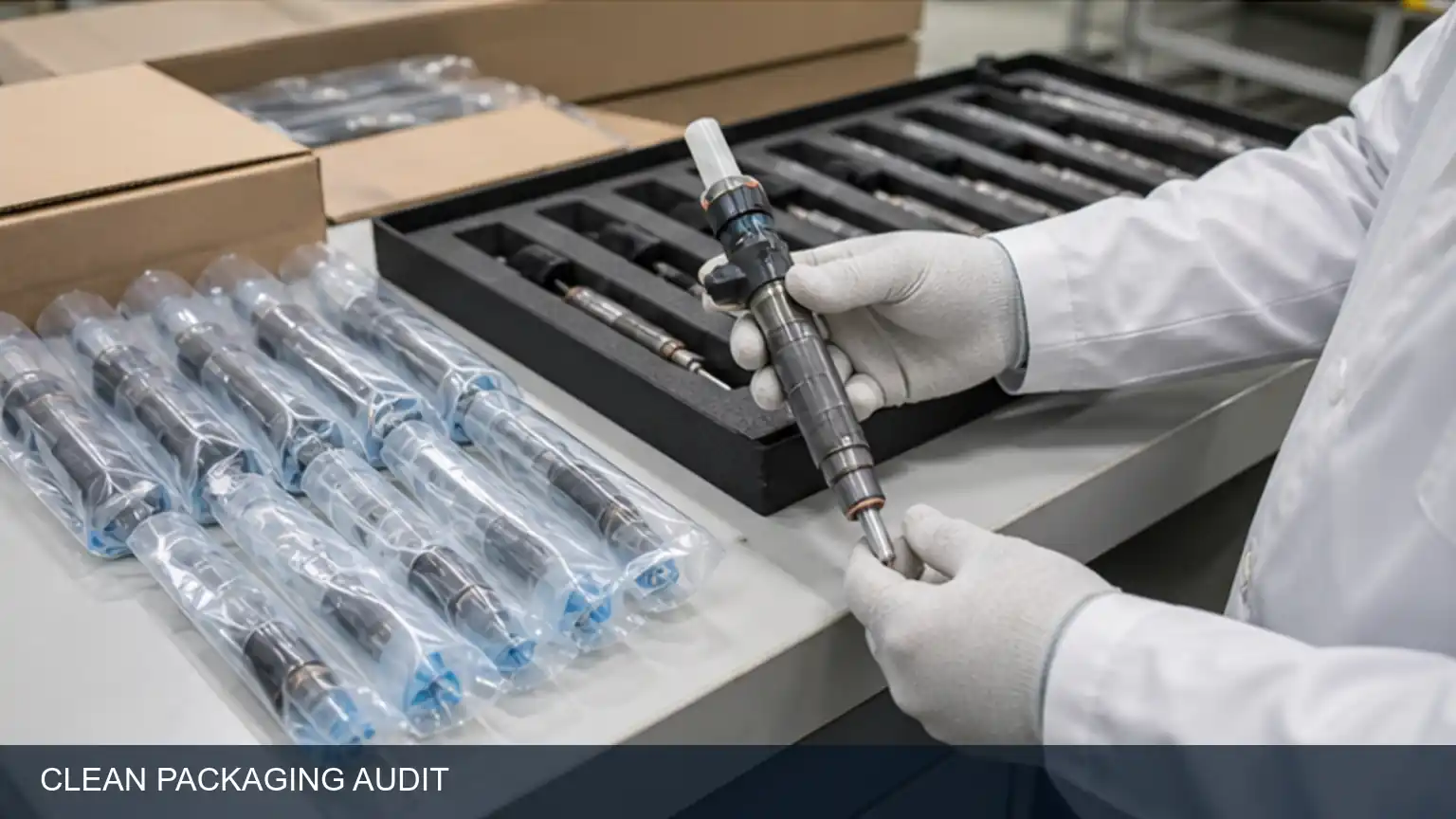
Inspect packaging as a layered contamination barrier. The image illustrates the task and does not certify any supplier or lot.
Count units by carton and lot, then compare purchase order, packing list, outer labels, individual labels and visible part markings. Record the declared condition—new, remanufactured, repaired or core—and do not merge those populations. Photograph calibration or trim codes without publishing them as interchange proof. A code can require programming or cylinder assignment; it does not replace the complete injector reference and application.
Use the approved reference file for the order. Compare the exact part and suffix, supplier revision, packaging specification, expected caps and included seals. If units are mixed, labels conflict, or a seller substituted a reference, quarantine the affected quantity even when the bodies appear identical. Functional testing cannot correct an undocumented identity change.
The injector test-report interpretation guide applies later, after identity and shipping condition pass. Receiving evidence and performance evidence should remain separate so a clean test result cannot erase a traceability defect.
Protective caps prevent dirt and impact from reaching high-pressure, return and nozzle interfaces. Delphi and DENSO service guidance repeatedly emphasizes capping exposed fuel-system connections and maintaining a clean environment because contamination can damage precision components. The same principle belongs at goods receipt.
Check whether every expected port and nozzle is capped, whether caps are fully seated, cracked, split or loose, and whether the cap style matches the approved packing specification. Look for particles, fibers, moisture or fuel residue trapped at the cap edge. Do not push a contaminated cap back onto a clean interface. Segregate the unit and record the condition.
Remove a protective cap only in the clean inspection or test area and only when the next step requires it. Use clean gloves and approved handling tools. Never touch the nozzle tip or sealing face, insert a probe into a port, wipe precision surfaces with a shop rag, or blow compressed shop air through the injector. Re-cap with a clean approved protector if the unit will not proceed immediately.
Magnification and controlled lighting can reveal handling damage, but the inspector must not add scratches, fibers or particles while looking for them.
Not every mark has the same consequence. A superficial rub on a non-sealing body area may be documentable and acceptable under the agreed cosmetic standard. A nick on a high-pressure sealing cone, chipped nozzle, bent return fitting, cracked plastic connector, damaged thread, distorted clamp surface or displaced calibration label can affect safety, fit, coding or traceability. These require quarantine until the supplier provides an acceptable disposition.
Observed condition | Immediate action | Evidence limit |
|---|---|---|
Outer carton crushed; inner barrier and caps intact | Photograph, identify units and complete focused inspection. | Intact packaging does not prove calibration. |
Cap loose or missing | Quarantine; do not wipe or blow out the interface. | No visible dirt does not prove cleanliness. |
Moisture inside sealed bag | Keep segregated, record bag and unit condition, request disposition. | Dry exterior does not exclude internal exposure. |
Body rub outside a functional surface | Compare with the agreed cosmetic standard and photograph. | Cosmetic acceptance says nothing about flow performance. |
Connector, thread, nozzle or sealing face damaged | Quarantine and prevent installation or test-fixture connection. | A later electrical or flow pass may not make the interface safe. |
Record color, location, area, texture and whether corrosion appears on a body, fastener, electrical terminal, thread, seal surface or nozzle. Compare unaffected units from the same shipment. Do not scrape, oil, polish or chemically clean the mark before supplier review. Those actions can destroy evidence and push residue into the component.
Look upstream for the moisture path: wet outer packaging, torn vapor barrier, missing desiccant when specified, temperature-condensation evidence, reused caps, storage exposure or fuel residue. Delphi's service information notes that water contamination can contribute to corrosion and that contamination control is essential around common-rail components. Receiving inspection cannot determine internal condition from exterior appearance alone, so unexplained moisture at a precision interface remains a hold.
If the supplier proposes cleaning or rework, require a written, part-specific method and a post-rework acceptance plan. Do not convert a new-unit order into repaired stock without commercial agreement and updated condition labeling.
Separate the receipt into three physical and digital zones. Green units have matched identity, intact protection and no visible shipping defect; they may proceed to the next approved inspection or testing stage. Amber units have incomplete evidence or a condition requiring supplier review; they remain sealed and cannot be picked. Red units have clear damage, contamination exposure, identity conflict or safety risk; they are blocked from installation and testing until formal disposition.
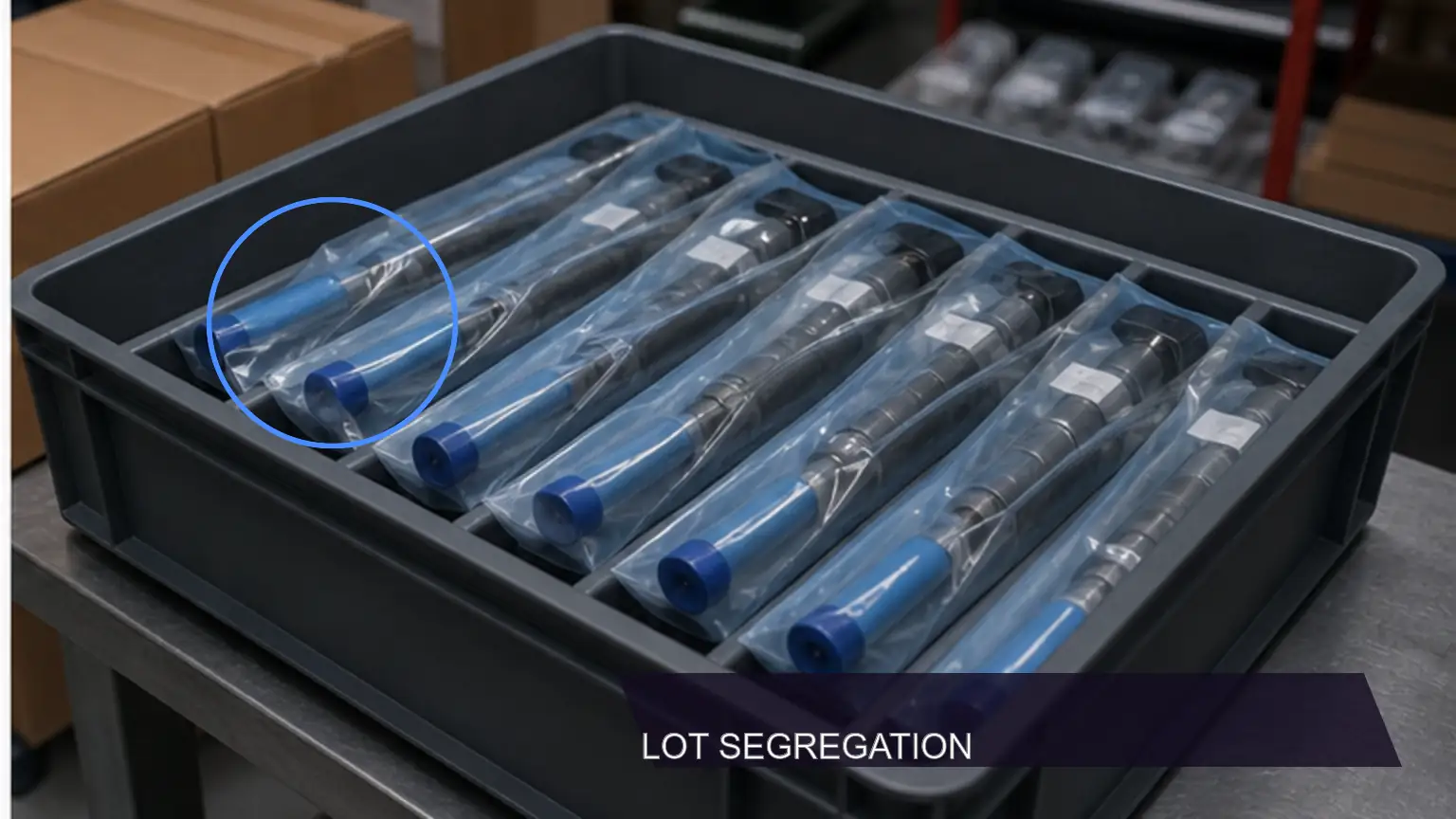
Tag each injector and package with case number, purchase order, part reference, lot or serial identifier, carton number and observed condition. Keep mixed lots separate. Restrict system status as well as shelf location; a red tag is ineffective if the ERP still allows shipment. Record who changed the status and why.
Lot segregation prevents an acceptable sample from silently releasing units whose packaging or identity was never checked.
A supplier needs evidence that connects the condition to a specific shipment and unit. Send the purchase order and packing list, carrier reference, carton map, unbroken sequence of arrival and unpacking photographs, unit and lot identifiers, cap and barrier condition, close-ups with scale, quantity affected, quarantine location and requested disposition. State whether any unit was uncapped, cleaned, connected or tested after discovery.
Ask for one clear response: accept as-is under an agreed deviation, authorize a defined inspection or rework, replace, issue credit, or arrange return. A generic instruction to “test them” is incomplete unless the method, safety controls, cost responsibility and acceptance boundary are defined. Preserve representative packaging and do not return parts until transport protection and evidence retention are agreed.
Visual inspection cannot prove internal cleanliness, calibration, leakage, delivered quantity, return flow, electrical response or durability. Move released units to a qualified bench or controlled installation process only when the order requires those checks. Do not use an engine as the first test fixture for a suspect common-rail injector. Follow the injector maker and engine maker procedures, including coding, seals, high-pressure safety and cleanliness.
Do not improvise. Quarantine it and obtain a part-specific supplier or manufacturer disposition. Exterior cleaning cannot prove that particles did not enter a high-pressure passage or damage a precision surface.
Not automatically. It triggers a documented focused inspection. Release depends on inner protection, identity and unit condition under the agreed receiving standard; the packaging evidence should still be retained.
No. Lighting, oil film, coating and handling marks can change appearance. Record the location and compare controlled samples, but keep the unit on hold when a functional or precision interface may be affected.
No. A defined bench test can answer performance questions at that moment. It does not restore missing traceability, prove internal cleanliness over time or correct an agreed packaging deviation.
Specify individual identity, protected precision interfaces, clean barrier packaging, cushioning, lot traceability, moisture control where required, outer-carton strength and a change-notification rule. Confirm the exact requirement with the supplier before sample approval.
Use the diesel fuel injector range to identify a possible reference family. For a new order or a discrepancy review, send Elecdura the exact injector identity, quantity, destination and receiving evidence. Ask the proposed part and packaging plan to be tied to the supplied reference; do not release an equivalent from appearance alone.
Technical references reviewed September 4, 2026: Delphi Technologies injector-contamination guidance and common-rail injector replacement procedure; DENSO Common Rail System Installation Guide; DENSO diesel-injector replacement cleanliness guidance. Product- and engine-specific instructions govern handling, testing and installation.