ELECDURA NETWORK

Your Whole New Supply Chain For Heavy-Duty Parts
Whatsapp:
+86 18915027366
Phone:
+86 18915027366
Views: 0 Author: Site Editor Publish Time: 2026-08-29 Origin: Site
Direct answer: A useful engine identity packet is a controlled evidence file, not a single data-plate photograph. Include wide engine and machine views, every identity location, readable plate or block stamp, engine serial and arrangement fields, current application and repower history, removed-part labels, interface photographs, measurements, fault or replacement reason, quantities, destination, and acceptance requirements. Separate observed facts from unverified assumptions. Give every photo and measurement a clear filename or worksheet reference. That structure lets suppliers quote starters, alternators, injectors, turbochargers, filters, and related parts without silently inventing the missing application.
A multi-brand RFQ packet should let a supplier review the same machine without standing beside it. It combines wide context photographs, engine identity, removed-part records, measured interfaces, commercial requirements, and version control in one indexed file. The heavy-duty starter catalogue illustrates one product-family route; every quoted line must still be governed by the packet's application and interface evidence.
Packet module | Minimum contents | Who uses it |
|---|---|---|
Identity core | Plate, block stamp, serial, arrangement | Defines the engine record |
Application context | Machine, vehicle, duty, repower history | Explains why original records may differ |
Removed-part evidence | Labels, interfaces, condition | Supports each requested product family |
Commercial scope | Quantity, destination, acceptance, timing | Makes quotations comparable |
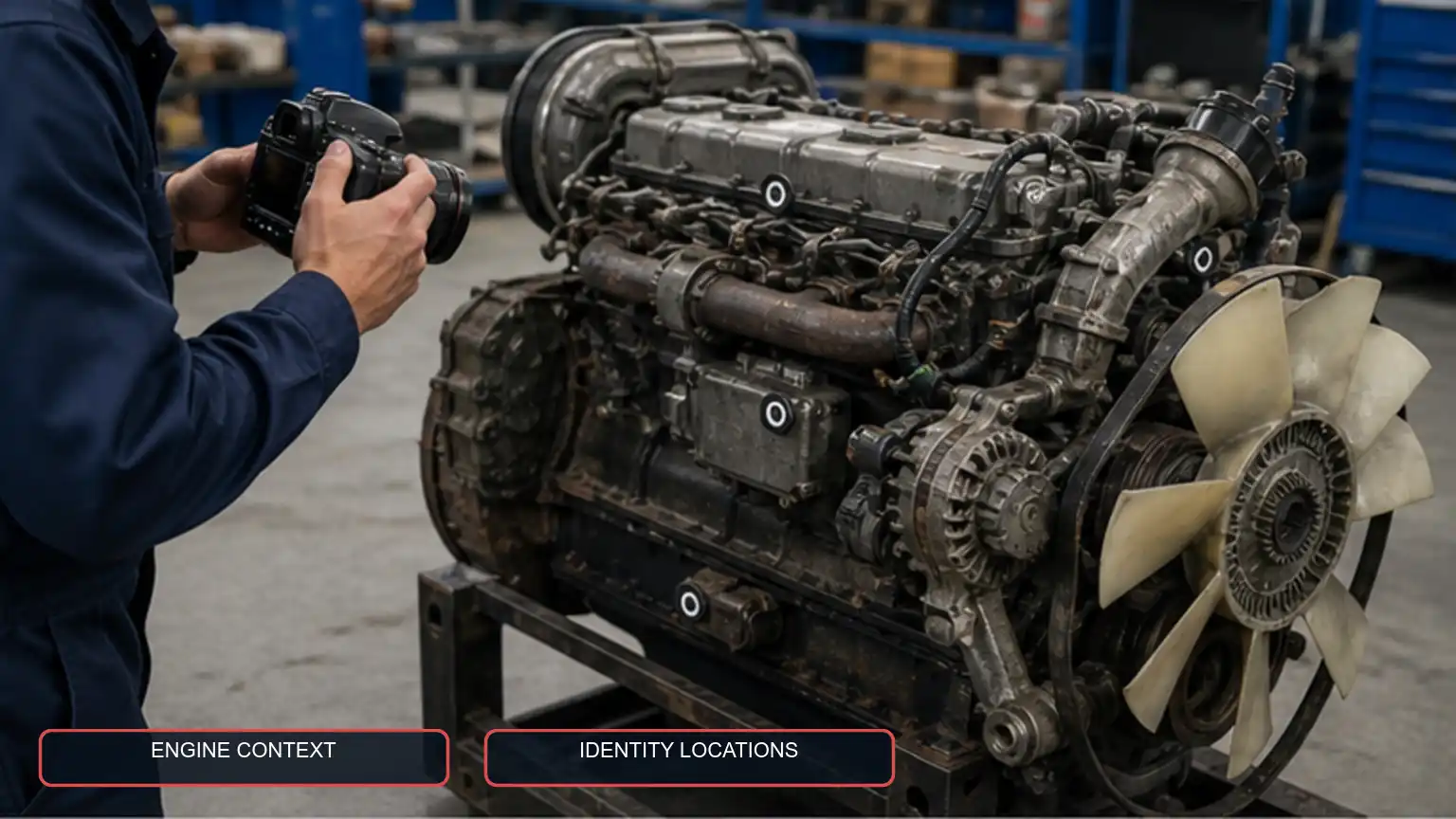
Technician photographing a complete heavy-duty diesel engine and its available identity locations for an RFQ packet.
Start with the complete vehicle, machine, engine bay, and engine from several angles. Include a visible orientation reference so close-up photographs can be located later.
Record vehicle or equipment identity, engine position, attachments, brackets, wiring, hoses, and signs of repower or field modification. These images prevent a supplier from treating a close-up plate as the entire application. A detail photo without system context should never be the only application evidence.
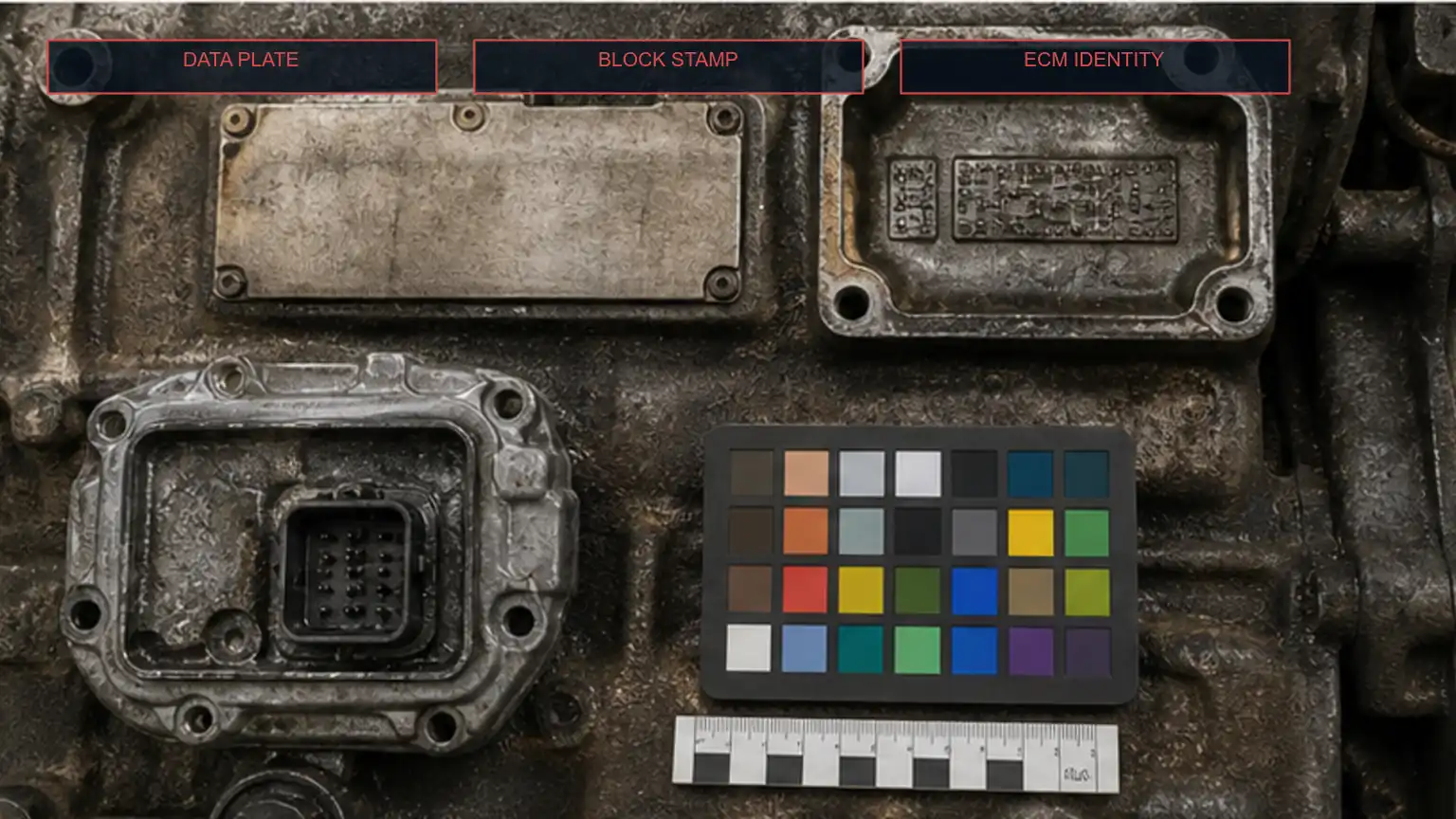
Photograph the data plate square to the camera with readable characters, then record any block stamp, ECM or controller identity, arrangement or CPL, model, serial, rating, and emissions information that is relevant to parts lookup. Keep raw images in addition to a typed transcription.
If sources conflict, do not choose one silently. Mark each as observed, documented, or unverified, add the date, and explain whether the engine, controller, or machine may have been replaced. The packet should preserve conflicts so the supplier can resolve them rather than inheriting an assumption.
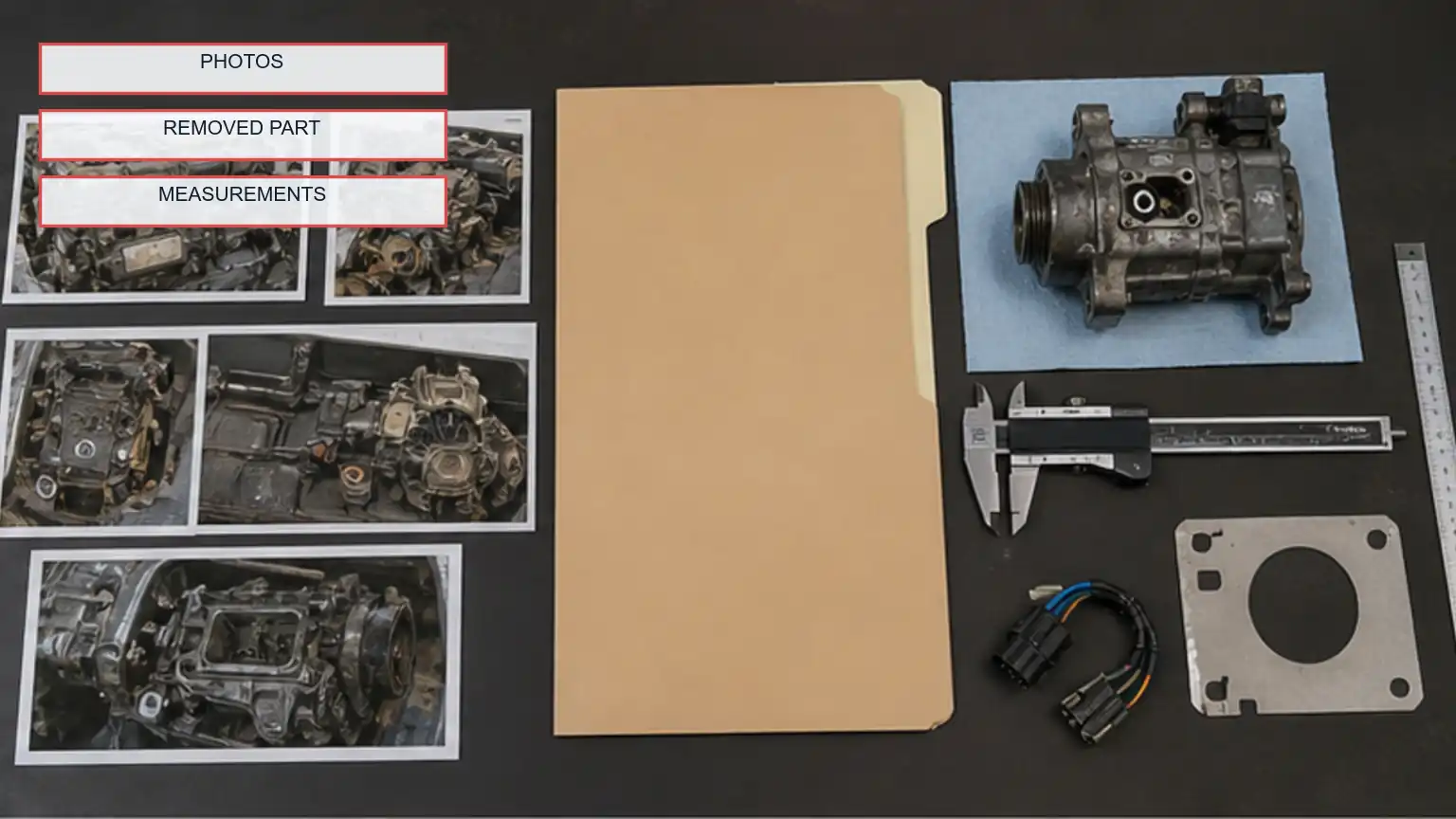
Engine photographs, removed component, gauges, connector samples, and a blank controlled folder arranged for a parts RFQ.
For every requested starter, alternator, injector, turbocharger, compressor, filter, or other assembly, photograph the complete removed unit, label, connectors, ports, mounts, drive interfaces, and adjacent installed components. Assign a unique evidence code to each part.
Record why the part is being replaced and whether it is known to be correct. A failed part can still be the right reference; a working but improvised part can be the wrong application. Removed-part identity must remain tied to the engine and request line.
Use suitable tools to record mounting patterns, pilots, depths, offsets, port types, thread or connector features, pulley or gear geometry, and installed clearance. Show the tool, datum, and unit in the photograph or worksheet.
Do not present approximate ruler photographs as precision evidence. State measurement uncertainty and use the maker's drawings or service limits when available. Measurements should reject incompatible candidates, not create unsupported universal tolerances.
Engine plate, block-stamp area, and control-module identity location documented with scale and color reference.
For each line, state product family, original reference, required condition, quantity, delivery location, expected duty, included accessories, documentation, sample plan, and acceptance fields. Separate must-have requirements from preferences.
Ask suppliers to return their proposed number, source or brand, declared condition, evidence path, unresolved fields, sample terms, lead time, Incoterm, warranty owner, and change-notice process in the same columns. A comparable RFQ reduces both wrong-part risk and commercial ambiguity.
Give the packet a version and date, keep a change log, and link every supplier answer to the corresponding evidence item. Do not allow email attachments with revised measurements to replace the controlled file without review.
After sample approval, add the supplier reference, media, incoming checks, installation result, and responsible approver. Keep the original questions and closed answers so future buyers can see the reasoning. One maintained packet is more useful than several disconnected quote conversations.
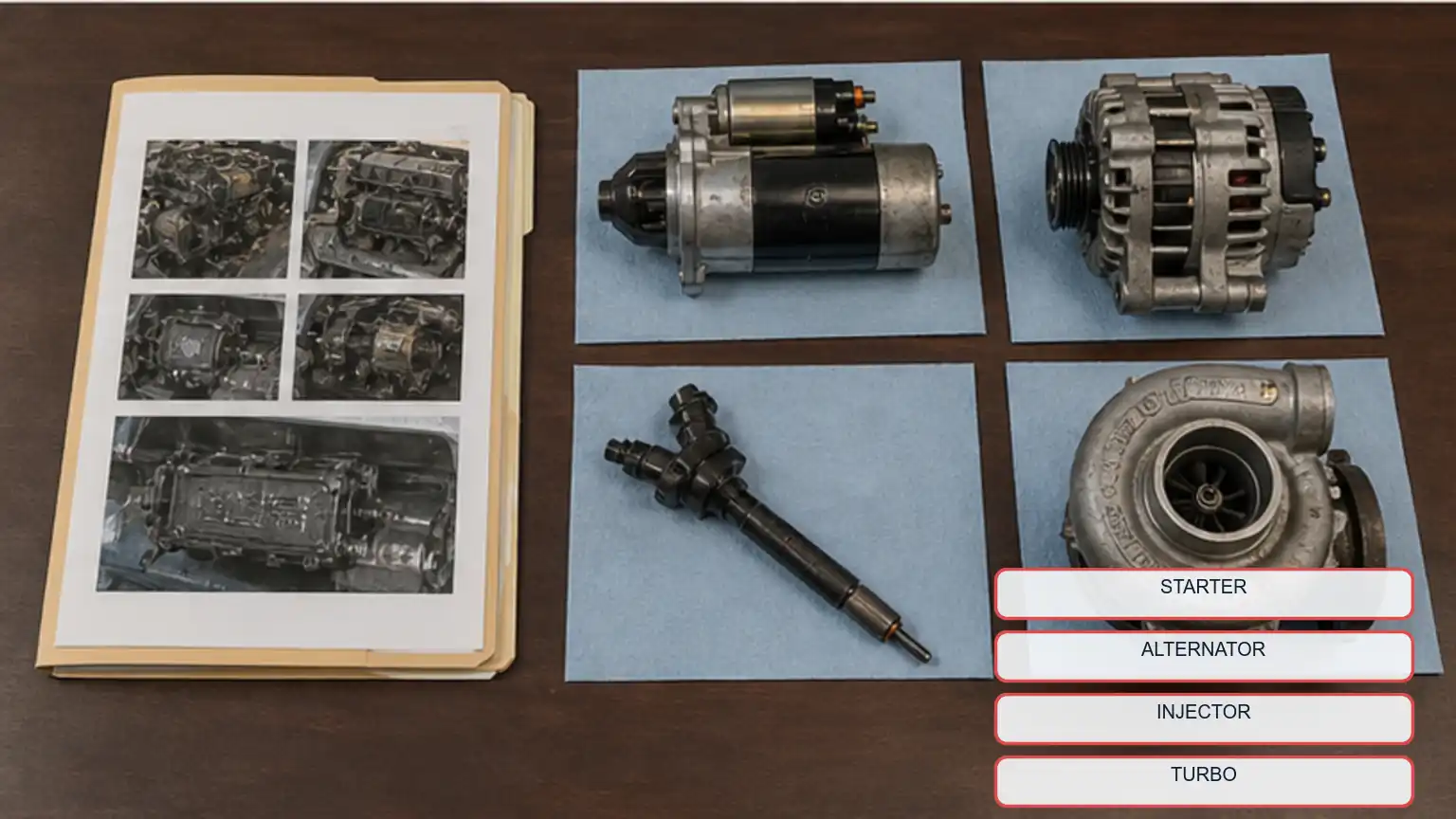
One engine identity packet reviewed against starter, alternator, injector, and turbocharger product families.
For an injector line in the packet, the diesel fuel injector category is a candidate-sourcing route; the indexed engine, removed-part, interface, condition, and quantity evidence must still govern the quotation.
A machine model does not prove the currently installed engine or components.
A typed serial number without the source image can preserve a transcription error.
A previous purchase order does not prove a repeat lot has the same source or interfaces.
Sending only a cropped plate photograph
Mixing observations and assumptions in one field
Using filenames such as IMG001 with no evidence index
Asking for price before stating condition, quantity, and acceptance needs
A general identity packet does not replace controlled engineering drawings, regulated emissions documentation, or the equipment maker's mandatory parts and repair system. Use those authoritative controls where available and attach this packet as structured field evidence.
Wide machine, engine-bay, and engine views
Plate, block stamp, controller, serial, and arrangement sources
Repower and service-history summary
One removed-part record per requested category
Measurements with datums and units
Line-by-line quantity, condition, destination, and acceptance fields
Version log, supplier answers, sample result, and approval
Send Elecdura one indexed engine identity packet and a line-by-line RFQ. Include the engine evidence, removed parts, measurements, requested condition, quantities, destination, and acceptance fields so each product family can be reviewed against the same controlled application. Continue through the multi-brand parts RFQ with the evidence named in this guide.
Usually not. A plate can identify one record but cannot show whether the engine was repowered, whether the installed accessories are original, or which interfaces the requested part must match. Include wide machine and engine-bay views, every readable identity source, repower and service context, the complete removed part, and relevant measured interfaces. Keep the raw photograph with the typed transcription so suppliers can verify characters instead of inheriting a transcription error.
Preserve both records and identify what each one belongs to: engine block, control module, machine, or replacement component. Record the photograph, transcription, date, and source for each field, then investigate repower, ECM replacement, calibration, and service history. Do not silently choose the number that produces the easiest quote. Mark unresolved fields clearly and ask suppliers to state which identity their proposed part and calibration are based on.
Yes, because their labels, mounts, ports, connectors, and installed context can be valuable evidence. However, state the failure mode, whether the component ever operated correctly, and whether it may be an adapted or earlier wrong replacement. Keep observation separate from assumption. A failed component can be the correct reference; a working improvised component can be the wrong one. Suppliers need that distinction to judge how much weight to give the removed-part record.
Assign every file an evidence code tied to the RFQ line and subject, such as ENG-PLATE-01, ALT-MOUNT-02, or TURBO-OIL-DRAIN-03. Keep raw and annotated versions distinguishable, record orientation, datum, unit, and tool where relevant, and list each file in one controlled index. Avoid generic camera filenames. The objective is that a supplier can cite the exact image or measurement behind a proposed number and a reviewer can reproduce the decision later.
Only after the packet includes the approved supplier reference, declared product condition, sample and incoming-inspection evidence, installation result, accepted deviations, and a change history. A previous invoice alone does not prove that a later lot has the same source, configuration, or interfaces. Reopen the record whenever the engine, supplier, part number, packaging, calibration, or critical measurement changes, and require the new lot to remain traceable to the revised approval.