ELECDURA NETWORK

Your Whole New Supply Chain For Heavy-Duty Parts
Whatsapp:
+86 18915027366
Phone:
+86 18915027366
Views: 0 Author: Site Editor Publish Time: 2026-09-07 Origin: Site
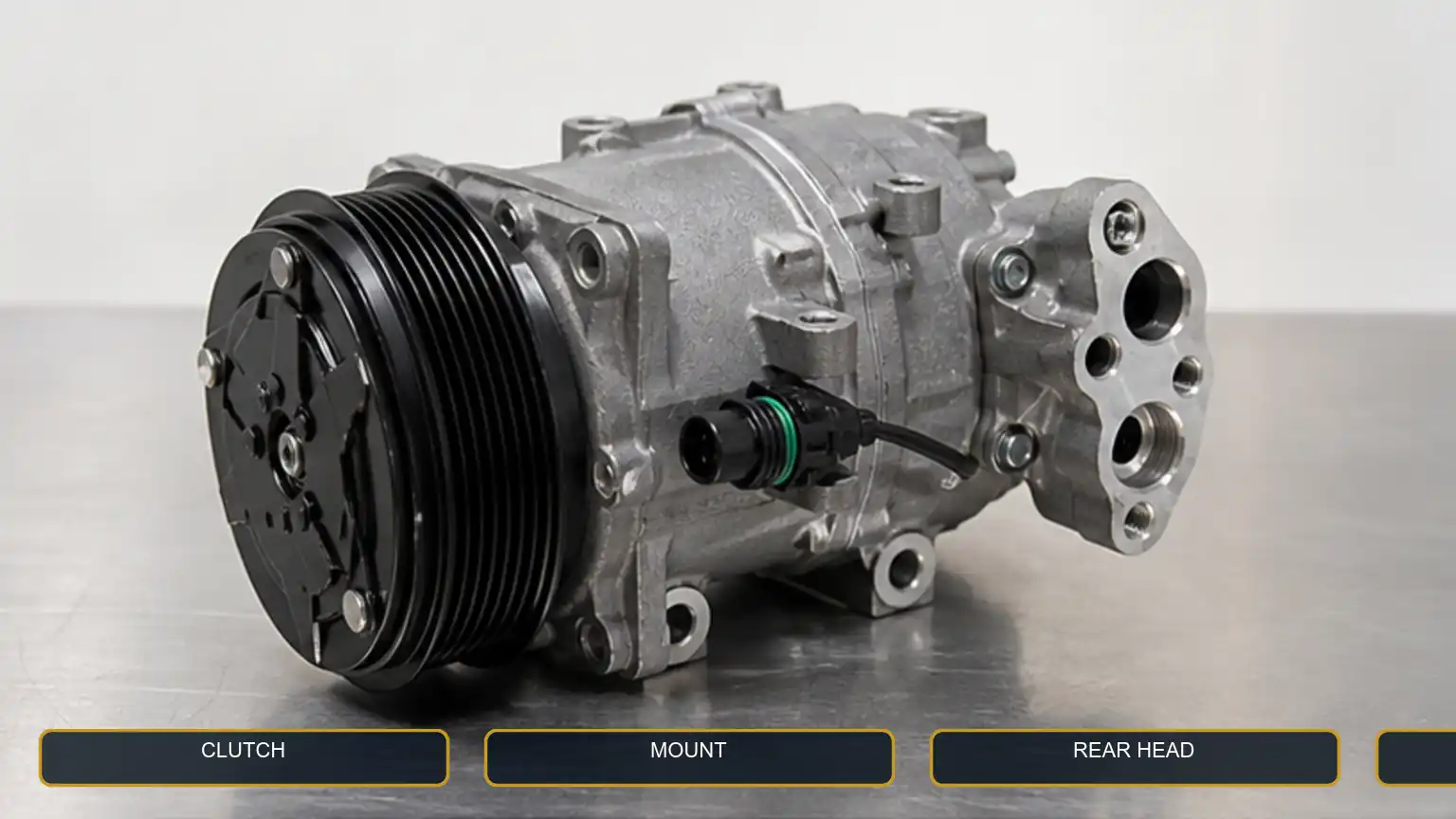
A matching compressor family and pulley do not prove that the rear head is correct. Hose ports can differ in orientation, spacing, diameter, sealing seat, pad or block arrangement and service-valve features. The connector can also identify a clutch coil, control valve, speed sensor, thermal protector or another circuit. Approve the replacement only when the complete label, mounting, pulley, rear-head geometry, connector function, refrigerant and oil requirements agree with the application.
This guide is for A/C parts distributors, fleet workshops and sourcing teams comparing compressors that share a familiar body or family number but present a different rear head. The buyer must decide whether the hose manifold, sealing seats and electrical connection will work in the actual vehicle without forcing, rewiring or creating an unapproved head conversion.
The suction and discharge ports are not identified safely by diameter alone. Record their relationship to the mounting ears, centerline and each other; then note the sealing system, bolt pattern, pilot, service-valve features and any pressure-switch or relief-valve provision. A rotated photograph without a fixed mounting datum can make two different heads appear equivalent.
The electrical connector must be assigned a function before it is compared. Depending on the compressor, it may serve a clutch coil, electronic control valve, speed sensor, thermal device or another circuit. Shell color and pin count are weak evidence because terminal assignment, keying and control strategy can differ inside similar housings.
Label and manufacturer reference with every suffix
Straight-on and angled rear-head photographs
Port orientation, spacing, seat type and manifold or hose evidence
Connector shell, keying, pin count and circuit function
Mounting ears, pulley grooves, diameter, clutch or control-valve design
Preserve the installed ac identity and its relationship to the vehicle before cleaning, dismantling or adjustment. Record the operating condition, instrument, datum and procedure behind each observation. That makes the supplier comparison repeatable and prevents an isolated number or photograph from being treated as universal approval.
Record the complete installed-unit and system evidence before choosing a ac replacement. The staged image supplies context, not application-specific limits.
Observed evidence | Possible interpretation | Decision-changing check |
|---|---|---|
Port layout | Rear-head clocking and relation to mounts | Hose stress, interference or impossible connection |
Seal interface | O-ring, gasket, pad or manifold seat | Leakage or damaged sealing face |
Connector | Shell, key, pins and electrical function | Wrong clutch or control behavior |
Rear clearance | Head, plug, valve and connector envelope | Contact with frame, hose or engine hardware |
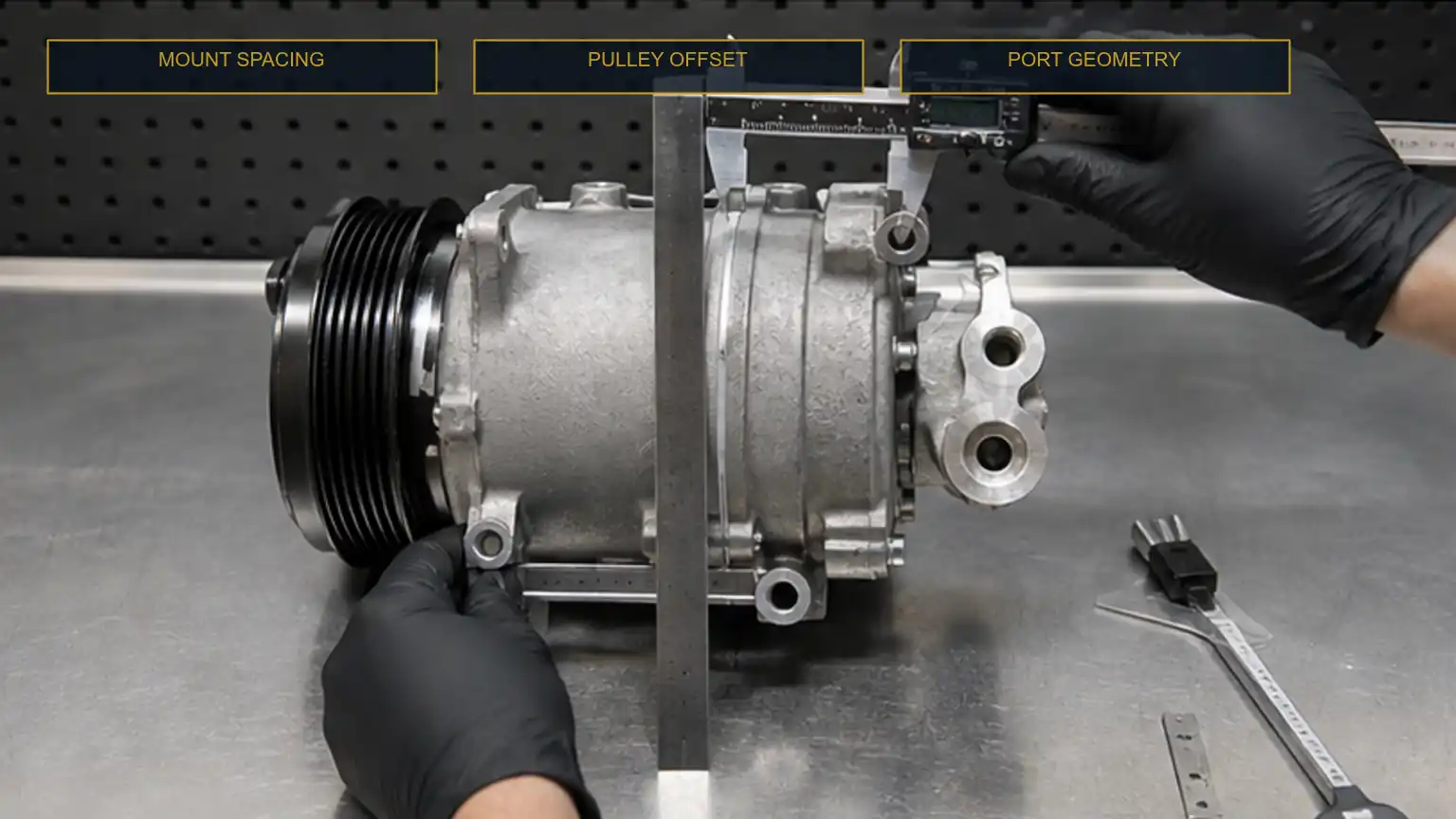
Take one straight-on rear view and at least two oblique views with the compressor resting on a repeatable mounting datum. Include a scale, but record measurements separately rather than reading dimensions from perspective-distorted photographs. Show port centers, bolt centers, sealing faces, connector key, pins, valve locations and the clearance envelope around the installed hose block.
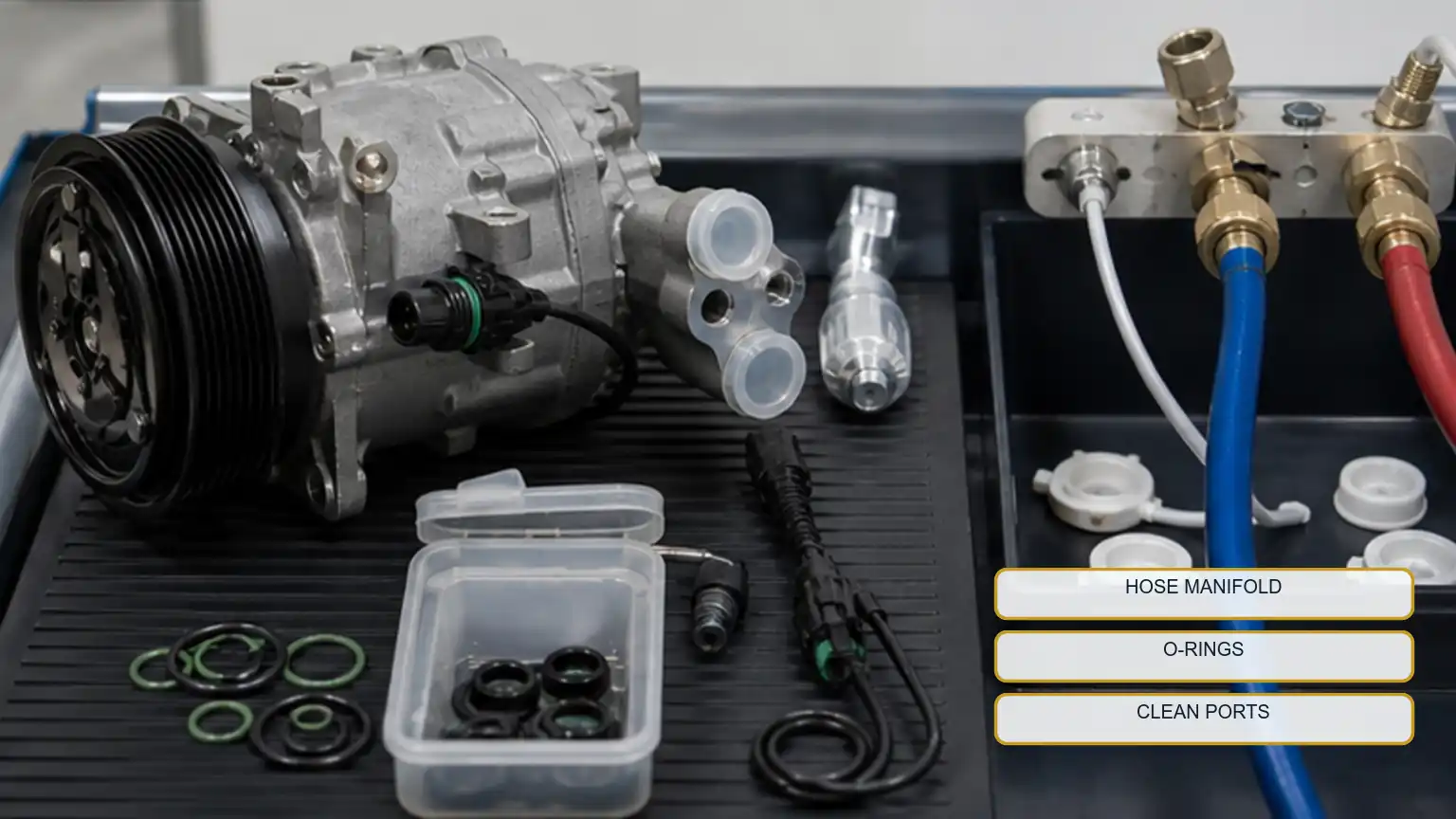
Protect open refrigerant ports during the comparison. The inspection should not introduce moisture or debris into a candidate that may later be installed. If the original compressor has already been removed, identify which fittings, seals and brackets belong to the vehicle and which were supplied with the compressor so the quotation does not silently omit required hardware.
Use undamaged mounting datums and show measurement points.
Keep protective caps installed until the clean comparison is ready.
Do not rotate or replace a rear head unless the compressor procedure permits it.
Confirm whether the connector belongs to a clutch, valve, sensor or protector.
Document oil state and system-cleanliness decisions separately from fitment.
Use the approved procedure and record the actual condition; appearance by itself is not a pass or fail result for AC compressor rear head port connector match.
Some compressor families support multiple approved head variants, but that does not make field swapping universal. The manufacturer procedure must cover fasteners, seal kit, oil control, cleanliness, torque sequence and final leak or functional test. Without that procedure, a proposed head swap changes the product and transfers uncontrolled workmanship risk to the buyer.
A hose that can be pulled into position is not evidence of fit. Forced alignment can load the manifold, damage a sealing face, kink a hose or place the connector against a hot or moving component. Release the sample only when the manifold seats freely with the correct seals and the installed routing preserves clearance through the full operating envelope.
Send the same revision-controlled packet to every supplier. Require a complete maker reference, condition, application basis, included hardware, specific AC compressor rear head port connector match evidence, traceability, packaging, lead time, warranty and return route. Ask the seller to mark fields it could not verify instead of filling them with a generic direct-replacement claim.
RFQ field | Evidence that can be audited | Reason to hold |
|---|---|---|
Identity | Maker, complete reference, label and proposed condition | Truncated, relabeled or mixed identity |
Application | Vehicle or equipment record plus interface comparison | Visual similarity or unsourced cross-reference |
Functional basis | Named procedure, conditions, actual results and limits | Tested or calibrated without a record |
Commercial scope | Included parts, packaging, warranty and return terms | Condition, core or fulfilment route unclear |
This method does not determine refrigerant charge, oil quantity or flushing requirements from a photograph. It also does not approve converting between clutch-controlled and externally controlled compressors. Those decisions require the exact vehicle service information, system condition and supplier procedure in addition to the physical rear-head match.
Approve one identified sample revision before scaling the order. At receipt, reconcile the package, label, ac, report and included parts; inspect protection, contamination, corrosion, impact and mixed-lot risk. Quarantine any mismatch. Installation release must correct the confirmed root cause and reproduce the original operating condition under the applicable service procedure.
Connect the exact sample or production lot to the approved application packet and post-install result.
Use the related Elecdura technical guide and Elecdura product category to organize the evidence before contacting Elecdura. For repeat orders, compare the production lot with the approved sample and require notice before a change to maker, reference, interface, test method, label, packaging or supplied hardware.
No. Misalignment can damage threads, seats, seals or hoses. Record the applicable identity, procedure and result before changing the purchase or repair decision; the observation alone cannot prove every related interface or system is acceptable.
No. Keying, terminal assignment and circuit function must also agree. Record the applicable identity, procedure and result before changing the purchase or repair decision; the observation alone cannot prove every related interface or system is acceptable.
Only when the manufacturer approves the exact combination and sealing procedure. Record the applicable identity, procedure and result before changing the purchase or repair decision; the observation alone cannot prove every related interface or system is acceptable.
Only if the compressor and vehicle documentation identifies the same electrical function, voltage or control signal and approves the adapter. Record pin assignments and the released part number. An adapter can make terminals connect while leaving the control strategy wrong, so physical connection is not an acceptance test.
Approve a sample with label, rear-head photographs, measured port and bolt relationships, connector function, mounting and pulley data, supplied seals and packaging condition. Compare those features again at receiving. A sample pass supports that revision only and cannot cover an unreported production or head change.
Rear-head matching succeeds when ports, seals, manifold seating, electrical function and installed clearance are treated as one system. A complete photo-and-measurement packet gives the supplier a reproducible target and prevents a familiar compressor family name from hiding a connection that will leak, interfere or operate incorrectly.