ELECDURA NETWORK

Your Whole New Supply Chain For Heavy-Duty Parts
Whatsapp:
+86 18915027366
Phone:
+86 18915027366
Views: 0 Author: Elecdura Publish Time: 2026-09-04 Origin: Site
A heavy-duty starter distributor should plan inventory around verified application demand and controlled replacement families, not the number of references collected from catalogs. Group inquiries by vehicle or equipment, engine, electrical system and starter configuration; map each requested reference to a candidate service part; then keep fitment conflicts, remanufactured condition and core obligations visible. Consolidate SKUs only when one documented configuration legitimately covers the applications. Set stock level from actual demand, lead time, criticality and acceptable service risk. A long cross-reference list can improve search, but it does not prove that every number is interchangeable.
This framework is for importers, regional distributors, fleet parts rooms and rebuilders managing heavy-duty truck, bus, construction, agricultural and industrial starter demand.
Start with twelve to twenty-four months of order lines, lost sales, emergency requests, quotation history and fleet population where available. Keep raw customer wording and the normalized identity used by the parts team. Count demand by application event, not every repeated email. Separate scheduled stock replenishment from breakdown demand and one-time project orders.
For each event, capture customer and region, vehicle or machine, engine, year or serial range when relevant, installed starter reference, voltage, power or family, pinion and mount evidence, quantity, requested date, quoted reference, outcome and reason lost. Mark uncertain application evidence instead of forcing it into a known SKU. A market query such as “truck starter motor” indicates category interest; it cannot select the inventory mix for a particular distributor.
Use the starter cross-reference fitment validation guide when a raw reference must be converted into a controlled candidate. The inventory plan should store both the customer's number and the approved service part so future consolidation remains auditable.
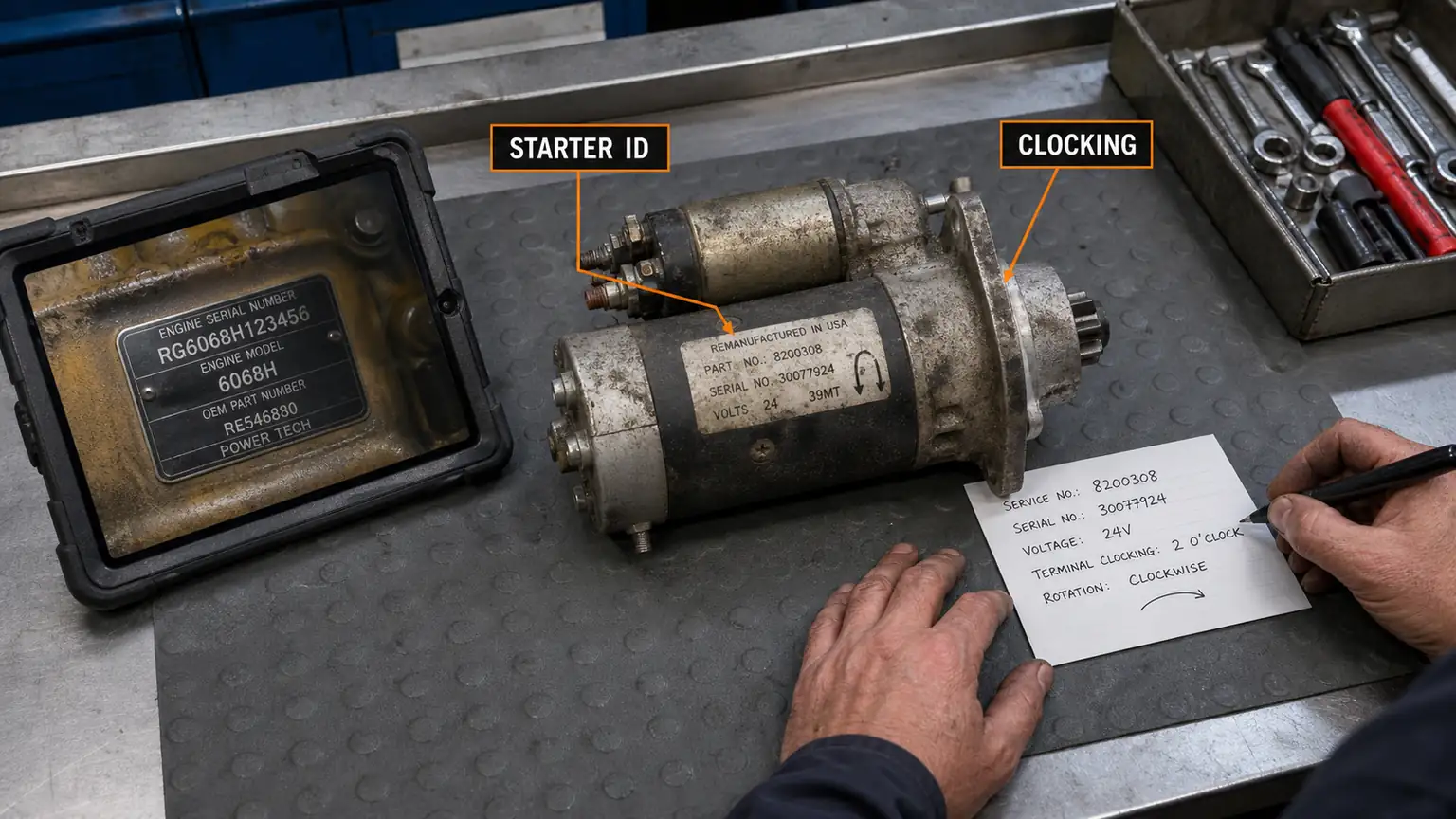
The inventory record begins with a serviceable identity, not a guessed family from one partial number.
A useful cross-reference table is not one flat column. It records relationships: exact replacement, supersession, competitor reference, model family, application listing, historical supplier number or customer alias. Add source, issue date and notes. Delco Remy's heavy-duty starter guide, for example, is presented as a way to find application replacements and consolidate inventory; its tables also show that model family, engine and replacement option matter alongside the original number.
Treat each new link as a candidate until configuration evidence agrees. Check system voltage, rotation, polarity or ground arrangement where applicable, mount type, pilot, bolt pattern, pinion teeth and pitch, rest position and engagement geometry, power rating, solenoid position, terminal layout, connector or switch features, clearance and engine/application evidence. A supplier catalog can nominate a part; it cannot inspect the removed unit for you.
When two sources disagree, do not choose the most convenient number. Store the conflict and require a label photograph, application catalog evidence, dimensioned drawing or approved sample. Inventory consolidation that hides a fitment conflict converts dead stock into field failure.
Not every starter deserves the same availability target. Create segments based on real service consequence and replenishment options rather than alphabetic brand groups.
Segment | Typical evidence | Planning response |
|---|---|---|
Critical repeat demand | Frequent verified orders, costly downtime, stable approved reference and long replenishment exposure. | Hold local safety stock, maintain approved alternate source and review lead-time variance. |
Consolidation candidate | Several requested references map to one proven service part with no unresolved configuration conflict. | Stock the controlled service part and keep the reference graph for search. |
Project or seasonal | Agricultural season, fleet overhaul or equipment project with a defined window and population. | Use planned purchase and reserve quantities; avoid treating the peak as a permanent monthly rate. |
Rare but supportable | Low frequency, reliable upstream availability and acceptable customer lead time. | Keep verified sourcing data and order on demand rather than holding a speculative unit. |
Unresolved identity | Partial references, conflicting applications or incomplete fitment fields. | Do not create a stocking SKU; improve the evidence request first. |
Define the service promise for each segment: stocked locally, available from regional stock, supplier lead time, rebuild-to-order or identification pending. Do not present supplier lead time as guaranteed until the current quotation and logistics route are confirmed.
Use actual demand during replenishment lead time plus a safety quantity based on variability and the agreed service risk. Keep the components visible: average qualified demand, peak or variance, supplier production time, consolidation time, transport, customs, receiving inspection and internal put-away. A single historical average can understate breakdown demand; the highest one-time project can overstate routine demand.
Review three scenarios rather than one magic number. A base scenario uses recent repeat demand and normal lead time. A constrained-supply scenario extends the lead time or reduces supplier availability. A fleet-event scenario adds a known overhaul or seasonal requirement without changing the permanent rate. Record who approved the assumption and when it expires.
Stockouts and excess are both evidence. A stockout caused by unresolved identification is not solved only by buying more; a high fill rate achieved with multiple misfit returns is not good service. Track qualified fill rate, emergency freight, aging, fitment returns, core exposure and unresolved inquiry rate together.
Supplier literature may identify replacement designs that cover several applications or reduce the number of part numbers. That can be valuable, but consolidation must preserve the application boundaries. Compare every requested reference to the proposed service part and note any change in mount, terminal, solenoid position, pinion, rotation, protection feature or installation instruction.
Create an approved-application list for the consolidated SKU and a reject list for visually similar configurations. Train the counter and web team to search by customer reference while displaying the approved service part only after application evidence agrees. Never rewrite the customer's original number into the consolidated number; keep both for traceability and analysis.
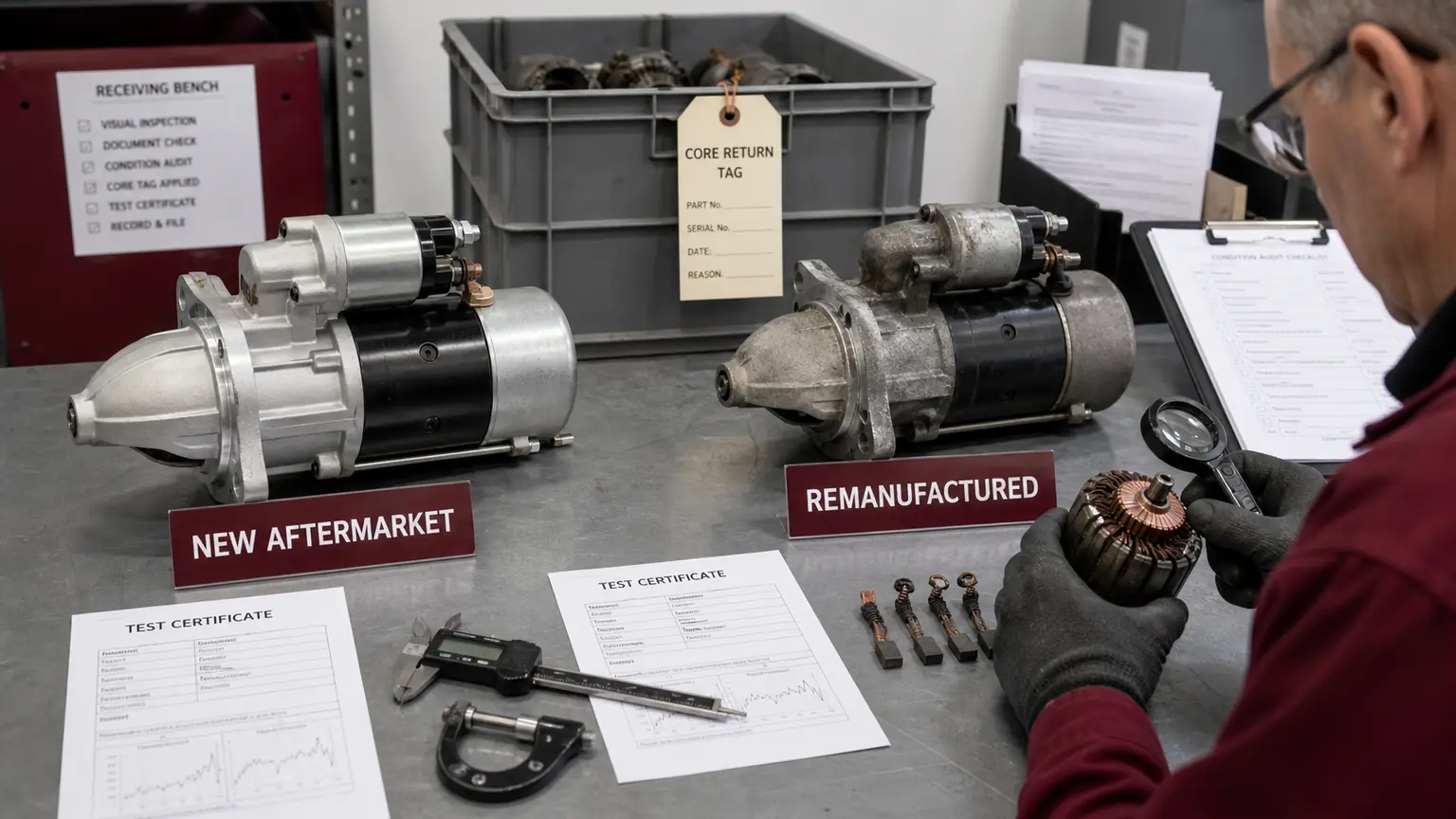
Condition is a commercial and technical field. New, remanufactured and core-return populations should not share one available quantity.
For remanufactured programs, record whether a core charge applies, eligible model group, return window, condition requirements, freight responsibility, credit process and rejection evidence. A reman sale can create both a service part movement and a recoverable or at-risk core asset. If the system records only the sale, apparent gross margin and available stock can be misleading.
Delco Remy's core identification resources illustrate that core eligibility depends on correct group and manufacturer identity, while coreless reman options remove deposit and eligibility tracking for the specific offered products. Do not generalize one supplier's rules to another. Store current terms per supplier and part family, and show the customer which core is expected before shipment.
Use separate statuses: core expected, received, quarantined, eligible, rejected, shipped, credited or written off. Photograph identity and condition at receipt. Keep a deadline alert and reconcile supplier credit to the exact return shipment. A shelf full of unidentified cores is not usable starter inventory.
At receiving, verify carton and product labels, declared condition, reference, voltage, key visual interfaces, quantity, lot and packaging. Segregate samples, approved production stock, returns, warranty holds and cores. Prevent a unit from becoming available before required inspection is complete.
Use one bin label that shows the sellable service part and searchable cross references without implying universal interchange. If a supplier changes the label, housing, solenoid, mount, pinion, included hardware or packaging, place new stock on change review until the configuration is reconciled with the approved record.
Physical separation should match system status so quarantined returns cannot be sold as approved stock.
Review demand and evidence by service-part family each month. Add qualified lost sales and remove duplicate inquiries; examine stockouts, aging, emergency freight, fitment returns, supplier delays, core losses and application conflicts. Decide whether to raise, lower, consolidate, split, source an alternate or leave a family on demand-only status.
A new stocking decision should state the problem it solves, supporting demand, approved application set, supplier evidence, lead-time assumption, first sample or lot result, initial quantity and review date. A deletion should preserve cross-reference history so the counter can still identify the request and offer a documented source path.
Do not judge the range only by revenue. A slow-moving critical unit may protect a fleet contract; a fast-selling ambiguous reference may generate costly returns. The range scorecard should show both commercial value and fitment confidence.
Do not consolidate when local regulation, vehicle warranty, fleet policy or supplier program requires a specific part. Do not set stock from historical orders after a major fleet change without refreshing the population. For starter-generators, high-voltage systems or proprietary integrated modules, use the applicable system expertise; conventional heavy-duty starter fields are not sufficient.
Only when the replacement is documented for each application and the complete electrical, mechanical and control configuration agrees. Keep the original request numbers searchable and record exclusions.
Not automatically. Compare downtime consequence, customer commitment, replenishment time, margin, alternate supply and fitment confidence. A rare critical unit may justify stock; an uncertain unit may belong on demand-only status.
Separate sellable reman units from expected, received and eligible cores. Record core charges and deadlines independently so stock availability and financial exposure are visible.
Collect the requested reference, application, required date and quantity, evidence available, reason not supplied and proposed alternative. Repeated unresolved identities are a data problem, not confirmed demand for one SKU.
Use a monthly operational review and an immediate review after a major fleet, supplier, supersession or fitment change. Each assumption should have an owner and expiry date.
Review the heavy-duty starter motor range to identify candidate families. Then send Elecdura the qualified reference list, application evidence, target stock quantity and destination. Ask each proposed aftermarket reference to state its application basis, configuration, condition and supply assumptions so it can enter the distributor's inventory model without hiding unknowns.
Technical and commercial references reviewed September 4, 2026: Delco Remy Medium & Heavy-Duty Commercial Vehicle Starter Cross Reference Guide; Delco Remy inventory-management article; Delco Remy online catalog and core-identification resources; Delco Remy coreless-reman information. Supplier-specific application and core rules are not generalized beyond their stated products.