ELECDURA NETWORK

Your Whole New Supply Chain For Heavy-Duty Parts
Whatsapp:
+86 18915027366
Phone:
+86 18915027366
Views: 0 Author: Site Editor Publish Time: 2026-09-17 Origin: Site
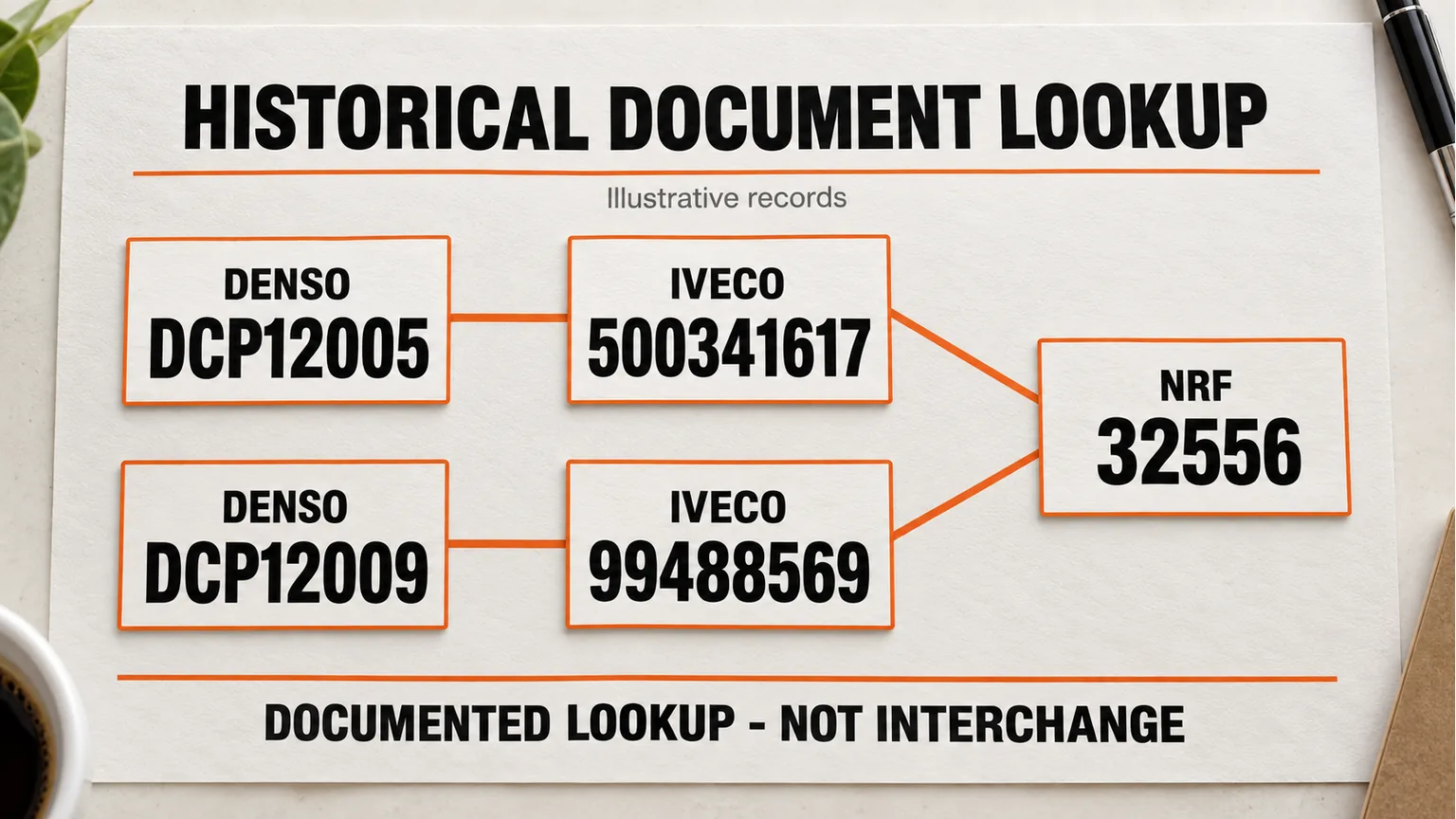
For a Polish parts desk comparing Iveco truck A/C compressor references, the DENSO heavy-duty bulletin and NRF Easy Fit brochure are useful sources because they expose a real purchasing question: should two original-reference lines become one stock item? DENSO lists 500341617 with DCP12005 and 99488569 with DCP12009, while NRF's historical brochure places both original references under 32556. That difference is a reason to request application confirmation, not proof that one catalogue is wrong or that the DENSO units interchange. Keep the original references separate until the quoted replacement is confirmed for each vehicle requirement.
This is a comparison of documented cross-reference resources, not a ranking of Poland's compressor manufacturers. It addresses a distributor or workshop deciding whether a consolidated supplier item can replace two existing order lines. The Elecdura heavy-duty A/C compressor category is a separate aftermarket sourcing route; it does not establish stock of these references or an authorised relationship with either named brand.
The examples below come from the DENSO October 2022 heavy-duty compressor update bulletin and the NRF Easy Fit truck-and-bus compressor brochure, whose document contains January 2021 update context. The table preserves the two sources' different numbering roles.
Iveco original reference | DENSO item in the bulletin | DENSO OE number in that row | NRF item in the brochure |
|---|---|---|---|
500341617 | DCP12005 | 447170-8610 | 32556 |
99488569 | DCP12009 | 447170-5430 | 32556 |
The NRF truck-and-bus row groups the two Iveco references under one item and identifies an Iveco Stralis application. The DENSO bulletin retains separate DCP items. Neither document, by itself, provides a current written approval to collapse every vehicle requirement covered by those historical references into one warehouse record.
Read the rows in both directions. Starting from 500341617 leads to a different DENSO item than starting from 99488569. Starting from NRF 32556 reaches both references in the brochure. These are the observed lookup relationships. They do not create a direct DCP12005-to-DCP12009 interchange statement.
Illustration of the two historical document relationships. The shared NRF listing does not establish that DCP12005 and DCP12009 are interchangeable.
Use this small sample to test a proposed order consolidation. It is not a coverage survey of either supplier, a live stock check or evidence of which catalogue is more accurate overall. Both sources are historical documents, so a present-day quotation must still be checked for current application notes and reference changes.
Poland is not added here as a substitute country name. An Iveco Poland July 2022 announcement about BEL-POL documents a local operator's Stralis and S-Way context. It establishes a real Polish Iveco fleet setting for parts support, but it does not say that the compressors in this example were installed on those vehicles. The fleet's present composition is not established by that historical announcement.
NRF also publishes Polish-language compressor and installation-support information. A local parts desk can use the relevant language resources when handing an order to a workshop. Language availability does not prove Polish stock, vehicle-specific approval or the contents of every delivered package.
The practical question is how to keep the workshop's vehicle requirement intact when a distributor proposes a common purchasing item. An order may begin with the removed component's number, pass through a regional supplier catalogue and end with a different brand's carton number. If the original vehicle request disappears during that handover, the warehouse cannot show which application was actually confirmed.
This topic is selected for that documented technical procurement gap, not a proven high-volume search opportunity. The useful outcome is a defensible purchasing record for a Polish workshop or distributor—not another general list of compressor brands serving Poland.
A catalogue groups information for its own product programme. Different groupings may reflect a supplier's replacement design, application coverage, document date or the way references are presented. The two PDFs do not establish which explanation accounts for this example. Do not choose one explanation merely because it makes ordering easier.
Instead, ask the proposed supplier to answer a precise question: does the exact item in its current quotation cover the vehicle represented by 500341617, the vehicle represented by 99488569, or both? The answer should identify the relevant application conditions and the quoted item revision. A reply repeating “cross-reference 32556” without addressing the two requirements leaves the original question open.
If you are buying DENSO-branded units, preserve DCP12005 and DCP12009 as separate quoted identities unless current authoritative documentation says otherwise. If you are considering NRF 32556, retain each original reference as an application line linked to the proposed NRF item. One supplier stock number can be investigated without declaring that every other brand's associated item is interchangeable.
The same caution applies to additional references found during a search. Adding another OE number to a spreadsheet does not extend the scope of an earlier confirmation. Keep a newly encountered reference outside the approved group until the supplier addresses that additional requirement.
Consider a hypothetical order with one workshop request recorded under each of the two Iveco references. This is a purchasing example, not an actual customer order or a claim about two specific trucks.
Create a line for each original reference and retain the vehicle identity, removed-part information and required quantity on that line. Add the proposed supplier item in a separate field. Ask the supplier to return a confirmation against each line, not a single unqualified tick next to the combined quantity.
If only one application is confirmed, release only that application through the normal approval process. The other remains an unresolved demand line. Do not let a warehouse merge, a minimum-order preference or a common price transfer the first confirmation to the second vehicle.
After both applications are adequately confirmed, a business may choose to purchase a combined quantity under one supplier item. That is a commercial ordering decision. The underlying vehicle/reference records should remain traceable so that a later specification change, return or repeat request can be checked against the original requirement.
A combined supplier order should therefore point back to both application lines rather than replacing them. If the current quotation changes the item revision or supplied package, review the affected approvals before reusing the previous consolidation. The purpose is to preserve the reason for the match, not to make the spreadsheet unnecessarily complex.
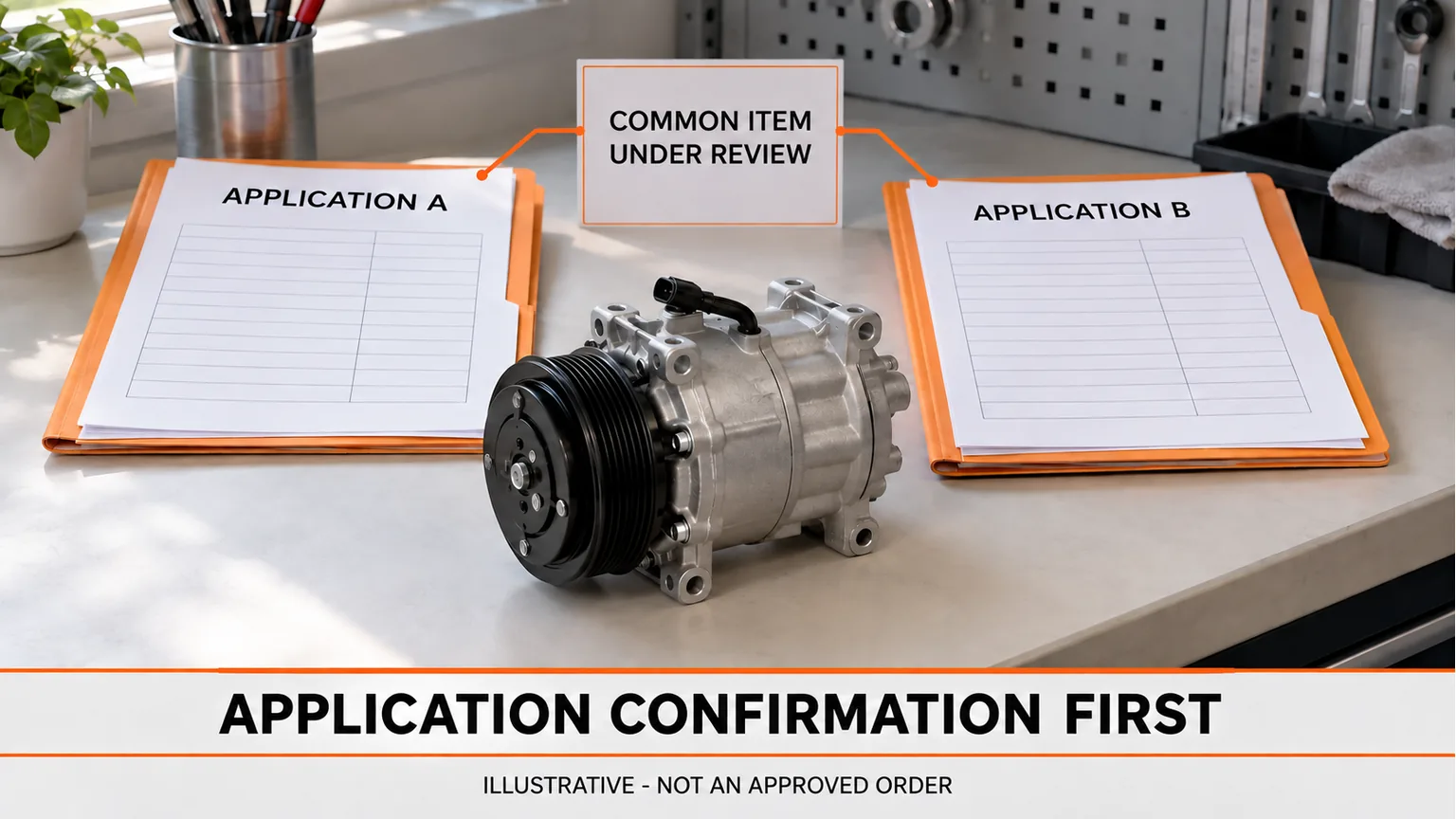
Hypothetical purchasing illustration, not an actual order or approved vehicle match. A combined quantity must retain the separately confirmed application records.
The supplier's response must identify what will arrive. Ask for the exact branded or aftermarket item, the application basis, identifying photographs or technical information where needed, and any installation conditions attached to that offer. Keep the intended component configuration and the vehicle system in the same discussion; a familiar number on a list is not a complete description of the delivered assembly.
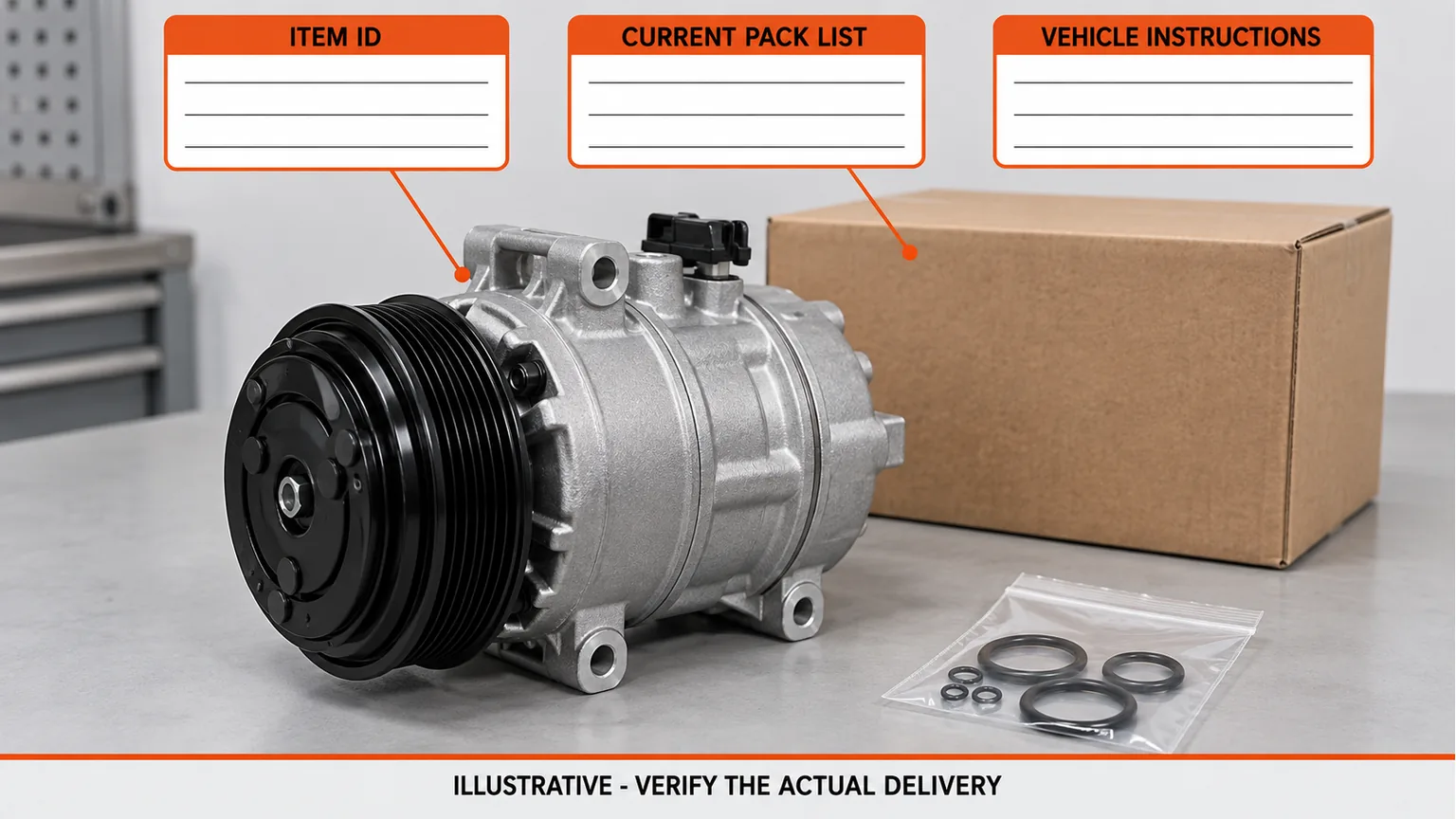
The historical NRF brochure indicates O-rings for its example row. That is a stated package feature in that document, not evidence of every current shipment's contents. Request the current pack list. It does not establish an oil specification, an oil quantity or a refrigerant choice for either vehicle.
Generic illustration, not a DENSO or NRF product photograph. Confirm the actual item, current pack contents and applicable instructions; no oil charge or fitment is specified.
Use the current applicable vehicle and compressor instructions to resolve installation requirements. Do not choose a fill amount by combining reseller listings or treat an included seal as permission to reuse other components. This article supplies no charging or installation procedure; those decisions depend on the exact system and authorised service information.
For the broader distinction between a reference lead and application evidence, the heavy-duty parts cross-reference evidence guide explains why source and scope matter. In this Iveco example, the immediate task is narrower: obtain a current answer for each of the two original-reference lines and the item actually being quoted.
A useful enquiry should contain the two original-reference lines, not just the proposed common replacement number. Attach the following information in a compact comparison record:
The original reference for each request and the vehicle identity associated with it.
Available removed-component identification and clear photographs of the relevant interfaces.
The DENSO or NRF item under consideration, with the source document and its edition kept separate from the quotation date.
The quantity required for each application and any proposed combined purchasing quantity.
A request for application-specific confirmation, current package contents and applicable installation documents.
Keep the enquiry neutral. “Please confirm these two applications for the exact item quoted” is more useful than “these numbers are interchangeable.” The first asks the supplier to resolve the evidence gap; the second embeds the unproved conclusion in the request.
For a separately evaluated aftermarket offer, send that record through the enquiry form on the Elecdura heavy-duty A/C compressor page. State whether a named genuine-brand item is mandatory or an aftermarket alternative may be considered. The quotation must establish the proposed identity and scope; this article does not promise branded supply, availability or a match.
The sample does not authorise a change in refrigerant, oil, connector, drive arrangement or vehicle specification. It does not diagnose a failed compressor or establish that replacement is necessary. A workshop should resolve the repair need and use the applicable service process before an accepted purchasing match becomes an installation decision.
Only the documented DENSO and NRF relationships above are compared. A failed website lookup from another brand is not proof that the brand lacks coverage, so no third-brand item has been inserted to make the list longer. The two verified resources are enough to expose this particular consolidation question; they are not a complete survey of the Polish aftermarket.
No. Publication dates help identify the source edition, but the documents describe different suppliers' programmes. Ask for current documentation for the item being purchased rather than assuming that one supplier's newer bulletin cancels another's mapping. If a current change notice affects the proposed match, record its scope and date against the relevant application line. Age alone does not resolve the physical compatibility question.
Only after the business has approved the stocked item's use for both application requirements. The label should identify the actual stocked item and link to the confirmed applications; it should not become a free-standing claim that DCP12005 and DCP12009 are identical. Keep any vehicle or configuration exclusions accessible to the parts desk so that a later pick does not rely on the label alone.
It helps trace the transaction, but it may not preserve all the application and package conditions used for the first approval. Compare the repeat quote's exact item and revision with the confirmed record, and check whether the receiving vehicle requirement is unchanged. A repeat purchase for a different vehicle is a new application question even when the original-reference text looks familiar.
Keep the order unresolved while the vehicle-based identification route is checked. Provide the vehicle identity and available installation photographs to the appropriate catalogue or supplier contact, and ask for an identified application result. Do not infer one of these two Iveco references from appearance or from the fact that the truck is a Stralis. If the application cannot be established, the shared NRF listing does not remove that uncertainty.