ELECDURA NETWORK

Your Whole New Supply Chain For Heavy-Duty Parts
Whatsapp:
+86 18915027366
Phone:
+86 18915027366
Views: 0 Author: Site Editor Publish Time: 2026-08-26 Origin: Site
The United Kingdom has a visible commercial turbocharger ecosystem, but a buyer should not mistake a list of familiar names for a universal approval list. A turbocharger for a heavy-duty truck, bus, generator, agricultural machine, or construction asset must be identified by its complete assembly data and operating context. This page offers 20 sourcing candidates for a B2B RFQ. It is not a quality award, and it does not state that every candidate manufactures turbochargers in the United Kingdom.
SCM Turbo, Universal Turbos, and Turboactive provide public signs of UK commercial turbo supply and specialist service routes. Those signs justify country-level research, yet they do not confirm a particular supplier’s current authorization, stock, remanufacturing process, or suitability for an individual engine. Buyers can compare the requested unit against Elecdurauto’s turbocharger category before treating any quote as technically acceptable.
The shortlist mixes global turbo brands, UK commercial supply routes, and specialist remanufacturing or component routes. That is deliberate. In a real sourcing project, a buyer may need an OE-new unit, an authorized remanufactured unit, a verified service exchange, or a new aftermarket equivalent. These are different commercial paths and must not be merged into one unverified claim of “manufacturer.”
Before a candidate progresses, confirm the exact part number, engine application, actuator configuration, housing orientation, supply origin, and warranty party. If the offered turbo is remanufactured, ask which critical parts are new, what balance and calibration steps are documented, and whether a core return is mandatory. If these answers remain vague, keep the candidate in a research queue rather than an approved vendor list.
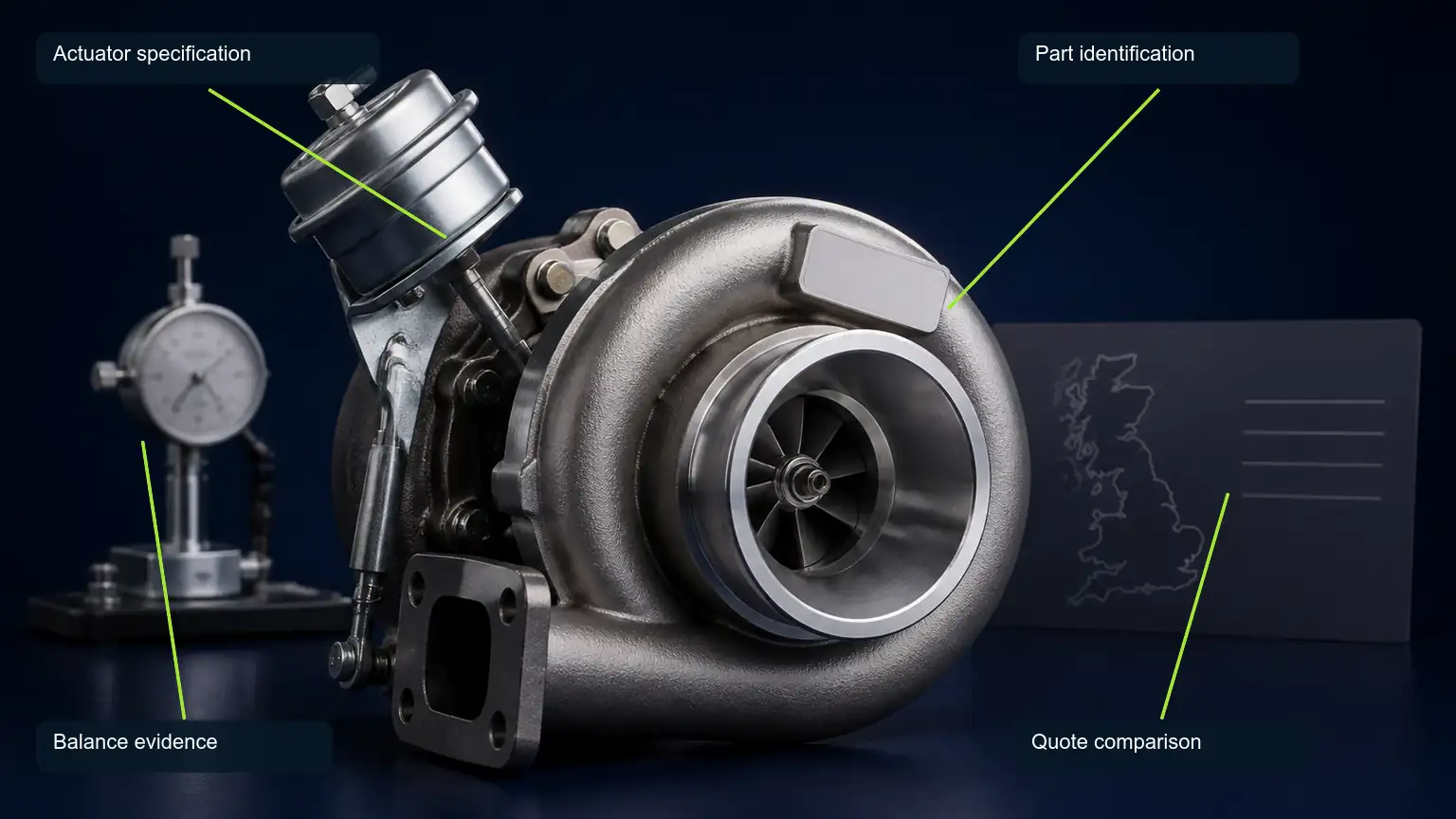
Set a precision and traceability benchmark without asserting a specific manufacturer ranking or origin.
No. | Candidate | Commercial route to investigate | Key question before quotation |
|---|---|---|---|
1 | SCM Turbo | UK commercial-turbo supply and technical-support route | Which brand, condition, and commercial-vehicle application support the quoted unit? |
2 | Turboactive | UK turbo distributor route | Can the source document the product condition and manufacturer channel? |
3 | Universal Turbos | UK new, exchange, and reconditioned turbo route | What is the exact scope of the offered service or remanufactured unit? |
4 | Garrett | Global turbocharger brand route | Is the part number, actuator, and authorized channel identified? |
5 | BorgWarner | Global turbocharger brand route | Does the quote specify OE-new, OE-reman, or aftermarket equivalent status? |
6 | Holset | Heavy-duty turbo brand route | Can the seller link the unit to the correct engine CPL or application data? |
7 | Mitsubishi Turbocharger and Engine Europe | Turbocharger brand route | Are housing orientation and wastegate or actuator configuration documented? |
8 | IHI | Turbocharger brand route | Can the source prove cross-reference and intended application? |
9 | Continental | Turbocharger brand route | What technical document supports the proposed replacement? |
10 | BMTS Technology | Turbocharger brand route | Is the part supplied through an authorized and traceable commercial channel? |
11 | Melett | Turbo component and repair-route candidate | Is the offer a complete balanced unit, a repair kit, or a component-only solution? |
12 | MAHLE | Aftermarket/OE-reference route | Can the supplier clarify product condition and applicable engine family? |
13 | Nissens | Aftermarket turbo route | Which catalog and test data support the reference match? |
14 | Rotomaster | Turbocharger sourcing candidate | Can the offered unit be traced to the required commercial application? |
15 | Turbo Technics | UK specialist turbo route | What evidence covers inspection, balance, and actuator setting where applicable? |
16 | Turbo Dynamics | UK turbo specialist route | Does the quote identify the complete core and housing configuration? |
17 | Midland Turbo | UK turbo supply or service route | Can the supplier state the operating use and warranty process? |
18 | AET Turbos | UK specialist turbo route | Is the proposed product suitable for commercial or off-highway duty, not merely a passenger-car application? |
19 | BTS Turbo | Turbocharger sourcing route | What UK channel and product-identification evidence is available? |
20 | Turbo Part International | Turbo component and supply-chain route | Does the quote provide a complete-unit specification and a responsible warranty party? |
Help buyers avoid selecting a visually similar turbo with mismatched control hardware.
A heavy-duty turbocharger is not defined only by compressor-wheel diameter or a familiar brand logo. The purchasing record should include the turbo assembly number, engine model, rated power or duty, compressor and turbine housing numbers, actuator type, electronic connector where present, oil-feed and oil-drain connection details, and clocking orientation. Photograph every visible marking on the removed unit before it is returned as a core.
Before authorizing a replacement, inspect the air intake, charge-air piping, oil feed, oil drain, crankcase ventilation path, exhaust restriction condition, and evidence of foreign-object damage. A replacement turbo cannot correct a blocked oil feed or a split charge-air hose. This distinction matters commercially because warranty discussion should be based on documented installation conditions rather than an assumption that the turbo alone caused the failure.
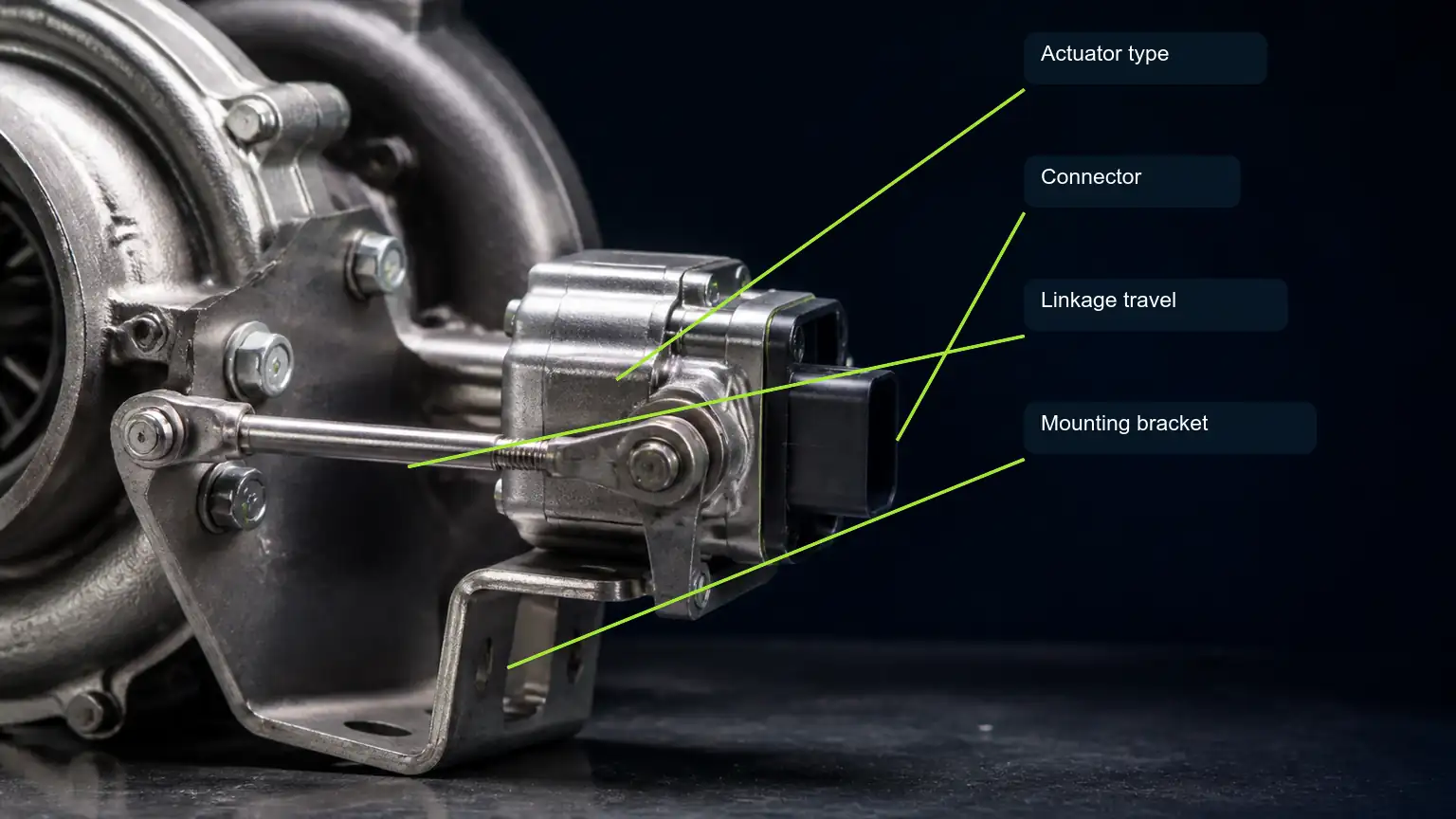
Where a turbo has an electronic actuator or a variable-geometry mechanism, record the actuator part number and connector, then ask the seller how the assembly is supplied and calibrated. Do not transplant or reset an actuator simply because its housing looks similar. A documented calibration and compatibility route is safer than a visual comparison.
Request a brand-channel statement, unit label photograph, country-of-origin information, and the standard warranty route. Check that the packaging protects the actuator, fittings, and open ports. The purchase order should name the full assembly number and any required installation kit rather than a vague product family.
Ask for a clear description of what the seller calls remanufactured. A buyer needs to know whether the transaction is a complete exchange unit, which components are replaced, whether balance and actuator work are recorded, what core condition is acceptable, and who decides a core surcharge. Keep the original unit and its photographs until the incoming replacement has passed identification and physical inspection.
Control point | Evidence to retain | Decision protected |
|---|---|---|
Application match | Engine and turbo reference cross-check, actuator details, housing photos | Prevents a visually similar but incompatible turbo from being approved. |
Failure-cause review | Oil-path, intake, exhaust, and charge-air inspection record | Reduces repeat failure risk after installation. |
Unit condition | OE-new, authorized reman, exchange, or aftermarket-equivalent declaration | Aligns price, warranty, and buyer expectation. |
Core handling | Core serial images, return label, acceptance rule, credit terms | Controls unexpected core charges and traceability loss. |
Packaging | Port caps, actuator protection, carton label, shock and moisture control | Protects the turbo during UK or export transport. |
Send the same RFQ pack to every viable candidate: assembly reference, engine details, photographs, requested condition, annual quantity, delivery destination, expected test evidence, and core-return requirement. Compare the responses against the same matrix. A well-documented quote that identifies the actual unit and warranty party is more useful than a lower price attached to a generic description.
Turbochargers should arrive with clean protected ports, a supported actuator or control mechanism, readable label data, and a carton that stops metal-to-metal movement. For cross-border orders, record the export packing method and any moisture-control requirement. Warranty wording should identify the seller, the inspection process, the evidence required, and whether a failed unit must be returned before a replacement or credit is considered.
To request a technical cross-reference rather than a generic turbo quote, send Elecdurauto the full turbo number, engine data, actuator details, and failure observations.
A turbo may be installed on an on-highway truck, a municipal vehicle, a bus, an agricultural machine, a loader, a generator, or an industrial engine. The same engine family can be configured differently by duty, emissions system, fuel setting, altitude, or control strategy. The RFQ should say where the engine operates and whether the buyer needs an exact OE-reference replacement, a service-exchange unit, or a verified aftermarket equivalent. Without that context, a supplier can only provide a generic product-family answer.
For fleets, describe the symptoms that prompted the sourcing request: loss of boost, oil consumption, unusual noise, repeated hose failure, fault codes, or a scheduled overhaul. Do not imply that any symptom proves a turbo failure. The information simply helps the source identify what application and supporting parts need to be reviewed. A strong supplier response will distinguish the complete turbo identification from the likely causes that must be corrected before installation.
Many repeat failures begin outside the new turbo. The order should state whether it includes installation gaskets, oil-feed hardware, oil-drain gaskets, air-intake seals, charge-air hose inspection, and required fasteners. If a seller supplies a kit, ask for the kit contents to be listed rather than assumed. A buyer may choose to source ancillary parts separately, but the decision should be explicit and traceable.
An actuator can be pneumatic, vacuum-operated, electronically controlled, or integrated with a variable-geometry mechanism. The external shape is not enough to prove interchangeability. Capture the actuator part number, connector, linkage orientation, calibration markings, and harness condition. If a candidate proposes a turbo with a different actuator arrangement, the change should be reviewed by a qualified technical authority before purchase.
The buyer should also ask how the supplied configuration is treated in the sourcing process. Is the actuator supplied with the assembly? Has the assembly been calibrated as a system? Is a separate setup procedure required after installation? A credible answer may vary by product and route, but it should be precise. “Fits the engine” is not sufficient evidence for an electronically controlled heavy-duty turbocharger.
Before mounting the incoming unit, compare the complete assembly and actuator to the approved specification, inspect the oil feed and drain paths, check the air intake and compressor inlet for debris, inspect charge-air hoses and clamps, and review exhaust condition. Keep photographs of the old and new units plus the external system condition. This process is not a replacement for an engine maker’s procedure; it is a procurement-friendly gate that preserves the evidence needed for a later technical discussion.
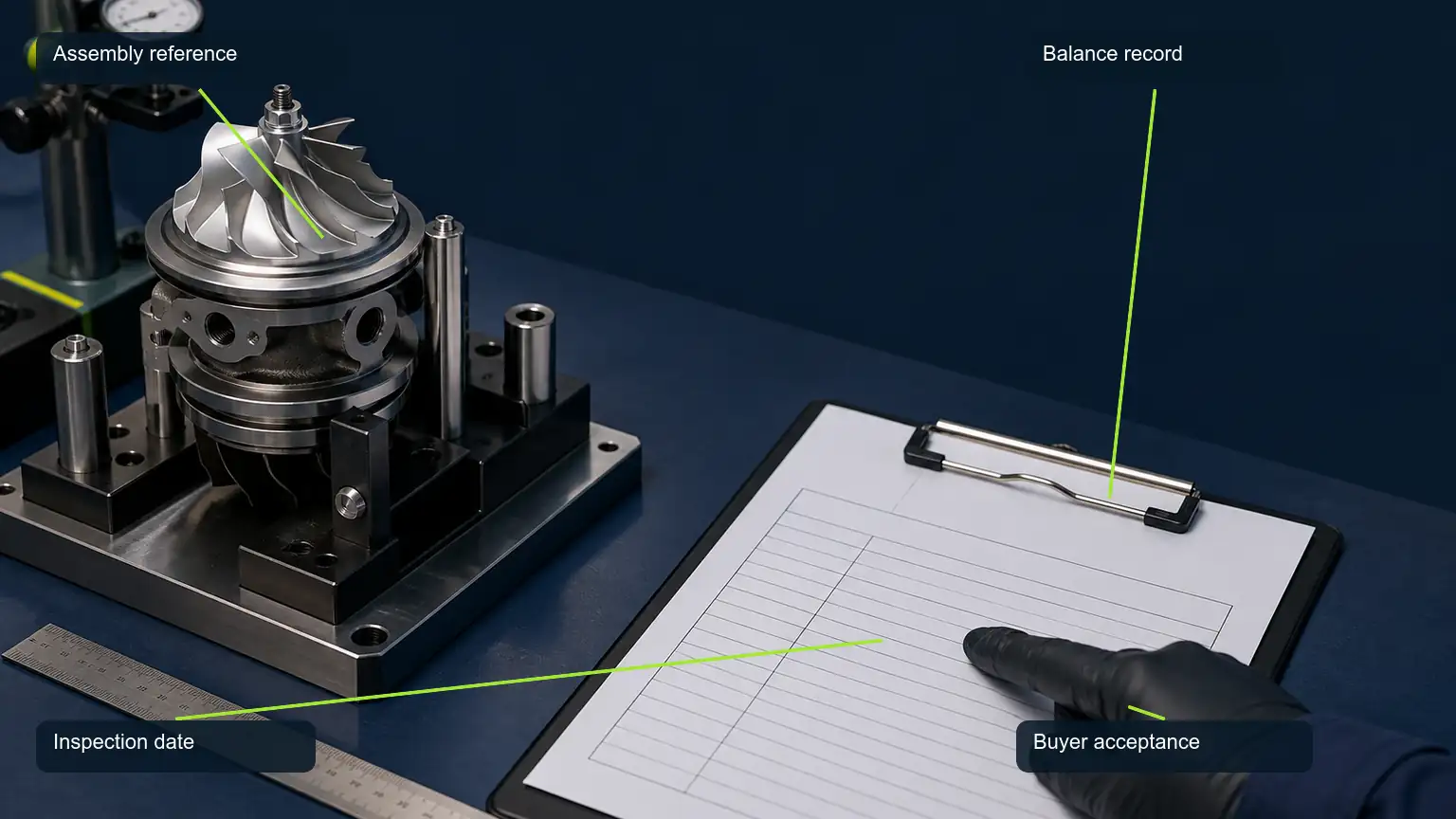
Show a buyer-side review of evidence rather than visually claiming a test passed.
For a new supplier route, select a reference with clear demand and good application data. Review the quotation, unit label, packaging, fitting kit, product condition declaration, and any test or inspection document before the first installation. Then collect workshop feedback in a structured form: application, installation findings, performance observations, and any deviations from the order. A controlled pilot is more informative than dispersing different unverified turbos across unrelated applications.
For distributors, retain the supplier’s quotation, packing list, lot record, and warranty contact with the approved part number. This allows future replenishment to be compared with the initial approval. If the manufacturer, remanufacturer, actuator, origin, or carton identity changes, open a change review instead of assuming that the same marketing description represents the same product.
An exchange route can be commercially attractive only when the core process is clear. Agree on the core acceptance criteria, the deadline for return, the return label or freight responsibility, the treatment of a damaged core, and the timing of any credit. Photograph the outgoing core’s identification and condition. That protects both sides from a later disagreement over whether a returned item corresponds to the supplied replacement.
Place every candidate against the same headings: supplier entity, brand or manufacturer, complete assembly number, product condition, actuator configuration, application evidence, origin declaration, expected lead time, packing, core terms, warranty party, and claim process. Where a field is missing, do not fill it with an assumption. Mark it as unconfirmed. This keeps a buyer from giving an artificially high score to an incomplete offer.
The best route for a fleet may be a documented local distributor with rapid support. The best route for a container buyer may be a traceable export supplier that can consolidate multiple references. The right conclusion depends on the availability of evidence, not merely on country name or a promotional claim. The UK article is valuable because it shows commercial options that can be qualified, not because it promises a universally superior source.
Before a removed turbo is returned, scrapped, or offered as a core, photograph the identification plate, actuator, compressor inlet, turbine outlet, oil-feed connection, oil-drain connection, and any visible damage. Record the engine model, operating complaint, mileage or hours where useful, and workshop observations. A clear record gives the buyer a factual basis for comparing a new or remanufactured candidate and for discussing a later claim without relying on memory.
Keep the evidence neutral. A stained compressor inlet does not by itself prove oil starvation, and a damaged wheel does not identify the source of foreign material. The purpose is to establish the starting condition, then verify the upstream and downstream system before a replacement is installed. This makes a UK distributor or exporter route easier to evaluate because the supplier receives a complete application package instead of a single partial photograph.
For a new part-number route, select a first installation where the engine data is clear and the workshop can complete the intake, lubrication, charge-air, and exhaust checks. Record the incoming unit’s label, actuator configuration, physical orientation, and installation kit. After the repair, retain the workshop’s observations and any required system setup record. A successful controlled first install is not a blanket approval for every engine, but it is stronger evidence than a catalog match alone.
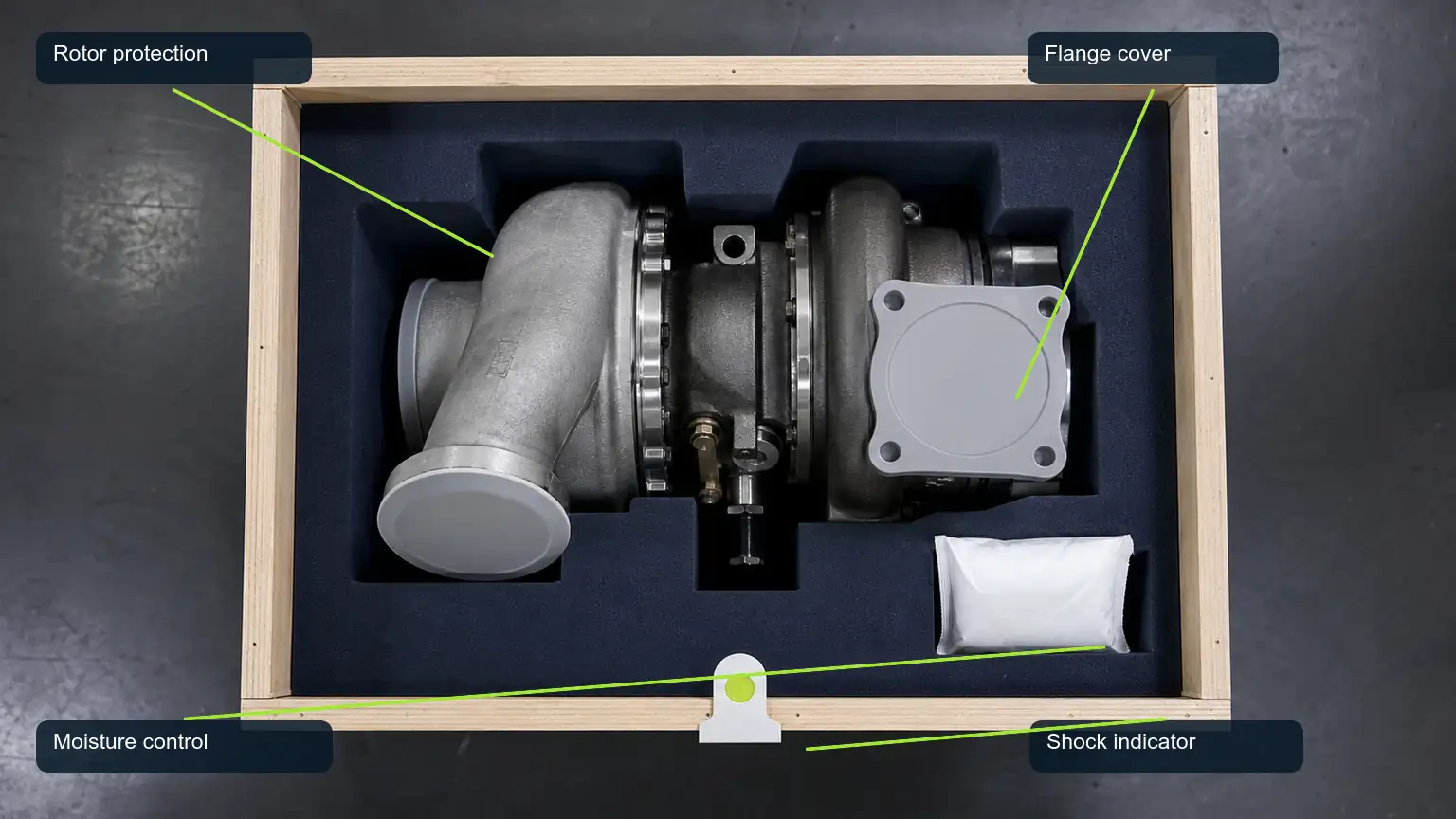
Visualize how buyers protect and inspect a turbocharger from warehouse release through arrival.
A heavy-duty turbocharger should leave the supplier with all fluid and air ports protected, the actuator supported against impact, and the assembly restrained inside a correctly labeled carton. For export, record gross weight, carton dimensions, pallet count, and any moisture-control requirement. On receipt, inspect the carton before opening, compare the product label with the approved quotation, and retain the packaging until the identity and condition checks are complete.
If an exchange core must travel back through the United Kingdom, cap open ports, prevent loose components from moving, identify the return against the supplied replacement, and keep the return tracking record. The core is both a commercial asset and a source of evidence. Careful handling helps avoid avoidable debit disputes and stops contaminated parts from being presented as if they were untouched warranty returns.
SCM Turbo — visible UK commercial turbo supply and support route.
Universal Turbos — visible UK new, exchange, and reconditioned turbo route.
Turboactive — visible UK turbo distribution route.
Editorial note: the shortlist must not be used to infer present authorization, local manufacturing, test capability, stock, pricing, or supplier performance. Verify every item directly before buying.