
English
Views: 0 Author: Site Editor Publish Time: 2026-08-28 Origin: Site


Direct answer: A supersession chain is valid for a bulk injector order only when each step can be traced to the exact engine application and current service information. Do not treat a marketplace cross-reference or a repeated seller list as proof. Record the original number, every replacement number, the source and revision date, and any required kit, line, seal, code, software, or installation change. Then compare connector, hold-down, feed and return ports, nozzle, body length, and calibration identity. Approve a controlled sample and retain incoming-lot traceability before releasing volume.
This audit treats a supersession chain as a dated change-control record, not a collection of seller cross-references. Start with the exact engine and original injector, preserve every intermediate number and condition, and prove what each replacement changes. The diesel fuel injector catalogue becomes a sourcing route only after the chain, coding requirements, declared condition, and physical interfaces are documented.
Chain checkpoint |
Required record |
Release consequence |
|---|---|---|
Original reference |
Installed or documented number |
Starting point, not automatic current service number |
Official supersession |
Maker parts or service source |
Must include revision and application context |
Interface review |
Connector, hold-down, ports, nozzle |
Rejects a chain that crosses incompatible hardware |
Sample and lot control |
Code, test, packaging, traceability |
Required before a bulk order is released |
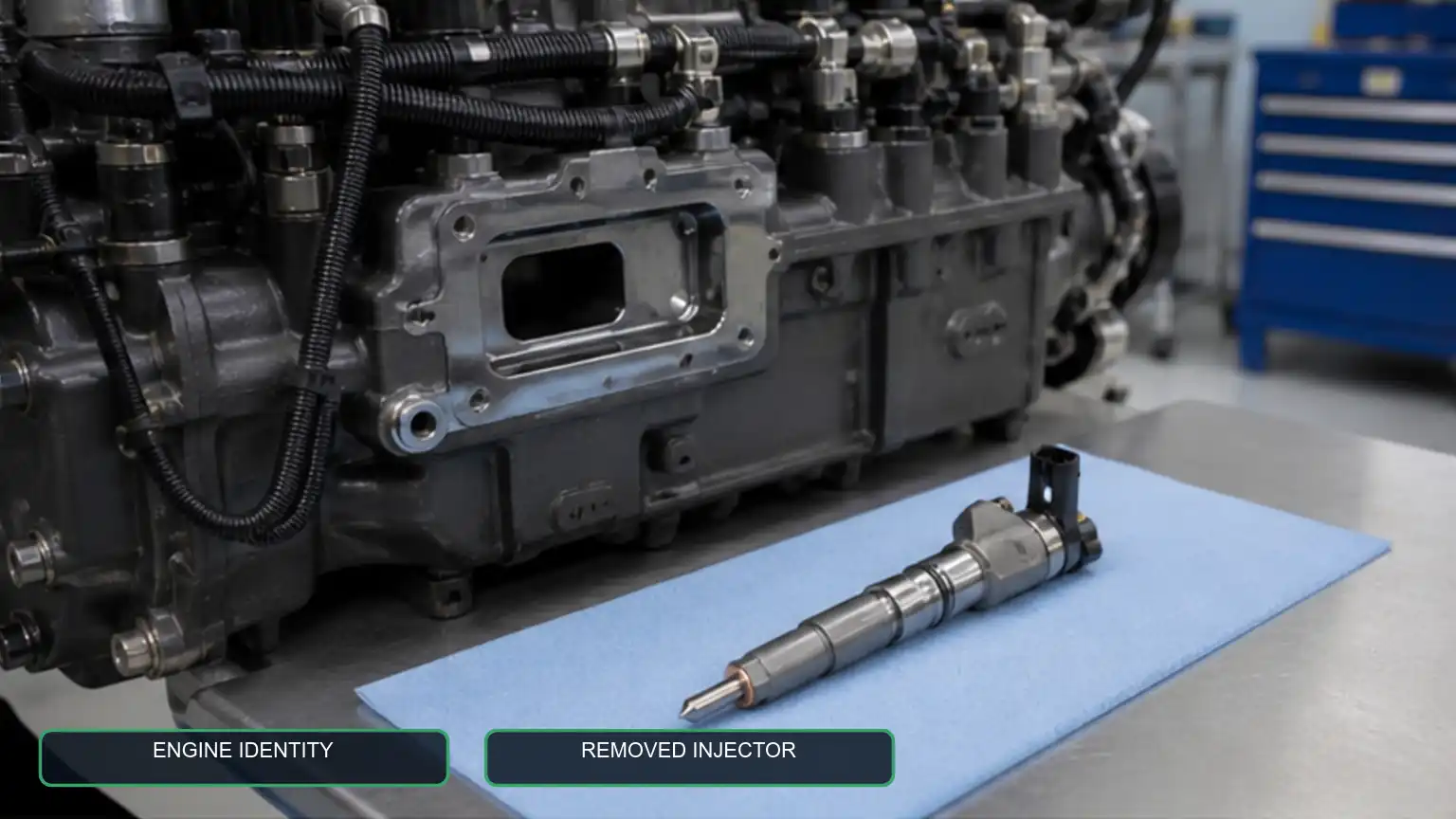
Heavy-duty diesel engine and removed common-rail injector documented together before accepting a superseded reference.
Record engine maker, model, serial, arrangement or CPL where applicable, emissions level, application, and the number on the removed injector. Preserve the carton or prior invoice only as supporting evidence, not as a substitute for the installed identity.
Use current official parts or service information that can be tied to that engine. Save the access date, document or system name, and the exact sequence shown rather than copying only the latest number. A chain without an engine anchor is a list of possible numbers, not an approved supersession.
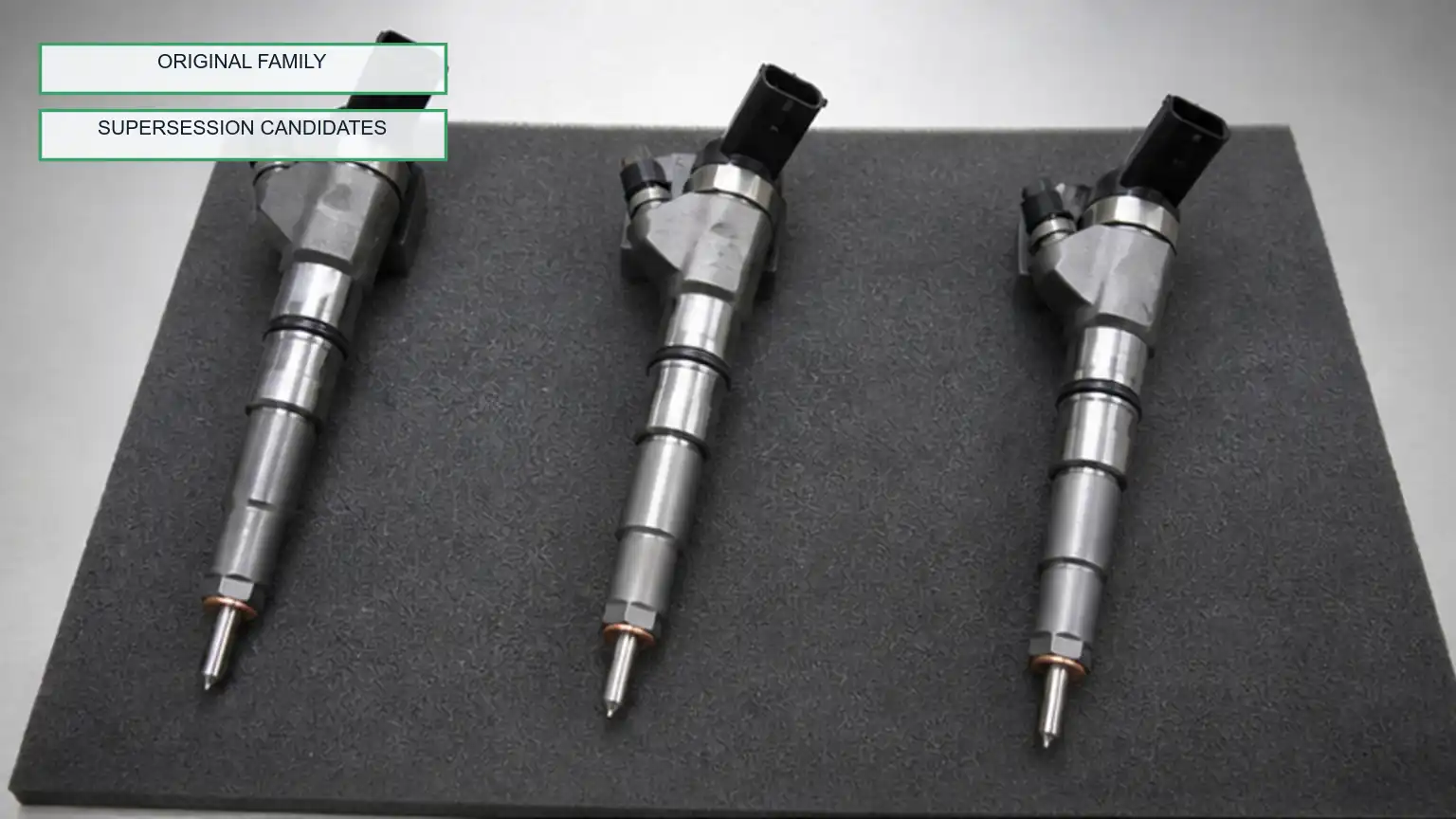
Three visually similar common-rail injectors arranged as supersession candidates on a controlled bench.
Create a dated sequence from original number to current service number. For each step, record whether it replaces, services, remanufactures, or packages the earlier reference and whether a seal, line, clamp, code, software update, or installation instruction changes.
Do not collapse several third-party cross-reference results into an apparent consensus. They may copy the same upstream error or omit market, emissions, or calibration conditions. The source and condition for every link must remain visible to purchasing and receiving.
Inspect connector keying and pin count, hold-down geometry, feed and return connections, nozzle protrusion, body length, sealing surfaces, leak-off arrangement, and any orientation constraints. Use photographs and measured datums rather than descriptive words alone.
A later number may legitimately look different, but the official replacement information should explain the change and its required installation parts. An unexplained interface change is a hold point. Reject look-alike compatibility when any engine-side interface remains unverified.
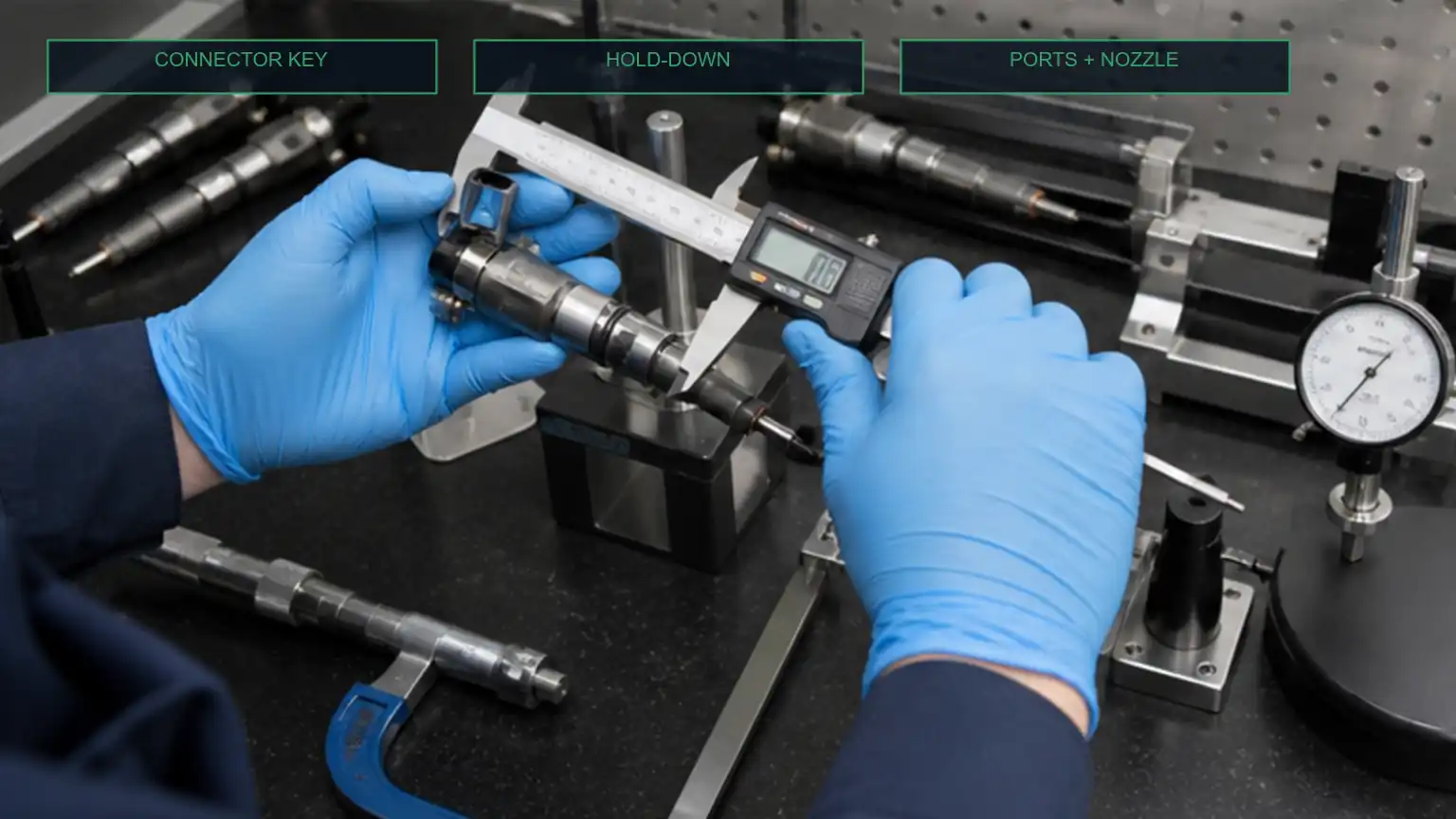
Fuel injector connector, hold-down, fuel ports, nozzle, and body length compared with precision gauges.
Identify whether the engine requires an injector trim, calibration, or compensation code and how it will be captured and assigned. Keep code identity tied to the individual injector and cylinder during receiving, installation, and warranty handling.
State whether the offer is new, remanufactured, repaired, or another declared condition. A superseded number does not by itself prove product condition, genuine status, authorization, or test quality. Part-number validity and product-condition evidence are separate approval gates.
Compare the sample with the approved chain, removed unit, interface record, and packaging requirement. Use engine-specific or supplier-agreed tests with stated conditions; do not turn a generic pass label into evidence for every application. Install or validate the sample through the controlled process, retain the removed and new identities, and document coding, leak checks, operating results, and any deviations. The sample result should be reviewable by service and purchasing. A bulk order should not precede a closed sample record when the chain introduces a new service number.
Require lot labels, individual identity, protective caps, readable codes, supplier source, and change notice. Compare sampled units with the approved reference and quarantine mixed or unexplained identities before they enter released stock.
Link the purchase order, supplier declaration, sample approval, lot records, installation feedback, and claims. If the supplier later changes source or number, reopen the supersession review instead of inheriting the prior approval. Volume release depends on repeat-lot consistency, not only first-sample success.
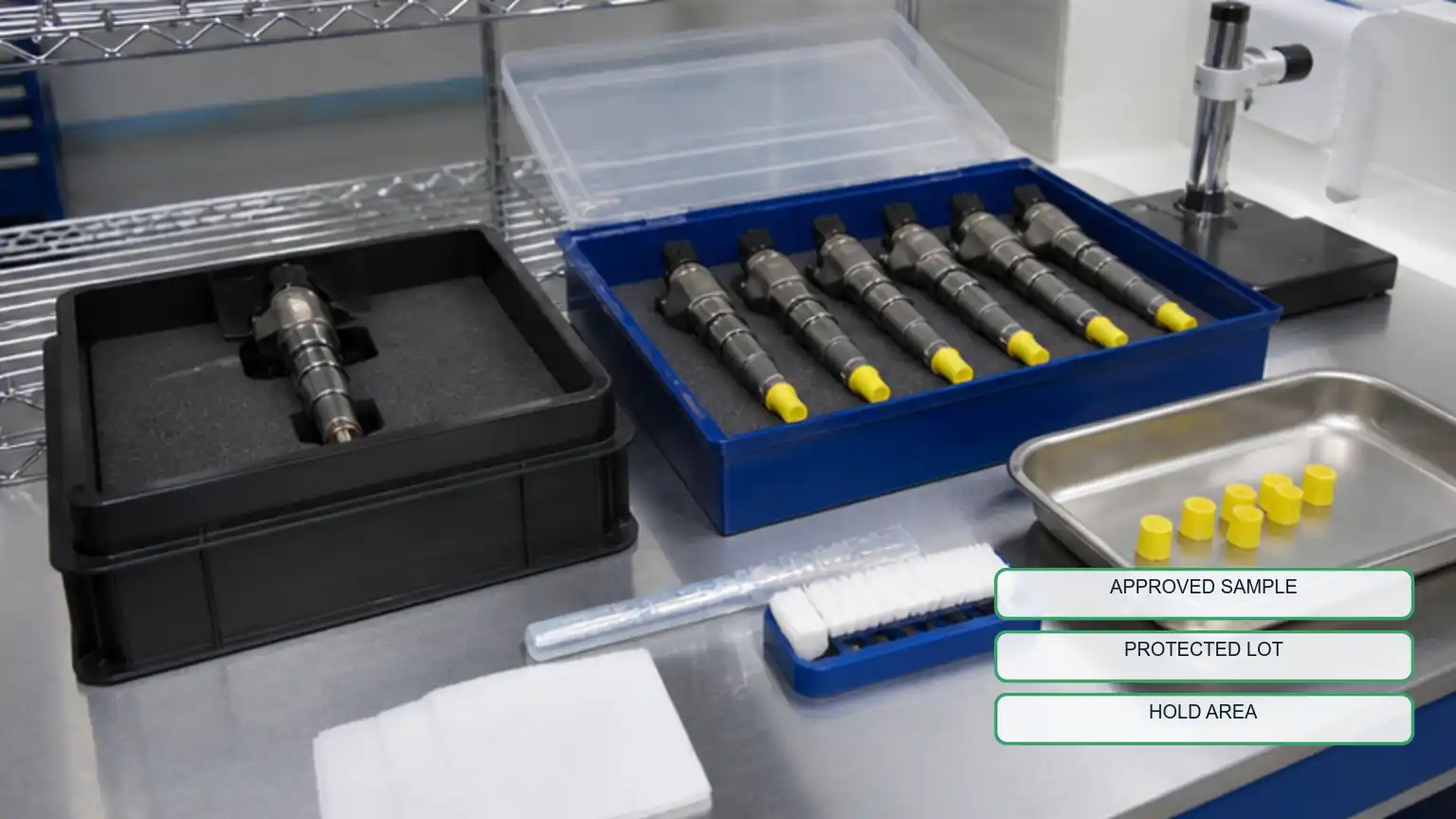
Protected diesel injector lot checked against an approved sample before wholesale release.
Once the chain is proven for the exact engine, compare the approved service number with the documented injector product example only when its number, application, condition, interfaces, and coding requirements genuinely match.
Repeated aftermarket cross-references do not equal independent official confirmation.
A correct supersession number does not prove the offered injector's condition or test quality.
A matching connector does not prove nozzle, calibration, hold-down, or fuel-interface compatibility.
Skipping intermediate supersession steps and their required kits
Mixing genuine, new aftermarket, remanufactured, and repaired condition language
Approving a chain without engine serial or arrangement context
Allowing unreadable codes into released inventory
When the engine maker supplies a current, serial-specific injector kit with a mandatory procedure, follow that information directly. This workflow is designed to make sourcing evidence auditable; it does not authorize substitution outside the supported engine, emissions, calibration, or service boundaries.
Engine serial, arrangement, application, and emissions context
Original and removed injector identities
Each supersession source and revision date
Required seals, lines, clamps, software, or procedures
Connector, hold-down, ports, nozzle, and body comparison
Code and declared-condition control
Sample approval and repeat-lot receiving plan
Send Elecdura the engine identity, original and removed injector numbers, the proposed supersession chain, required condition, code information, quantity, and destination. Elecdura can review the request against an explicit evidence path rather than a single marketplace interchange. Continue through the injector sourcing RFQ with the evidence named in this guide.
No. A later service number may supersede an earlier number only for specified engine serial ranges, calibrations, hardware revisions, or installation conditions. Verify every link in the chain from a current authoritative source and record its qualifiers, date, and direction. Check whether the change requires a connector, line, seal, clamp, software, calibration code, or installation instruction. If any link is conditional or one-way, the newest number cannot be treated as universal backward compatibility.
Seller pages can help discover candidate numbers, but repeated listings do not prove independent agreement; several sites may copy the same outdated source. Use current engine-maker or injector-maker parts information, service bulletins, and serial-specific records to close the chain. Record the exact source and revision for each arrow between numbers. Where primary evidence is unavailable, label the relationship as unverified and use a controlled sample rather than presenting repetition as authority.
No. A supersession establishes a part-number relationship, not the identity, origin, condition, calibration, or test status of the unit offered. Source evidence, label and code inspection, declared new or remanufactured condition, packaging, traceability, physical interfaces, calibration requirements, and any test documentation must be reviewed separately. A correct number on an untraceable or mixed lot remains a supplier and quality risk even when the application chain is valid.
The number chain cannot expose every execution error. A sample can reveal connector, nozzle, body, clamp, seal, code, protective-cap, packaging, or declared-condition differences before they reach a bulk lot. Compare the sample with the engine-side requirements and the source documents, record any coding or calibration procedure, and retain the approved identity and inspection images. Sample approval reduces physical and documentation risk; it does not replace repeat-lot controls.
Quarantine mixed or unreadable identities, codes that do not match the approved record, missing protective caps, damaged sealing or connector surfaces, contamination, corrosion, unexplained source or packaging changes, inconsistent declared condition, and any unit that differs from the approved sample. Keep affected cartons and lot markings tied to the inspection record. Release should resume only after the supplier explains the change and the technical, condition, and traceability evidence is reapproved.


