
English
Views: 0 Author: Site Editor Publish Time: 2026-08-31 Origin: Site


Direct answer: Incoming alternators should be screened for pulley condition before they enter released stock. Secure the unit on a suitable fixture, rotate it safely, and measure pulley rim or specified datum runout with a dial indicator under a documented method. Inspect groove profile, groove count, pulley offset, shaft seating, retaining hardware, edge damage, and corrosion. Compare belt-plane alignment and, when the approved plan allows it, observe tracking on a guarded low-speed rig. Quarantine units with impact damage, unstable readings, incorrect offset, damaged grooves, or unexplained pulley changes.
This article is a measurement and lot-disposition procedure, not a general alternator overview. Define the pulley and its datum, inspect shipping condition, measure runout and offset, and use guarded tracking only when the approved plan requires it. The heavy-duty alternator catalogue identifies candidate families; the pulley record, belt plane, packaging, and repeatable readings determine release.
Procedure stage |
Recorded evidence |
Disposition question |
|---|---|---|
Static inspection |
Grooves, edges, fastener, corrosion |
Finds visible shipping and assembly damage |
Runout measurement |
Dial indicator and stated datum |
Detects wobble under a repeatable method |
Offset and alignment |
Pulley plane vs mount datum |
Controls belt tracking and edge load |
Guarded tracking |
Belt movement under controlled speed |
Supports system behavior without proving full-duty life |
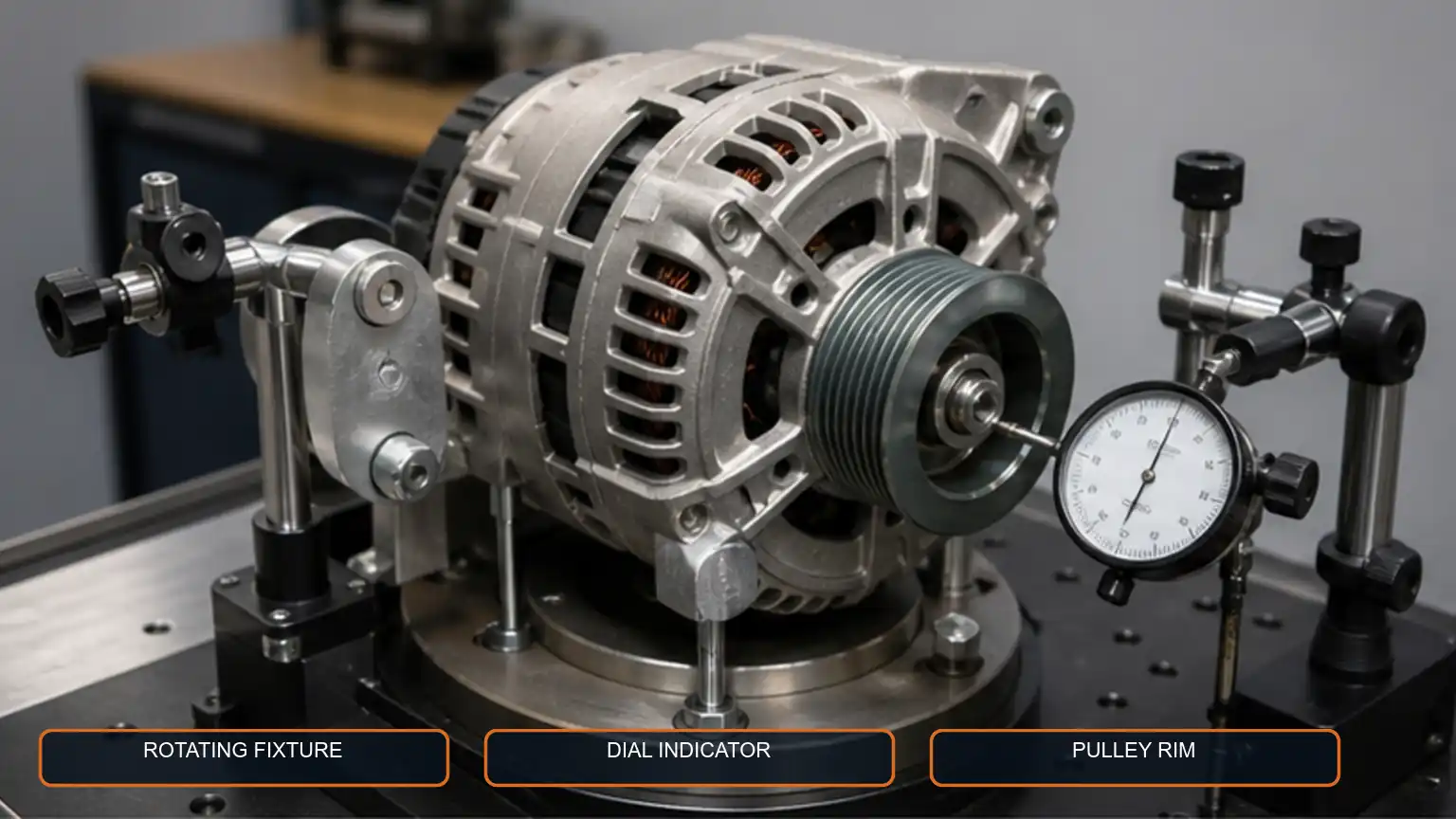
Heavy-duty alternator secured on a precision fixture while a dial indicator checks pulley rim runout.
Record alternator identity, mounting type, pulley number or geometry, groove count and profile, outside diameter, offset, overrunning or solid pulley design where applicable, retaining method, and approved application. Keep clear front and side photographs.
A supplier change from one pulley style to another must be explained even when the alternator body remains unchanged. The pulley is part of the drive-system fitment. Release criteria must describe the exact pulley and its datum.
Check pulley edges, grooves, hub, fastener, shaft exposure, protective packaging, corrosion, dents, and evidence of side impact. Rotate by the permitted method and listen or feel for abnormal contact without using unsafe improvised power.
Inspect whether the pulley sits fully and squarely on the shaft and whether spacers or washers match the approved build. Record any change before attempting correction. Do not repair impact evidence before the lot decision is documented.
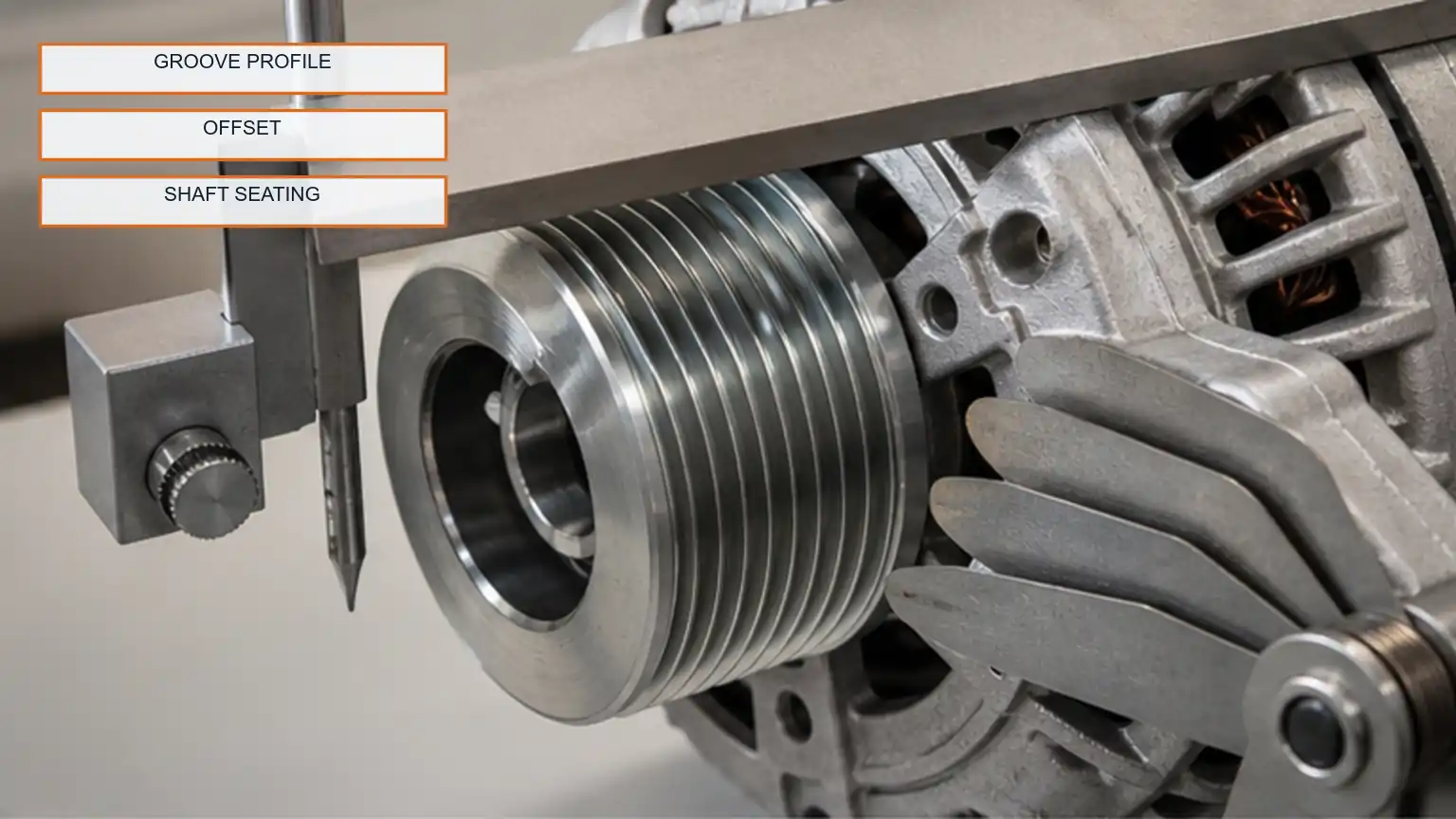
Alternator pulley groove profile, offset, and shaft seating inspected with straightedge and gauges.
Secure the alternator on a stable fixture without distorting the housing. Place a dial indicator on the specified pulley datum, rotate slowly through a full revolution, record maximum and minimum readings, and repeat to confirm stability.
State indicator position, fixture, rotation method, units, and acceptance source. Do not publish a universal runout limit for all alternators; use the approved drawing, supplier agreement, or maker requirement. An unstable or unrepeatable result remains unresolved rather than averaged into a pass.
Compare groove count, pitch, width, condition, and belt type with the approved drive. Measure pulley offset from a defined mounting datum and use a straightedge or suitable alignment method to evaluate the expected belt plane.
Inspect mount geometry at the same time because a correct pulley on a different mount can still misalign. Consider tensioner range and nearby component clearance. Runout and alignment are separate checks; both must pass.
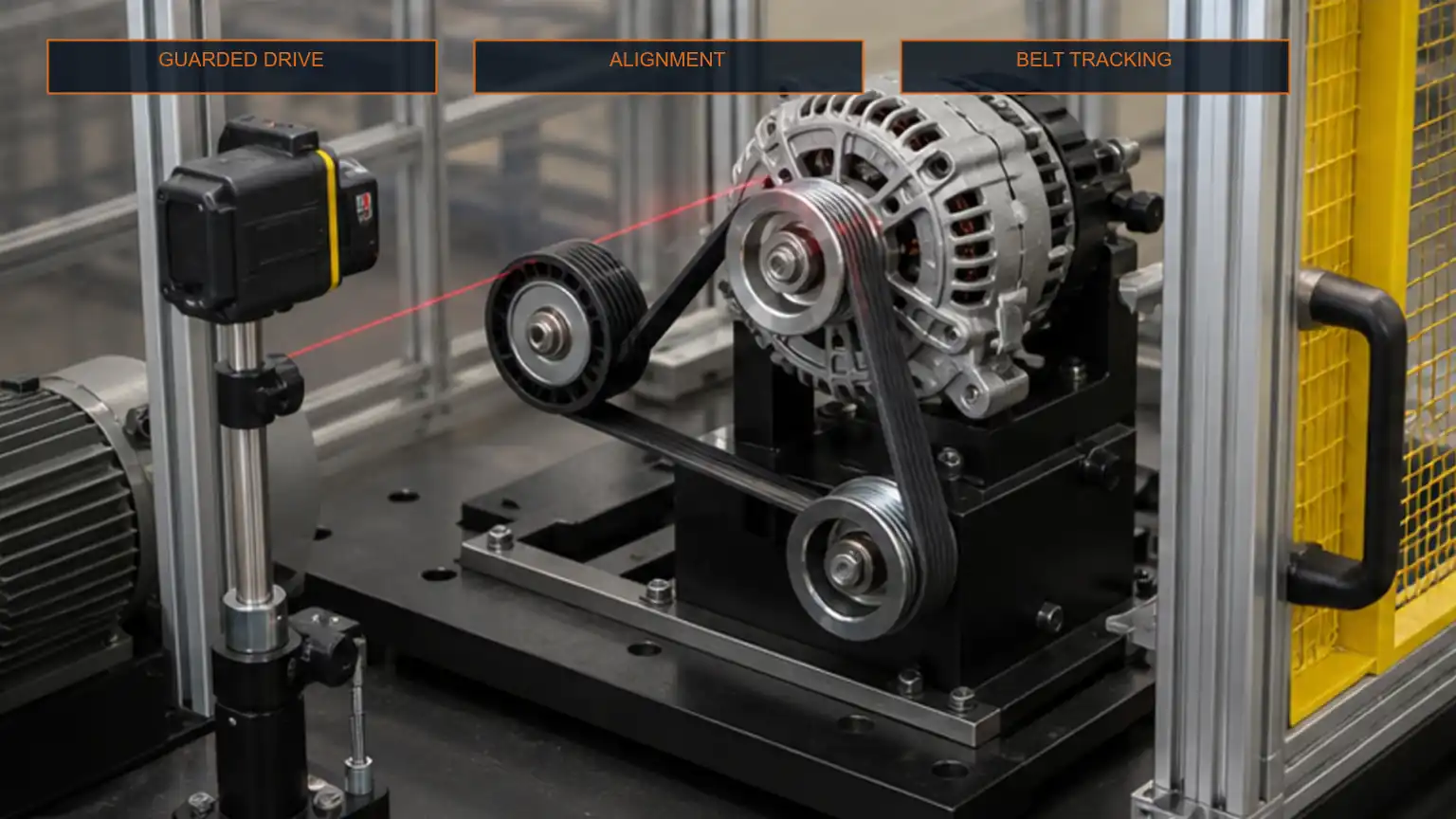
Alternator, belt, tensioner, and alignment tool operating on a guarded low-speed belt-tracking test rig.
On an approved guarded fixture, use the correct belt, tension, alignment tool, and controlled speed. Observe whether the belt centers, walks, flutters, contacts an edge, or produces abnormal noise.
Record speed, duration, belt, tension, fixture, temperature if relevant, and result. This check can expose a gross pulley or alignment issue, but it does not reproduce every vehicle load, thermal cycle, or vibration condition. Never run an exposed high-speed belt to speed up receiving inspection.
Compare sampled units with the approved alternator and pulley record. Hold mixed pulley styles, damaged grooves, inconsistent runout, incorrect offsets, loose hardware, corrosion, or packaging that leaves the pulley exposed.
Retain photographs, raw readings, supplier lot, sample identity, disposition, and change notice. Use installation feedback to refine the controlled plan without replacing measured incoming evidence with anecdote. One damaged unit may trigger broader sampling when the packaging or handling cause can affect the lot.
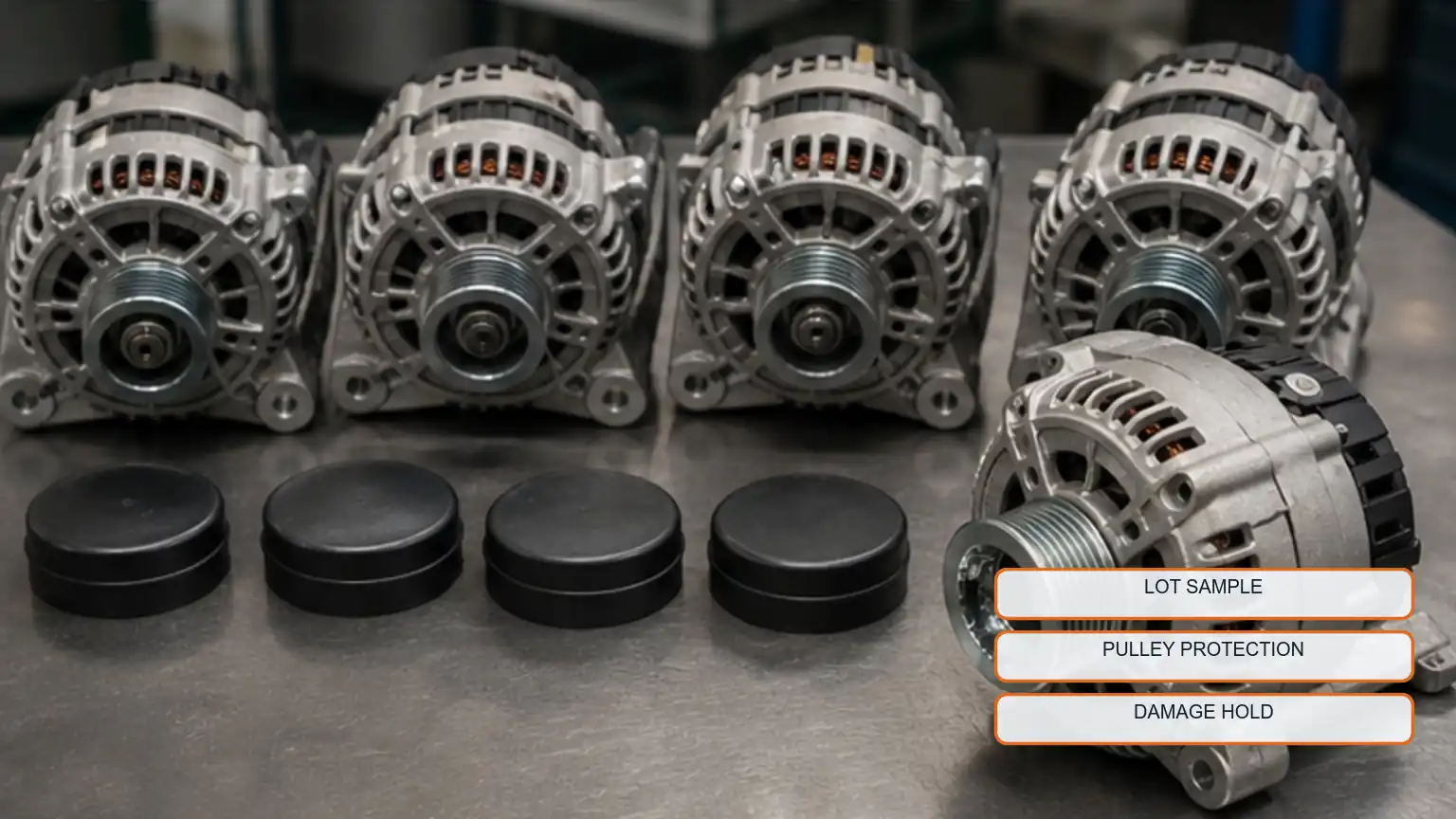
Incoming alternator lot compared with an approved sample and one isolated unit with pulley-edge damage.
Use the alternator supplier research guide for supplier context only after pulley configuration, runout datum, offset, mount, belt plane, packaging, and lot-release evidence are defined.
A static runout check does not prove bearing life or full-load durability.
A guarded tracking test does not reproduce every installed bracket and tensioner condition.
Correct groove count does not prove pulley offset or shaft seating.
Measuring runout on an unstable fixture
Using a universal tolerance with no approved source
Ignoring pulley edge damage under protective caps
Running an exposed belt during receiving
Use the alternator, belt-drive, engine, or vehicle maker's procedure and limits when available. This workflow does not authorize high-speed unguarded testing, pulley removal, or modification of the approved drive system.
Approved alternator and pulley identity
Groove count, profile, diameter, and design
Edge, hub, fastener, shaft seating, and corrosion inspection
Fixture, indicator location, units, and repeated runout readings
Pulley offset and belt-plane alignment
Guarded tracking conditions and result where required
Lot sampling, packaging, quarantine, and change notice
Send Elecdura the alternator and pulley reference, mount and belt details, required runout and offset fields, sample plan, quantity, and destination. The quotation can incorporate the pulley evidence needed for incoming release. Continue through the alternator quality RFQ with the evidence named in this guide.
No. The groove count must be considered with groove profile and pitch, pulley diameter, belt width, offset, shaft and nut interface, overrunning or solid-pulley function where applicable, alternator rotation, mounting geometry, and the installed belt plane. A belt may sit on the pulley and still run out of plane or at the wrong speed ratio. Approve the pulley as part of the complete alternator and drive system, not as an isolated visual match.
Use the datum, radial or axial measurement location, and acceptance limit defined by the approved drawing, supplier agreement, or maker procedure. Secure the alternator without distorting its housing, clean the pulley and shaft seating surfaces, position the indicator consistently, rotate the shaft through a complete cycle, and repeat the reading to confirm the setup. Record the instrument, fixture, datum, location, and observed excursion. A number without its method cannot support lot disposition.
No. Runout is evaluated from the observed excursion under a stable setup, not rescued by averaging inconsistent readings. Variation between repeats may indicate fixture movement, dirt, burrs, a damaged seating face, shaft play, indicator misalignment, or operator loading. Stop and correct the measurement system first. If the reading remains unstable after the setup is verified, quarantine the unit as unresolved rather than converting uncertainty into an apparent pass.
Use a documented sampling and risk plan rather than an improvised universal test. Tracking observation becomes more valuable after a pulley source, machining process, mount, packaging method, or supplier changes, or when prior lots show alignment or damage concerns. Perform it only in an approved guarded fixture and record test conditions. It complements dimensional runout and offset checks; it must not replace them or expose personnel to an unguarded rotating drive.
The package should restrain the alternator body without loading the pulley, keep groove edges and shaft or hub surfaces away from carton walls and adjacent units, prevent metal-to-metal contact, and control moisture and corrosion. Inspect for crushed inserts, polished impact marks, bent groove edges, loose hardware, or a pulley that carried the shipping load. If damage could share a packaging cause, expand sampling and hold the affected lot range until the cause is dispositioned.


