
English
Views: 0 Author: Site Editor Publish Time: 2026-08-29 Origin: Site


Direct answer: A complete-assembly label normally carries more identification weight than a housing casting number because the label can distinguish the finished part number, customer number, serial or date information, and revision. A casting number usually identifies a raw or machined housing that may serve several assemblies with different wheels, internals, ports, pulleys, actuators, calibrations, or connectors. However, a label can be damaged, transferred, or attached to a rebuilt mixed assembly. Use both identifiers, then verify the application and every critical interface before approving the part or a bulk lot.
This guide separates three markings that buyers often collapse into one: the complete-assembly label, the housing casting number, and the supplier's commercial reference. Each identifies a different level of the product. Use the heavy-duty turbocharger catalogue to view complete-assembly candidates, then verify the label's credibility, the casting's role, the application, and every critical port, mount, drive, connector, or actuator interface.
Marking type |
What it belongs to |
Safe procurement use |
|---|---|---|
Assembly label |
Finished part, serial, revision, customer number |
Primary when legible and attached to a credible complete unit |
Casting number |
Housing or casting family |
Secondary; may be shared across assemblies |
Interface evidence |
Ports, mounts, drives, connectors |
Rejects a mislabeled or mixed assembly |
Application source |
Serial-specific parts or service record |
Connects the physical unit to the intended system |
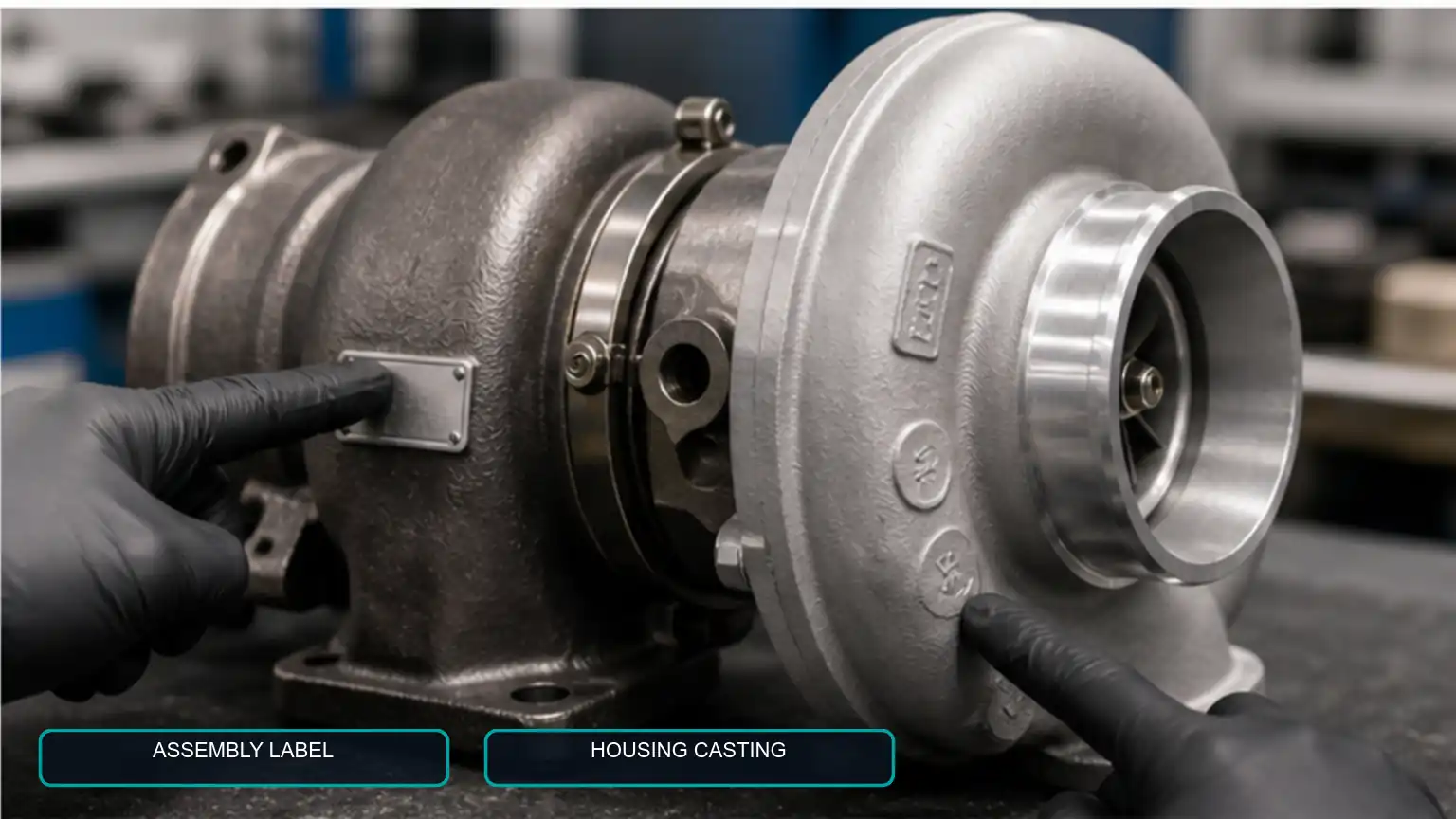
Turbocharger assembly label area and raised housing casting marks inspected as two different identifiers.
Read the label for maker, complete part number, customer number, serial, date, voltage, calibration, model, or condition markings that apply to the finished assembly. Photograph it before cleaning removes fragile print.
Treat raised or recessed casting marks as housing-family evidence. They can help narrow research, but the same housing may contain different internal or external configurations. Do not convert a casting mark into a complete part number without independent evidence.
Inspect label material, attachment, wear, placement, print consistency, and whether the marked fields agree with the actual hardware. Rebuilt products may carry a rebuilder identity that must be read separately from an underlying original plate.
A clean label on a visibly mixed, damaged, or modified assembly is a conflict. Preserve the label but verify interfaces and declared condition before trusting it. Label priority depends on the label remaining tied to the actual complete assembly.
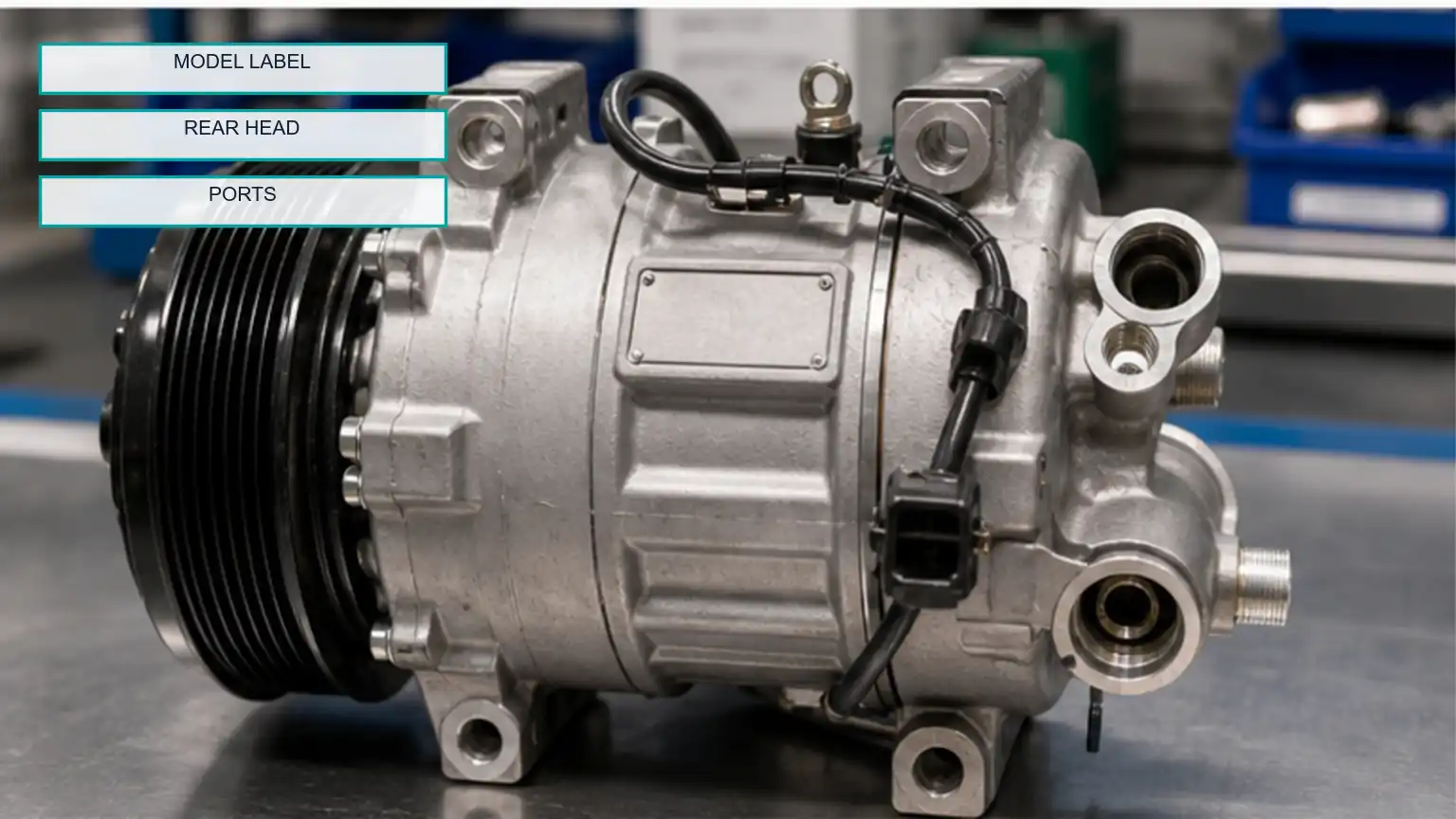
Heavy-duty A/C compressor model-label area, rear-head casting, hose ports, clutch, and connector shown together.
For a turbo, compare complete-unit number, actuator, flanges, housing clocking, oil and air ports. For an A/C compressor, compare model label, clutch, mount, rear head, hose ports, connector, and oil or refrigerant requirements.
For starters and alternators, compare voltage, rotation, flange or mount, pinion or pulley, terminals, and clocking. The relevant interfaces change with the product family. The candidate must match both its identifier role and the system interfaces.
Photograph the original label area under controlled lighting and preserve any remaining characters. Record casting marks, dimensions, interfaces, application identity, service records, and installed context as separate evidence fields.
Do not ask a supplier to guess a complete number from one blurred image. Request a candidate list with the evidence fields that distinguish each assembly and use a sample when uncertainty remains. Missing labels increase the evidence burden; they do not promote the casting number to primary proof.
Identify which organization declares the current product condition and which complete number it supports. Look for mismatched housings, brackets, pulleys, actuators, rear heads, connectors, ports, or fasteners that indicate parts from several assemblies.
Ask for the rebuild or test identity and acceptance record without calling the product genuine or OE unless supported. A rebuilder label can validly identify its offered assembly while still requiring application proof. Condition and source claims must be explicit and auditable.
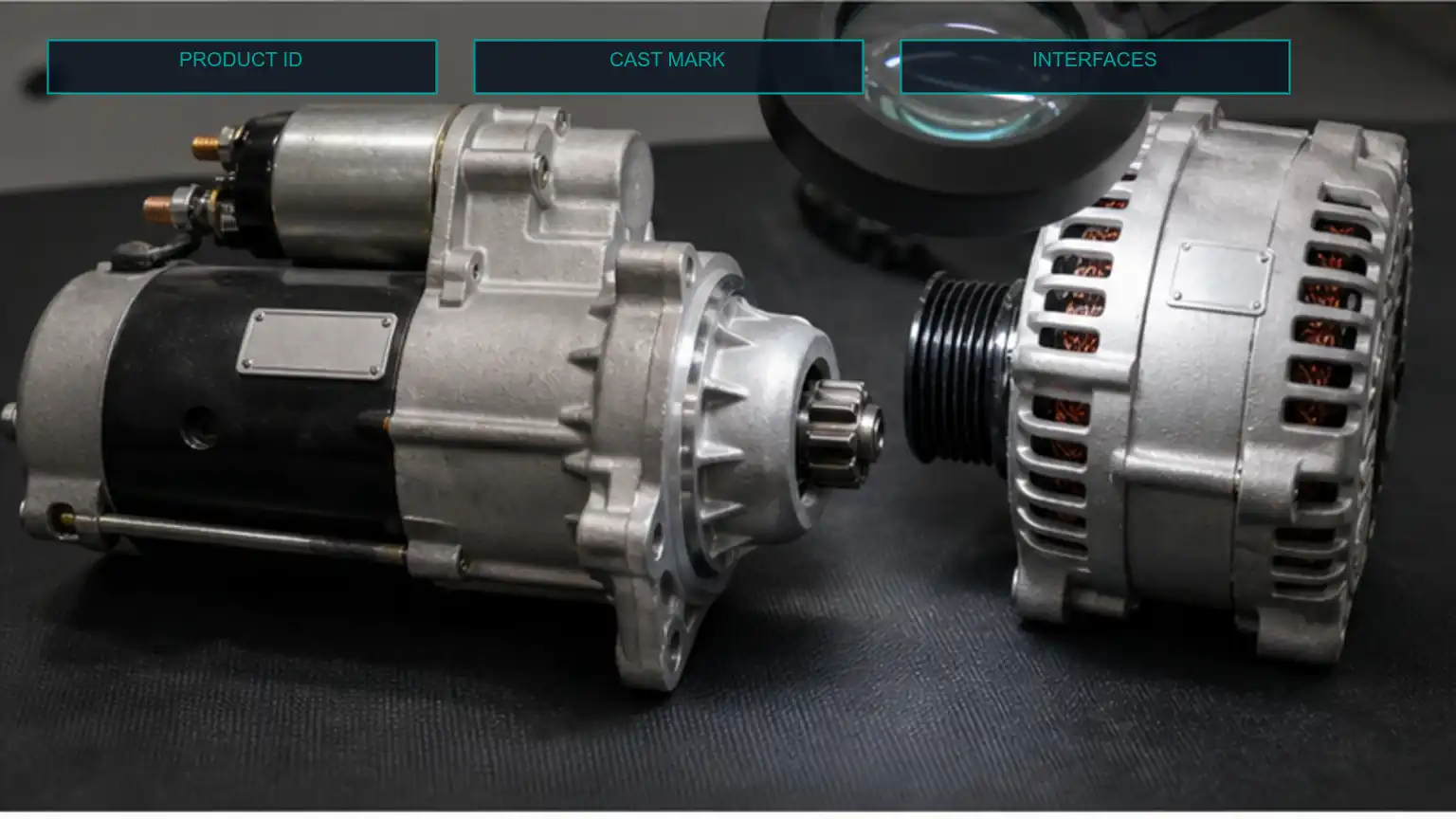
Heavy-duty starter and alternator label areas and casting marks examined under magnification.
Compare each sample with the approved identity and interface record. Hold unreadable labels, mixed numbers, altered interfaces, unexpected casting changes, damaged ports, or units that differ from the sample.
Record whether the difference is cosmetic, housing-source related, or functionally significant before releasing the lot. Require written change notice for any approved variation. Quarantine preserves evidence and prevents a shared casting from masking multiple assemblies.
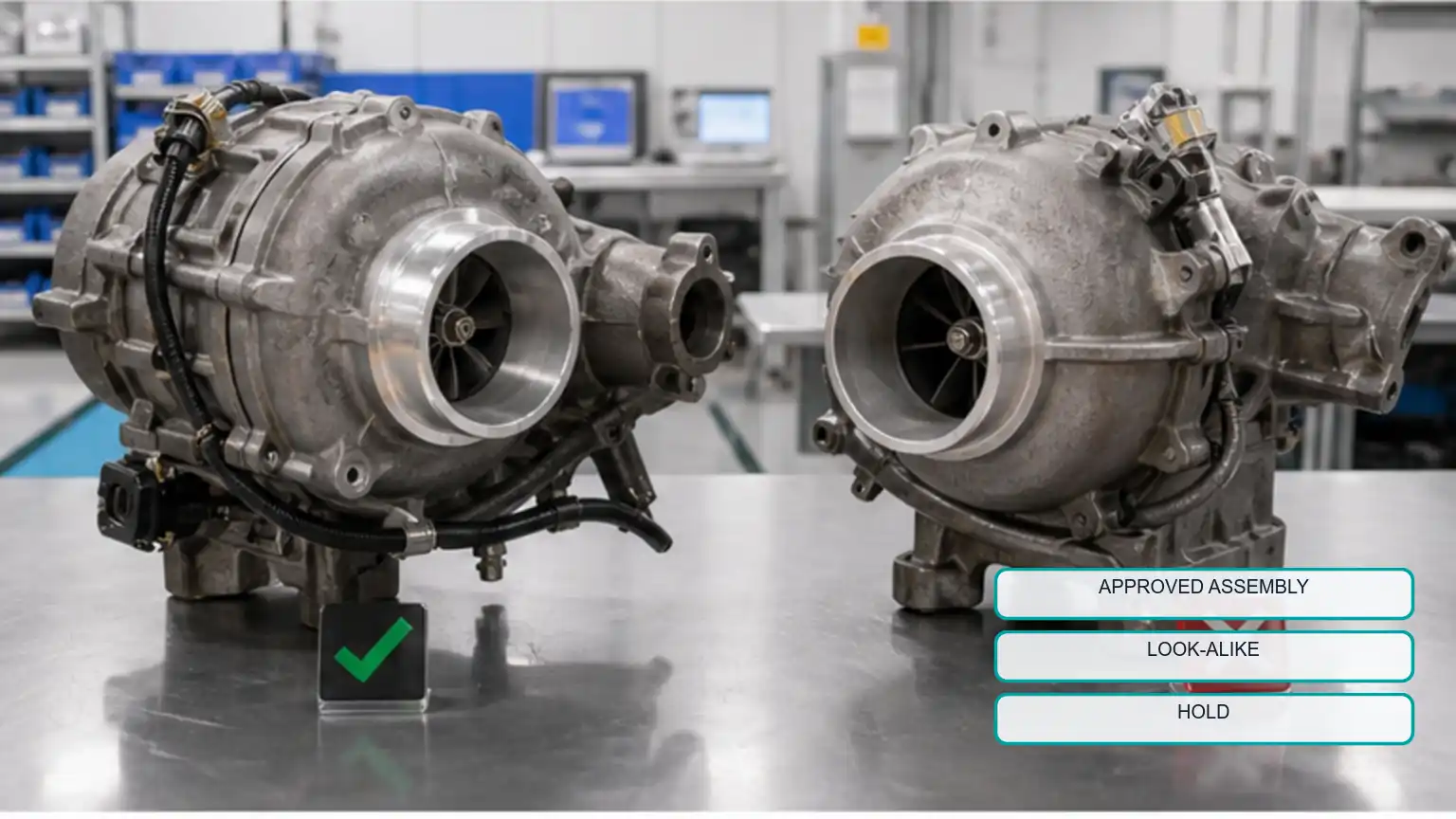
Approved heavy-duty assembly compared with a look-alike candidate that shares housing features but differs at interfaces.
For compressor examples, the heavy-duty A/C compressor category can supply candidate assemblies, but rear-head, clutch, mount, connector, and label evidence must remain tied to the complete unit.
A casting number may identify only one component of the assembly.
A label does not prove genuine status, authorization, or internal condition.
A matching label does not excuse conflicting ports, mounts, connectors, or calibration.
Searching a casting mark as if it were the service part number
Ignoring a rebuilder label and declared condition
Trusting a label after interfaces show a mixed assembly
Accepting a lot with multiple unexplained identifiers
If the maker's current serial-specific parts system provides an unambiguous service number and the inspected assembly matches it, use that authoritative result. This guide is for resolving identifier roles and conflicts, not for replacing controlled parts information.
Complete label photographs and transcription
Casting marks recorded as secondary identifiers
Product-family interface checklist
Application serial or service source
Declared new, remanufactured, repaired, or other condition
Conflict notes and sample decision
Incoming-lot identity and change-notice control
Send Elecdura clear label, casting, and full-assembly photographs together with the application identity and critical interfaces. An identity-led RFQ can distinguish a complete service part from a shared housing reference. Continue through the identity-led parts RFQ with the evidence named in this guide.
It can in a specific numbering system, but equivalence must be demonstrated by the maker's current parts information or drawing—not assumed from search results. First classify where the number appears and what physical component it identifies. Then check whether the source explicitly maps it to the finished assembly. If the same casting is used with different internals, ports, pulleys, actuators, or calibrations, it remains component evidence rather than an orderable service identity.
Start with a legible and credible complete-assembly label because it may contain the finished part number, customer number, model, serial, date, voltage, or revision. Record the label exactly, including suffixes and spaces, and retain a photograph. Then use casting and component marks to support the search and expose conflicts. Before ordering, verify the interfaces and application; a strong label is primary evidence, but it does not override a physically different assembly.
A label may be transferred, remain on one housing after a mixed rebuild, or describe an earlier configuration that no longer matches the finished unit. Check attachment, wear, placement, print consistency, and whether its model and number agree with the actual mount, ports, drive, connector, actuator, and declared condition. When hardware conflicts with the label, preserve both records and quarantine the identity until the supplier explains the assembly history.
Treat the casting as a candidate-family clue. Capture the complete part from multiple angles, all remaining labels or stamps, application identity, mounts, pilots, flanges, ports, drives, connectors, clocking, dimensions, and installed context. Record which fields are observed and which are inferred. Ask the supplier to return candidate numbers with a field-by-field comparison. If more than one assembly remains possible, use a controlled sample instead of promoting the casting to a complete part number.
Not automatically, because a controlled source or tooling revision may leave the approved assembly unchanged. It does require quarantine until the supplier provides a change notice and evidence covering material or source, critical dimensions, interfaces, function, traceability, and affected lot range. Compare the new sample with the approved record before release. A verbal statement that the part is 'the same' is not sufficient when the visible identity has changed.


