Your Whole New Supply Chain For Heavy-Duty Parts
Whatsapp:
+86 18915027366
Phone:
+86 18915027366
Views: 0 Author: Site Editor Publish Time: 2026-09-01 Origin: Site
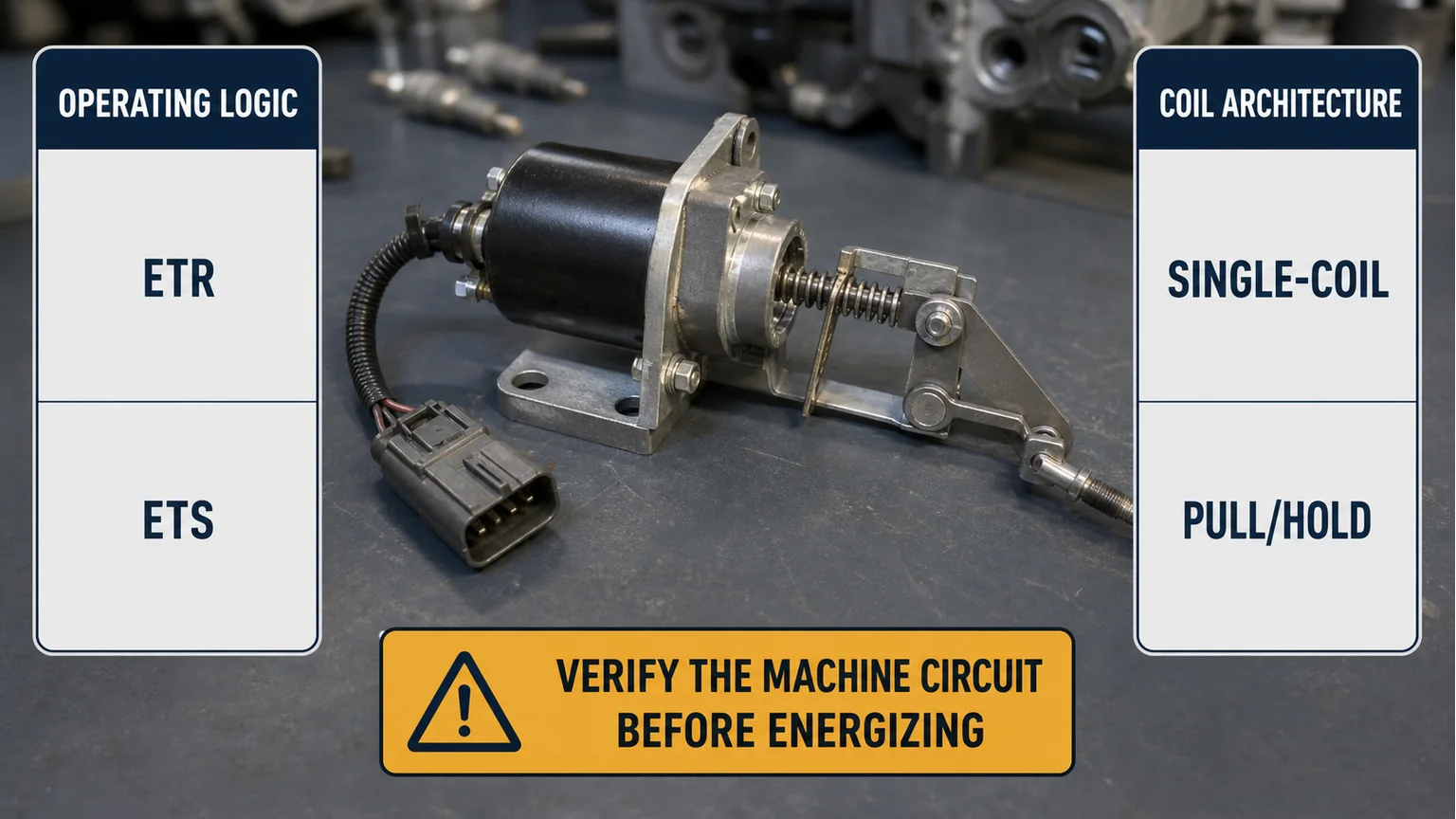
Do not match a diesel fuel shutoff solenoid from voltage and connector shape alone. First identify the operating logic: does electrical power move or hold the engine in RUN, or is power applied only to STOP? Then identify the coil architecture: a unit may use one winding, separate pull and hold windings, or an internal control device. These are different questions. Confirm the plunger's required direction, usable stroke, linkage geometry, mounting, ground path, voltage and duty from the exact engine documentation and removed unit. Applying a generic jumper pattern can burn a pull coil or command the linkage in the wrong direction.
This guide helps equipment-parts buyers move from a symptom to a controlled request in the Elecdura heavy-duty solenoid valve range. It is not a universal wiring diagram.
ETR and ETS describe what energization does in the engine's operating sequence. Pull and hold describe how an actuator may divide the high-force movement from the lower continuous holding demand. A pull/hold unit can therefore be part of an energize-to-run system; “pull/hold” is not automatically a third operating logic that replaces ETR or ETS.
Identity question | Evidence to capture | Unsafe assumption |
|---|---|---|
What state does loss of power create? | Applicable sequence and observed linkage position | All shutdown solenoids de-energize to stop |
How is movement produced and held? | Circuit diagram, wire functions and label | Three wires always mean the same pinout |
What does the plunger move? | Installed linkage, stroke and mounting views | A matching body length guarantees function |
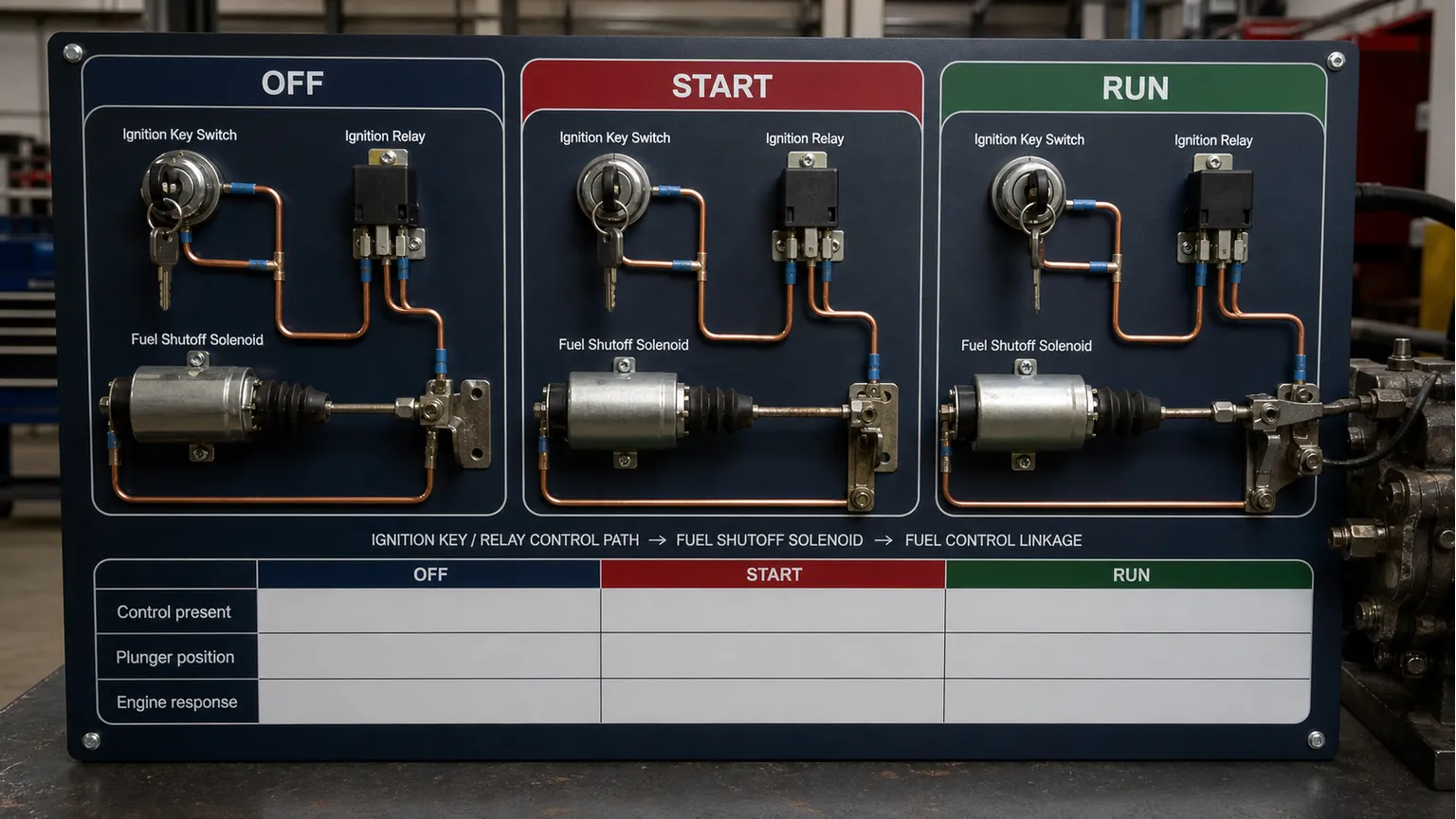
Record the solenoid and fuel-control linkage in OFF, START and RUN using the manufacturer's terminology. In the Toro Reelmaster 3100-D service example, the documented fuel stop solenoid must be energized for the engine to run. A pull coil initially retracts the plunger, a hold coil keeps it retracted, and loss of energization allows shutdown. That example proves one architecture exists; it does not make its wire colors, resistance values or timing universal.
Other engines use an energize-to-stop strategy in which a stop command briefly moves the fuel control toward shutdown. The sourcing record must therefore state the actual state sequence. If documentation and observed movement conflict, stop the match and resolve whether the installation, linkage or prior replacement was altered.
Photograph the complete label and connector, but also photograph the installed bracket, rod or clevis, lever attachment, free direction of movement and the dimension the plunger must cover. A solenoid can energize correctly yet fail to move the injection-pump lever through the required range. Conversely, a seized or misadjusted linkage can overload a sound solenoid.
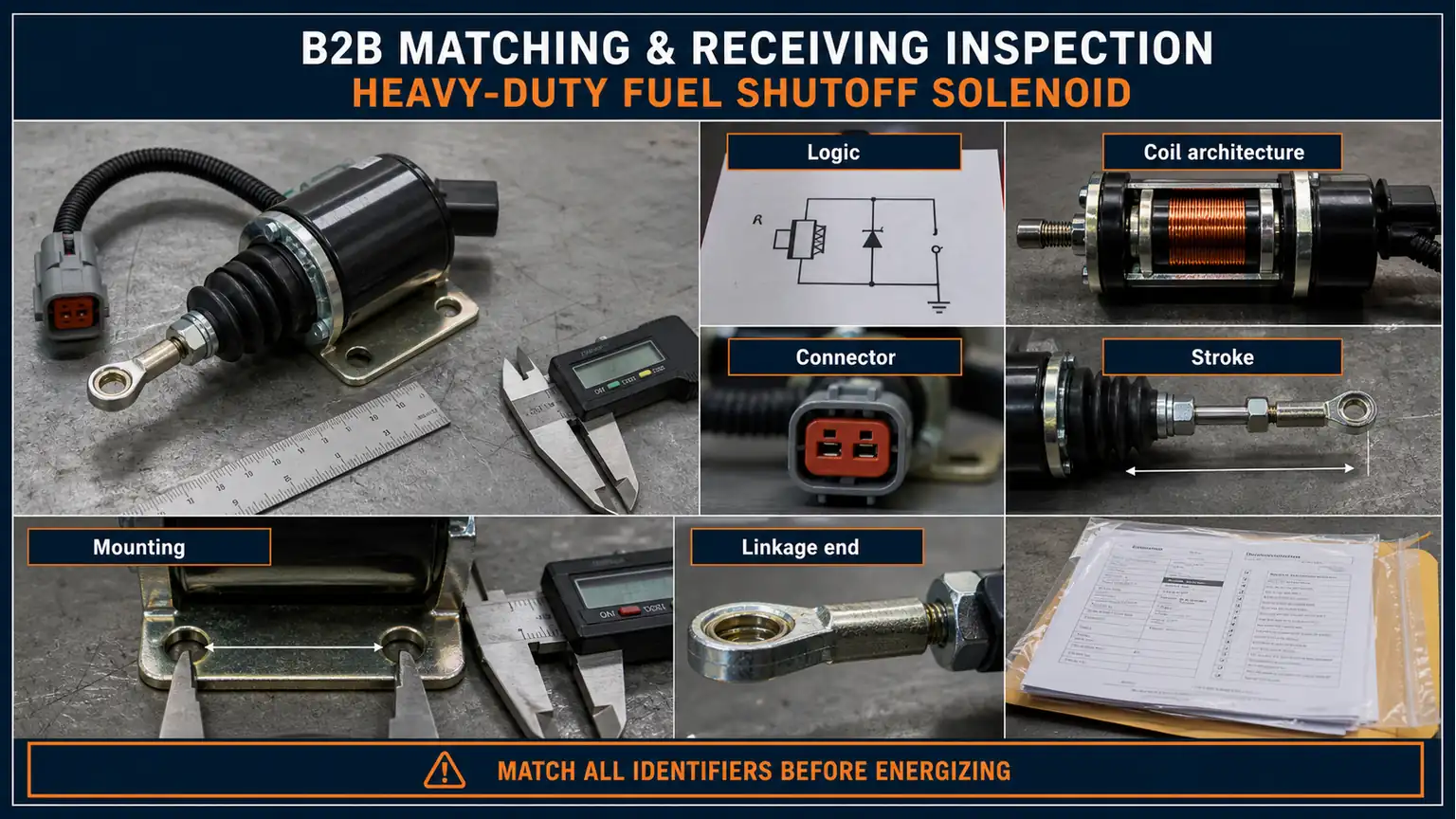
Record whether ground is provided by a dedicated terminal, common wire or housing according to the applicable diagram. Confirm nominal system voltage, connector keying, pin count, body thread or bracket, rod end, orientation and any external return spring. Do not infer duty rating from coil resistance or body size.
A fuel-control solenoid and an emergency intake-air shutoff serve different failure scenarios. This article does not authorize either device to substitute for the other. Preserve the equipment maker's shutdown and overspeed protection architecture; do not simplify it to a generic two-wire switch.
Yanmar service material warns that prolonged voltage on a documented pull circuit can burn the solenoid. That is why a brief bench movement copied from another unit is not an acceptable receiving test. Before energizing anything, obtain the correct diagram, safe test setup, duty limitation and plunger condition. Keep the injection system in a safe no-fuel state if the procedure requires it.
An audible click confirms only that something moved. It does not prove full stroke, holding force, linkage adjustment, correct shutdown direction or continuous-duty suitability. If the manual specifies resistance, current, timer operation or stroke, record the method and temperature conditions stated there. Otherwise, classify the electrical acceptance criterion as unresolved rather than inventing a number.
An engine that starts and immediately stops can involve a missing hold command, an unlatched plunger, a linkage problem or another fuel condition. An engine that will not stop can involve wrong logic, failed command, stuck linkage, misadjustment or another fuel source. A hot coil can reflect excessive duty or mechanical load rather than prove an internal short. Diagnose the system before using the symptom as a product specification.
For incoming goods, compare the approved and incoming units without operating them outside their specified test. Verify label, connector keying, wire or terminal functions, mounting, linkage, free movement, stroke and return behavior. A sample that fits the bracket but reverses the safe state must be quarantined.
This guide does not authorize bypassing safety interlocks, energizing an unknown terminal, defeating an emergency stop, adjusting sealed injection-pump settings or working near moving linkages with the engine able to start. It also does not cover electronically controlled common-rail quantity valves that have been mislabeled as mechanical stop solenoids.
If the engine cannot be stopped by its approved method, follow the equipment emergency procedure and isolate it from service before further testing.
Provide the engine or equipment model and serial evidence, complete old-unit number, OFF/START/RUN state sequence, voltage marking, connector and pin count, ground method, installed linkage views, mounting dimensions, usable stroke, rod or clevis details, quantity and destination. State whether the request is for a complete solenoid, bracket or linkage components.
The heavy-duty solenoid valve selection guide helps keep diesel shutdown, hydraulic and proportional functions separate. When the fuel-control function is confirmed, send Elecdura the identity record for matching and quotation.
No. The plunger position has meaning only when tied to the installed linkage and the engine's documented fuel state. Record what the lever does in OFF, START and RUN. A loose solenoid on a bench cannot show whether the same physical direction opens or closes fuel on a different pump.
Not without an application-specific catalog or engineering determination. Wire count may reflect a common ground, internal switch, timer or a different coil strategy. Compare the circuit, duty, force, stroke and controller expectations. Physical fit and one successful pull do not prove continuous operation or safe shutdown.
In a documented pull/hold ETR system, that pattern can indicate that initial movement occurred but the hold path or mechanical latch condition was not sustained. Verify the controller output, wiring, ground, hold winding and full seating by the engine procedure. It does not automatically condemn the hold coil because voltage loss or incomplete linkage travel can produce the same result.
Only when the exact service information defines the terminals and acceptable values. Relative readings on an unknown solenoid are not a pinout, and meter-lead resistance matters when values are small. Do not energize a guessed terminal to confirm the theory; resolve the identity from the label, diagram and application.
Retain both labels, the approved cross-reference, voltage and connector record, mounting and linkage measurements, documented operating logic, pre-installation inspection, installation photographs and observed state sequence. Do not modify or dismantle the returned unit before instructions. The record supports review, but the applicable commercial terms decide the claim.