Your Whole New Supply Chain For Heavy-Duty Parts
Whatsapp:
+86 18915027366
Phone:
+86 18915027366
Views: 0 Author: Site Editor Publish Time: 2026-09-01 Origin: Site
Diesel fuel in engine oil does not, by itself, prove that an injector has failed. Fuel can reach the sump through a leaking component, incomplete combustion or an in-cylinder post-injection strategy used for aftertreatment regeneration. The correct investigation first confirms contamination and the engine's fuel and regeneration architecture, then identifies the entry route. A rising oil level or fuel smell warrants attention, but neither identifies the responsible part. Follow the engine manufacturer's response to suspected dilution, preserve a representative sample when safe, and establish the cause before authorizing an injector replacement or returning the engine to service.
For a fleet maintenance team, the question is not simply whether to change the oil. It is whether the next operating period will contaminate the replacement oil again. For a parts buyer, it is whether the workshop has identified a defective component or has only found a symptom. The diesel fuel injector category can support a replacement inquiry after that distinction is resolved.
Record what prompted the investigation: a level increase, a laboratory report, an oil-condition warning or a change noticed during service. Then verify the circumstances. Was the level checked by the correct procedure? Was oil added recently? Is the sample linked to the right engine and oil service interval? These questions prevent an undocumented top-up or sampling mix-up from being interpreted as a component failure.
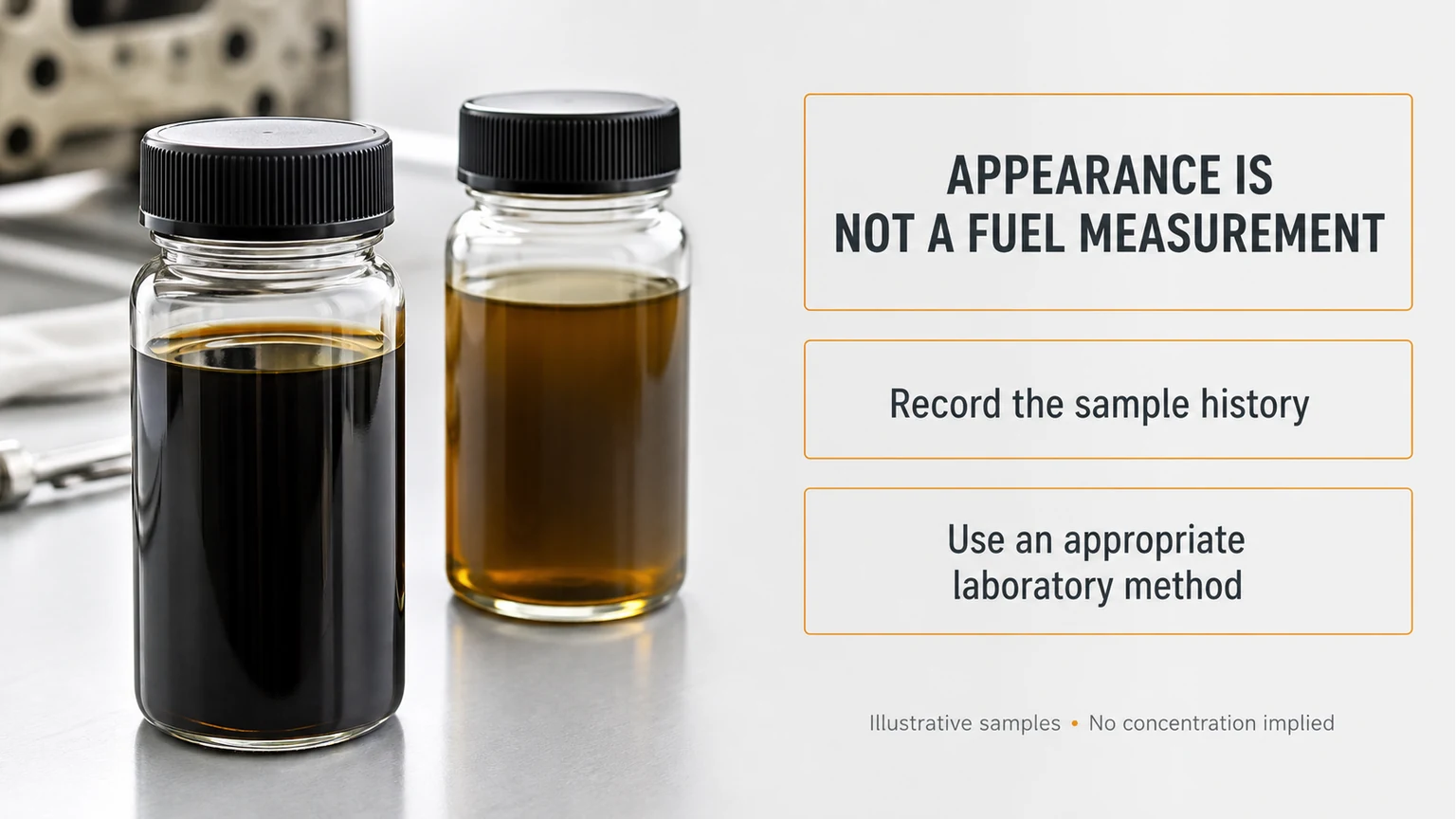
A normal-looking level does not exclude contamination. Oil consumption and fuel addition can occur during the same interval. Likewise, dark oil is not a measurement of diesel content. Treat appearance and odor as observations for the work order, not as a percentage result or permission to keep operating.
Fuel dilution matters because it can impair lubricant performance and the protection needed by loaded engine components. TotalEnergies' explanation of fuel dilution describes the interaction between fuel, viscosity and the lubricating film. It does not provide a universal safe concentration for every heavy-duty engine. Use the limits and actions appropriate to the engine, lubricant and analysis method.
Illustrative samples, not laboratory results. Oil color and a photograph cannot establish a fuel concentration.
Build the investigation around the actual engine layout. The presence of a diesel particulate filter does not mean that all regeneration fuel passes through the cylinders. Similarly, not every injector has an under-cover fuel connection, and not every fuel pump has the same relationship to engine oil. The engine model, serial identification and applicable service information determine which routes are possible.
A leaking or improperly operating injector can be one reason fuel reaches the cylinder wall rather than participating normally in combustion. Poor combustion or another engine condition may also contribute. The relevant diagnostic sequence must distinguish the injector's behavior from the conditions in which it operates; a fuel-in-oil result alone cannot make that distinction.
Some aftertreatment strategies also use late in-cylinder post-injection. Research published by SAE International describes how fuel deposited on the cylinder wall can reach the sump during such operation. That is a mechanism, not proof that regeneration explains a particular vehicle's contamination. The SAE study on post-injection and oil dilution supports checking the injection strategy and operating history rather than automatically blaming a leaking injector.
Other systems use a dedicated exhaust-fuel circuit for active regeneration. That arrangement does not put the regeneration fuel through the combustion chamber in the same way. SAE's study of diesel injection into the exhaust line explicitly distinguishes this route from in-cylinder post-injection.
Therefore, “the truck has frequent regenerations” is incomplete evidence. Identify how that engine supplies regeneration heat and which faults or operating conditions are recorded. A separate doser does not prove that the engine cannot have fuel dilution; it means the proposed explanation must fit the actual route.
Where the design permits it, a fuel connection, injector-related seal or pump interface can provide another entry route. Do not generalize a leak location from one engine family to another. Ask the workshop to identify the component, its interface with the oil space and the test that confirms leakage under the specified conditions.
This distinction changes the purchase order. A leak at a connection or seal may require a different repair scope from a failed complete injector. A pump-related finding should not become an injector order merely because injectors are easier to identify in the parts catalog. Preserve the actual finding and the specified repair parts.
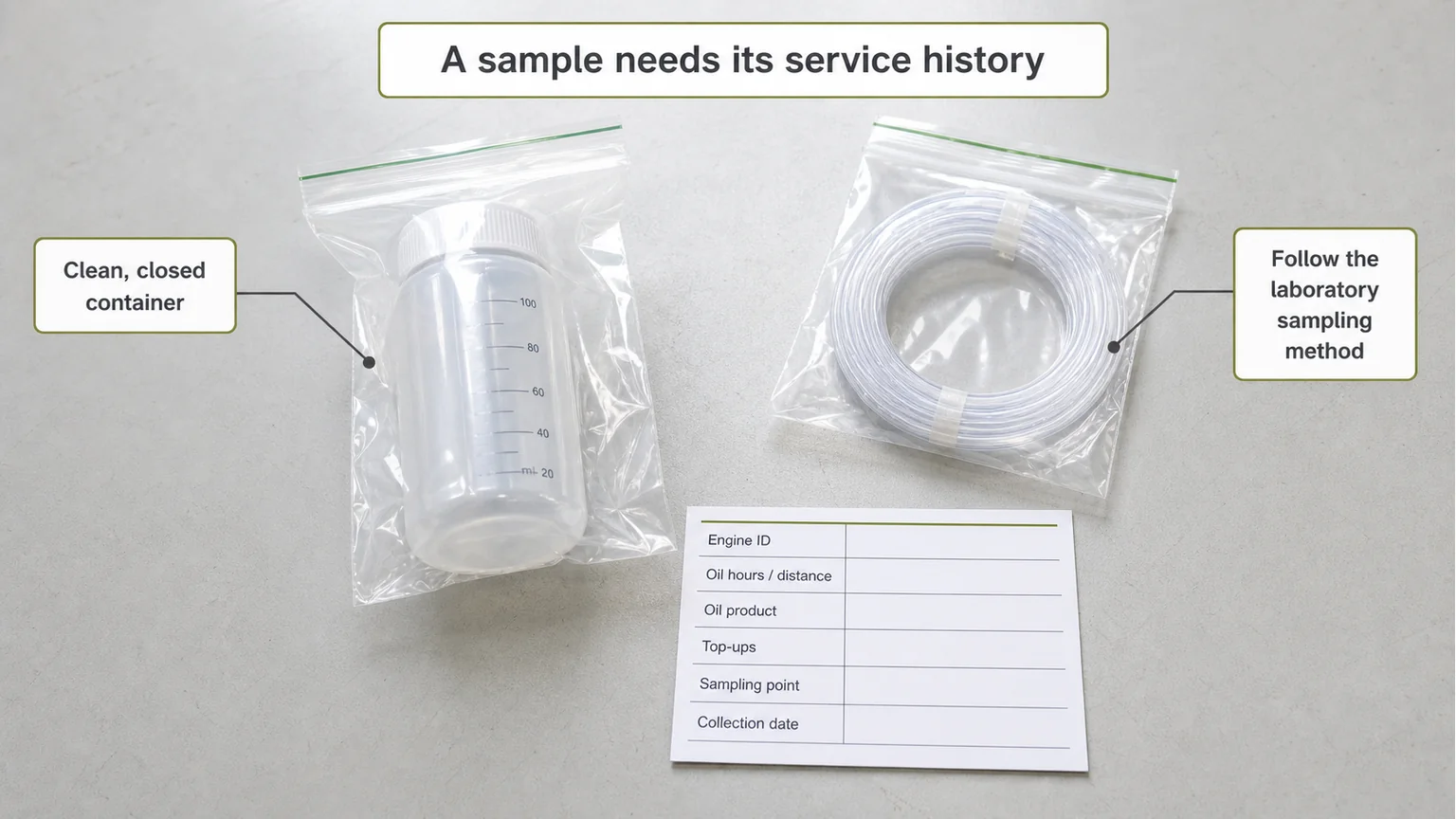
Ask the laboratory which sampling method and container are appropriate, and collect the sample without creating an unsafe operating condition. A clean bottle alone does not establish that the sample is representative. Its timing, collection point and relationship to any oil change, top-up or repair affect the interpretation.
The sample record should include engine hours or distance, hours or distance on the oil, oil product and grade, additions since the last change, the sampling point and the collection date. Add the complaint and recent relevant work. Where available, retain previous results from the same engine and method; an isolated number has less context than a properly comparable history.
Preparation example only. Use the laboratory's sampling instructions and the vehicle's safe access procedure.
Know what the laboratory actually measured. A viscosity change is useful context, but it does not uniquely identify diesel contamination. A fuel-dilution result also needs its method and reporting basis. Fluid Life's fuel-dilution overview distinguishes laboratory measurements from field observations. Do not transfer a generic website's percentage-action table to a fleet's engines without the applicable manufacturer and laboratory guidance.
Ask for clarification when a report says only “fuel detected” or gives a warning with no method. Determine whether the result is a screening indication or a quantified measurement, what the laboratory considers significant for that application, and whether another analysis is needed. A report can confirm contamination without identifying the entry route.
Put the records in chronological order. Start with the last known oil fill, then add top-ups, operating pattern changes, regeneration events, warning messages and fuel-system work. The aim is to find a testable explanation, not to choose whichever event occurred closest to the complaint.
Compare the reported onset with changes in duty cycle, extended low-load operation or incomplete warm-up, while avoiding assumptions based only on trip length.
Review regeneration frequency and completion records where the engine exposes them. An event count without the relevant operating hours or prior baseline can be misleading.
Retain diagnostic codes and the associated conditions before clearing them. A code may identify a circuit or operating problem without identifying the leaking component.
Check whether recent injector, pump, seal or software work changes the diagnostic route. A recent repair is a reason to inspect its evidence, not automatic proof of fault.
There can be more than one contributor. An unfavorable operating pattern and a component leak are not mutually exclusive. If the records support more than one plausible route, the workshop should state which tests separate them. It is more defensible to leave a cause unresolved temporarily than to order an injector on the strength of an oil smell.
This is a record-keeping sequence, not a sample vehicle history or a diagnostic verdict.
After the specified repair and oil-service actions, establish how the correction will be checked. Record the new fill and any required follow-up sampling or diagnostic routine. A clean result immediately after an oil change does not, on its own, prove that the entry route has stopped. Follow-up must be meaningful for the actual duty cycle and comply with the manufacturer's instructions.
This article is not authorization to run an engine with a serious oil-level, lubrication or mechanical warning. Do not attempt a long road run or a forced regeneration simply to “burn the diesel out of the oil.” Follow the engine's prescribed response and the workshop's safety controls. Contaminated oil and the condition that produced it require assessment before further operation.
The guide also does not define a common dilution threshold for different engines, approve an oil additive, shorten a service interval by an arbitrary amount, or recommend changes to emissions controls. An application-specific instruction takes precedence over a general explanation of contamination mechanisms.
The workshop's finding should name the failed component or interface and the evidence behind it. A parts request should then identify the engine, the complete component reference, the relevant configuration and the exact supply scope. Include photographs of the removed part and label where removal has been authorized, rather than asking for a generic injector based on the vehicle name alone.
If the request concerns a complete common-rail injector, a 0445120045 MAN-application product reference illustrates the level of identification needed. The engine and removed component still require confirmation; the reference is not a recommendation for every MAN truck or an assertion that an injector caused the oil contamination.
For a quotation, send Elecdura the identified replacement reference, engine details, quantity and destination. State whether the workshop needs a complete injector or a separately specified repair item. Keep the contamination diagnosis and post-repair verification with the service team; a supplier's availability response is not a diagnosis.
A viscosity result describes the combined condition of the sampled oil, not a unique contaminant. Several changes can affect it during service, so an apparently acceptable viscosity should not override a relevant fuel-dilution finding. Ask the laboratory to interpret the measurements together, using the oil identity, service history and test methods. Do not calculate a diesel percentage from viscosity alone or compare results from unlike oil grades as if they were the same baseline.
Yes. A resistance, inductance or insulation result addresses the tested electrical characteristic; it does not establish nozzle sealing, delivery balance or every internal leakage path. Keep the electrical result attached to its method and injector identity, then follow the engine or test-equipment procedure for the remaining suspected route. For purchasing, this prevents an electrical pass from becoming a blanket certificate of injector health and prevents a hydraulic symptom from being relabeled as an electrical failure.
Tell the laboratory the amount and identity of the added oil and when it was introduced relative to sampling. Fresh oil changes the mixture being measured and may reduce the apparent concentration of contaminants. The result can still be useful, but it is not directly comparable with an undisturbed sample from the preceding interval. Preserve both the top-up record and the earlier complaint; do not treat a lower result as proof that a leak disappeared.
Request a diagnostic hold rather than a guessed injector reference. The workshop should state the engine identification, confirmed contamination method, applicable regeneration architecture, inspected interfaces and the tests still needed to separate the plausible routes. A quotation can be prepared once a component and supply scope are identified, but availability must not be presented as fault confirmation. If downtime requires contingency pricing, label it as conditional and do not release the order as a confirmed repair part.