Your Whole New Supply Chain For Heavy-Duty Parts
Whatsapp:
+86 18915027366
Phone:
+86 18915027366
Views: 0 Author: Site Editor Publish Time: 2026-09-01 Origin: Site
A diesel relative compression test compares how evenly the cylinders resist the starter during cranking; it does not identify a defective injector. A repeatable imbalance in the cranking pattern is a reason to investigate the affected cylinder mechanically before ordering fuel-system parts. An even pattern is also not proof of adequate compression: cylinders can be similarly weak. For a fleet workshop deciding whether to replace an injector, the useful result is a documented next test, not a parts verdict. Confirm the test conditions and cylinder identification, then combine the result with the engine-specific mechanical, electrical and fuel-system checks.
This guide is for heavy-duty workshops, maintenance planners and parts buyers investigating rough running, difficult starting or an apparent weak cylinder. It explains how to use a screening result in a repair decision, not how to replace the engine manufacturer's service procedure. When an injector fault has been established, the heavy-duty diesel fuel injector category is a starting point for matching the replacement—not a substitute for diagnosis.
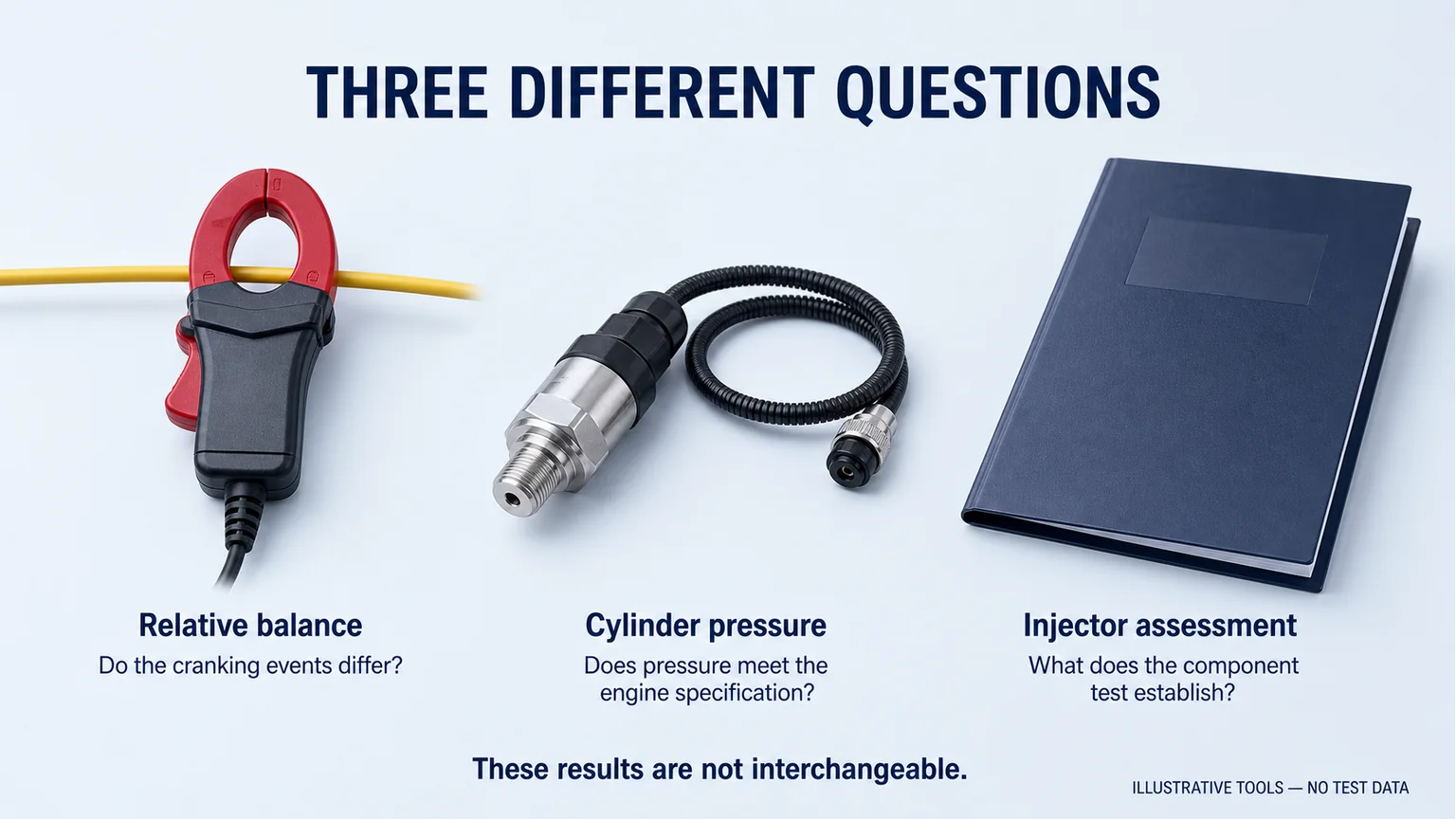
Three observations are often presented as if they mean the same thing: a cylinder contributes less torque while the engine runs, its cranking pattern differs from the others, or its injector has failed a specified test. They answer different questions. A contribution or cutout test concerns the running cylinder. Relative compression examines cranking behavior. An injector assessment concerns the identified component under a defined method.
If a job card says only “low cylinder, replace injector,” ask which test produced the finding and how the cylinder was identified. A mechanical sealing problem can affect the running cylinder without an injector fault. Conversely, a comparable cranking pattern does not establish that fuel delivery, electrical control or combustion is correct. The first job is to prevent these different observations from collapsing into one unsupported conclusion.
Pico Technology's heavy-duty relative-compression guide uses starter-current behavior to compare cylinders. It provides a method for directing investigation; it does not turn the waveform into an injector replacement instruction.
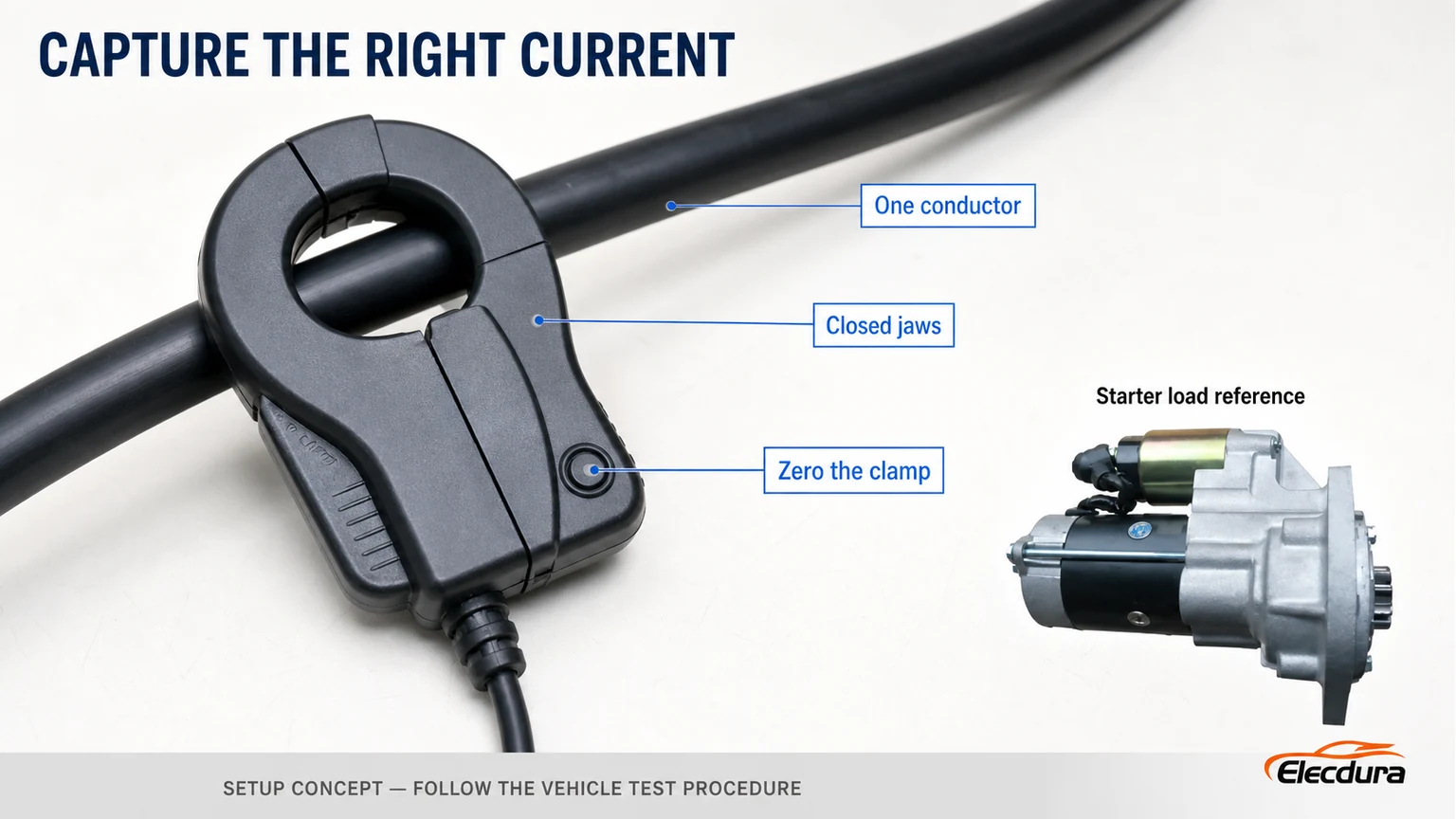
Illustrative measurement setup only. Cable routing, fuel disablement and test limits must follow the particular vehicle's service information.
Before drawing a conclusion, the technician needs a stable and correctly configured capture. Record the engine identification, symptom, engine temperature, battery arrangement, tool and measurement method. An automated ECU test and a scope-based starter-current test may display similar-looking percentages without calculating them in the same way. Name the test, not just its displayed result.
Heavy-duty battery installations may have parallel cables, multiple batteries or separate feeds. A clamp around one branch may not represent the entire starter load. Trace the accessible circuit using the wiring information and choose the measurement point prescribed by the tool and service procedure. Do not assume that the most convenient cable carries all the current of interest.
For a clamp measurement, confirm its range, zero adjustment, orientation and closed jaws. Enclosing outgoing and returning conductors together can cancel the magnetic signals the clamp is intended to measure. A trace captured this way is a setup problem, not evidence of good or bad cylinder compression. Use the vehicle-specific connection information; a generic diagram cannot identify the correct access point on every engine.
Use the approved procedure to prevent the engine from starting, secure the equipment and observe the manufacturer's cranking and cooling limits. There is no universal instruction to unplug an injector, remove a particular fuse or crank every diesel for the same duration. Those choices depend on the fuel system and test routine.
Check for a deteriorating battery supply, abnormal starter operation or an inconsistent capture before investigating cylinder hardware. If starting-system behavior is suspect, assess the supply path separately using the relevant vehicle procedure. A changing test condition can make comparisons misleading; correcting that condition is not the same as repairing the engine.
Preserve the original capture and repeat the approved test under comparable conditions when the result is questionable. Do not average incompatible cold and warm tests into a single apparently reassuring number. Record what changed and why a second capture was taken.
The important word is “relative.” A normalized display can set the strongest measured event to a reference level and compare the other events with it. That reference is not a measured compression pressure and does not establish that the strongest cylinder meets the engine specification. Pico Technology's compression-testing training explains this distinction and the need for a suitable reference when identifying cylinders.
A recurring feature can identify a place in the capture sequence without identifying the engine's cylinder number. The technician must relate it to a valid synchronization reference and the correct engine information. A software label such as A, B or C must not silently become cylinder 1, 2 or 3 on a purchase request. Document the numbering convention, reference signal and interpretation used.
If all events look alike, the method may have found no substantial difference under those conditions. It has not measured an absolute pressure for each cylinder. Similar mechanical deterioration across cylinders can therefore remain outside what the comparison establishes. This limitation is also described in AutoDITEX's Relative Compression Test overview. Use the applicable absolute or mechanical assessment when the symptom and engine history still warrant it.
Do not borrow a universal percentage spread from a generic tutorial. The tool's algorithm, capture quality and engine-specific procedure determine how a displayed result can be used. A percentage without those details is unsuitable as a procurement acceptance criterion.
The three assessments answer different questions. No measured waveform, pressure result or injector test result is represented in this illustration.
The best next test addresses the remaining uncertainty. Repeating several displays of the same underlying observation does not necessarily provide independent confirmation. The following situations illustrate how a workshop can keep its reasoning explicit.
Observed situation | Question still unanswered | Useful follow-up |
|---|---|---|
A repeatable relative-compression difference is tied to a cylinder. | Is mechanical sealing or valve operation responsible? | Perform the specified mechanical assessment for that engine before treating the finding as an injector fault. |
The relative pattern is comparable, but a running contribution test flags a cylinder. | What causes the running-cylinder difference? | Follow the engine-specific electrical, fuel-delivery and mechanical diagnostic sequence; do not infer a failed injector from contribution alone. |
Repeated captures change with battery supply or starter behavior. | Is the test repeatable enough to interpret? | Resolve or document the cranking-condition problem, then repeat the approved capture. |
An identified injector fails a relevant, documented component test. | Does the result justify this replacement, and is its identity correct? | Review the test's scope and the component identity before releasing the parts order. |
An injector result and an engine-mechanical result can both matter. Replacing a demonstrably faulty injector does not automatically address a separate mechanical defect. Likewise, finding a mechanical concern does not prove every injector is serviceable. Keep both findings on the repair record instead of forcing them into a single-cause explanation.
A report should identify the component tested, the method, relevant conditions and result. An unexplained pass label is not enough to connect a component finding with the engine complaint. High-pressure fuel-system work must use the applicable safe procedure; opening live fuel lines is not a diagnostic shortcut.
Do not begin or continue a cranking screen when the engine's condition makes cranking unsafe, or when the service procedure requires a different diagnostic sequence. Suspected liquid in a cylinder, mechanical interference, an unsafe starting installation or another stop-work condition calls for the relevant service instructions first. This article is not permission to crank through an abnormal mechanical condition.
The guide also does not supply acceptance limits for a particular engine, certify a used engine, or validate an injector calibration. Where the manufacturer specifies an automated diagnostic routine, dedicated adapters or a defined pressure procedure, use that information. A relative screen cannot replace a mandatory test merely because it is quicker to perform.
Once replacement is justified, send the parts team a concise statement of what was established and what remains unresolved. “Injector requested following component test; engine-mechanical concern still under investigation” is more useful than “bad cylinder.” It prevents a quotation from being mistaken for confirmation that the entire complaint will be cured.
Include the following information with the enquiry:
Engine manufacturer, exact model and serial or application identification, plus the vehicle or machine details.
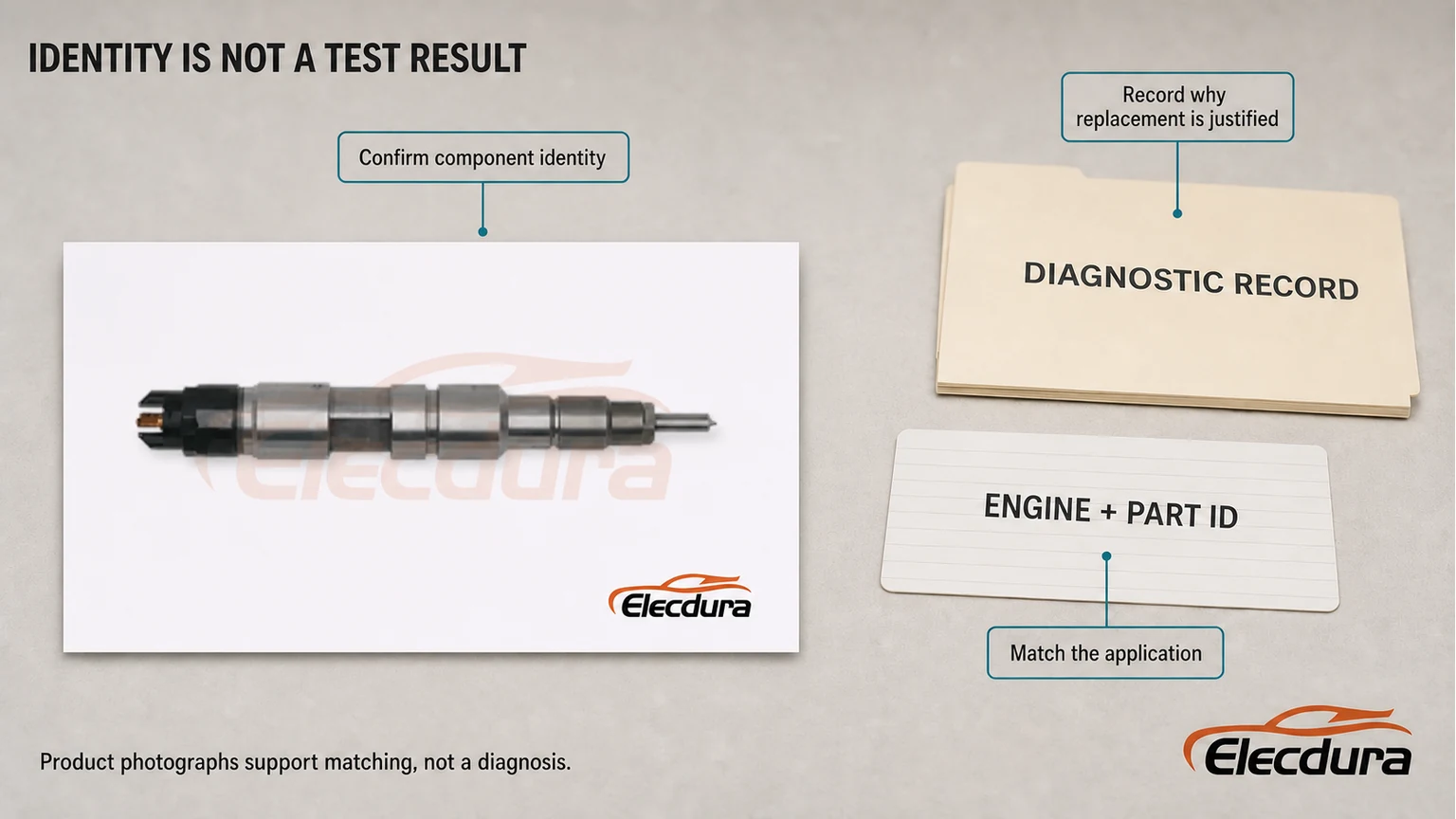
The complete injector reference and clear photographs of the existing component's label, connector and relevant interfaces.
The diagnosed cylinder, how it was identified, and the component-test or service-procedure finding supporting replacement.
Any specified coding, calibration or installation requirements that affect the ordered part or repair plan.
Quantity, destination market and required supply scope, distinguishing a complete injector from repair components.
A 0445120045 common-rail injector enquiry for a MAN application and a BEBE4D14101 unit-injector enquiry for a Volvo D16 application require different identity checks. These examples illustrate why “diesel injector” is not a complete specification; neither page makes the two systems interchangeable or guarantees fitment without application confirmation.
Product photography supports identification. It does not prove an injector's condition, calibration or compatibility with every engine in a vehicle family.
For a replacement enquiry, send Elecdura the injector reference, engine identification and supporting diagnostic information. State whether you need a quotation for an already identified part or help resolving the part identity. Keep the workshop's repair conclusion separate from the supplier's matching and availability response.
Only if their methods and reporting conventions are understood to be comparable. One tool may normalize starter-current events; another may use an engine-control routine with its own calculation. Obtain the tool identification, selected test and instructions explaining the output before comparing numbers. If those details are missing, use the reports as separate observations rather than combining them into a numerical trend. Agreement between two labels is not automatically independent confirmation of cylinder pressure.
Keep the cold result attached to the cold-start complaint. Record temperature and the relevant operating history, and follow the engine's prescribed investigation for that condition. A later warm capture may be informative, but it does not erase a reproducible cold symptom. The report should show which conditions produced each finding and whether the symptom was present. A parts decision based only on the more convenient warm test can overlook the actual complaint.
Removing a component that closes or accesses the combustion chamber can change the mechanical conditions of the test. Do not compare such a capture with an intact-engine relative screen as though nothing changed. Record the engine configuration and use the procedure intended for it. If an adapter-based pressure test is required, treat it as that separate method, including its specified preparation and interpretation. This is also why a test report needs setup information, not just a final graph.
Request the original saved capture or complete report, the tool and test name, engine identification, capture conditions and the technician's cylinder-identification explanation. A cropped screenshot may omit the scale, sequence, setup or observation that made the finding meaningful. If the original data cannot be recovered, record that limitation instead of presenting the image as complete diagnostic evidence. A clear written conclusion should state the next action and the uncertainty still remaining.
It can happen when several injectors are removed together and photographs, labels or reports are not linked to the individual components. Before using a bench finding to justify an order, reconcile the report's component reference and identifying record with the removed injector and its documented engine position. A report for a different unit cannot settle this unit's condition. The same traceability should follow any returned core, without treating the engine position alone as a unique part identity.