Your Whole New Supply Chain For Heavy-Duty Parts
Whatsapp:
+86 18915027366
Phone:
+86 18915027366
Views: 0 Author: Site Editor Publish Time: 2026-09-01 Origin: Site
Weak VGT-assisted exhaust braking does not prove that the turbocharger is defective. The engine first has to accept a braking request, command the variable-geometry system and receive a plausible response under conditions defined by its control strategy. An inhibited request, a wiring or actuator problem, a mechanical restriction and an air or exhaust fault can produce similar driver complaints. Preserve the operating conditions and diagnostic data, then follow the engine-specific test sequence. Replace an actuator or turbo only when the evidence identifies that repair scope; a dashboard switch position or a weak downhill sensation is not enough.
This guide is for fleet workshops, distributors and parts buyers reviewing a report that says an exhaust brake is “weak.” It treats the heavy-duty turbocharger category as a sourcing route after diagnosis, not as the starting assumption.
A driver feels vehicle deceleration, but the control system manages several steps before vane movement can contribute to braking. The useful question is therefore not “does the switch work?” It is “where did the requested action stop?” Record the selected braking mode, vehicle and engine conditions, warning messages, relevant codes and whether the complaint is repeatable in an authorized test.
Decision layer | Evidence to retain | What it cannot prove alone |
|---|---|---|
Request accepted | Applicable switch, enable and inhibit information | That the actuator moved |
Command and response | Engine-specific desired and actual data or approved functional test | That every mechanical passage is healthy |
Mechanical repair scope | Specified actuator, calibration and turbo inspection results | The root cause without related-system checks |
The table is an evidence order. It prevents a control complaint from jumping straight to the most expensive component.
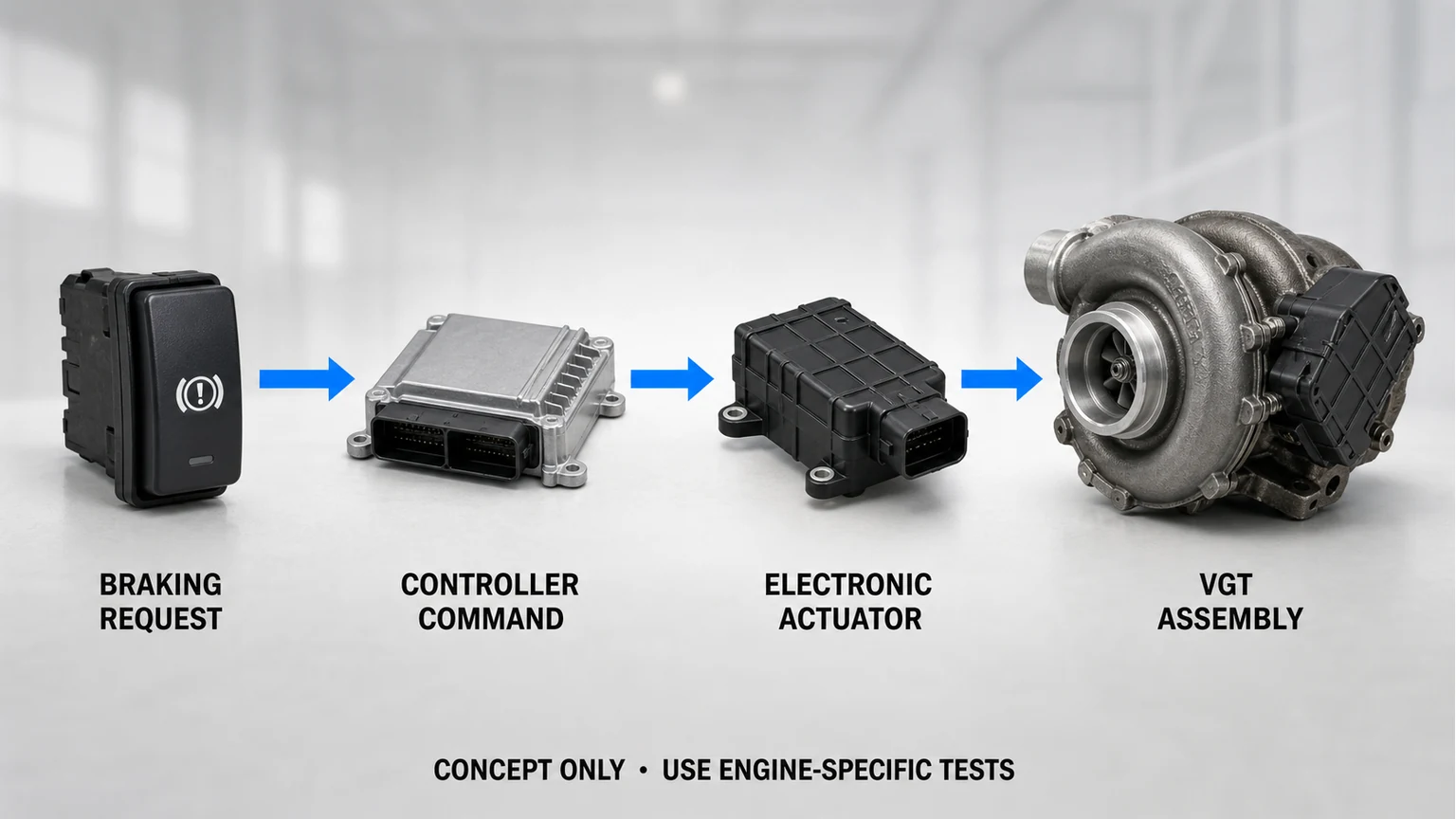
Conceptual signal chain only; the actual enable conditions, data labels and test functions depend on the engine.
Engine controls may inhibit or modify auxiliary braking for reasons that are not turbo failures. The exact conditions vary by platform and calibration. Do not copy an enable threshold from another engine family. Instead, use the applicable service information to determine whether the operating state should have allowed the requested mode.
Retain the complaint conditions before clearing codes or changing settings. Vehicle speed, engine speed, temperature, transmission state, brake inputs and other parameters may matter, but only the manufacturer documentation defines their use. If the control did not accept the request, an actuator replacement cannot correct that upstream decision.
“Engine brake” and “exhaust brake” are sometimes used loosely in work orders. A vehicle may combine different braking devices or control them together. Identify which system the diagnostic tool and wiring information are addressing. Otherwise, a failure in one subsystem can be attributed to a VGT simply because the driver used a common dashboard control.
Cummins describes VGT operation as changing the exhaust passage to support boost control and engine braking. That function does not make every response parameter universal. Use the supported diagnostic test for the exact engine and tool version, and record the requested function, observed response and test outcome in the language used by that procedure.
A commanded position with no plausible response can direct the next inspection, but it does not identify the failed part by itself. The signal path may include power, ground, communication, an actuator, a linkage or mechanism, depending on the design. A response value that appears to track also does not prove that the exhaust path produces the intended braking effect.
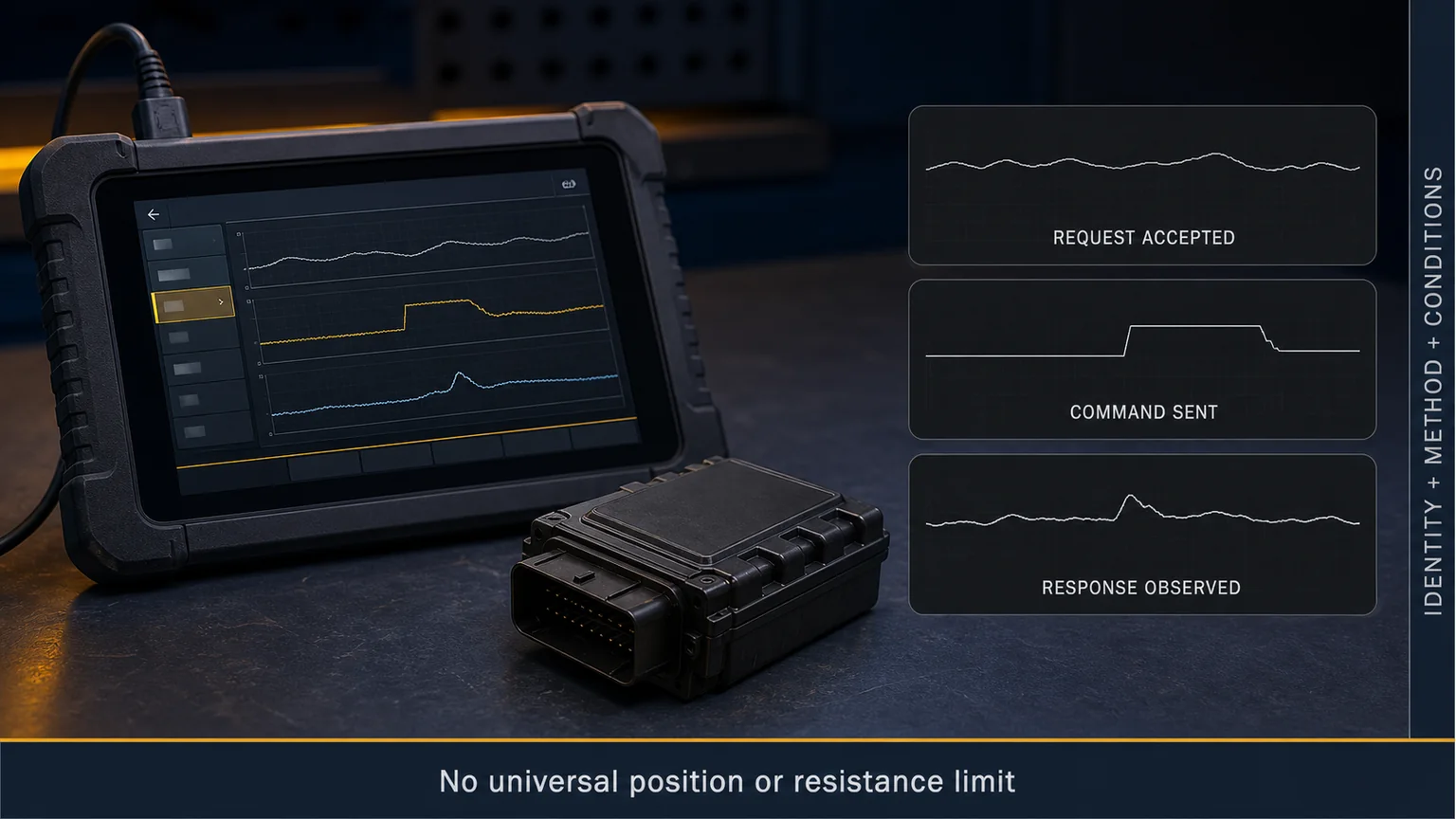
Use actual engine data names and limits. The illustration intentionally contains no pass value or generic vane percentage.
Competitor repair pages often publish connector pins, voltages or resistance figures from a single engine case. Those details can be useful inside that exact procedure but unsafe when transferred. Record the engine, control module and actuator identity before using any electrical specification. If those identities are absent, the result is not ready to support a part order.
When the control path justifies mechanical inspection, follow the approved actuator and turbo procedure. Determine whether the actuator is serviced separately, whether installation requires calibration, and whether the turbo mechanism can be assessed without damaging or misaligning the assembly. Do not force a linkage, rotate a powered actuator by hand or improvise a calibration.
Also inspect the related air and exhaust path specified by the diagnostic procedure. A leak, restriction or unrelated engine-performance problem can change the braking result even if an actuator moves. Conversely, residue or soot near a joint is an observation, not automatic proof of the complaint's cause. Confirm the defect by the applicable method.
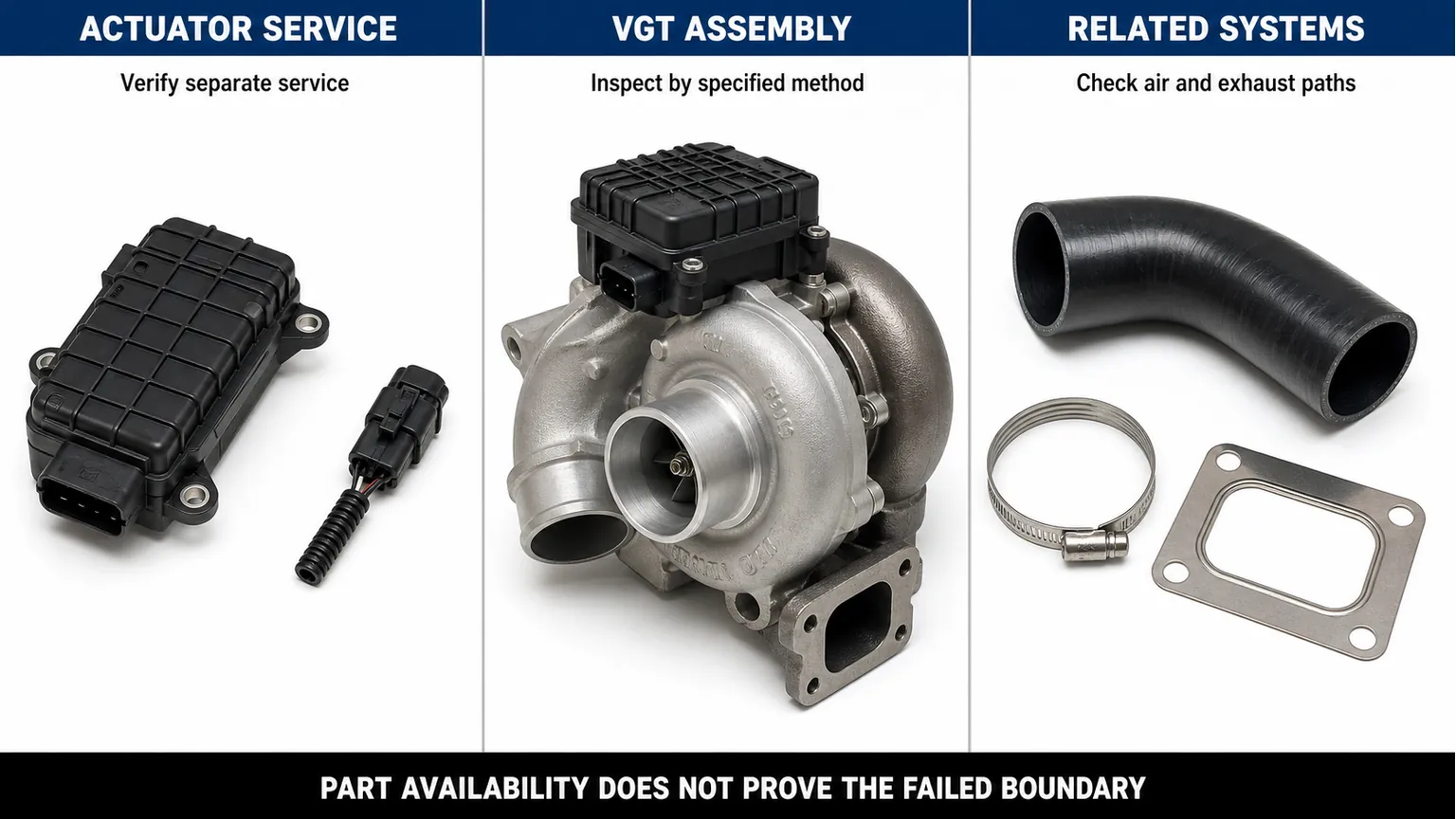
The repair boundaries are deliberately separate. Availability of one replacement option does not establish which boundary failed.
Auxiliary-brake testing changes vehicle deceleration and may require controlled operating conditions. Follow the fleet's safety plan and the manufacturer's procedure; this article does not recommend an improvised public-road test. If a supported stationary or service-tool test is available, perform it only under its stated precautions.
After repair, repeat the same relevant test and retain comparable data. A different route, load, temperature or braking mode may produce a different sensation without proving that the repair succeeded or failed. Use the engine's acceptance criteria, not a driver's memory of another vehicle.
This is not an instruction to alter emissions controls, recalibrate braking performance, continue with an overspeed or overtemperature warning, or operate a vehicle whose braking behavior is unsafe. It also does not cover a fixed-geometry turbo or a separate exhaust-brake valve that has merely been labeled “VGT” in a parts request.
If the turbo has confirmed wheel contact, severe oil loss or other critical damage, follow the applicable shutdown and failure-analysis procedure rather than repeatedly activating the brake to gather more data.
An actuator request should include the engine and turbo identification, actuator label, connector views, mounting relationship and the diagnostic or calibration result that supports separate service. A complete-turbo request needs the full turbo nameplate reference, engine arrangement, connection photographs, actuator inclusion and confirmed repair scope. The VGT actuator hysteresis and calibration guide can help explain why a calibration result must remain linked to the exact assembly.
If the evidence supports replacement, send Elecdura the confirmed assembly identity, quantity and destination for matching and quotation. A quotation confirms a supply option, not the original diagnosis.
Yes, but the absence of a code does not localize the fault. Confirm whether the request was accepted, compare the supported command and response data, and inspect the related air and exhaust path. The resulting evidence may justify an actuator, turbo or non-turbo repair; “no code” should neither certify the VGT nor condemn it.
Soot can identify an area for inspection, but earlier leakage or service contamination may remain after conditions change. Record the exact location, examine the joint and confirm leakage using the approved method. A confirmed pre-turbine leak can affect the investigation, yet it does not establish the condition of the actuator or every other joint.
Only the applicable service information can answer for that engine and turbo. Cummins supported-test documentation lists install and calibration functions for relevant applications, which is evidence that procedure and tool support matter. Do not infer that every actuator is self-learning or that every separate actuator is field-serviceable.
The data may show that a reported position follows a command without proving exhaust-flow effect, sensor accuracy or the health of related systems. Confirm the test's meaning, operating conditions and any specified mechanical or air-path checks. The next purchase decision should follow the failed boundary, not one apparently tidy data trace.
Retain its identification, installation and failure chronology, relevant codes and data, calibration or functional-test results, and photographs requested by the supplier. Ask for return instructions before dismantling or cleaning. This material helps a claim review but does not guarantee acceptance; the actual warranty terms govern the decision.