Your Whole New Supply Chain For Heavy-Duty Parts
Whatsapp:
+86 18915027366
Phone:
+86 18915027366
Views: 0 Author: Site Editor Publish Time: 2026-09-01 Origin: Site
Do not identify a C15 ACERT replacement turbo from the words “high pressure,” “low pressure” or “twin turbo” alone. First confirm the exact engine arrangement and whether it still has the original two-stage serial system. Then record each turbo's installed position, air-flow connections and complete nameplate information. In a serial arrangement, air passes through the low-pressure stage before the high-pressure stage, but product listings and modified installations can use inconsistent labels. Match the stage, assembly reference, interfaces and supplied equipment together; a similar cartridge or a URL containing “low pressure” is not sufficient evidence.
This article is for distributors and fleet parts teams converting a workshop photograph into a defensible purchase request. The heavy-duty turbocharger category is useful only after the requested stage and assembly scope are clear.
“C15 ACERT” covers more than one application and does not, by itself, prove a particular on-highway two-stage configuration. Caterpillar's C15 ACERT well-service engine page, for example, lists a single turbo. That industrial configuration is not a truck fitment reference; it demonstrates why the family name cannot replace the actual arrangement evidence.
Record the machine or vehicle, engine serial and arrangement information, emissions configuration where applicable, and whether the intake, exhaust or controls have been modified. Compare the installed layout with the authoritative parts and service information for that identity. If the system has been converted, describe what is present rather than ordering against the original marketing name.
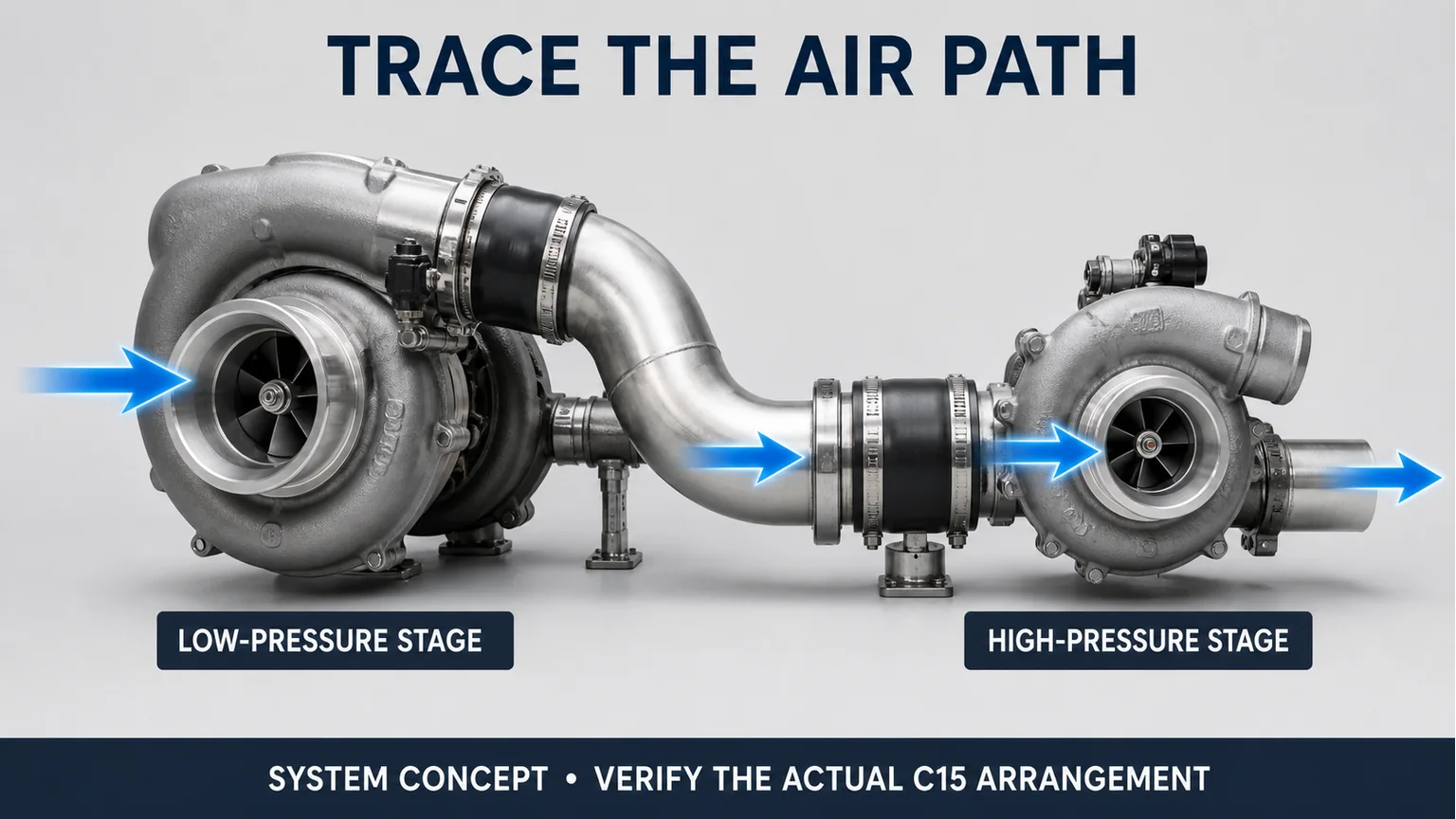
Serial-airflow concept only. It is not a universal C15 plumbing diagram or a stage-specific replacement reference.
Garrett's description of two-stage serial turbocharging explains the general sequence: the first compressor raises the intake pressure before air reaches the second compressor. In common high- and low-pressure terminology, the larger first stage is the low-pressure turbo and the following stage is the high-pressure turbo. That functional description helps locate a stage, but it still does not establish the exact C15 part number.
Begin at the clean-air inlet and follow the compressor connections. Note which compressor receives ambient filtered air, which outlet feeds the next compressor, and which outlet continues toward charge-air cooling or the engine. Then trace the exhaust connections with the system safely shut down and cool. Photograph a wide view before close-ups so each nameplate can be tied to its installed location.
Observation | Why it helps | Why it is not enough |
|---|---|---|
First compressor in the air path | Supports low-pressure-stage location | Does not identify its assembly reference |
Wastegate or actuator visible | Defines supplied equipment to compare | Is not a universal stage label |
Seller calls it HP or LP | Provides a claim to verify | Can be contradicted by the visible product and label |
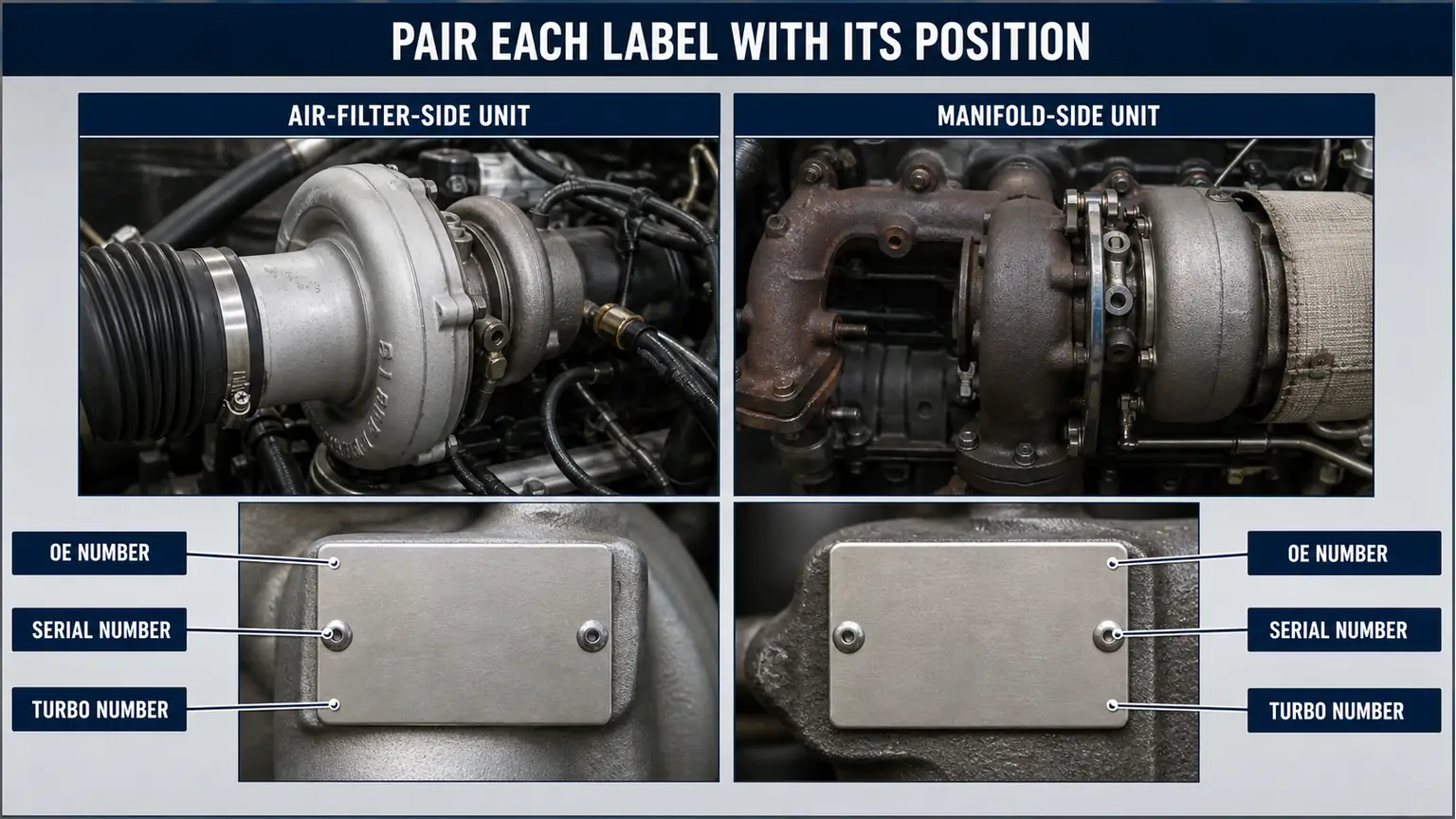
Photograph the nameplate or housing identification on each unit, then photograph the same turbo in the wider engine layout. A loose close-up with no location context can be assigned to the wrong stage. Keep the file names or inspection record explicit: for example, “air-filter-side turbo label” and “manifold-side turbo label,” provided those descriptions match the actual installation.
BorgWarner's identification guidance distinguishes the OE part number, serial number and turbocharger-maker number on its nameplates. Record every legible field exactly, including suffixes and separators. Do not merge fields into one guessed number, and do not discard a serial number merely because a catalog search does not use it.
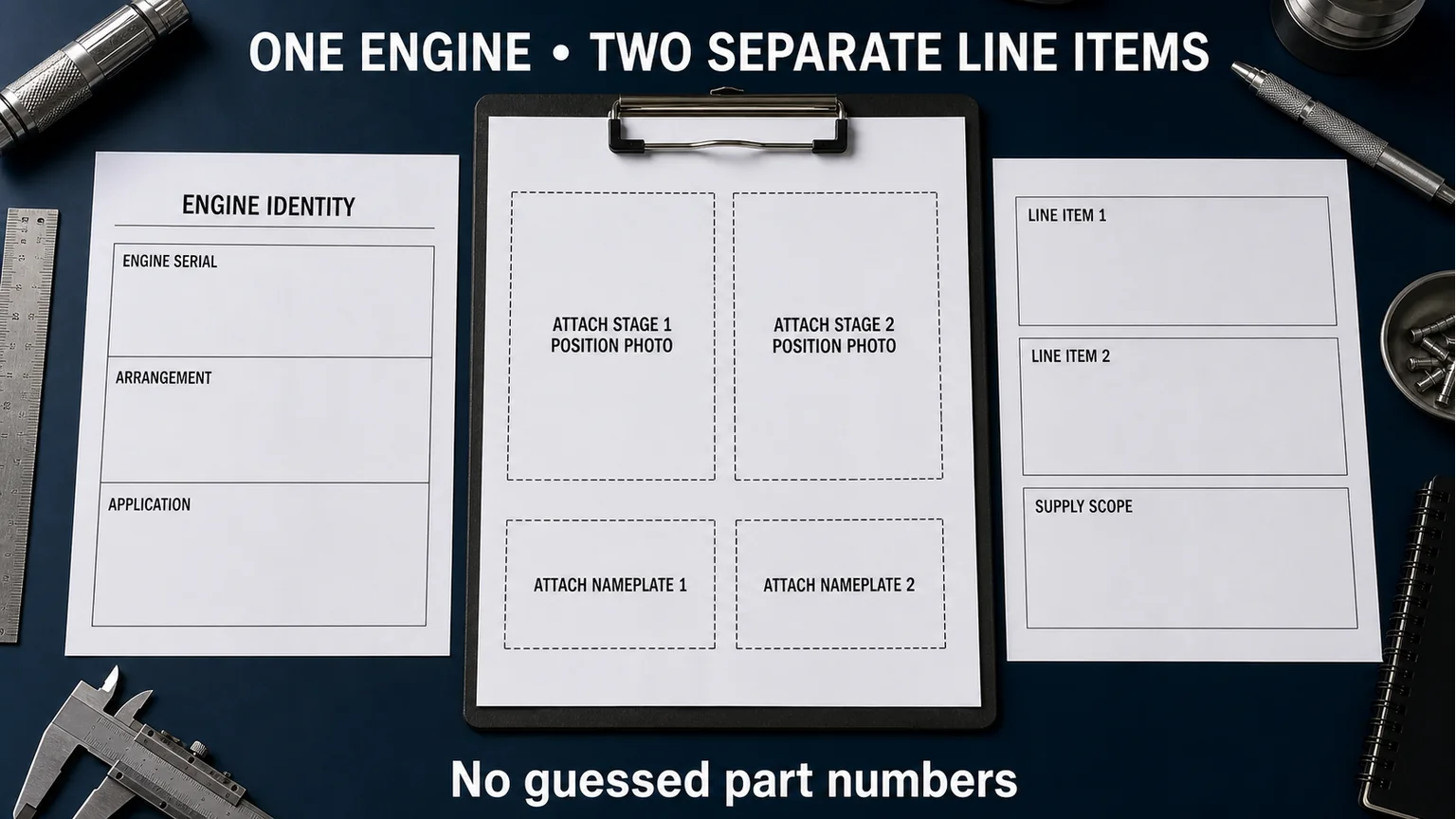
Illustrative record layout only. Use the actual labels, installed views and engine identity; the graphic contains no substitute part numbers.
One inspected competitor page used a URL that said low pressure while its visible H1 and body described a high-pressure unit. Another seller provided a useful stage table but limited the listed set to specific prefixes and excluded another application. These conflicts are a warning: keep the proposed seller reference separate from the removed unit's evidence until the match is resolved.
If one data source disagrees with the label or installed geometry, place the order on hold. Ask for the source of the cross-reference, compare supersessions in the applicable catalog and confirm whether the proposal is a complete turbo, a cartridge or a set. Do not resolve a contradiction by repeating the most common search result.
After identity, compare the features that affect installation. These can include compressor and turbine housing orientation, inlet and outlet connections, mounting flange, oil and coolant connections where applicable, brackets, wastegate or control equipment, and the items supplied with the assembly. Use the actual service and parts information to decide which dimensions or photographs are necessary.
A matching cartridge number does not automatically match the complete turbo. A cartridge leaves housings and external controls outside its supply scope. The complete-turbo versus turbo-core buying guide explains that commercial distinction; it does not authorize reuse of unassessed housings.
A complete evidence packet prevents the two stages from being reduced to one ambiguous “C15 turbo” line item.
A seller may offer the two units as a set, and a workshop may decide that system damage or policy justifies replacing both. Neither fact creates a universal rule. Preserve the diagnosis for each stage, the cause investigation and the condition of related piping, lubrication and air-filtration systems. If both are requested, state whether that is an engineering repair decision, a fleet policy or a contingency purchase.
Likewise, replacing one confirmed failed stage does not certify the other. The service process should inspect the related system and address the cause that produced the damage. The purchase request should not silently expand from one identified assembly to two.
This guide does not identify a turbo for a single-turbo C15 application, a converted engine, an emissions-deleted arrangement, an unidentified industrial engine or a system that no longer matches its original parts information. It also does not prescribe a high- versus low-pressure performance specification or authorize mixed-stage upgrades.
If wheel contact, severe oil loss or foreign-object damage is present, follow the manufacturer procedure for shutdown and root-cause inspection. Identification photographs should not delay a safety response.
For each requested unit, include the engine serial and arrangement information, installed stage and position, all label fields, wide and close photographs, connection and control details, quantity, destination and required supply scope. If two units are requested, create two separately identified line items and cross-reference them to the same engine rather than writing “C15 twin turbo set” with no evidence.
Send Elecdura the two-stage identification packet for matching and quotation. Any proposed cross-reference remains subject to confirmation against the removed assemblies and engine arrangement.
A prefix can narrow the applicable catalog path but should not replace the complete engine and arrangement evidence or the installed labels. Production changes, supersessions and modifications can alter the answer. Use the prefix as an index, then verify both stages and the proposed references before releasing the order.
Size can support the airflow interpretation in a known serial system, but visual size alone is not a purchase specification. Camera perspective, housing choice and unfamiliar configurations can mislead. Trace the compressor path, retain both labels and compare the applicable arrangement data.
Do not invent the missing characters. Supply engine identity, installed position, complete views of the housings and connections, and the readable companion-stage label. Ask the catalog or supplier to state how the proposed match was derived. Keep the order conditional until the unresolved assembly is identified by acceptable evidence.
No. A list may omit suffix conditions, supplied equipment or application boundaries. Trace the cross-reference to its source and compare the label, interfaces, orientation and control equipment. The result can support matching, but it does not establish the condition of reused parts or the diagnosis that led to replacement.
Only if a verified catalog relation identifies the correct cartridge and its application. The complete assembly number and cartridge number describe different supply scopes. Record both separately, confirm the housing and control reuse decision, and do not infer the internal core from a similar external housing.
Garrett Motion — Commercial Vehicle Two-Stage Serial Turbochargers.
Caterpillar — C15 ACERT Dry Manifold Well-Service Engine (used only to show that the ACERT name does not define one universal turbo arrangement).