ELECDURA NETWORK

Your Whole New Supply Chain For Heavy-Duty Parts
Whatsapp:
+86 18915027366
Phone:
+86 18915027366
Views: 0 Author: Site Editor Publish Time: 2026-08-31 Origin: Site
Direct answer: Receiving inspection for an actuator-equipped turbocharger must protect the calibrated relationship between the actuator and turbo mechanism. Verify the complete turbo and actuator numbers, label, mounting bolts, connector keying and pins, housing seal, lever and rod position, external damage, protective caps, and fitted packaging. Do not loosen actuator fasteners, force the lever, or power the unit with an improvised signal. If the purchase specification requires calibration-state evidence, use the approved diagnostic or controlled fixture method for that exact assembly and quarantine any unexplained position, connector, seal, or packaging difference.
This receiving workflow protects the calibrated relationship between the actuator and the turbo mechanism. Keep the actuator mounted and review three distinct evidence groups: identity and transit protection, connector and linkage condition, and any approved non-destructive state check. The heavy-duty turbocharger catalogue helps identify candidates, but release depends on the exact pairing, undisturbed hardware, traceability, and controlled inspection evidence.
Inspection lane | Permitted evidence | Immediate quarantine trigger |
|---|---|---|
Identity | Complete turbo and actuator numbers | Confirms the calibrated assembly under review |
Non-destructive visual | Connector, seal, bolts, lever, rod | Finds damage without disturbing calibration |
Controlled state check | Approved diagnostic or fixture method | Supports calibration state under defined conditions |
Packaging and lot | Restraint, shock protection, traceability | Prevents transit damage from entering stock |
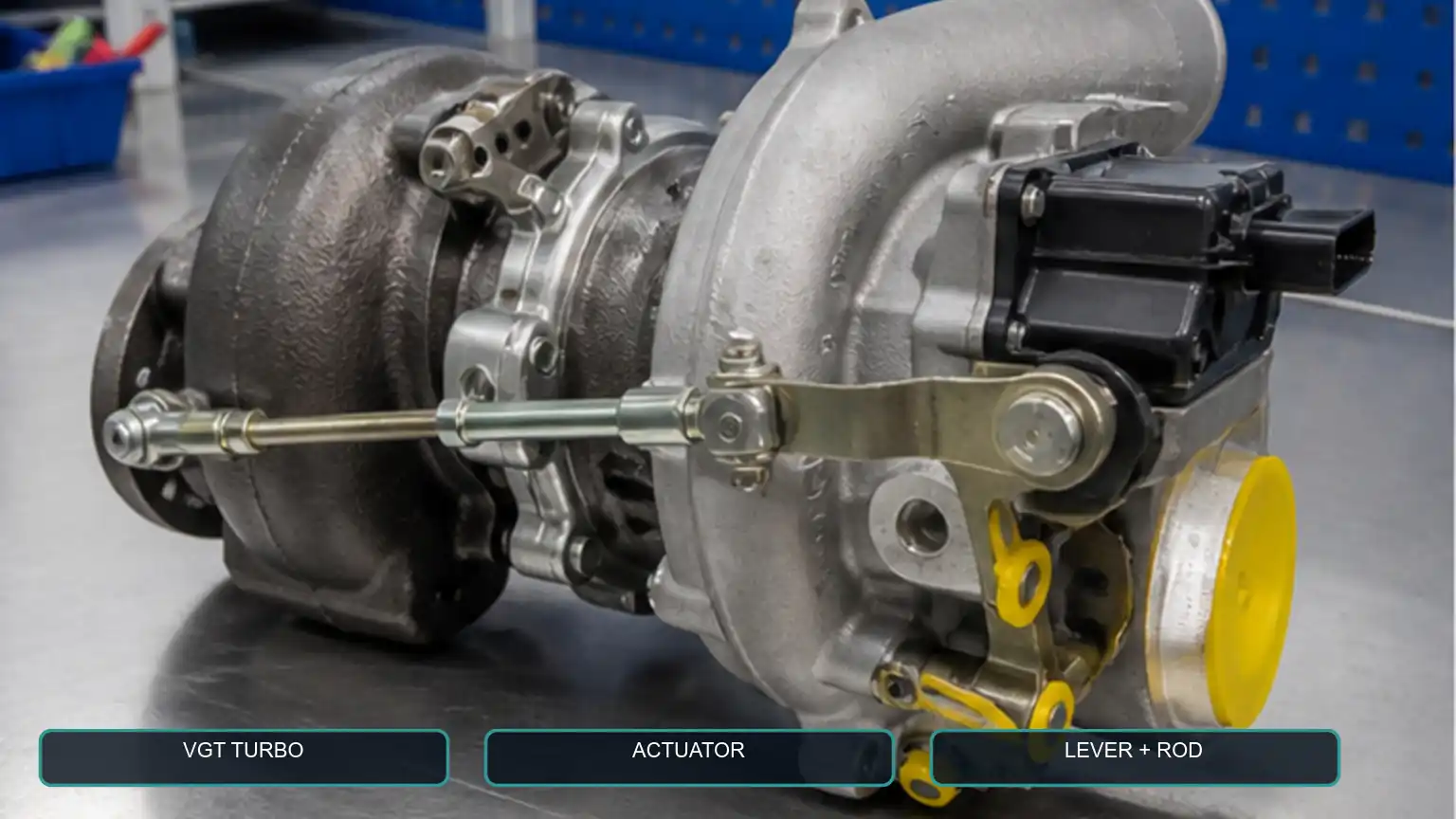
Complete VGT heavy-duty turbocharger with electronic actuator, lever, rod, connector, and protected ports visible.
Record the turbo assembly number, actuator number, customer reference, serial or date information, declared condition, and supplier lot. Photograph the complete unit and the actuator-to-turbo mounting relationship before handling.
Do not approve an actuator only because its connector or housing resembles the expected unit. The lever geometry, mounting calibration, software or control compatibility, and complete turbo configuration may differ. The receiving identity must remain tied to the complete calibrated assembly.
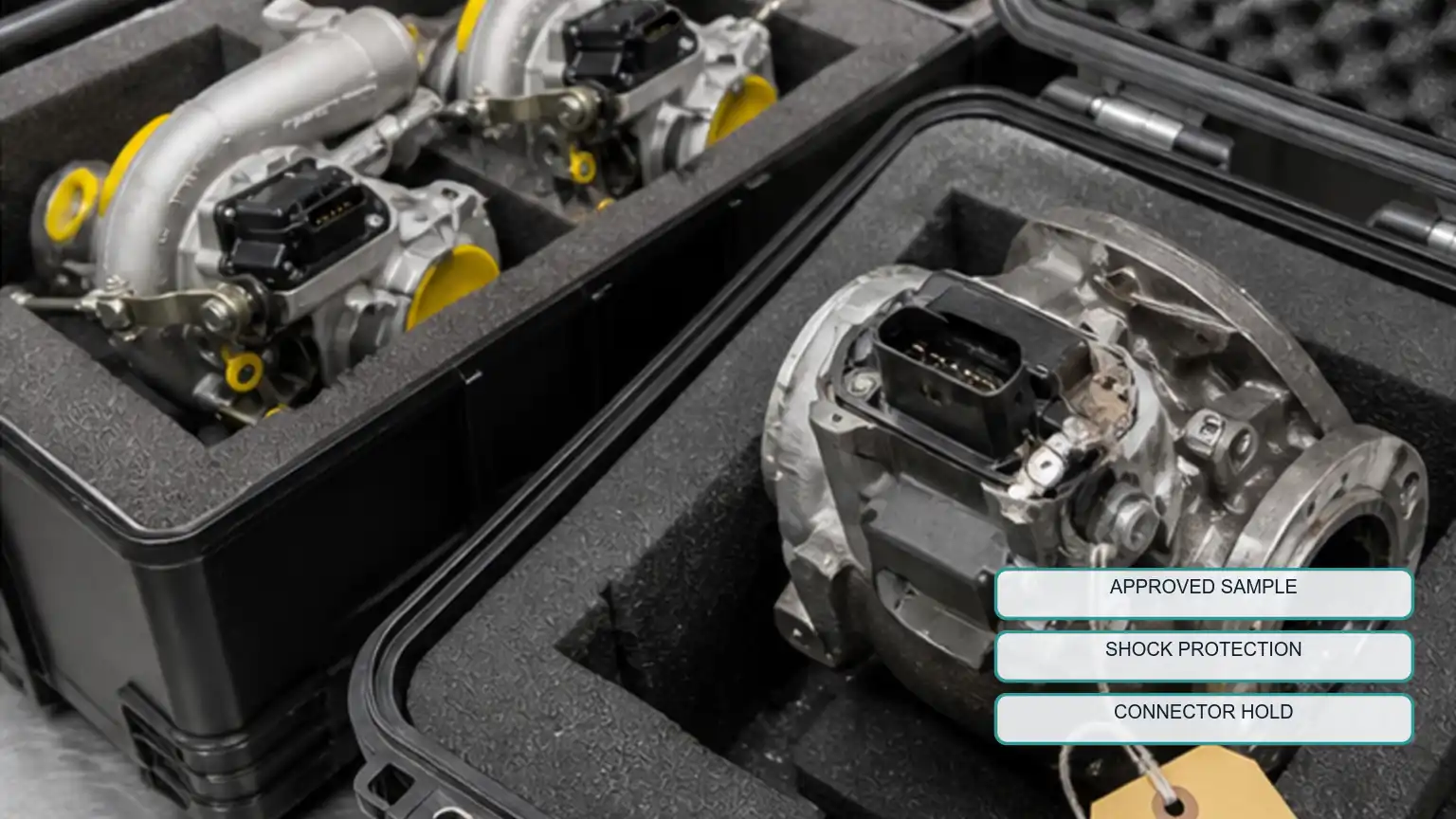
Check fitted supports, shock and vibration restraint, connector protection, lever clearance, port caps, moisture control, carton identity, and evidence of crushing or impact. The actuator and lever should not carry carton loads. If one unit has a broken connector, displaced lever, loose fastener, or crushed support, expand sampling according to the approved plan and investigate the packaging cause. Transit protection is part of actuator quality because damage can alter the calibrated assembly before installation.
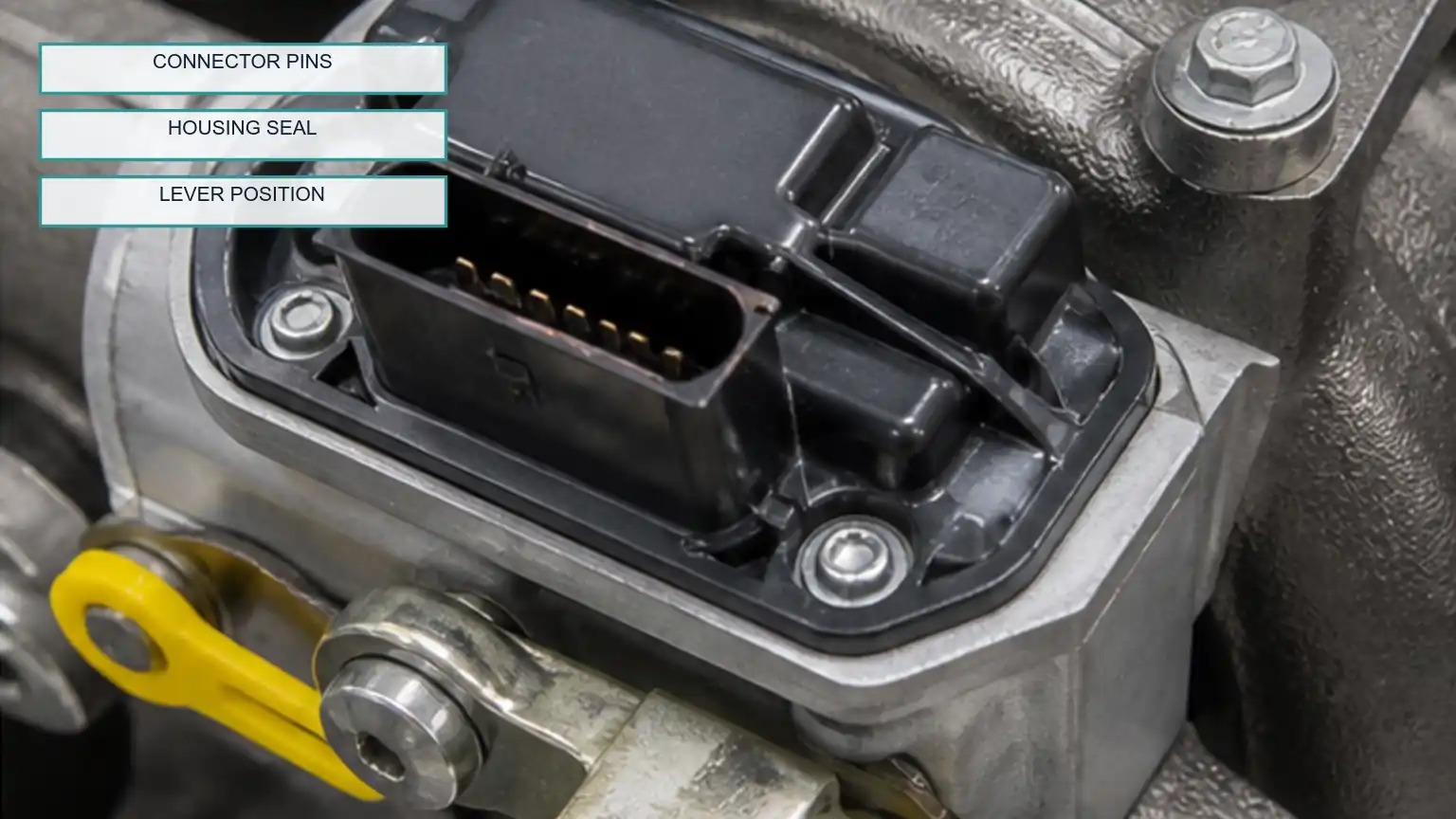
Turbo actuator connector pins, housing seal, mounting bolts, and lever position inspected without disassembly.
Use suitable lighting and magnification to check connector keying, pins, pin alignment, contamination, moisture, cracked plastic, housing seams, tamper evidence, fasteners, and seals. Keep protective plugs installed until the controlled inspection requires removal.
Compare with the approved sample and photographs. A damaged connector can create an intermittent fault even when the actuator housing appears intact. Any connector or seal damage is a quarantine condition until disposition is documented.
Observe lever, rod, clips, joints, stop position, corrosion, impact marks, and relationship to the turbo mechanism. Photograph the as-received position and compare it with the approved assembly.
Do not use pliers or hand force to move an electronic actuator. Do not loosen mounting bolts to align a lever. These actions can disturb calibration or damage the gear train and make the original state impossible to assess. Position evidence must be collected without changing the calibrated relationship.
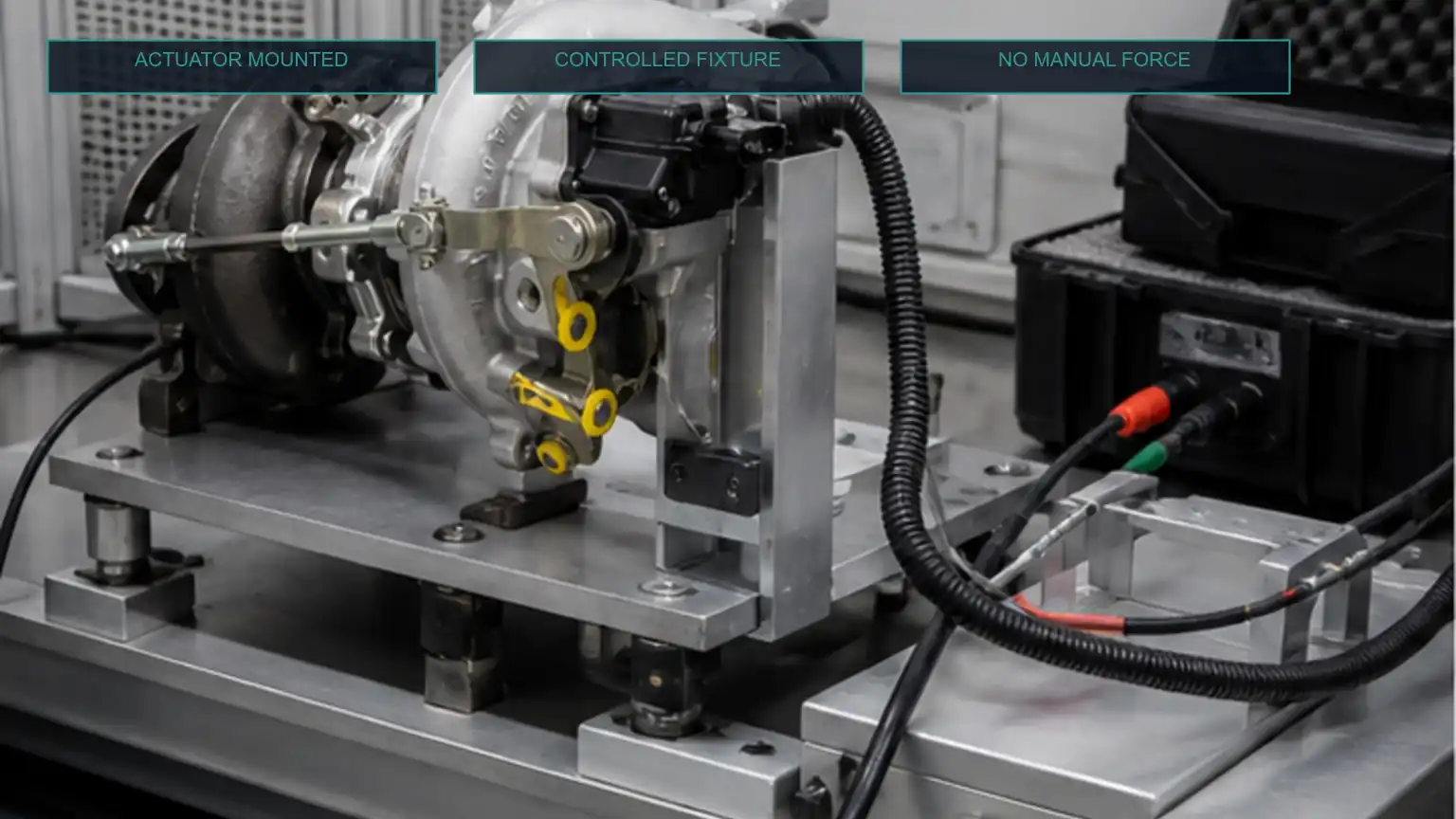
Mounted electronic turbo actuator undergoing a protected non-destructive calibration-state verification on a fixture.
If required, follow the turbo or actuator maker's approved diagnostic, pairing, or fixture method using the correct power, communication, adapters, software, and limits. Record the assembly identity, tool, method, state, result, and reviewer.
An improvised voltage supply or generic sweep command can overdrive the mechanism or create a misleading result. A no-fault message also does not prove the entire turbo is correctly matched to an engine. A controlled state check supports receiving; it does not replace application calibration and installation procedures.
Release only units that match the approved identity, non-destructive visual fields, required state evidence, and packaging standard. Quarantine mixed numbers, tamper evidence, unexplained lever positions, damaged connectors, loose actuator bolts, missing caps, or unclear condition. Keep supplier lot, unit serial or sample ID, photographs, inspection result, retained sample, installation feedback, and claim route together. Reopen qualification if the actuator, connector, software, packaging, or source changes. A receiving pass must remain traceable to the exact turbo and actuator, not only the carton label.
Actuator-equipped turbochargers reviewed in fitted packaging with one damaged connector unit quarantined.
Supplier comparison may use the turbocharger supplier guide, but release still depends on the exact turbo-actuator pairing, connector, linkage, transit protection, approved state check, and lot traceability.
A matching connector does not prove actuator calibration or turbo application.
A no-fault diagnostic state does not prove full turbo performance on the engine.
External appearance cannot prove internal gear condition after impact.
Forcing the actuator lever by hand
Loosening actuator mounting bolts during receiving
Applying improvised voltage to make the actuator move
Releasing units with damaged packaging because the housing looks intact
Use the turbo or actuator maker's controlled pairing, calibration, installation, and service procedure for the exact assembly. This receiving guide does not authorize actuator disassembly, manual adjustment, improvised actuation, or calibration changes.
Complete turbo, actuator, and lot identities
Connector keying, pins, cleanliness, and protection
Housing seams, seals, fasteners, and tamper evidence
Lever, rod, clips, position, and impact inspection
Approved diagnostic or fixture method when required
Fitted packaging, shock protection, caps, and carton identity
Release, quarantine, traceability, and change-notice record
Send Elecdura the complete turbo and actuator numbers, connector and lever photographs, application, required condition, inspection fields, quantity, and destination. The RFQ can define the non-destructive evidence needed before the lot is released. Continue through the turbo actuator RFQ with the evidence named in this guide.
Do not force the lever, rod, or actuator output to see whether it moves. The actuator geartrain and the vane or wastegate mechanism form a calibrated relationship, and manual loading can damage gears, shift a setting, or create misleading position evidence. Keep the actuator mounted and inspect the visible linkage without applying motion. Functional or position checks should use only the approved diagnostic or fixture method for the exact turbo-actuator assembly.
No. The actuator number identifies one component and may be used across several turbo assemblies or calibrations. Record the complete turbo assembly number, actuator number, serial or date fields, connector, bracket, lever or rod geometry, and the physical pairing as received. Compare those fields with the application and approved reference. An actuator that looks correct or plugs in cannot establish wheel, housing, vane, calibration, or engine-control compatibility.
Do not apply uncontrolled voltage, polarity, current, or a guessed command signal. An electronic actuator may require a specific supply, communication protocol, initialization, position range, or load relationship with the mounted turbo. An improvised test can damage electronics or move the mechanism outside its controlled state. Use the maker's approved diagnostic tool or validated fixture and record the assembly identity, procedure, command state, response, and test limits.
Quarantine crushed or displaced supports, contact marks on the actuator, lever, rod, connector, or housing, broken connector locks or pins, missing protective caps, moisture, corrosion, loose fasteners, impact marks, and any assembly that could move inside the carton. Photograph the packaging before handling and keep it tied to the unit and lot. Do not straighten a lever or reconnect damaged parts before the supplier and technical reviewer can inspect the original evidence.
No. It shows only that the actuator and mechanism responded within the approved check under the stated conditions. Engine fitment still depends on the complete turbo number, application, control strategy, calibration, connector and harness, manifold and outlet geometry, oil and air paths, and installation procedure. Preserve the state-check record as incoming evidence, then close application matching and commissioning separately. A passing bench state must not be generalized into an engine approval.