ELECDURA NETWORK

Your Whole New Supply Chain For Heavy-Duty Parts
Whatsapp:
+86 18915027366
Phone:
+86 18915027366
Views: 0 Author: Site Editor Publish Time: 2026-08-28 Origin: Site
Direct answer: After an engine swap, the vehicle model and the replacement engine serial number are both incomplete turbocharger identifiers. Reverify the complete turbo assembly number, exhaust-manifold flange, turbine outlet, compressor inlet and outlet, housing clocking, oil-feed and drain geometry, coolant ports, actuator type and connector, charge-air plumbing, exhaust aftertreatment, and installed clearance. Confirm that the engine calibration and control system support the proposed actuator and turbo configuration. If pipes, oil lines, brackets, or wiring must be forced to fit, stop and resolve the system mismatch before installation.
A repower changes the question from “Which turbo fits this vehicle model?” to “Which complete turbo integrates with this engine and this chassis?” Compare the replacement engine and calibration with the actual exhaust, intake, lubrication, coolant, actuator, wiring, aftertreatment, and clearance interfaces. The heavy-duty turbocharger catalogue can narrow candidates only after that system-level delta is recorded.
Changed system | Evidence to compare | Fitment risk |
|---|---|---|
Engine identity | Serial, arrangement, calibration | Defines the engine-side turbo requirement |
Complete turbo ID | Assembly label and actuator | Separates full unit from shared casting marks |
System interfaces | Flanges, clocking, oil, coolant, air | Proves physical integration |
Control and clearance | Harness, calibration, pipes, heat shields | Prevents forced installation and control faults |
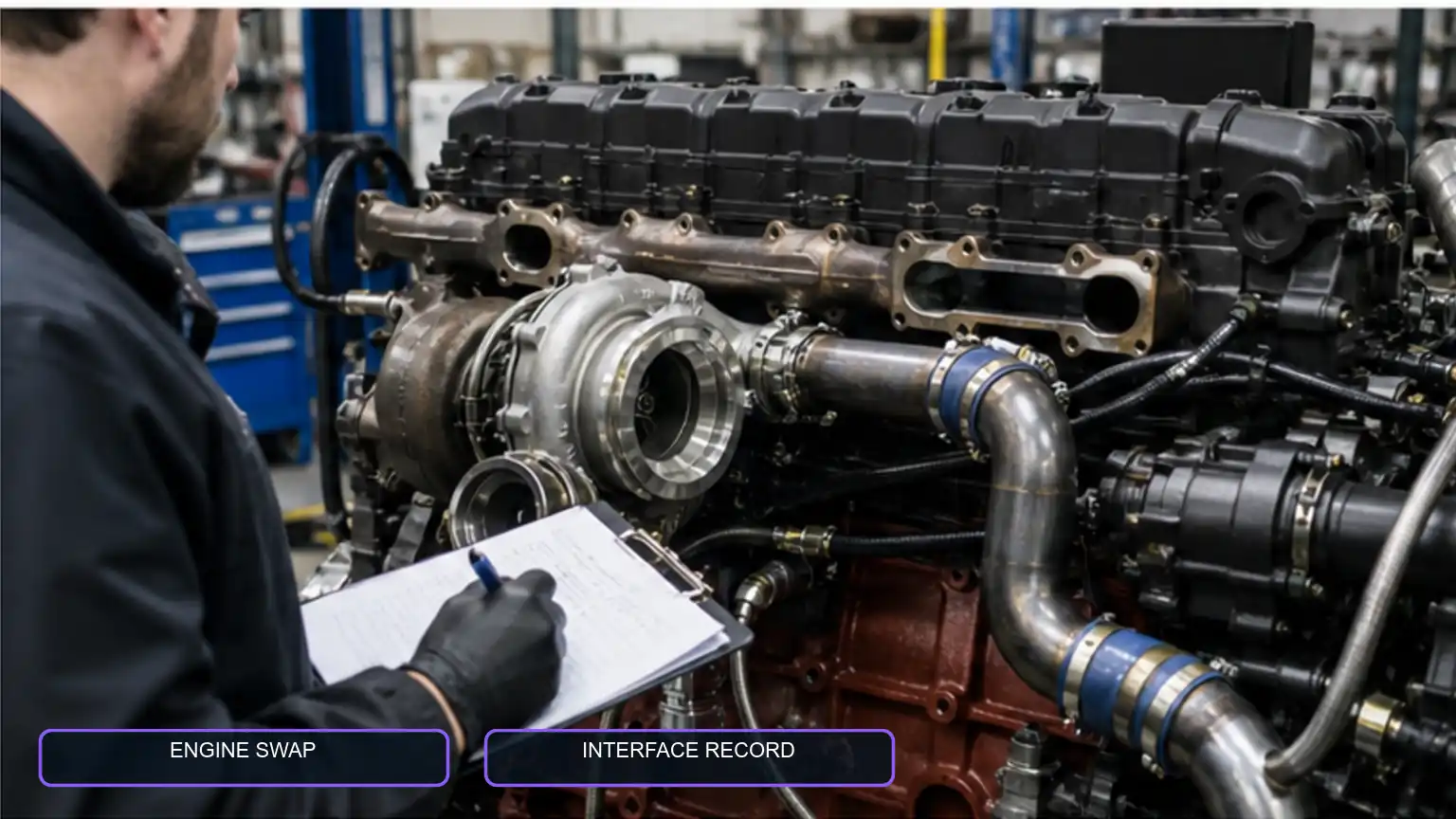
Technician documenting turbocharger, manifold, oil-line, and charge-air interfaces after a heavy-duty engine swap.
Record engine maker, model, serial, arrangement or build list, calibration, emissions configuration, and the donor or reman source. Compare this with the host vehicle's control system, exhaust aftertreatment, charge-air package, and prior conversion documentation.
Do not search the turbo only by vehicle model after the original engine has been removed. The same engine family may use different complete turbo assemblies across power ratings, emissions levels, actuator strategies, and industrial or on-highway applications. The engine-side requirement must be established before vehicle-side plumbing is used to choose a turbo.
Photograph the maker's identification plate or tag and record the complete assembly number, customer number, serial information, and actuator identity. Keep housing casting marks as secondary observations because the same casting can be used on different calibrated assemblies.
Inspect whether housings, actuator, lever, compressor wheel, turbine housing, or ports have been mixed during an earlier repair. A complete-unit number is useful only when the hardware still represents that assembly. A casting mark alone cannot close a turbocharger match.
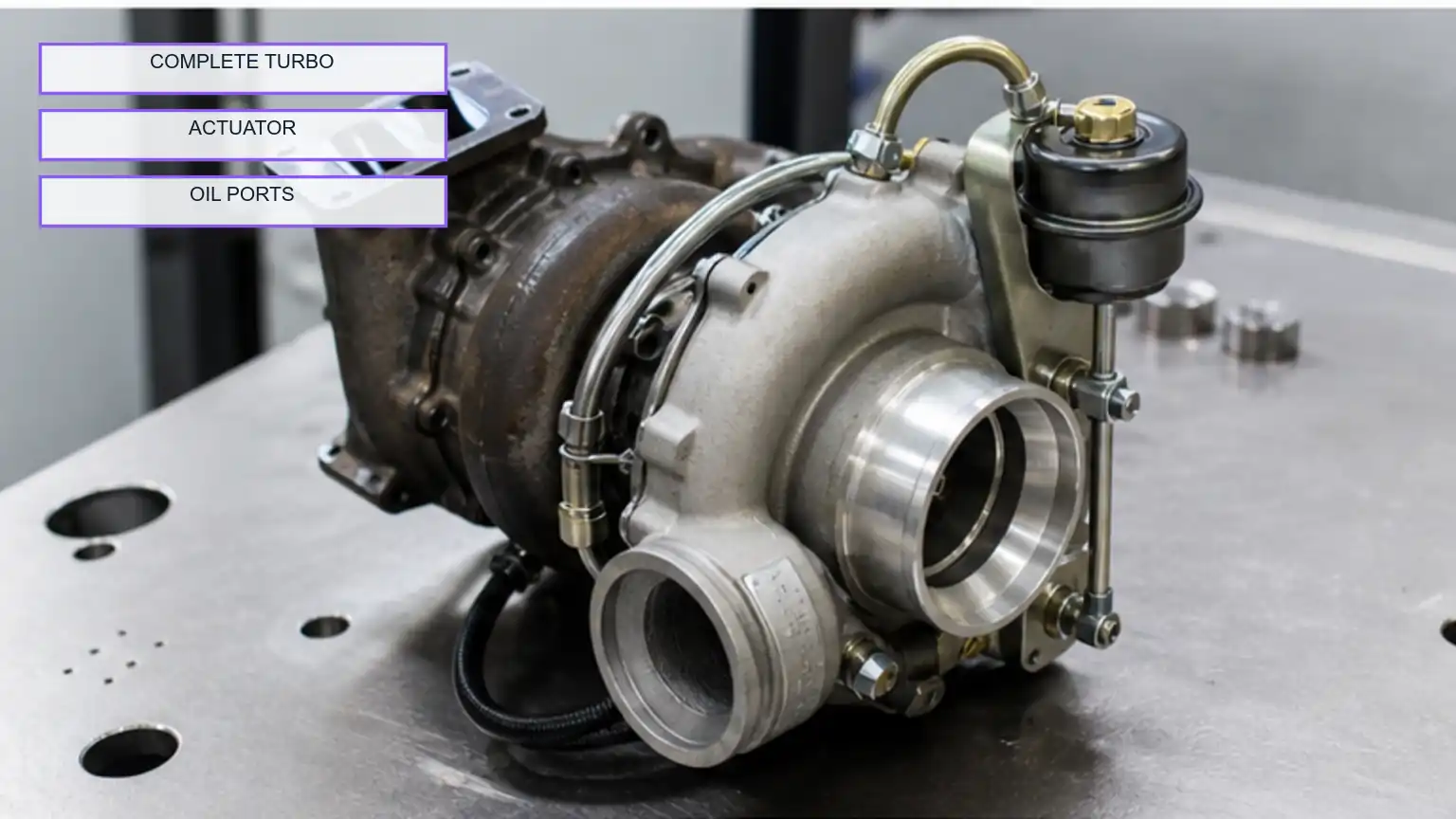
Complete actuator-equipped heavy-duty turbocharger positioned for full assembly identification.
Compare the exhaust-manifold flange, turbine outlet, compressor inlet and outlet, fastener orientation, v-band or bolt pattern, housing clocking, brackets, heat shields, and service access. Record where the candidate sits relative to the block, frame, cab, filters, and wiring.
Do not rotate housings or actuator brackets casually. Any permitted clocking change must preserve oil-drain orientation, actuator calibration, compressor and turbine clearances, and the maker's installation limits. Forced pipes or altered actuator geometry are mismatch signals, not installation techniques.
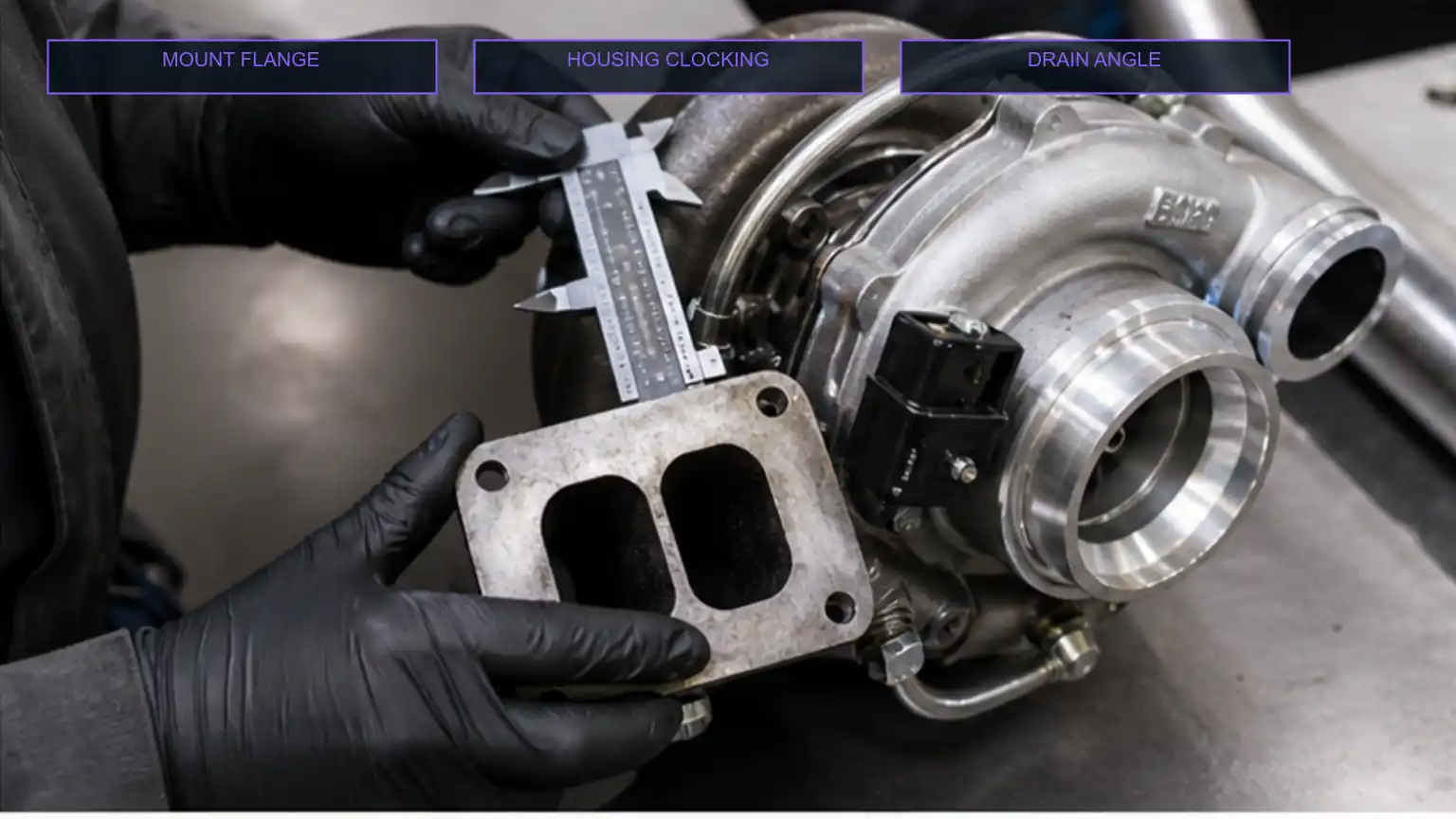
Turbocharger mounting flange, housing clocking, compressor outlet, and oil-drain angle checked during fitment review.
Verify oil-feed source, line size and routing, cleanliness, restrictions, drain diameter and downward path, crankcase pressure context, and any coolant connections. Replace or clean lines only according to the applicable service information.
Mock up compressor inlet, charge-air outlet, clamps, hoses, filter, intercooler path, and manifold connection. Check for debris, leaks, collapsed hoses, and old-system contamination that could damage the replacement. The turbo is only one component in the lubrication and air system; system evidence must accompany the part match.
Identify pneumatic, vacuum, mechanical wastegate, electronic wastegate, or VGT actuator type, connector, lever geometry, harness, and controller. Confirm the engine calibration and diagnostic system support the proposed complete assembly.
Do not loosen an electronic actuator or force its lever to make a different turbo appear compatible. Garrett warns that actuator fasteners can be calibration-sensitive; follow the turbo maker's procedure for any actuator work. A connector that plugs in does not prove the calibration, range, lever, or control strategy is correct.
Before installation, inspect the candidate, protective caps, wheel condition, ports, fasteners, and documentation. Prime and install only by the applicable maker procedure, keeping oil, coolant, intake, exhaust, and charge-air paths clean and correctly supported.
During the first run, observe oil and coolant leakage, abnormal noise, charge-air joints, actuator or fault behavior, smoke, boost response under approved conditions, and post-run fastener or hose condition. Do not use an uncontrolled overspeed or free-rev test. A successful first start supports the installation record but does not erase unresolved calibration or duty questions.
Save the engine identity, turbo assembly number, interfaces, clocking, line and pipe changes, actuator information, installation procedure, first-run result, and approved deviations. Photograph the final routing so a later repair does not reconstruct the conversion from memory. Use the record for future orders and receiving inspections. If the engine calibration, charge-air package, aftertreatment, or turbo source changes, reopen the fitment review. The controlled repower record becomes the application truth for later service.
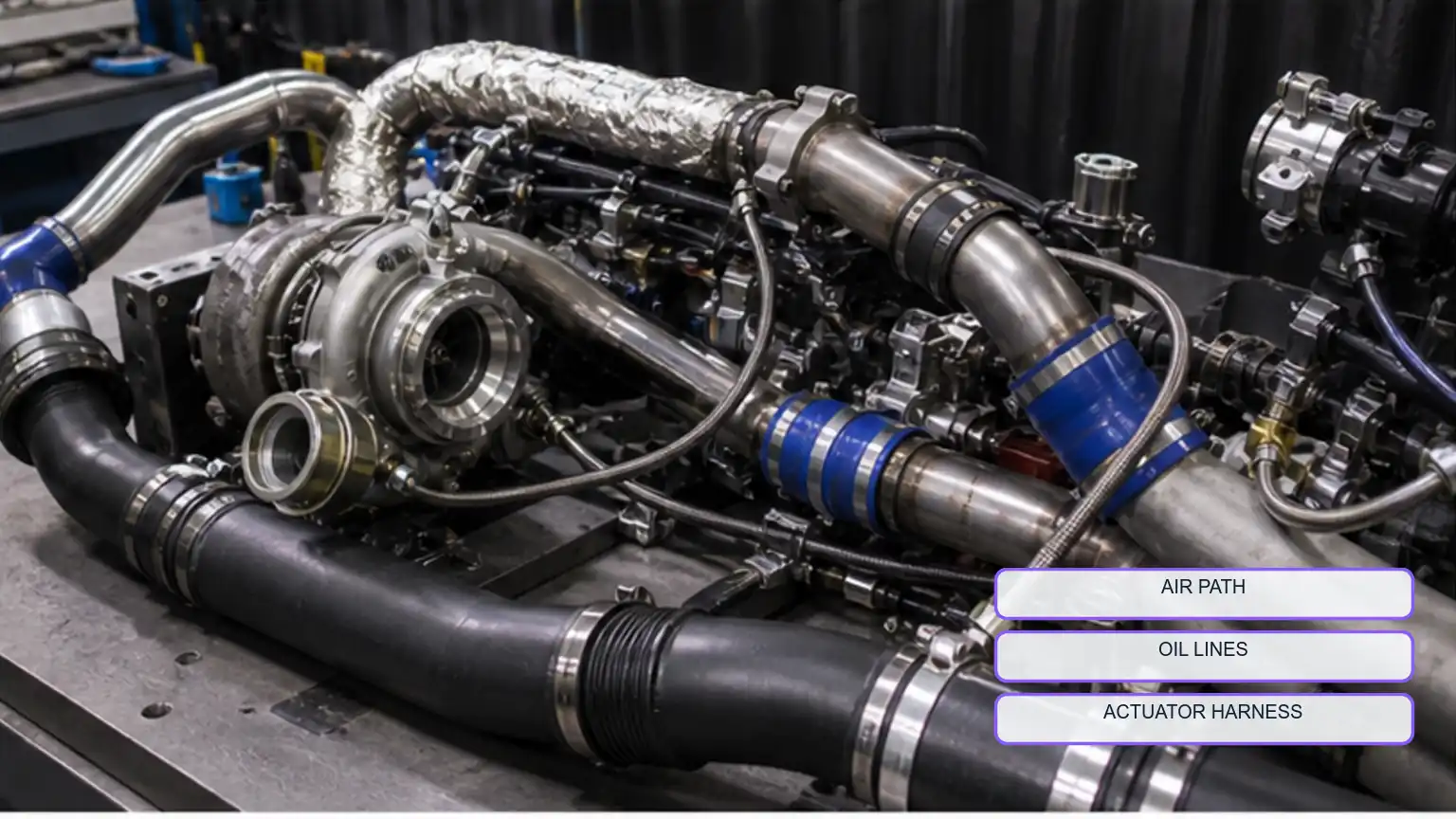
Candidate heavy-duty turbocharger staged with charge-air pipes, oil lines, clamps, and actuator wiring before installation.
Supplier research can begin with the turbocharger supplier guide only after the replacement engine, complete turbo identity, actuator, flange, clocking, lubrication, air path, and control requirements are documented.
A vehicle model does not identify the turbo after an engine conversion.
A housing casting number does not identify a complete calibrated assembly.
A successful connector fit does not prove actuator calibration or engine-control compatibility.
Matching the turbo to the original vehicle engine
Forcing oil drains or charge-air pipes into position
Loosening actuator fasteners to change lever position
Ignoring old-system debris or oil-line restrictions
This guide does not approve an engine repower, emissions modification, calibration change, or custom turbo upgrade. Those decisions require the responsible engine, vehicle, regulatory, and engineering procedures. Use this workflow to document compatibility inside an already authorized conversion scope.
Replacement engine serial, arrangement, and calibration
Complete turbo and actuator identities
Manifold and outlet flange comparison
Housing clocking and installed clearance
Oil feed, oil drain, coolant, intake, and charge-air paths
Actuator connector, lever, harness, and control strategy
Clean installation, first-run evidence, and repower record
Send Elecdura the replacement engine identity, complete turbo number, actuator details, flange and clocking photographs, oil and air-path layout, required condition, quantity, and destination. The RFQ can then be reviewed as a repower configuration rather than a vehicle-model lookup. Continue through the turbo fitment RFQ with the evidence named in this guide.
No. After a repower, the vehicle model describes the chassis history but may no longer describe the engine-side turbo requirement. Start with the replacement engine serial, arrangement, calibration, and manifold configuration. Then map the host vehicle's exhaust, intake, charge-air, lubrication, coolant, actuator, wiring, and clearance interfaces. The correct candidate must satisfy both sides of the conversion; neither the original vehicle catalog nor the engine catalog alone can close the fitment.
Usually not. A casting number can identify a housing family that is used across several complete assemblies with different wheels, turbine housings, clocking, wastegates, VGT mechanisms, actuators, or calibrations. Use the nameplate or engraved complete-assembly number as the primary identifier, then verify the observed components and interfaces. A casting mark can narrow the search, but it should not be converted into an orderable turbo identity without independent assembly evidence.
Only when the exact turbo maker's procedure explicitly permits that change. Reclocking can affect oil-drain orientation, compressor and turbine clearances, actuator bracket geometry, wastegate or VGT calibration, fastener position, and pipe support. Do not loosen calibration-sensitive actuator hardware or force oil and charge-air pipes into alignment. If an approved clocking procedure exists, record the original and final positions, required fasteners or torque instructions, and the resulting clearances.
Do not force the lever or use it as a convenient handling point. The actuator, rod, geartrain, and vane mechanism form a calibrated relationship, and impact or manual movement can create damage that was not present before inspection. Keep the actuator mounted, protect connector pins, and use only the approved diagnostic or fixture procedure for the exact assembly. Visual position evidence is useful, but it does not authorize adjustment.
Keep the replacement engine and calibration identity, complete turbo and actuator numbers, flange and clocking comparison, oil-feed and drain routing, coolant and charge-air connections, wiring and control information, clean-installation procedure, first-run observations, and every approved deviation. Photograph the final hose, pipe, drain, and harness routing. This controlled repower record becomes the basis for future service and repeat orders; a successful first start alone is not an adequate application record.