ELECDURA NETWORK

Your Whole New Supply Chain For Heavy-Duty Parts
Whatsapp:
+86 18915027366
Phone:
+86 18915027366

114-0616
114-0616
OE-Equivalent Replacement Quality
IATF 16949 / ISO 9001 / CE / RoHS
50 pcs
7 - 15 Days
12 Months
114-0616
Caterpillar 312B, 315B, 317B, 318B, 322B, 325B, 330B, 330C and 345B excavators subject to equipment configuration
Confirm 24v catalog version, connector, flange mounted pressure reducing valve group, seals and hydraulic circuit before installation.
| Quantity: | |
|---|---|
114-0616 is a solenoid and pressure reducing valve group for Caterpillar 312B, 315B, 317B, 318B, 322B, 325B, 330B, 330C and 345B excavators subject to equipment configuration. Buyers should confirm the full reference, 24v catalog version, 2-pin dt, flange mounted pressure reducing valve group before approving replacement stock.
Specification | Confirmed Information |
|---|---|
Product Type | Solenoid and Pressure Reducing Valve Group |
Primary Reference | 114-0616 |
Cross References | 114-0616 |
Electrical Version | 24V catalog version |
Working Pressure Reference | 41 bar catalog reference |
Interface | Flange mounted pressure reducing valve group |
Application Scope | Caterpillar 312B, 315B, 317B, 318B, 322B, 325B, 330B, 330C and 345B excavators subject to equipment configuration |
MOQ | 50 pcs |
Delivery Time | 7 to 15 Days |
Warranty | 12 Months |
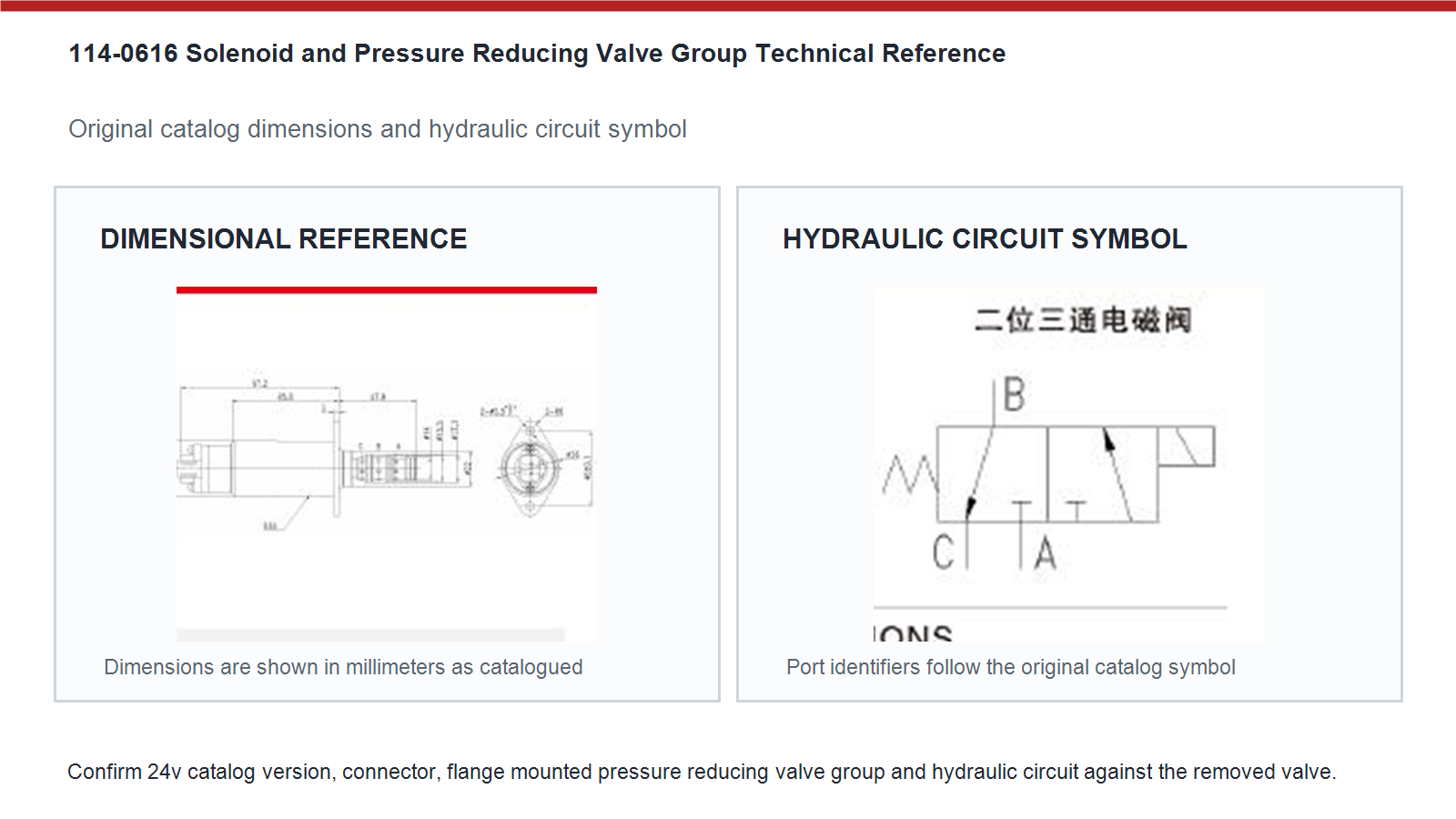
Use the original catalog dimensional reference and hydraulic symbol to compare the valve with the removed component and machine schematic before purchase approval.
Complete every control point below before a sample or bulk order is released.
Approval Point | Buyer Review |
|---|---|
Reference | 114-0616 |
Electrical | 24V catalog version; verify at the loaded connector |
Mechanical | Compare flange mounted pressure reducing valve group, sealing positions and installed clearance |
Hydraulic | Confirm normal state, energized state and port relationship |
Machine Evidence | Caterpillar 312B, 315B, 317B, 318B, 322B, 325B, 330B, 330C and 345B excavators subject to equipment configuration |
Separate electrical command, component movement and final machine response so the actual wiring or hydraulic fault is not hidden by parts replacement.
Observed Condition | Recommended Check |
|---|---|
No movement | Check loaded connector voltage, ground, controller command and coil resistance. |
Slow response | Inspect oil cleanliness, filter condition, viscosity and valve movement. |
Reversed response | Stop operation and compare normal and energized port logic. |
External leakage | Inspect seals, valve surface, bore condition and seating depth. |
Repeated heating | Confirm voltage, duty cycle, connector resistance and full movement. |
When an emergency field repair is reviewed, keep the verified measurements and test result in the service record. Use the complete old marking, 24v catalog version electrical version, connector face, flange mounted pressure reducing valve group, sealing positions and the machine hydraulic schematic. A reference alone cannot prove that the normal and energized flow paths match. Record the machine model, serial number and removed-valve photographs with the approved sample so repeat orders follow the same engineering basis.
When an old label is partly unreadable, keep the verified measurements and test result in the service record. Read the voltage marking on the removed coil and measure supply at the loaded connector while the controller commands the valve. Do not infer voltage only from battery count because converters, harness changes and mixed fleets can produce another coil supply. Keep the confirmed value on the inquiry, purchase order, carton label and incoming inspection record.
When a valve body was replaced during an earlier repair, keep the verified measurements and test result in the service record. Treat 41 bar catalog reference as a component reference that must remain within the actual circuit requirement, not as permission to ignore the machine service data. Confirm which ports see pressure in both switching states, review return pressure and verify the cavity or flange. Pressure capability cannot correct a wrong spool function, cartridge depth or manifold relationship.
When a warm hydraulic system develops slow response, keep the verified measurements and test result in the service record. Measure supply and ground at the loaded connector, then check coil resistance and verify that the controller issues the command. If electrical input is correct, inspect oil cleanliness, filter condition, moving-element freedom and manifold contamination. Separate electrical command from hydraulic response before replacing another valve so a harness or blocked pilot passage is not missed.
When an installer measures unexpected voltage drop, keep the verified measurements and test result in the service record. Check the complete reference and voltage against the purchase order, then sample connector keying, overall length, mounting interface, seal count and coil resistance. Keep voltage and suffix variants physically separated. For the first lot, compare one unit with the approved old component before releasing the remaining quantity to warehouse stock or field service.
When a machine harness revision is compared, keep the verified measurements and test result in the service record. Reuse is not recommended when the service procedure specifies new seals or the old rings show flattening, cuts or heat damage. Confirm material compatibility with the hydraulic oil, clean the flange mounted pressure reducing valve group and inspect the bore for scoring. Lubricate seals without twisting and follow the equipment torque procedure rather than forcing the valve past resistance.
When a sample moves into volume production, keep the verified measurements and test result in the service record. Treat every suffix as an engineering identifier until its meaning is proven. It can change voltage, connector, spring calibration, spool geometry or mounting details while the base model looks similar. Keep 114-0616 in purchasing records and accept a cross-reference only after dimensional, electrical and hydraulic checks agree.
Send the complete old marking or component evidence, confirmed voltage, machine information, clear photos, measurements and required quantity for a fitment-focused B2B quotation.