ELECDURA NETWORK

Your Whole New Supply Chain For Heavy-Duty Parts
Whatsapp:
+86 18915027366
Phone:
+86 18915027366

474-9387
474-9387
OE-Equivalent Replacement Quality
IATF 16949 / ISO 9001 / CE / RoHS
50 pcs
7 - 15 Days
12 Months
474-9387
Caterpillar equipment using factory part 474-9387, confirmed by serial number and parts diagram
Confirm voltage, connector, cartridge or flange dimensions, seals and hydraulic circuit before installation.
| Quantity: | |
|---|---|
474-9387 is a Caterpillar hydraulic cartridge solenoid valve group reference. A 12V product version is available, but the removed valve marking and measured circuit voltage must confirm the coil before ordering. Use the machine serial number, parts diagram, connector and cartridge dimensions for replacement approval.
Item | Confirmed Information |
Product Type | Hydraulic cartridge solenoid valve group |
OE / Reference Numbers | 474-9387 |
Voltage | 12V product version; verify old valve |
Application Scope | Caterpillar equipment using factory part 474-9387, confirmed by serial number and parts diagram |
Electrical Version | 12V product version; confirm voltage from removed valve |
Valve Function | Two-position, three-way |
Thread | 7/8-14 UNF-2A |
Maximum Working Pressure | 350 bar |
Filtration | 25 micrometres or better |
Operating Temperature | -40 to +120 degrees Celsius |
Installation Torque | 34 to 37 Nm |
MOQ | 50 pcs |
Delivery Time | 7 - 15 Days |
Warranty | 12 Months |
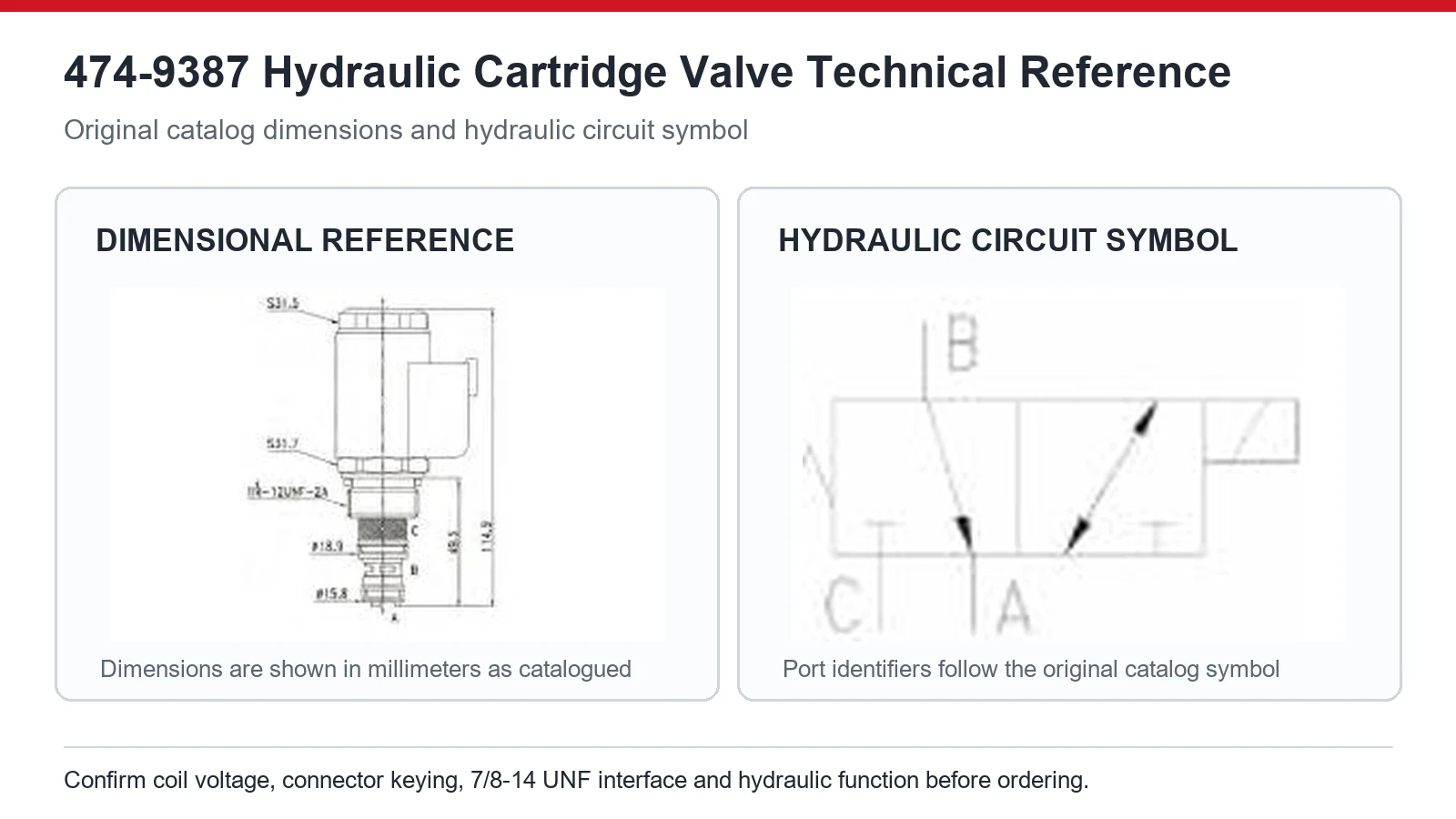
Use the 474-9387 drawing to verify cartridge length, sealing positions, connector space and three-way hydraulic behavior before purchase release.
Approve 474-9387 from the Caterpillar parts record, confirmed coil voltage, 7/8-14 cartridge measurements, sealing lands and 350 bar circuit duty.
Approval Point | Buyer Review |
Reference Control | 474-9387 |
Electrical Control | 12V product version; verify old valve; verify at the connector under command |
Mechanical Fit | Compare thread or flange, cartridge length, sealing lands and installed clearance |
Functional Control | Confirm normal state, energized state and hydraulic port relationship |
Application Evidence | Caterpillar equipment using factory part 474-9387, confirmed by serial number and parts diagram |
Leakage or incorrect movement should be traced through seal condition, seating depth, applied torque, electrical command and the valve-block port relationship.
Observed Situation | Recommended Check |
No hydraulic response | Check command voltage, connector, coil and whether the cartridge moves. |
Slow response | Review oil cleanliness, filter condition, viscosity and connector voltage under load. |
Reversed response | Compare normal and energized circuit states with the machine schematic. |
External leakage | Inspect seals, cartridge surface, bore condition and seating depth. |
Repeated coil heating | Check voltage, resistance, duty cycle, contamination and incomplete spool movement. |
Approval Item | Required Information |
Old Part Evidence | Complete label, connector face, mounting or cartridge side and one installed view |
Machine Evidence | Caterpillar equipment using factory part 474-9387, confirmed by serial number and parts diagram |
Measurements | Thread or flange, cartridge length, seals and installed clearance |
Electrical Evidence | 12V product version; verify old valve; measured under the actual command |
Commercial Evidence | Quantity, destination, packing, labeling and inspection requirements |
The available product information shows a 12V version, while the removed Caterpillar valve remains the controlling evidence. Read the coil marking and measure connector voltage under command before purchase. Do not print or stock an assumed voltage until the old unit and approved sample agree, especially when similar cartridge groups can carry different coils.
Use the complete Caterpillar serial number and the relevant parts diagram to confirm that 474-9387 belongs at the intended valve location. Add photographs of the removed group and installed block. A factory part reference identifies the component more accurately than a broad model list, but physical configuration still needs comparison before volume replacement.
Compare cartridge length, shoulder position, sealing lands, nose profile, connector and two-position three-way circuit. Verify the pressure duty does not exceed 350 bar. A matching thread and pressure figure cannot approve another valve if port openings or normal flow state differ, because hydraulic response may be blocked or reversed.
Depressurize the system and inspect each seal, the cartridge surface, cavity bore and seating depth. Confirm compatible lubrication and 34 to 37 Nm installation torque after smooth thread engagement. Cut seals, contamination or bore damage commonly create leakage. Do not increase torque blindly, because excessive force can distort the cartridge or damage the block.
Keep the complete marking, connector orientation, cartridge measurements, sealing pattern and machine serial record together. Compare the normal and energized hydraulic states where circuit information is available. Similar Caterpillar valves may share a general shape or thread but control another port arrangement, pressure stage or electrical version, so one feature cannot establish identity.
Inspect reference marking, approved voltage, connector, 7/8-14 geometry, seals and body dimensions by lot. Sample coil resistance, controlled movement and leakage where a fixture is available. Protect the nose and seals during packing, and link the incoming record to the Caterpillar serial group and approved sample used for the original technical release.
Send 474-9387, Caterpillar serial and parts information, measured voltage, connector and cartridge views, dimensions, operating duty and order quantity.